

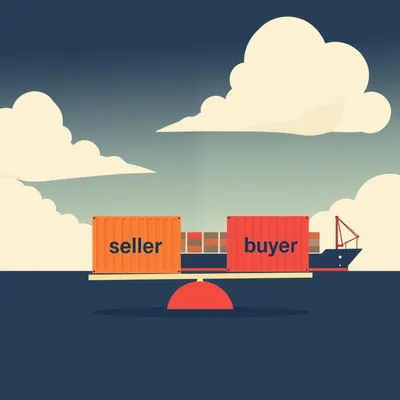
Incoterms 2020 are the invisible skeleton of global trade — 11 standardized three-letter codes published by the International Chamber of Commerce that define when risk, cost, and responsibility transfer between seller and buyer. This episode walks through every rule alphabetically, from EXW (Ex Works), where the seller's obligation ends at their loading dock, to DDP (Delivered Duty Paid), where the seller bears everything. Along the way, we highlight critical traps: EXW leaves the buyer responsible for export clearance, CFR splits risk and cost in a way that can leave buyers exposed, and CIF insurance is often minimal "boat disappeared" coverage. The 2020 update fixed a major letter-of-credit issue with FCA, allowing on-board bills of lading after container loading. For small importers, the key insight is knowing which terms are "buyer-heavy" (EXW, FCA, FAS, FOB), "neutral" (CFR, CIF, CPT, CIP), or "seller-heavy" (DPU, DAP, DDP). The episode also covers why FOB became the workhorse of containerized ocean freight, and why container loading supervision is worth the cost. Understanding these codes is the single highest-leverage negotiation skill most buyers don't have.
Episode 4357 custom
Incoterms 2020: The Full Walkthrough
All 11 Incoterms 2020 explained — who pays, who risks, and when the skeleton of global trade breaks.
25:22 Transcript
Episode Details
- Episode ID
- MWP-4536
- Published
- Duration
- 25:22
- Audio
- Direct link
- Pipeline
- V5
- TTS Engine
-
 chatterbox-regular
 - Script Writing Agent
- DeepSeek v4 Pro
AI-Generated Content: This podcast is created using AI personas. Please verify any important information independently.
Mentions
- Alibaba Global B2B sourcing marketplace
- Amazon FBA Amazon's fulfillment and storage service
- Apple Podcasts Apple's podcast directory
- Incoterms 2020 ICC rules defining international trade responsibilities
- International Chamber of Commerce Defines Incoterms like DDP
- Spotify Podcast streaming platform
Downloads
Transcript (TXT)
Plain text transcript file
Episode Book (PDF)
The episode's record — date, duration, models, sources — with the full transcript
You Might Also Like


Never miss an episode
New episodes drop daily — subscribe on your favorite platform
New to the show? Start here#4357: Incoterms 2020: The Full Walkthrough

Daniel sent us this one — he knows we've done Incoterms episodes before, but he thinks they're so vital for small importers that he wants one definitive walkthrough. All eleven Incoterms 2020, alphabetical order, who uses each, when, why, advantages and disadvantages. Plus a mental model for grouping them by who carries the weight. By the end, someone who's never heard the word Incoterm should understand the whole framework. I like the ambition here.

He's right — these eleven three-letter codes are genuinely the invisible skeleton of global trade. They determine who pays, who risks, and who's on the hook when a container falls off a crane. With supply chain volatility still elevated and small importers getting squeezed by hidden fees, understanding Incoterms is the single highest-leverage negotiation skill most buyers don't have.
The skeleton analogy works. Most people see the body of trade moving around the world — ships, containers, warehouses — but never see the bones underneath holding the whole thing together. And when the bones are wrong, the body collapses in expensive ways.
So before we walk through all eleven rules, let's make sure we're on the same page about what an Incoterm actually is — and isn't. Because the misconceptions are where people get hurt.
Lay the foundation.
Incoterms are eleven standardized rules published by the International Chamber of Commerce, the ICC. First published in nineteen thirty-six, updated roughly every ten years. The current version is Incoterms 2020, effective January first of that year. Next revision expected around twenty thirty. They define the transfer point of risk, cost, and responsibility between seller and buyer in international sales contracts.
Here's where it gets important — what they don't do.
Three things people constantly get wrong. First, Incoterms do not govern transfer of ownership or title. That's governed by the sales contract and local law, not by the Incoterm. You can be carrying all the risk under an EXW shipment but already own the goods — or vice versa.
The person holding the risk isn't necessarily the person who owns the thing.
Second, they don't cover payment terms. Incoterms are about delivery, risk, and cost — not when or how money changes hands. And third, they don't supersede carrier liability. If a shipping line damages your cargo, their liability is governed by maritime law and the bill of lading, not by whether you bought CIF or FOB.
Those are three separate legal layers all running in parallel — ownership, payment, carrier liability — and none of them are the Incoterm's job. I can see why small importers get tangled.
The three-letter code structure helps. First letter indicates the category — E, F, C, or D — which roughly maps to increasing seller responsibility. E is minimum seller obligation. F is where seller delivers to a carrier. C is where seller pays for main carriage but risk transfers early. D is where seller bears risk all the way to destination.
That four-bucket structure is already a useful frame. But Daniel asked for a different grouping — buyer-heavy, neutral, seller-heavy — so we'll build that as we go. Let's start the alphabetical walkthrough.
First up: EXW — Ex Works.
The one where the seller basically points at a pallet on the loading dock and says "it's your problem now.
That's not even an exaggeration. EXW represents the seller's minimum obligation. The seller makes the goods available at their premises — factory, warehouse, whatever — and the buyer handles absolutely everything else. Loading, export clearance, transport to port, ocean freight, insurance, import clearance, delivery. All of it.
Why would anyone choose this?
Because on paper, it gives you the lowest unit price. The supplier quotes you five dollars a unit EXW, and it looks like a great deal. The trap is that EXW is the only Incoterm where the buyer is responsible for export clearance. Every other Incoterm places export clearance on the seller.
Export clearance is not trivial if you're a small importer in another country who's never dealt with Chinese customs.
The classic scenario — and I've seen this play out — is an Alibaba supplier quotes EXW, the buyer thinks that's the price, and then gets hit with loading fees, warehouse charges, export documentation fees, and consolidation costs they never saw coming. Suddenly that five-dollar unit price is seven-fifty, and they've lost all visibility into where the money went.
The five-dollar decoy. So when would EXW actually make sense?
When you have your own logistics infrastructure in the seller's country — your own forwarder, your own customs broker, your own trucking. If you're a large buyer with established operations at origin, EXW gives you maximum control and cost visibility because you're running the whole show. For everyone else, it's a trap dressed as a bargain.
Next: FCA — Free Carrier.
This is where we start moving into the buyer-heavy group, but with an important safety net. Under FCA, the seller delivers the goods to a carrier nominated by the buyer at a named place — could be the seller's premises, could be a port, could be a freight forwarder's warehouse. Risk transfers when the goods are handed to that carrier.
The seller handles export clearance under FCA, unlike EXW.
That alone makes FCA a massive upgrade over EXW for most buyers. But the really interesting thing about FCA is the twenty twenty update. Before twenty twenty, if you bought FCA and needed a letter of credit from your bank, you had a problem. Banks typically require an on-board bill of lading as proof of shipment, but under the old FCA rules, the seller handed goods to the carrier at a terminal — before they were on board the vessel — so you couldn't get that bill of lading. Banks refused to finance FCA shipments.
FCA was effectively broken for anyone using letters of credit.
The twenty twenty update fixed this. Now, under FCA, the buyer and seller can agree that the carrier will issue an on-board bill of lading after loading. The seller then gets that bill of lading from the carrier and presents it to the bank. It solved a decades-long container shipping headache in one rule change.
That's a useful fix. Alright, next: FAS — Free Alongside Ship.
This one's niche. Seller places the goods alongside the vessel at the named port. Risk transfers at that point — when the goods are sitting on the quay next to the ship, not on it. Seller handles export clearance.
Who actually uses FAS?
Almost exclusively bulk and breakbulk cargo — oil, grain, steel coils, lumber. Goods that aren't in containers. If you're shipping containers, FAS is almost certainly the wrong choice, because containers aren't placed "alongside" a vessel in the same way. They go through a terminal, get stacked, get loaded by gantry crane — the physical process doesn't map to the FAS risk point.
If someone's importing containerized goods and their supplier quotes FAS, that's a red flag.
It means the supplier doesn't understand what they're selling, or they're deliberately using the wrong term. Either way, walk away or educate them.
Which brings us to FOB — Free On Board.
The workhorse of containerized ocean freight. The default Incoterm for imports from Asia. Seller loads the goods onto the vessel nominated by the buyer. Risk transfers once the goods are on board. Seller handles export clearance. Buyer handles ocean freight, insurance, and everything after loading.
Why has FOB become the default?
Clean risk transfer point. The ship's rail — or in practice, once the container crosses the edge of the vessel during loading — is a bright line. Before that, seller's problem. After that, buyer's problem. It's the most standardized, most understood Incoterm in ocean freight, and it gives the buyer control over the ocean leg while keeping the seller responsible for getting the goods to the port and onto the ship.
There's a coordination gap.
The seller controls the loading process, the buyer controls the ocean freight. If a container gets damaged during loading — crushed corner, water ingress, whatever — you get the classic dispute. Seller says it was fine when it went over the ship's rail. Buyer says it was damaged when it arrived.
The answer is whoever has better documentation.
Which is why container loading supervision matters. If you're importing under FOB, you should have someone at the port — your forwarder's agent — watching the loading and documenting condition. Most small importers skip this step because it costs a few hundred dollars. Then they lose thousands fighting a damage claim they can't prove.
Those first five — EXW, FCA, FAS, FOB — are what I'd call the buyer-heavy group. The buyer controls most of the chain, bears most of the risk early. Now let's look at the middle ground and the seller-heavy rules.
Starting with CFR — Cost and Freight. This is where we enter the C-group, and this is where things get psychologically tricky.
Because CFR splits risk and cost in a way that's not intuitive. The seller pays the cost and freight to the destination port. They arrange and pay for ocean transport. But — and this is the crucial part — risk transfers when the goods are on board at origin, same as FOB. So the seller is paying for a service during which they bear no risk.
If the ship sinks halfway across the Pacific, the buyer still owes the seller for the goods, even though the seller arranged the shipping.
And here's the danger zone — CFR does not include insurance. Unlike CIF, which we'll get to in a moment, CFR leaves the buyer completely exposed during transit. If the cargo is lost, the buyer pays the seller and has no insurance claim unless they bought coverage themselves.
That feels like the worst of both worlds. The seller controls the shipping contract — chooses the carrier, the route, the vessel — but the buyer eats the loss if something goes wrong.
It's not quite the worst, because at least the seller has an incentive to choose a reliable carrier — their reputation is on the line if shipments keep sinking. But structurally, yes, CFR creates a moral hazard. The seller's cost incentive is to pick the cheapest carrier, not the safest one.
Which brings us to CIF — Cost, Insurance, and Freight.
Same structure as CFR, but the seller must also procure marine insurance. Minimum coverage is one hundred ten percent of the CIF value, and the insurance must be ICC Clause C.
That sounds comprehensive. It's not.
It's absolutely not. Clause C is minimum coverage. It covers things like the vessel sinking, burning, or colliding with another ship. It does not cover theft, pilferage, water damage from heavy weather, or a whole range of common causes of loss. It's named-perils coverage, not all-risks.
The insurance you get automatically under CIF is basically "the boat disappeared" insurance.
And the second trap — the seller chooses the insurer. If a claim arises, the buyer is dealing with a foreign insurance company they've never heard of, operating under a foreign legal system. Real-world example: Chinese CIF policies often exclude war risk and strikes. If your cargo transits the Red Sea and gets held up, you're not covered.
CIF gives the illusion of protection without much of the substance.
For many small importers, CIF is fine — the seller handles logistics, the buyer gets basic insurance, it's simple. But if you're shipping high-value goods or through risky routes, CIF insurance is a false friend.
Now CPT and CIP — the multimodal equivalents.
CPT is Carriage Paid To. CIP is Carriage and Insurance Paid To. They're the multimodal versions of CFR and CIF — used when transport involves more than just ocean freight, like truck plus ship plus rail. Seller pays carriage to the named destination. Risk transfers at the first carrier, same as the C-group pattern.
There's a key twenty twenty change here.
Under Incoterms twenty twenty, CIP now requires ICC Clause A insurance — all-risks coverage, the most comprehensive level. Meanwhile, CIF still only requires Clause C. So CIP actually provides meaningful insurance protection, while CIF provides the bare minimum.
Why did the ICC make that change?
Because CIP is often used for manufactured goods and higher-value cargo moving through multiple transport modes, where the risk of theft, handling damage, and weather exposure is higher. The ICC recognized that minimum coverage wasn't adequate for those scenarios. CIF, by contrast, is mostly used for commodity bulk cargo where Clause C is often sufficient — nobody's stealing a ship full of iron ore.
That distinction between CIP and CIF insurance is something I'd bet most importers don't know exists. They see "insurance included" and assume it's the same thing.
It's one of the most expensive assumptions in trade. Alright, now we move into the D-group — the seller-heavy rules. Starting with DAP, Delivered at Place.
This is where the seller really starts carrying the weight.
Under DAP, the seller delivers the goods to the buyer's named location — could be a warehouse, a factory, a distribution center — ready for unloading. The seller bears all risk and cost of main carriage. Risk transfers when the goods arrive at that location, before unloading.
The buyer's responsibility starts when the truck pulls up to their dock.
The buyer handles import clearance and any import duties or taxes, but the seller handles everything else — export clearance, main carriage, delivery to the named place. Advantage for the buyer is maximum convenience. Disadvantage is that the seller builds all that risk and cost into the unit price, and the buyer loses visibility into what freight actually costs.
Which makes it harder to optimize logistics or negotiate freight rates separately.
DAP is common in EU road freight, where borders are relatively frictionless and trucking is straightforward. Less common in ocean freight, where the variables are bigger.
Next is DPU — Delivered at Place Unloaded. The only Incoterm where the seller unloads.
This is the renamed rule. In twenty ten it was DAT — Delivered at Terminal. The twenty twenty version changed it to DPU because the delivery point isn't limited to terminals anymore. It can be any place — a warehouse, a construction site, a factory floor.
The seller actually unloads the goods.
DPU is the only Incoterm that explicitly requires the seller to unload at destination. Every other rule, unloading is the buyer's problem or negotiated separately. The niche use case is when the buyer has no unloading equipment — no forklift, no dock, no crane — and the seller's logistics include that service.
You'd use DPU if you're importing heavy machinery to a construction site with no infrastructure.
It's a specialized rule for specialized situations. Most importers will never use it, but when you need it, nothing else works.
Finally, DDP — Delivered Duty Paid. The seller does everything.
The seller's maximum obligation. Under DDP, the seller delivers the goods cleared for import, duties paid, taxes paid, to the buyer's named place of destination. The seller handles import clearance, pays all import duties and VAT, and bears all risk until delivery.
This is the only Incoterm where the seller is responsible for import clearance and duty payment.
It's the mirror image of EXW. EXW is minimum seller obligation, DDP is maximum. And the reason many sellers refuse DDP is exactly what you'd expect — they have to navigate foreign customs, understand foreign tariff codes, register for foreign VAT, and comply with foreign regulations. That's a massive compliance burden.
Yet DDP is everywhere in e-commerce.
Because Amazon FBA sellers love it. They want one landed cost from their Chinese supplier, shipped directly to Amazon's warehouse, with all duties and taxes handled. The supplier builds all that complexity into the price. The downside — and this is a real problem — is that the buyer has zero visibility into which HS codes were used, what duty rates were applied, or whether the customs declaration was accurate. If customs audits the shipment two years later, the importer of record is still the buyer, and they're on the hook for any misclassification.
DDP gives you simplicity now and potential liability later.
That's the trade. For low-value e-commerce, it's often worth it. For B2B bulk shipments, it's rare.
Alright, we've walked all eleven. Now let's build the mental model Daniel asked for. How do we group these by who carries the weight?
First, buyer-heavy — the buyer bears most risk and cost from an early stage. That's EXW, FCA, FAS, and FOB. The buyer controls the chain from close to the origin. More complexity, more work, but more cost visibility and more control over carrier selection.
The second bucket?
Neutral or balanced — risk and cost are split. That's CFR, CIF, CPT, and CIP. The seller handles main carriage and pays for it, but risk transfers at origin. The buyer handles destination charges, import clearance, and final delivery. These are the middle-ground rules where the insurance distinctions really matter.
The third bucket — seller-heavy.
DAP, DPU, and DDP. The seller bears most risk and cost all the way to destination. The buyer gets simplicity and convenience but pays a premium and loses cost visibility. The seller controls the entire chain and builds that cost into the unit price.
If I'm a small importer negotiating with a supplier, where should I default?
For containerized ocean freight, FOB is the sweet spot. It gives you control over the ocean leg — you choose the forwarder, you negotiate the freight rate, you see the line-item costs. It keeps the seller responsible for getting goods to the port and onto the ship, which is their area of expertise. And it's the most standardized Incoterm in global trade, so everyone understands it.
What about the trap where suppliers default to EXW?
If a supplier quotes EXW, ask for an FOB quote instead. You'll see the freight cost as a line item and you can compare carriers. The unit price will be higher because it includes inland transport and port charges, but you'll actually know what you're paying. If a supplier quotes DDP, ask for a DAP quote and handle customs yourself — you'll typically save five to fifteen percent on duty brokerage markups.
The negotiation move is always to pull the Incoterm one step toward the middle, toward more visibility.
That's the framework. Start with buyer-heavy rules to build cost visibility. As you scale and your supply chain matures, you might move toward neutral rules where the supplier manages more. Only use seller-heavy rules when you have a trusted long-term partner and need hands-off simplicity.
One thing we haven't mentioned — the named place matters.
"FOB Shanghai" is not enough. It should be "FOB Shanghai Port, China, Incoterms 2020." Ambiguous locations are the number one source of Incoterm disputes. If the named place is vague, the risk transfer point is vague, and vague risk transfer points generate lawyers.
We've covered all eleven. But how do you actually use this? Let me give you a practical framework for your next negotiation.
Start by asking the supplier what Incoterm they usually quote. Don't accept the first answer as a given — it's a starting point for negotiation, not a fixed term. If they quote EXW, counter with FOB. If they quote CIF, ask whether the insurance is Clause C or Clause A, and whether it covers your specific route risks.
The one Incoterm every small importer should master is FOB. It's the most common, the most standardized, and it gives you the best balance of control and simplicity for containerized ocean freight. Learn the FOB process — booking with a freight forwarder, container loading supervision, bill of lading review — and you can handle roughly eighty percent of import scenarios.
Here's the thing about freight forwarders under FOB — you choose them, so you can build a relationship. A good forwarder will flag Incoterm problems before they become problems. They'll tell you if a supplier's FOB quote looks inflated or if the named place is ambiguous. They become your eyes and ears at origin.
The mental model in practice: if you're new to importing, start with FOB. As you scale, you can move toward CIF or CPT where the supplier manages more of the chain. Only go to DDP when you have a trusted long-term partner and need hands-off simplicity. And never, ever start with EXW unless you have your own logistics infrastructure in the seller's country.
One more pro tip — always specify the Incoterms version. Write "Incoterms 2020" in the contract. If you just write "FOB," courts may default to an older version, and the rules have changed meaningfully over the decades. Three words — "Incoterms twenty twenty" — can save you from a legal argument about which version applies.
One last thing before we wrap. Here's a question I want you to ask yourself about your last shipment. Go look at your last three purchase orders. What Incoterm did you use? If you can't find it, that's a problem — it means the term wasn't specified, which means the risk transfer point is undefined. If you can find it, ask yourself: did you choose it intentionally, or did the supplier choose it for you?
That's the shift from reactive to proactive importing. Most small importers inherit their Incoterms from their suppliers. The ones who get good at this choose their Incoterms deliberately based on the shipment, the route, the value, and their own capabilities.
The ICC is already working on Incoterms twenty thirty. I'm curious what changes. Should there be a digital Incoterm for blockchain-based trade finance? Should the eleven rules be consolidated — do we really need both CFR and CPT, or both CIF and CIP? The distinction made more sense when ocean and multimodal were separate worlds, but those lines are blurring.
The CIP insurance upgrade in twenty twenty suggests the ICC is willing to make meaningful changes where the market has evolved. I'd watch for something addressing digital trade documentation — electronic bills of lading, smart contracts, automated customs clearance. The legal framework is still catching up to the technology.
If this episode helped you, leave a review on Apple Podcasts or Spotify. It helps other small importers find the show.
Now: Hilbert's daily fun fact.

The word "quipu" — the knotted-string recording system used by the Inca Empire — entered the English language via an eighteen eighty-seven anthropological paper on pre-Columbian Andean accounting, published by a researcher who had been studying Inuit fishing-line record-keeping in Labrador and noticed the conceptual parallel.
...right.
This has been My Weird Prompts. I'm Corn.
I'm Herman Poppleberry. You can find us at my weird prompts dot com. We'll be back next week.
This episode was generated with AI assistance. Hosts Herman and Corn are AI personalities.