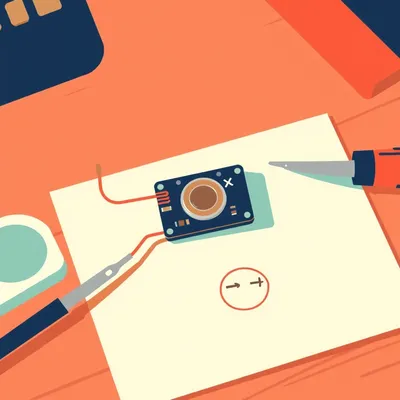
Daniel sent us this one, and I have to say, it actually earns the "weird prompts" name. He's been making the leap from Home Assistant to learning how hardware actually works — first ESP32 project, deep in the weeds of datasheets and power management. And it got him thinking: who builds the actual spy gadgets? Not the software people, not the analysts, but the hardware engineers who design covert listening devices and concealment rigs. He wants to know if there's a recruitment pipeline for that kind of work, what those job descriptions even look like, and whether the Le Bureau character Sylvain Ellenstein — the technical manager who analysts bring problems to — is anything close to reality. So where do we even start with this?

Let's start with the thing on your workbench right now. That ESP32 you're tinkering with draws about five microamps in deep sleep. That's the same power discipline that let a Soviet engineer named Léon Theremin build a listening device in nineteen forty-five that ran for seven years without a battery, hidden inside a carved wooden seal gifted to the US ambassador in Moscow.
The Great Seal bug. Also called The Thing. Which is somehow both the most ominous and the least creative codename in espionage history.
It's the canonical example of hardware spycraft at its most elegant. No battery, no active components, just physics. A passive resonant cavity with a diaphragm that modulated reflected radio waves when people spoke near it. The Soviets had it embedded in the ambassador's residence for seven years before it was discovered in nineteen fifty-two.
Seven years of conversations, and the device itself had no power source. That's the kind of engineering constraint that separates hardware spycraft from everything else. You're not writing code — you're solving for thermal dissipation in a device the size of a coin.
That's the connection Daniel's making, whether he realizes it or not. The five microamp deep sleep figure on his ESP32 datasheet is the same spec that matters when you're designing something that needs to sit in a room for weeks without anyone changing a battery. The line between hobbyist tinkering and professional surveillance engineering has collapsed to near invisibility. So let's unpack that connection between your soldering iron and the Mossad workbench.
The central question Daniel's asking is really about people, not gadgets. Who ends up in these roles? How do they get recruited? And what does their day actually look like? Our cultural impression of spies is dominated by human intelligence operators — trench coats, dead drops, the whole rooting-character archetype. But the person who builds a covert listening device is a fundamentally different personality. You're not meeting them at a cocktail party. You're meeting them at a hardware hacking village.
That's the tension I want to sit with. The spy myth versus the engineering reality. The person who can't walk past a problem without trying to solve it with a soldering iron — that's a very different archetype from the field operative. To understand who builds spy hardware, we first need to understand the organizations they work in.
Walk me through it. What does the organizational structure actually look like?
The CIA's Directorate of Science and Technology, or DS and T, was formally established in nineteen sixty-three, though technical operations existed well before that. Within DS and T, there's the Office of Technical Service — OTS — which employs roughly a thousand people across engineering disciplines. These are the people building custom surveillance devices, audio systems, concealment methods, biometric tools. Mossad's equivalent is the Technical Division, sometimes called Keshet, which handles similar hardware engineering.
A thousand people is not a small operation. That's a mid-sized engineering firm dedicated entirely to building things that aren't supposed to be found.
And the actual work is solving physical problems at the edge of what's possible. OTS engineers are managing thermal dissipation in a device the size of a coin. They're designing passive resonant cavities that require zero power. They're figuring out how to transmit a signal through six inches of concrete without anyone noticing. These are not software problems. These are physics constraints — battery life, signal range, concealment volume. The kind of thing that keeps you up at night if you're the kind of person who can't let a problem sit unsolved.
What does that actually look like day to day? Because "solving physics constraints" sounds dramatic, but I imagine a lot of it is just... test bench work. Iterating on the same problem for months.
That's exactly what it looks like. An OTS engineer might spend six months trying to reduce the power draw of a transmitter by fifteen percent. That's the whole project. Because fifteen percent is the difference between a device that needs a battery change every three days and a device that runs for two weeks. You're not building a product for a million users — you're building one device for one operation, and it has to work perfectly the first time. There is no version two. There's no firmware update. If the battery dies during an operation, someone's source might get burned, or worse.
The stakes are wildly different from commercial engineering, but the day-to-day work is the same bench testing, the same oscilloscope debugging, the same "why is this voltage rail oscillating" frustration.
And that's what makes the recruitment pipeline so interesting. You're not looking for someone who thrives on adrenaline. You're looking for someone who genuinely enjoys spending a Tuesday afternoon figuring out why a capacitor is behaving strangely at a specific temperature range. That's the personality.
Which brings us to the cat.
You know the one I mean.
I absolutely know the one I mean. The CIA's Acoustic Kitty project, nineteen sixties. Cost approximately twenty million dollars in today's money. The idea was to surgically implant a microphone and antenna into a cat, then release it near targets to eavesdrop on conversations.
On its very first field mission, the cat was killed by a taxi.
Killed by a taxi. Twenty million dollars, years of surgical and engineering work, and a taxi undoes it in seconds. It's the perfect illustration of the audacity of these teams. They thought, we need to get a microphone close to a target — what if we used a cat? And then they actually tried to build it. The physics-first problem-solving mentality is the same whether it works or fails spectacularly.
There's something almost admirable about the failure. They didn't fail because the concept was impossible. They failed because the world is chaotic and taxis exist. The engineering itself was pushing boundaries — miniaturized microphones, implantable transmitters, biocompatible materials. These were real problems being solved by real engineers.
That's the personality profile Daniel's asking about. These engineers think in terms of constraints. Battery life, signal range, thermal dissipation, concealment volume. They're closer to his ESP32 tinkering than to a React developer. The key trait is the inability to walk past a problem without trying to solve it with components and a soldering iron.
Here's what I wonder — how do you even test something like Acoustic Kitty? You can't exactly run a focus group. You can't do A/B testing on cat behavior in the field. How do you validate that your implantable cat microphone is going to work before you deploy it?
That's the brutal part of hardware spycraft that never makes it into the stories. The testing is often just... deploy and pray. You do as much bench testing as you can — you verify the microphone works, you verify the transmitter range, you verify the biocompatible coating doesn't cause infection in lab animals. But at some point, you have to put the cat in a real environment and see what happens. And what happened was a taxi. The gap between bench testing and field deployment is where most of these projects die, and it's a gap that software people rarely have to think about. Your React app doesn't get hit by a taxi.
How do you find these people? Daniel's question about the recruitment pipeline is the interesting one, because it's not the Unit 8200 story.
Unit 8200 has this famous direct pipeline from IDF intelligence to Israeli tech startups — software people, signals intelligence, cybersecurity. It's well-documented and almost institutionalized at this point. But hardware roles recruit from a completely different pool. Electrical engineers, RF specialists, materials scientists. And the recruitment happens in places that look nothing like a career fair at an elite university.
DEF CON's Hardware Hacking Village.
Running since twenty fourteen, and it's a known informal recruitment ground for government agencies. The CIA and NSA have been observed sending recruiters to these events. They're not looking for credentials — they're looking for demonstrated competence. Someone who built a software-defined radio from scratch. Someone who created a low-power sensor network that runs for months on a coin cell. The skills that get noticed are the ones you can't fake on a resume.
The pipeline exists, but it's opaque and informal. Unlike the software pipeline where you can practically map the trajectory from military intelligence unit to startup founder, the hardware pipeline relies on demonstrated competence at the fringes of the field. You get noticed because you built something impressive under extreme constraints, not because you went to the right school.
There are other entry points. The NSA has run electronics challenges at their Take Your Kid to Work Day events — which sounds wholesome until you realize it's also a talent filter. The CIA publicly recruits RF engineers at trade shows like the International Microwave Symposium. These are real, documented recruitment channels. They're just not the ones people talk about when they discuss intelligence careers.
It's almost like the hardware people are the quiet ones. The software pipeline gets all the attention because it produced visible billion-dollar startups. The hardware pipeline produces people who disappear into labs and workshops and never give interviews.
That's actually a feature, not a bug. The personality type that gravitates toward this work tends to be more interested in solving the problem than in being recognized for solving it. They're not building a personal brand. They're building a device that fits inside a coat button.
I want to pause on that coat button for a second, because it's not a metaphor. The CIA actually built microphone transmitters into coat buttons during the Cold War. The entire device — microphone, transmitter, antenna — had to fit in something the size of a shirt button. That's not a design constraint you can work around. That's a design constraint that defines the entire project.
The coat button transmitter is actually a great case study in the kind of engineering trade-offs we're talking about. You're limited to a volume of maybe a cubic centimeter. Your antenna is necessarily tiny, which means your transmission range is going to be terrible. Your battery is going to be minuscule. So now you're solving three impossible problems simultaneously — and the solution to each one makes the other two harder. That's the daily reality of hardware spycraft. It's not about building the best device. It's about building a device that's good enough within constraints that would make a commercial engineer quit on the spot.
We know the organizations exist. But how do you actually get into one of these roles? And is the Le Bureau depiction anything like reality?
This is where it gets interesting. Daniel mentioned Sylvain Ellenstein from Le Bureau — the technical manager who analysts come down to visit at his workbench. They brief him on a challenge, and he gets to work building a solution. For the French external security agency, the DGSE, this depiction is actually quite accurate.
Because it feels almost too clean. Analyst walks down to the workshop, describes the problem, engineer builds the gadget.
The DGSE's technical division is closely integrated with operations in exactly this way. Analysts and engineers work in proximity, problems get brought directly to the workbench, and solutions get built in-house. There's a cross-functional collaboration that the show gets right, even if they compress timelines for dramatic purposes.
That's France. What about the US and Israel?
In the CIA, OTS engineers rarely interact directly with field operatives. The structure is compartmentalized — requirements come through official channels, solutions get delivered back through the same channels. Mossad's Technical Division operates similarly. The engineer and the field agent probably never meet.
Which makes sense from a security perspective but must be maddening from an engineering perspective. How do you build the right solution if you can't talk to the person who's going to use it?
That's the trade-off. The French model prioritizes integration and speed — the engineer understands the operational context because they're in the room. The American and Israeli models prioritize compartmentalization — if one person is compromised, the damage is contained. Neither is wrong, they're just optimizing for different risks.
I imagine the French model leads to better devices faster, but the American model leads to devices that are harder to trace back to their source. If an OTS engineer gets captured, they don't know which operation their device was used in or which agent deployed it. That's a feature.
And the trade-off shows up in the engineering itself. A DGSE engineer might build a device that's perfectly tailored to a specific operational need because they understand the context intimately. An OTS engineer might build a device that's more generic but also more robust, because they're designing for a broader set of unknown use cases. Same skills, same constraints, but the organizational structure shapes the output.
Le Bureau gets the dynamic right even if the org chart is specific to the DGSE. The core truth is that someone has to sit at that workbench and translate operational requirements into physical objects. And that person is not James Bond.
The person at that workbench is the one who looked at an ESP32 datasheet and thought, I wonder what I can do with five microamps of deep sleep current. The step from Home Assistant to understanding hardware is the same step that every spy hardware engineer took. The only difference is what they built next.
That's the convergence that makes this whole topic feel so immediate. The ESP32 on Daniel's workbench has WiFi, Bluetooth, I2S audio input, and deep sleep modes for battery conservation. It can transmit audio over WiFi at under a hundred milliamps active draw. That chip could power a covert listening device. The same chip that runs his home automation project.
The Soviets needed Léon Theremin — one of the greatest electrical engineers of the twentieth century — to design a passive resonant cavity that required no power. Today, you can buy a chip for five dollars that achieves something functionally similar with active components, and the power draw is so low that battery life stops being the primary constraint.
There's something almost vertigo-inducing about that. The Great Seal bug was a triumph of physics and engineering that took seven years to discover. Its modern equivalent is a weekend project with off-the-shelf components.
That's not hyperbole. The ESP32 already exceeds the capabilities of many Cold War listening devices. Better audio quality, digital transmission, remote configuration, encryption. The only barrier is intent and application. The hardware is democratized.
Let me push on that a bit. Because when you say the hardware is democratized, I think some people hear that and think, great, anyone can build a spy device now. But there's still a gap between "can build" and "can build something that actually works in the field," right? The ESP32 might have the specs, but a real covert deployment has constraints that a hobbyist never faces.
That's a fair push. The gap is in the details. Your ESP32 project on a breadboard draws power and works great. But can you solder it onto a flexible PCB that fits inside a coat lining? Can you shield it so that its RF emissions don't give it away to a counter-surveillance sweep? Can you design an antenna that's both effective and invisible? Can you write firmware that handles edge cases gracefully — what happens when the WiFi network goes down, what happens when the battery voltage drops below three volts, what happens when the device is physically jostled? The hobbyist solves the happy path. The professional solves every failure mode.
That's the difference between a prototype and a deployable device. And it's why the recruitment pipeline cares about demonstrated competence under constraints, not just competence. Anyone can make an ESP32 transmit audio. Not everyone can make it do that while fitting in a pen cap and running for three weeks on a battery the size of a watch cell.
That's where the maker community and the intelligence community overlap. The person who enters a low-power design competition at a hardware conference is solving the same fundamental problems as the OTS engineer. The constraints are different — the hobbyist is optimizing for battery life because it's an interesting challenge, the OTS engineer is optimizing for battery life because an operation depends on it — but the engineering is the same.
Which brings us to the ethical dimension Daniel didn't explicitly ask about but that's sitting underneath the whole question. His journey from Home Assistant to hardware hacking is the same path that leads some people to build tools for intelligence agencies. What separates the paths?
Intent and opportunity, not skill level. The ESP32 on your workbench is the same starting point as the one that might end up in a Mossad technical operations lab. The difference is trajectory and context. Who you meet, what problems you're asked to solve, which doors open.
There's a version of this where someone gets really good at low-power embedded systems, posts their projects online, gets noticed at a conference, and suddenly they're having a very interesting conversation with someone who doesn't give their full name. That's not a movie plot. That's the actual pipeline.
It's worth being clear-eyed about what that pipeline looks like. The DEF CON Hardware Hacking Village is not a secret. Government recruiters there are not hiding in trench coats — they're engineers talking to engineers. The conversation starts with, "that's an interesting power management solution you built," and it goes from there. The recruitment is soft, informal, and based on mutual technical respect.
It's almost refreshingly honest, in a way. Nobody's being tricked. You build something impressive, someone notices, and they ask if you've ever thought about applying those skills to national security problems. The answer is up to you.
I think it's worth noting that a lot of people say no, and that's fine. The intelligence community doesn't need everyone. They need the specific subset of people who hear "national security problem" and think "that sounds like an interesting constraint to solve." The filter is self-selecting.
There's actually an interesting parallel here to the early days of the Internet. In the nineteen nineties, if you could set up a web server, you were suddenly interesting to a lot of people — companies, governments, all kinds of organizations. The skill was rare enough that it opened doors regardless of your background. Low-power embedded systems are in a similar position now. The skill is common enough that hobbyists can learn it, but rare enough that expertise still gets noticed.
That's a sharp observation. And just like the early web, the barrier to entry is dropping fast. Ten years ago, building a WiFi-connected sensor that ran for months on a battery required serious RF engineering knowledge. Today, the ESP32 abstracts away most of that complexity. The skill that's becoming valuable isn't "can you make it work" — it's "can you make it work when everything is working against you." That's the differentiator.
All of this raises a practical question for someone who's currently learning to blink an LED on an ESP32.
What should Daniel actually do with this information? He's got his first ESP32 project. He's learning to read schematics and manage power. What's the next step if he wants to go deeper?
First, recognize that what he's doing right now is not just a hobby — it's building the same foundational skills that hardware engineers in intelligence agencies use daily. Schematic reading, component selection, power management, signal integrity. The five microamp deep sleep figure on his datasheet is the same spec that matters when designing a covert device that needs to operate for weeks without battery replacement. He's already in the right territory.
Second, study the history. The Great Seal bug is a masterclass in zero-power signal transmission that still has no modern equivalent for certain applications. The CIA's concealment devices, the evolution of laser microphones — these are case studies in solving extreme engineering constraints. If you want to think like these engineers, study the constraints they faced and how they solved them.
The passive resonant cavity design of The Thing is particularly instructive. Theremin didn't have transistors. He didn't have integrated circuits. He had vacuum tubes and radio waves, and he figured out how to modulate a reflected signal using nothing but a diaphragm and a cavity. That kind of thinking — using physics itself as your active component — is what separates hardware spycraft from consumer electronics.
Here's a fun detail about The Thing that most people miss: the resonant cavity wasn't just clever physics, it was also a brilliant concealment strategy. A device with no battery and no active components doesn't show up on a bug sweep. The standard counter-surveillance technique of the era was to look for active RF emissions from oscillator circuits. The Thing had no oscillator. It was completely inert until illuminated by an external microwave beam. The concealment wasn't just physical — it was electromagnetic.
The counter-surveillance team sweeps the ambassador's office, finds nothing because there's nothing active to find, and clears the room. Meanwhile, the Soviets are parked outside with a microwave transmitter, reading the modulated reflections off the diaphragm. It's almost beautiful.
It is beautiful. And it's the kind of multi-layered problem-solving that defines the field. The engineer isn't just thinking about "does the microphone work." They're thinking about "how will the opposition try to find this, and how do I make their tools useless." It's chess, not checkers.
Third, and this is the actionable one — engage with the hardware community. Maker spaces, hardware hacking conferences, open-source hardware projects like the ESP32 ecosystem. These communities are the closest civilian equivalent to the intelligence agency technical division experience. Build something that solves a real constraint problem. Extreme power efficiency, minimal form factor, novel signal transmission. If you can demonstrate those skills in public, you're speaking the language that gets noticed.
Notice what I'm not saying. I'm not saying get a security clearance. I'm not saying apply to a government job. The pipeline doesn't start there. It starts with demonstrated competence. Build the thing first. Let the thing speak for itself. The rest follows.
There's something almost liberating about that. You don't need permission. You don't need credentials. You need a soldering iron, some components, and the inability to walk past an unsolved problem.
Which brings us back to the personality archetype. Daniel's original question was about who these people are, and I think we've circled around an answer. The person who builds spy hardware is not the trench-coat spy. It's the person who looked at a problem and thought, I can solve this with physics and a well-placed capacitor.
It's the person who, when told something is impossible, starts calculating whether that's actually true. The Acoustic Kitty team was told you can't put a microphone in a cat. They responded by doing it anyway. The fact that a taxi undid their work doesn't invalidate the impulse.
That impulse is what connects Daniel's ESP32 project to the Mossad workbench. The step from Home Assistant to understanding hardware — really understanding it, at the level of datasheets and power budgets and signal paths — is the same step that every spy hardware engineer took. The only difference is what they built next.
Where does this leave us? And more importantly, where does it leave Daniel and his ESP32 project?
I think it leaves us with a question about the future. What happens as hardware becomes more accessible and powerful? We're already at the point where a five-dollar microcontroller exceeds the capabilities of Cold War listening devices that cost millions to develop. The convergence of AI and hardware hacking is the next frontier — imagine an ESP32 running a tiny machine learning model with TensorFlow Lite for Microcontrollers that can classify audio in real time and only transmit when it detects a target voice.
That's not science fiction. That's a weekend project with off-the-shelf components.
The same trajectory that took Theremin from radio engineering to passive resonant cavities is now available to anyone with a soldering iron and a GitHub account. The tools are democratized. The knowledge is public. The only thing that determines where you end up is what problems you choose to solve.
That's the through-line. Daniel's ESP32 project is not just a hobby. It's a starting point. The skills he's building right now — reading schematics, managing power, understanding signal integrity — are the exact same skills that hardware engineers in intelligence agencies use every day. The five microamp deep sleep figure matters. The I2S audio input matters. The hundred-milliamp active draw matters. These are not abstract specs. They're the difference between a device that works for a day and a device that works for a month.
If I'm Daniel, I'm not thinking about intelligence agencies. I'm thinking about the next project. Build something that pushes a constraint. See how long you can run a sensor on a coin cell. See how small you can make a functional device. See what happens when you combine low-power hardware with on-device machine learning. The rest follows from demonstrated competence.
Your ESP32 project is not just a hobby. It's the same first step that every spy hardware engineer took. Where you take it is up to you.
And now: Hilbert's daily fun fact.

In nineteen seventy, a bioacoustics researcher at the University of Hawaii discovered that humpback whale songs evolve over time in a pattern resembling human pop music trends — entire populations adopt a new song variant each season and abandon the old one — but the discovery was nearly lost when the Navy, which had funded the research for submarine detection purposes, classified the recordings for three years because the whale vocalizations were interfering with their Soviet submarine tracking algorithms.
The Navy classified whale songs.
As a national security risk. I have no follow-up questions.
That's going to sit with me for a while. This has been My Weird Prompts. Thanks to our producer Hilbert Flumingtop. If you enjoyed this episode, tell someone who's ever looked at a datasheet and wondered what's possible. Find us at my weird prompts dot com. I'm Corn.
I'm Herman Poppleberry.