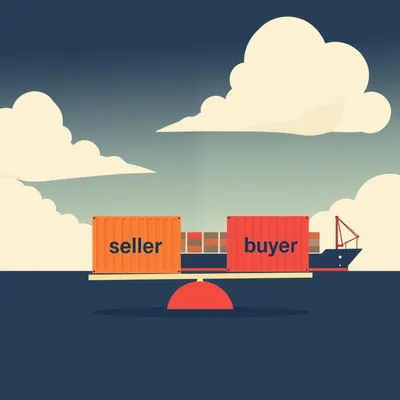
Daniel sent us this one — he wants a head-to-head comparison of EXW and FOB for importers using a freight forwarder to handle pickup and shipment from China. Specifically, the real cost and risk tradeoffs, what hidden fees to watch for, and how to actually verify that an Alibaba supplier can deliver under whichever incoterm you agree to. This is one of those topics where the difference between the two options can quietly eat thousands of dollars before your shipment even reaches the port.

Most small importers don't realize they're making the choice at all. Alibaba suppliers default to EXW — it's just what they quote — and buyers accept it because the unit price looks lower. Then the freight forwarder sends an invoice with a pickup fee, a consolidation fee, an export clearance fee, and suddenly that bargain isn't a bargain.
The illusion of control at the cost of actual complexity.
So let's define the terms, because the operational split is where everything happens. Under EXW, Ex Works, the seller makes the goods available at their premises — factory or warehouse. That's it. The buyer arranges and pays for absolutely everything from that point: loading onto the truck, domestic transport, export customs clearance, terminal handling, and onward shipping.
Free on Board. The seller delivers the goods onto the vessel at the named port of shipment. Risk and cost transfer to the buyer once the goods are physically on board. The seller handles everything upstream — domestic trucking to the port, export clearance, loading charges at the terminal.
The clean line is: EXW means the factory gate is where your responsibility starts. FOB means the ship's deck is where it starts. Everything between those two points is either yours or theirs.
That gap — between a factory gate somewhere in inland China and a vessel at Shanghai or Shenzhen — is where the hidden costs live. I pulled some numbers from Flexport's logistics data. Domestic trucking from a typical factory to a major port runs two hundred to six hundred dollars for a full truckload. Export customs clearance through a broker is another fifty to a hundred and fifty dollars. Under EXW, those are all on you, and they're not in the unit price the supplier quoted.
The supplier's EXW price looks cheaper by, say, four hundred dollars, and you think you're winning. Then the forwarder's bill lands and you've paid five hundred and fifty.
There's a case from Yiwu to Ningbo that illustrates this perfectly. Buyer pays five hundred dollars for EXW pickup from a factory in Yiwu to Ningbo port, plus eighty dollars for export customs clearance — five hundred eighty total. If they'd negotiated FOB Ningbo, the supplier would have bundled those same services into their price at about four hundred twenty dollars. The supplier has volume relationships with local trucking companies and brokers. The buyer's forwarder is arranging a one-off pickup. The buyer overpaid by a hundred and sixty dollars.
That's before we even talk about what happens if the pickup is delayed. Demurrage charges at the port, storage fees at the consolidation warehouse — EXW puts all of that timing risk on the buyer.
Flexport reports that EXW shipments have a fifteen to twenty percent higher rate of delay compared to FOB, purely because of pickup scheduling issues. The truck shows up late, the factory wasn't ready, the paperwork isn't done — under FOB the supplier absorbs that friction because they're incentivized to get the goods on the vessel on time. Under EXW, it's your problem and your forwarder is charging you waiting time.
Why do Alibaba suppliers push EXW so hard?
One, it's simpler for them — they don't need to think about logistics, they just make the goods and you figure out the rest. Two, and this is the one that matters, many of them don't actually have the capability to handle FOB. They don't have an export license, they don't have a relationship with a customs broker, they've never filed export documentation. Quoting EXW lets them avoid admitting that.
Which means the supplier quoting FOB is actually signaling something. They're saying they've done this before.
In practice, you need to verify it. Because there's a whole second layer of traps here. The FOB port trap.
Walk me through that.
Supplier quotes you FOB Shanghai. Great, you think, they're handling everything to the port. But their factory is in Chengdu — eight hundred kilometers inland. They're not eating that trucking cost out of generosity. They're building it into the unit price, and they're probably building it in at a markup. So your FOB Shanghai price might actually be more expensive than EXW plus your forwarder's consolidated truck from Chengdu, because your forwarder might have a regular consolidation run on that route and get better rates.
The "better" incoterm depends on geography.
Geography and relationships. If the factory is within two hundred kilometers of the port and the supplier has export experience, FOB is almost always the right call. If the factory is deep inland and you have a forwarder with a consolidation hub nearby, EXW might actually be cheaper — but only if your forwarder has quoted you a firm door-to-port price in writing.
There's a specific number I saw — something like fifteen cents per kilogram gets added for inland freight from Chengdu to Shenzhen. That adds up fast on a full container.
And here's where the freight forwarder friction comes in. Under EXW, many forwarders charge fees that aren't in the initial quote. A pickup fee, a consolidation fee, a warehouse receiving fee — these can add fifty to two hundred dollars that the buyer didn't budget for. Under FOB, the supplier delivers to the forwarder's nominated carrier at the port, so those pickup-related fees simply don't exist.
The forwarder's quote for EXW is inherently less predictable than their quote for FOB.
Because under EXW, the forwarder is sending a truck to an unfamiliar factory, possibly in an industrial park they've never been to, dealing with a supplier they've never coordinated with. Under FOB, the supplier handles all of that domestically, in their own language, with their own relationships. The forwarder just receives the goods at the port.
Let's talk about risk allocation, because cost is only half of this. Under EXW, when does the buyer's risk start?
The moment the goods leave the factory. If the forklift drops the pallet during loading, that's on the buyer's cargo insurance. If the truck gets in an accident on the way to the port, that's on the buyer's cargo insurance. If the goods sit in a consolidation warehouse and get water damaged, buyer's insurance.
Risk transfers when the goods are on board the vessel. Per the ICC twenty twenty Incoterms, it's specifically when the goods are physically on the vessel, not when they arrive at the port terminal. So if the container falls off the truck on the way to Shanghai, the supplier eats it. If the goods get damaged during loading onto the ship, the supplier eats it. The buyer's insurance kicks in once the ship departs.
That's a massive difference in practice. Because under EXW, you're insuring a domestic Chinese trucking leg with a local operator you've never met, and if something goes wrong, you're filing a claim against a small trucking company in a language you probably don't speak.
Alibaba Trade Assurance reflects this asymmetry. Trade Assurance covers up to a hundred thousand dollars for FOB shipments, but it requires proof of loading — the bill of lading showing the goods were actually on the vessel. Under EXW, claims are harder to validate because the handoff point is a factory gate with no neutral third party. Was the damage pre-existing or did it happen during loading? Good luck proving either.
If you're a new importer, FOB is not just more convenient — it's structurally safer.
Structurally safer, easier to insure, easier to dispute. But only if the supplier can actually execute on FOB. And that brings us to the verification question Daniel asked about. How do you know if an Alibaba supplier is actually FOB-capable, versus just saying they are?
Because anyone can type "FOB Shanghai" into a quote template.
So here's the practical checklist. First, ask for their export license. In China, companies need a specific export license to clear customs in their own name. If they don't have one, they can't legally handle export clearance — they'd be subcontracting it, which means your FOB arrangement is actually a disguised EXW with extra steps.
What does an export license look like? Is there a standard format?
It's issued by China's Ministry of Commerce, and it has a registration number. You can ask the supplier for their customs registration code — it's a ten-digit number. If they hesitate or say they don't have one, they're EXW-only, full stop.
Ask for their customs broker's contact information. A legitimate FOB supplier has an ongoing relationship with a licensed customs broker. They should be able to give you the broker's company name and phone number without blinking. If they say they'll "arrange it when needed," that means they don't have one and they'll be figuring it out on your timeline.
Which means delays. Export clearance can take one to three days if the supplier knows what they're doing. If they're learning on the job, it can take a week.
A week of delay at the port is a week of storage fees, a missed vessel, and a rebooking charge. I've seen cases where a supplier's inexperience with export documentation caused a three-day delay that cascaded into missing the sailing and costing the buyer three hundred dollars for the next available vessel.
Third verification step?
Request proof of past FOB shipments. Ask for a bill of lading from a previous shipment that shows their company name listed as the shipper. Not your forwarder's name, not a trading company's name — their name. That proves they've actually executed an FOB shipment where they were the party delivering goods to the vessel.
If they can't produce one?
Then they've never done FOB before, and you're their guinea pig. Which might be fine if you're ordering five hundred dollars of sample goods. It's a disaster if you're ordering a full container.
What about Alibaba's own verification systems? The "Verified" badge, Trade Assurance history?
The Verified badge tells you the supplier is a real company with a real address — it doesn't tell you they can handle FOB. But you can dig into their Trade Assurance transaction history and look for patterns. If you see multiple transactions with FOB in the incoterm field, that's a good sign. If everything is EXW, even for large orders, that's a signal.
There's also the loading dock test. Ask for photos of their loading dock and warehouse. If they don't have a proper dock — if they're loading from a dirt lot or a residential garage — EXW may be the only realistic option, because they're not set up for the kind of logistics coordination FOB requires.
That's not necessarily a dealbreaker. Some small factories make excellent products at great prices, but they're just not equipped for export logistics. In that case, EXW with a trusted forwarder who has a local office in China is the right call. You're paying more for logistics, but the product quality justifies it.
The key is knowing which situation you're in before you commit.
And that's where the forwarder becomes your most important partner. Before you even negotiate with the supplier, get your forwarder to quote both scenarios. EXW door-to-port versus FOB port-to-port. Give them the factory address and the port, and ask for a written comparison. A good forwarder will tell you honestly which one is cheaper for that specific route.
Because the forwarder's incentive is aligned with yours here — they want the shipment to move smoothly, and they know which incoterm creates less friction on their end.
Here's a negotiation tactic that works surprisingly well. If the supplier is hesitant about FOB — maybe they're worried about the inland trucking cost — offer to split it. Say you'll cover half the domestic freight if they quote FOB. It reduces their risk, it reduces your total cost compared to EXW, and it gets you the structural protections of FOB. I've seen importers use this to get FOB terms from suppliers who initially refused.
Let's talk about the knock-on effect on lead time. You mentioned it briefly — two to five days of difference.
Under EXW, you have to schedule a pickup after the goods are ready. The forwarder contacts the factory, arranges a truck, the truck may not be available for two days, then it drives to the port, then customs clearance happens — sequentially. Under FOB, the supplier manages domestic logistics in parallel with production. While the last units are being packed, the truck is already scheduled, the customs broker already has the documentation. The timeline compresses.
FOB doesn't just shift cost and risk — it shifts the entire coordination burden onto the party best positioned to handle it.
The supplier knows their local trucking market, they know the port procedures, they speak the language. Asking a buyer in Chicago or Dublin to coordinate a truck pickup from a factory in Dongguan is inherently inefficient.
Yet that's what EXW asks of you.
That's why EXW persists — because it's the path of least resistance for the supplier. They quote it, the buyer doesn't push back, and the forwarder figures it out. The forwarder can figure it out, but they charge for the headache.
We've covered the cost split, the risk split, the verification steps. Where does this leave the small importer making their first or fifth order?
I'd say the rule of thumb is this. Choose FOB if the supplier is within two hundred kilometers of the port and has demonstrable export experience — license, broker relationship, past FOB bills of lading. Choose EXW only if you have a trusted forwarder with a local office in China who's given you a firm written quote for door-to-port service from that specific factory.
If neither condition is fully met?
Then you're gambling. And the house — the house being Chinese domestic logistics — usually wins.
There's also the question of what happens when something goes wrong. We touched on this with Trade Assurance, but let's make it concrete. Under EXW, if goods are damaged during domestic transit, who do you claim against?
The trucking company. Which is often a small local operator with minimal assets and no English-speaking staff. Your forwarder might help, but they're not liable — they just arranged the truck. Under FOB, the supplier is responsible until the goods are on the vessel. If there's damage during domestic transit, you claim against the supplier, and you can enforce that through Alibaba Trade Assurance or through your payment terms.
That's a much cleaner enforcement path. The supplier has an ongoing relationship with you, they care about their Alibaba rating, they have assets you can claim against. A random trucking company in Zhejiang province has none of those incentives.
Practically speaking, the supplier's cargo insurance during the domestic leg is almost certainly better than whatever ad-hoc coverage your forwarder arranges for a one-off EXW pickup. The supplier ships regularly, they have a blanket policy, the rates are better, the coverage is more comprehensive.
Let's talk about one more trap I've seen. The FOB port mismatch. Supplier quotes FOB Shanghai, but they actually deliver to a consolidation warehouse three kilometers from the port, not to the vessel. That's not FOB — that's FCA with the wrong label.
That's a real problem. The ICC twenty twenty Incoterms clarified that FOB requires delivery on board the vessel — not to a terminal, not to a warehouse near the port. If the supplier is delivering to a consolidation point, that's FCA, Free Carrier, which has a different risk transfer point. Some suppliers use "FOB" colloquially to mean "we'll get it to the port area," and that's not what the term legally means.
Part of verification is confirming they understand what FOB actually requires.
Ask them: "When you say FOB Shanghai, do you mean you deliver the goods onto the vessel, and you provide the bill of lading showing the goods on board?" If they hesitate or qualify, you've found the gap.
What about the forwarder's role as an intermediary under EXW? You mentioned a good forwarder can act as the buyer's agent.
A forwarder with a China office can handle everything — trucking, export clearance, consolidation, loading. They effectively become your logistics department in China. But they charge for it. The question is whether their consolidated rates — combining your shipment with others on the same route — beat the supplier's FOB markup. In some cases, especially for less-than-container-load shipments from inland factories, the forwarder's consolidated truck can be cheaper than the supplier's dedicated truck to the port.
Which is why the written comparison quote is essential. You can't guess this — the numbers will tell you.
The numbers change depending on the route, the season, the forwarder's current consolidation schedule. What's true for Shenzhen in March might not be true for Shanghai in September.
There's no universal answer to "which is better." It's a decision you remake for each supplier, each order, each route.
Which is exactly why understanding the mechanics matters more than memorizing a rule. If you know what costs live in the gap between factory gate and ship's deck, and you know how to verify who's actually capable of handling those costs, you can make the right call case by case.
Let's turn this into something actionable. If I'm placing an order on Alibaba tomorrow, what's my step-by-step?
Step one, before you even message the supplier, get your forwarder to quote EXW door-to-port and FOB port-to-port for that factory location. Step two, ask the supplier for their FOB price and their EXW price — both, so you can compare. Step three, run the verification checklist: export license, customs broker contact, past FOB bill of lading, loading dock photos. Step four, compare the forwarder's EXW total versus the supplier's FOB total, and pick the cheaper one — but only if the supplier passes the verification for FOB. If they don't, EXW with a trusted forwarder is your only option.
If the supplier quotes FOB but fails the verification?
Walk away, or renegotiate to EXW with full awareness of what you're taking on. A supplier who claims FOB capability but can't prove it is either dishonest or confused, and neither is someone you want handling your export clearance.
One thing we haven't touched on — what about FCA? You mentioned it earlier as the technically correct term for some of these arrangements.
FCA, Free Carrier, is wildly underused by small importers. It's actually a better fit than FOB for a lot of modern shipping, especially containerized freight where the seller delivers to a terminal rather than loading onto the vessel directly. But Alibaba suppliers don't quote it, and buyers don't ask for it. FOB has become the default shorthand for "seller handles everything to the port," even when the legal specifics don't match.
The market has settled on EXW and FOB as the two poles, and everything else is niche.
For the small importer on Alibaba, yes. FCA is technically superior in many cases, but practically, you're going to see EXW and FOB, and you need to know how to navigate between them.
Let's look forward for a moment. You mentioned Flexport and other digital forwarders — they're building apps that let buyers manage EXW pickups with real-time tracking, automated customs documentation, transparent pricing. Does that shift the calculus?
It does, and I think it's going to shift it further. If a digital forwarder can give you an app that makes arranging an EXW pickup as easy as booking a rideshare — fixed price upfront, real-time tracking, automated customs — then EXW becomes much less risky. The main problem with EXW today is opacity and unpredictability. Remove those, and EXW becomes a viable default for a lot more buyers.
We're not there yet for most forwarders.
The big digital players are moving that direction, but the typical freight forwarder still operates on email and phone calls. Until that changes, FOB remains the safer default for new importers.
On the regulatory side — the Incoterms twenty twenty revision tightened the FOB definition. Do you expect further changes?
The ICC reviews Incoterms roughly every ten years, so the next revision would be around twenty thirty. I'd expect them to clarify the FOB versus FCA distinction further, because the current ambiguity — where FOB is widely used for containerized freight even though it was designed for break-bulk — creates exactly the kind of misuse we've been discussing. There's also pressure to update the terms for digital documentation and blockchain-based bills of lading, which could change how risk transfer is verified.
The landscape isn't static. What's true today about EXW and FOB might look different in five years.
The fundamentals won't change — someone has to pay for the gap between factory and ship, and someone has to bear the risk during that gap. But the tools for managing that gap, and the transparency around it, are improving fast.
To land the plane on Daniel's question. EXW gives you a lower unit price but exposes you to unpredictable domestic logistics costs, harder insurance claims, and a more complicated dispute path. FOB bundles those costs into the supplier's price, shifts the risk to the party best positioned to manage it, and gives you cleaner enforcement through Trade Assurance. But FOB only works if the supplier can actually deliver it — and verifying that takes four specific checks.
Export license, customs broker contact, past FOB bills of lading, and loading dock photos. Run those four checks, get your forwarder's comparison quote in writing, and make your decision supplier by supplier. There's no one-size-fits-all answer, but there is a reliable process for finding the right answer each time.
If you're new to this and don't have a trusted forwarder yet, default to FOB with verified suppliers near the port. It costs a bit more on paper, but it's dramatically less likely to produce a nasty surprise.
The nasty surprise is the thing you're really paying to avoid. A hundred and sixty dollars in hidden EXW fees is annoying. A missed sailing because the supplier couldn't clear customs is a relationship-ender.
And now: Hilbert's daily fun fact.

In the high medieval period, approximately one in every three hundred households on the Yamal Peninsula owned a cooking vessel carved from mammoth ivory, making it roughly as common as bronze cookware in the same region.
I have so many questions and I'm not sure I want answers to any of them.
Mammoth ivory soup. That's a new one.
This has been My Weird Prompts. Thanks to our producer Hilbert Flumingtop. If you enjoyed this episode, rate and subscribe wherever you get your podcasts — it helps more people find the show. We'll be back soon with another prompt from Daniel.