So Daniel sent us this one — and I have to say, after three hundred episodes of modular carry deep-dives, he's finally gone for the nuclear option. He wants Herman to design a whole-body modular carry system. Head to shin, one attachment standard, pouches that can move between your skull and your ankle without an adapter. The constraints: stick to one existing standard so everything's interchangeable, minimize custom fabrication, and at least two carries have to make actual biomechanical sense. Flashlight on the head is a given. Wallet placement is up for debate. And he wants a DIY-plus-daily-carry configuration that could theoretically survive parenting, house projects, and a business call.

This is the most gloriously unhinged design brief I've ever received, and I am completely here for it. The previous headband carry episode was fun, but treating the head as an isolated platform was always going to be a dead end. The real question is: what happens when you connect the head to the shoulders, the shoulders to the waist, and the waist to the legs as one continuous load-bearing chain?
And the answer is either a breakthrough in personal logistics or the most elaborate way to look like you're about to defuse a bomb at a PTA meeting.
Probably both. But let's take this seriously, because the underlying problem is real. Daniel's been juggling parenting, DIY, and business calls during an apartment move, and what he's really asking is: can I wear my entire toolkit and still function as a human being? So let's establish the rules of the game before we start bolting pouches to our shins.
Three zones. Head, torso, lower body. One attachment standard across all of them. And we're not allowed to invent some proprietary Herman Poppleberry clip system and 3D-print it in the shed.
Right — buy, don't build. Which means we need a standard that's already in wide production, already used across multiple body zones, and mechanically robust enough to handle everything from a head-mounted flashlight to a thigh panel. There's really only one candidate: MOLLE.
Modular Lightweight Load-carrying Equipment. U.S. military standard from the nineties. Woven nylon webbing in one-inch-wide rows, stitched at one-and-a-half-inch intervals, pouches thread through with straps.
And it's everywhere. Belts, vests, chest rigs, backpacks, drop-leg platforms — MOLLE webbing is the USB port of tactical gear. The question isn't whether MOLLE can do this. The question is whether we can adapt it to curved surfaces and moving joints without making the wearer miserable.
So walk me through the head. Last time we talked head carry, we weren't locked into MOLLE. Now we are. What's the problem?
The problem is geometry. Standard MOLLE webbing is sewn onto flat or gently curved fabric panels — think the back of a plate carrier. The human skull is a compound curve. If you try to stitch MOLLE webbing directly onto a soft headband, it's going to pucker, gap, and the pouches won't sit flush. You'll have a flashlight wobbling around on your temple like a loose antenna.
So you need a rigid substrate.
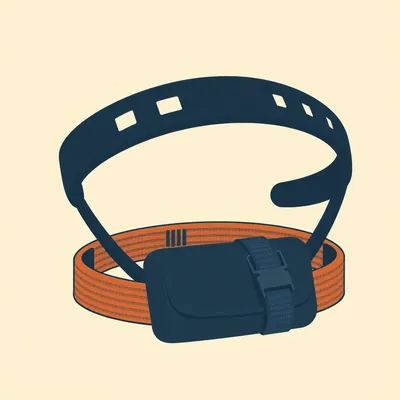
A semi-rigid headband frame that matches the curvature of the skull, with MOLLE slots molded or cut directly into it. Think a Kydex or 3D-printed nylon band, about an inch and a half wide, wrapping from the forehead around to the back of the head, with a secondary strap over the crown for vertical stability. The MOLLE slots are milled right into the band — no fabric, no stitching. You thread your pouch straps through the slots the same way you would through webbing.
And the padding?
Sweat-wicking EVA foam on the inside, the kind used in hiking backpack straps. Perforated for breathability. The whole headband assembly — frame plus foam plus a Petzl Actik Core headlamp at ninety-five grams — comes in under two hundred grams total. That's the ergonomic ceiling for head-mounted weight without neck strain. Studies of head-mounted displays have pegged the comfort threshold right around two hundred grams for extended wear.
And the flashlight specifically makes sense on the head because it tracks your gaze. You look at the fuse box, the light looks at the fuse box. You look at the toddler who's gone suspiciously quiet, the light follows.
That's the biomechanical win. Hands-free, gaze-directed illumination is genuinely the best use case for head carry. But here's where the unified system gets interesting — that same MOLLE flashlight pouch can come off the headband and snap onto your chest rig if you decide you don't want weight on your head that day. No re-lacing, no adapter plate. Just unthread the straps, move the pouch, rethread.
Which is the whole point of the exercise. So the headband frame is our one custom-fabricated component. Everything else is off-the-shelf. Let's move down to the upper body.
The upper body is actually the easiest zone, because MOLLE-compatible suspenders and chest rigs already exist. Companies like 5.11 Tactical and Condor make suspenders with integrated MOLLE webbing panels — designed for people who carry heavy belt loads and need shoulder support. The 5.11 Tactical Suspenders run about forty to fifty dollars and have MOLLE webbing across the front straps. The Condor MCR4 chest rig is a modular torso panel with MOLLE webbing across the entire front surface, about sixty dollars.
So you're wearing suspenders with webbing, and a chest panel. But now we've got a headband and a torso harness, and the question is how they connect — or whether they should.
They should connect, but carefully. If you just run a strap from the back of the headband straight down to the suspenders, you're loading the cervical spine in compression. That's a neck injury waiting to happen. The trick is to route the connection rearward and downward to the upper back — between the shoulder blades — where the suspenders cross. A single adjustable nylon strap with a quick-release buckle, running from the rear of the headband frame down to a D-ring at the suspender crossover point. That transfers head weight to the trapezius muscles and the shoulder girdle, not the neck.
So the head is essentially suspended from the shoulders, like a counterweighted lamp.
Right. And it also stabilizes the headband against rotation. Without that rear strap, if you put a hundred-gram pouch on one temple, the headband wants to twist. With the rear strap tensioned, the load is triangulated — temple pouch, opposite side of the headband, rear anchor point. Much more stable.
Now for the lower body. Belt and legs.
The belt is straightforward — MOLLE tactical belts are commodity items. You can get a decent one for thirty dollars. Two-inch-wide nylon with two or three rows of MOLLE webbing around the entire circumference. That's your heavy-lift platform. But the innovation Daniel's prompt demands is the leg carry, and that's where biomechanics gets interesting.
Because legs move.
Legs move a lot. When you walk, your thigh accelerates forward, decelerates, reverses direction — about one point eight meters per second squared of peak acceleration during normal gait. Anything attached to your leg is subject to those forces, plus the pendulum effect of swinging mass. That's why leg carry has to be extremely light and tightly coupled to the body.
So what's the platform?
A drop-leg rig — Blackhawk STRIKE platform, about thirty to fifty dollars. It's a MOLLE panel that hangs from the belt via two or three straps, secured around the thigh with an elastic strap. The panel sits against the outer thigh, roughly where your hand naturally falls. The key modification — and this isn't custom fabrication, it's just a buckle swap — is adding a quick-disconnect buckle at the waist attachment point. So the entire leg panel can be removed in two seconds without unbuckling the thigh strap or removing any pouches.
Which means you can strip the leg panel for a business call, clip it back on for DIY.
And because it's MOLLE, the pouches on the leg panel are the same pouches you'd use on your chest or headband. A multitool pouch that lives on your thigh during a renovation project can move to your belt for a grocery run, or to your chest rig for a hike.
Let's talk about that interoperability, because it's the core promise of the whole system. Give me a concrete example.
Take a Condor MA41 MOLLE utility pouch — about fifteen dollars, roughly four inches by five inches by two inches. It's designed to hold a multitool, a small flashlight, or a pack of batteries. On Monday, you're doing electrical work in the attic: that pouch is on your headband, holding a bit driver. Tuesday, you're at the park with the kid: it's on your chest rig, holding wipes and a pacifier. Wednesday, you're assembling furniture: it's on your leg panel, holding screws and a hex key set. Same pouch, three different locations, no adapters.
That's the pitch. But let's get to the question Daniel actually asked, which is about wallet placement. He wants to know where the wallet should go, and he wants it to make biomechanical sense.
This is surprisingly non-trivial. The traditional back-pocket wallet is a sitting disaster — it tilts the pelvis, compresses the sciatic nerve, and has been implicated in chronic lower back pain. Front-pocket carry is better but still creates an asymmetric bulge when you sit. The belt-line wallet in a MOLLE pouch is better for sitting but awkward to access — you have to reach down to your hip, which is fine standing but weird when seated in a car or at a desk.
So where?
Chest-mounted horizontal pouch at sternum level. Here's my reasoning. The sternum is within the natural reach envelope of both hands — you don't have to twist or lean. It's visible, so you can see what you're grabbing. It's secure against pickpocketing because it's literally in your line of sight and under your chin. And it distributes the wallet's weight — typically a hundred fifty to two hundred grams — across the shoulder straps rather than concentrating it on one hip or one buttock.
The marathon runner approach.
Distance runners have been using chest pouches and running belts for phones and gels for years. They've figured out that sternum carry minimizes bounce and keeps the weight centered over the body's center of mass. A MOLLE chest pouch at sternum level — something like the Condor MA31 admin pouch, about twenty dollars — sits flat against the sternum, doesn't interfere with arm swing, and you can access it while wearing a backpack or a child carrier.
And it doesn't look like you're wearing a tactical vest if you choose the right pouch.
That's the low-vis variant. Black webbing, low-profile pouches, no camo, no morale patches. From ten feet away, it reads as a photographer's vest or hiking gear. The full head-to-toe rig in coyote brown with six pouches is going to look absurd no matter what we do — but the sternum wallet setup with a slim chest pouch and suspenders under a jacket is subtle.
Let's put some numbers on the weight distribution, because this is where a lot of carry systems fall apart. People load up without thinking about where the mass is going.
Here's the breakdown. Head carry: two hundred grams maximum. That's a headlamp plus maybe a small bit driver or a single AAA flashlight. Go heavier and you'll feel it in your neck within thirty minutes. Upper body — the suspenders and chest rig: two to three kilograms distributed across both shoulders. That's your wallet, phone, multitool, maybe a small first-aid kit. The belt: up to five kilograms. That's your heavy items — spare batteries, tape measure, a full-size multitool, a water bottle in a MOLLE bottle pouch. Leg panels: under one kilogram per leg. Anything heavier disrupts your gait — you start swinging your leg differently to compensate, and that cascades into hip and knee strain over time.
So the total system weight, fully loaded, is about four kilograms. Which is comparable to a light daypack.
And the distribution is what makes it work. A daypack puts all four kilos on your shoulders and upper back. This system splits it across your head, shoulders, waist, and thighs. Each zone is carrying a fraction of the total, and the fractions are matched to what each body part can comfortably handle. The belt carries the most because your hips are designed to bear weight — that's literally what the pelvic girdle evolved to do.
So we've got the hardware. Let's build a configuration for Daniel's actual life. He mentioned parenting, DIY, and a business call — not all at the same time, he emphasized, which I appreciated.
Here's the setup. Headband: Petzl Actik Core headlamp in a MOLLE-compatible mount on the right temple, plus a small bit driver pouch on the left temple for balance. Chest rig: Condor MCR4 with an admin pouch at sternum level holding wallet, phone, and keys; a multitool pouch on the left side; a small notepad pouch on the right. Belt: MOLLE tactical belt with a tape measure pouch on the left hip, a battery organizer pouch on the right hip, and a water bottle pouch at the small of the back. Leg panel: Blackhawk STRIKE drop-leg on the right thigh with a general-purpose utility pouch for whatever the task of the moment demands — screws and wall anchors during DIY, a spare onesie and a pack of wipes during parenting.
And when the business call comes?
Unclip the leg panel — two seconds. The headband can stay on if it's a video call and you want to look like a cyborg, or you can pop it off and set it aside. The chest rig and belt stay on because they're under a jacket or a button-down shirt. You go from full workshop mode to presentable in about five seconds.
The parenting configuration has an interesting wrinkle. Daniel mentioned literally holding a child. Does the chest rig interfere with that?
It depends on the child carrier. If he's using a front-facing baby carrier like an Ergobaby or a BabyBjörn, the chest rig would compete for the same real estate. But if he's using a back carrier, or if the kid is old enough to be on his hip, the chest rig is out of the way. The leg panel actually becomes useful here — you can attach a MOLLE-to-carabiner adapter and clip on a toy, a sippy cup, or a small diaper pouch. The thigh is a surprisingly good platform for parenting accessories because it's at the kid's eye level when you're carrying them on your hip.
The child can help themselves to their own supplies.
Which is either a feature or a bug, depending on the child.
Let's talk about the absurdity factor, because we can't pretend this isn't ridiculous. A grown adult walking around with MOLLE webbing from scalp to shin is going to get looks.
Oh, absolutely. The full rig — headband, chest rig, belt, dual leg panels — looks like you're about to fast-rope out of a helicopter. In a suburban context, you'd be the most aggressively prepared person at the hardware store. But I think there's a spectrum here. At one end, you've got the full tactical cosplay. At the other end, you've got the low-vis variant: black MOLLE webbing, slim pouches, no dangling straps, everything in matte finishes. That version reads as eccentric outdoor gear rather than paramilitary.
The photographer's vest defense.
Photographers have been wearing multi-pocket vests and chest rigs for decades and nobody blinks. If your MOLLE chest rig is black, slim, and loaded with a phone, wallet, and multitool rather than magazine pouches, you just look like a guy who really likes pockets.
Which, to be fair, is exactly what Daniel is.
A man who looked at the standard five-pocket jean configuration and said, "I can do better."
Let's get into the cost breakdown, because one of Daniel's constraints is minimizing custom fabrication. What does this actually cost to assemble?
I've priced this out using current retail numbers. The 5.11 Tactical Suspenders: forty-five dollars. Condor MCR4 chest rig: sixty dollars. A basic MOLLE tactical belt: thirty dollars. Blackhawk STRIKE drop-leg platform: forty dollars. The custom headband frame — if you 3D-print it in nylon or have it cut from Kydex — maybe twenty-five dollars in materials plus the foam padding. Then pouches: three Condor utility pouches at about fifteen dollars each, one admin pouch at twenty dollars, a water bottle pouch at fifteen dollars, a tape measure pouch at twelve dollars. Total: somewhere around two hundred ninety dollars, give or take.
Under three hundred dollars for a whole-body modular carry system. That's less than some people spend on a single designer backpack.
And you don't have to buy it all at once. The build order Daniel asked about — start with the belt and chest rig. Those two alone cover about eighty percent of carry needs. The belt handles tools and heavy items. The chest rig handles wallet, phone, and frequently accessed items. That's a hundred thirty-five dollars for the core system. Add the headband only if you're doing night work or need hands-free light regularly. Add the leg panel only if you're carrying enough tools that the belt is overflowing.
And the wallet-on-chest placement is the cheapest ergonomic win in the whole system. Twenty dollars for a MOLLE admin pouch at sternum level, and you've solved the back-pocket wallet problem without committing to the full rig.
That might be the single most actionable takeaway from this entire exercise. Even if you never wear a headband or a drop-leg panel, moving your wallet from your back pocket to a chest-mounted MOLLE pouch on a pair of suspenders is a genuine quality-of-life improvement. Your spine will thank you.
I want to poke at one assumption here. We've built this whole system around MOLLE, and it works, but is there a better standard we're ignoring? ClipTech, magnetic attachments, something else?
ClipTech is interesting — it's faster to attach and detach than MOLLE, and it's used on some high-end EDC belts. The problem is availability. MOLLE pouches are made by dozens of manufacturers in hundreds of configurations. ClipTech is proprietary to a handful of companies. If you want a very specific pouch — say, a horizontal wallet pouch with a clear ID window and a key clip — you can find that in MOLLE from at least three different brands. In ClipTech, you're probably out of luck.
And magnetic?
Magnetic attachments are great for quick access but terrible for security. If you're wearing a magnet-mounted pouch on your thigh and you brush against a doorframe, the pouch pops off. For head carry especially, magnets are a non-starter — you don't want anything on your head that can be knocked loose by a low branch or a cabinet door. MOLLE's weakness is that it's slow to reconfigure — threading straps through webbing takes thirty seconds per pouch. But its strength is that once attached, the pouch is not coming off until you deliberately remove it.
So MOLLE is the right call for this application. Slow to configure, but bombproof once set up.
And for a system that's meant to be worn while parenting and doing DIY — environments full of unpredictable forces, small children yanking on things, power tools vibrating — bombproof is exactly what you want.
Let's do a quick stress test. Daniel's in the middle of a DIY project — he's got the full rig on, headband with flashlight and bit driver, chest rig with wallet and multitool, belt with tape measure and batteries, leg panel with a pouch full of screws. He needs to crawl under a sink to fix a pipe. What happens?
The leg panel is the first point of interference. Crawling on your belly with a thigh-mounted pouch is awkward — the pouch catches on the floor. But that's where the quick-disconnect buckle earns its keep. Pop the leg panel off, set it aside, crawl under the sink. The headband is actually an asset here — the flashlight is pointing exactly where you're looking, which is the one thing you can't easily do with a handheld light when both hands are occupied with a wrench.
And the chest rig?
Lying prone with a chest rig is uncomfortable if the pouches are thick, but the sternum wallet and slim multitool pouch we specced are low-profile enough that they shouldn't dig in. If they do, the chest rig comes off in about ten seconds — it's just buckles.
So the system is modular in the genuine sense: you can shed components based on the task, and the remaining components still work independently.
That's the design principle. Each zone is self-contained and functional on its own. The headband is a complete headlamp platform with or without the chest rig. The belt is a complete tool-carry system with or without the leg panel. The chest rig is a complete EDC platform with or without the headband. You're not locked into wearing the full exoskeleton every time you leave the house.
Which brings us to the open question. Could a system like this actually replace pocket-based carry entirely? Is the friction of donning and doffing a multi-zone rig too high for daily use, or is there a tipping point where the convenience of having everything accessible outweighs the hassle of suiting up?
I think the friction is real, and it's the main reason this hasn't gone mainstream. Pockets are zero-setup — you put on pants, you have pockets. A MOLLE rig requires you to put on suspenders, buckle a belt, maybe attach a leg panel. That's thirty to sixty seconds of additional dressing time. For most people, most days, that's not worth it.
But for Daniel's use case — parenting plus DIY plus business calls, all in the same day, often in the same hour — the equation shifts. The time he loses donning the rig, he gains back by not having to search for tools, not having to charge his phone in a different room, not having to put the baby down to grab a screwdriver.
That's exactly the calculus. This system isn't for everyone. It's for people whose daily activity pattern involves frequent context-switching between tasks that require different tools, in environments where putting things down means losing them. New parents. Renovators. Field technicians. Anyone who's ever said, "I just had it in my hand two seconds ago."
The future implication is interesting too. 3D printing is getting cheaper and more accessible. We're already at the point where you can print a custom-contoured headband frame in nylon for twenty-five dollars. In a few years, you'll be able to 3D-scan your torso and print a chest panel that perfectly matches your ribcage curvature, with MOLLE slots positioned exactly where your hands naturally fall.
Body-contoured MOLLE panels. That's the next frontier. Right now, chest rigs are one-size-fits-most, which means they fit nobody perfectly. A custom-printed chest panel with integrated MOLLE webbing, matched to your specific torso geometry, would be more comfortable, more stable, and lower-profile than anything off the shelf. Combine that with a custom headband frame and a 3D-printed leg panel contoured to your thigh, and you've got a whole-body system that feels like it's part of your body rather than strapped onto it.
The cyborg transition, one MOLLE pouch at a time.
And the thing is, we're not talking about implanting anything. This is all external, all removable, all non-invasive. It's just a really, really thorough approach to pockets.
Before we wrap, let's give people the build list. If a listener wants to assemble this system, what do they buy and in what order?
Step one: MOLLE tactical belt, thirty dollars. Start carrying your multitool and flashlight on your waist. Step two: 5.11 Tactical Suspenders, forty-five dollars, plus a Condor admin pouch for your chest, twenty dollars. Move your wallet and phone to sternum level. You've now spent ninety-five dollars and solved the two biggest ergonomic problems in EDC — belt weight distribution and wallet-induced back pain. Step three: Condor MCR4 chest rig, sixty dollars, if you want more torso real estate. Step four: custom headband frame, twenty-five dollars in materials, plus a MOLLE-compatible headlamp mount, if you need hands-free light. Step five: Blackhawk STRIKE leg panel, forty dollars, only if your tool load exceeds what the belt can handle.
Total for the full system: about two hundred ninety dollars. Core system — belt plus suspenders plus chest pouch — under a hundred.
And every component is returnable if it doesn't work for you, because it's all off-the-shelf except the headband.
There's something satisfying about a system that's absurd in concept but completely practical in execution. Daniel asked for whole-body modular carry, and we've actually delivered something that could be assembled this weekend and worn on Monday.
The fact that it looks ridiculous is almost beside the point. Functionally, it works. The weight distribution is sound, the biomechanics check out, the cost is reasonable, and the modularity is real. Whether anyone has the courage to wear it to the hardware store is a separate question.
I'd pay good money to see the expression on the cashier's face when Daniel walks in wearing a head-mounted flashlight, a chest rig full of pouches, and a drop-leg panel.
"Sir, are you here to buy drywall or secure the perimeter?"
And now: Hilbert's daily fun fact.

A tenth-century Turkmen manuscript on navigation, preserved in the library of Gonbad-e Kavus, includes a detailed description of Polynesian wayfinding — specifically the use of bioluminescent organisms to read wave patterns at night — centuries before any known contact between Central Asia and the Pacific. Scholars still cannot explain how the author obtained this knowledge.
...right.
Thanks, Hilbert.
That's going to bother me for the rest of the day.
One final thought before we go. The whole-body carry system we've designed here is ultimately a response to a very modern problem: we carry more small objects than ever before, and our clothing hasn't evolved to match. Pockets were designed for a handkerchief and a few coins. Now we're carrying phones, wallets, keys, multitools, flashlights, battery packs, and whatever a toddler hands us. The MOLLE rig is one answer. I suspect we'll see more elegant answers in the next decade — clothing with integrated attachment points, magnetic docking systems that don't compromise security, fabrics that stiffen on demand to support loads. The problem isn't going away. The solutions are just getting started.
And if anyone builds the full Herman Poppleberry Whole-Body Carry System, send us a photo. We want to see it in the wild.
This has been My Weird Prompts. If you enjoyed this episode, leave us a review wherever you listen — it helps. We'll be back soon.
Thanks to our producer Hilbert Flumingtop. See you tomorrow.