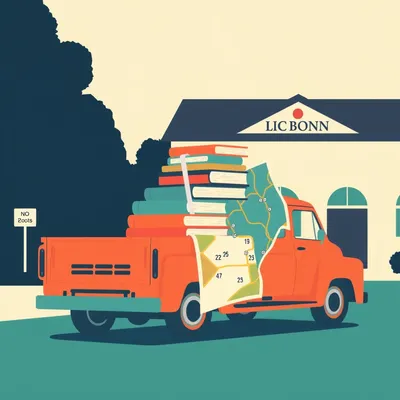
So here we are. Episode three hundred and one. And Daniel sent us something that is not a prompt at all — it is an instruction. He says the listeners have waited long enough, and it is time for Herman Poppleberry to tell the full story of Poppleberry Logistics of Storrs, Connecticut. The founding generation, how the Poppleberrys got into freight, the pivotal moments, the questionable decisions, the glory years, and how a tiny Connecticut moving company somehow ended up doing apartment moves in Jerusalem. And — this is the part that connects a lot of dots — Daniel, our Daniel, does some work with them. So this is the origin story of every euro box tangent you have ever heard on this show.

Poppleberry Logistics is real. It has been real this whole time. And I have been sitting on this story for three hundred episodes because you do not just drop a seventy-two-year family business saga into a tangent about port delays. You wait for the right moment. Daniel finally said the moment is now. So let us start at the very beginning. Storrs, Connecticut, nineteen fifty-two. Population about fifteen thousand, best known as the home of the University of Connecticut. My grandfather's cousin — once removed, the family tree gets tangled — Ezra Poppleberry, born nineteen twenty-three, came back from the war and bought himself a single flatbed truck. One truck. He started hauling dairy equipment between farms in Tolland County. Milk tanks, pasteurization vats, cream separators. Not freight. Not moving. Farm equipment.
So the Poppleberry logistics empire began with a man and a flatbed and a lot of curdled milk residue.
That is exactly what it began with. And it probably would have stayed that way — a one-truck agricultural hauler that faded out when the small dairy farms consolidated — except for one decision. Ezra's son, Walter Poppleberry, joined the business in nineteen sixty-five. Walter was twenty-six years old and he had opinions. He looked at the books and said, we are never going to grow hauling milk tanks for farms that are disappearing. We need to pivot to general freight.
And Ezra, the founder, just handed over the keys?
Not immediately. There was a year of arguments. But Walter found an opening. The Hartford Courant needed to move their printing presses from an old facility to a new one in nineteen sixty-seven. Massive, heavy, delicate equipment. Walter underbid every other carrier by forty percent. Forty percent. The company lost money on that contract for two solid years. Ezra was furious. But Walter's calculation was that once they had proven they could handle a big newspaper's printing press relocation, other contracts would follow. And he was right. By nineteen seventy the company had five trucks and was hauling general freight across New England.
So the first questionable decision was actually the one that saved them. Lose money deliberately to build a reputation. But I have to ask — how do you even underbid by forty percent? That is not a pricing strategy, that is a cry for help. Did Walter just pull a number out of the air?
According to family accounts, he calculated the absolute minimum cost of labor and fuel, then cut another fifteen percent off that. He was not pricing for profit. He was pricing for visibility. The Hartford Courant was the biggest newspaper in the state. If you could say you moved their presses, every other business in Connecticut would at least take your call. Walter understood something that a lot of small business owners miss — sometimes the value of a contract is not the revenue. It is the credential.
So he treated the Courant job as a marketing expense dressed up as a moving contract. That is actually quite sophisticated for a twenty-six-year-old in nineteen sixty-seven.
Walter was a sophisticated thinker trapped in the body of a Connecticut trucking operator. He read business books. He studied what the national carriers were doing. He understood that Poppleberry could not outspend the big companies, so it had to out-think them. The Courant contract was a calculated loss leader. And it worked exactly as he predicted — within three years of completing that job, they had contracts with three regional newspapers and a manufacturing plant in Bridgeport.
So the first questionable decision was not questionable at all. It was strategy disguised as desperation.
That pattern repeats through the entire history of this company. But the truly questionable decision — the one that nearly ended everything — came in nineteen seventy-four. A growing national carrier approached Walter with a buyout offer. This was later revealed to be UPS, which was aggressively expanding its Northeast footprint at the time. Walter turned them down flat. His stated reason, and I am quoting family lore here, was that he did not trust corporations. He said a corporation would gut the company, fire the drivers, and turn Poppleberry into a brand name on someone else's truck.
Which, to be fair, is exactly what would have happened. I have seen that movie. The acquiring company promises to preserve the culture and retain the employees, and eighteen months later the trucks are rebranded and the drivers are looking for work.
Probably. But here is what he did instead. He took the family savings and bought six used Ford trucks to expand the fleet. Three of those trucks had odometer rollback issues. They were sold as sixty-thousand-mile vehicles. In reality, each had over two hundred thousand miles. This was discovered during a DOT inspection in nineteen seventy-six, nearly cost the company its operating license, and resulted in fines that wiped out two years of profit. Walter had to personally appear before a state transportation board and beg to keep the business alive.
So the man who did not trust corporations got taken by used truck salesmen. There is a poetry to that.
There is a very specific Connecticut poetry to that. And the hearing before the transportation board is still talked about in the family. Walter stood in a room full of state officials and said, I made a mistake trusting the wrong people, but I have never missed a delivery and I have never put an unsafe vehicle on the road. He brought maintenance records. He brought testimonials from clients. He basically argued that the company's reputation should count for more than one bad purchasing decision. The board agreed, but they put Poppleberry on probation for three years. Every truck had to pass a supplemental inspection every six months. It was expensive and humiliating, but it kept the company alive.
And that probation period probably made them better operators in the long run. Nothing focuses the mind like a state regulator looking over your shoulder.
The inspection discipline they developed during those three years became standard operating procedure. When the probation ended, they just kept doing the supplemental inspections. That is pure Walter — take a punishment and turn it into a process.
But the company survived. And then came what the family calls the glory years. Nineteen eighty-five to two thousand one. Poppleberry Logistics became the go-to regional carrier for university moves. UConn, Yale, Trinity College. They specialized in delicate lab equipment and library relocations. At their peak they operated forty-seven trucks and employed a hundred and twenty people.
Forty-seven trucks in Storrs, Connecticut. That is a legitimate mid-sized carrier. How did they go from surviving on probation to becoming the university moving specialist for the entire state?
The university niche was another Walter insight. He noticed that universities move things constantly — departments relocate, labs get renovated, libraries expand — but they do not move on the same schedule as commercial clients. A corporate office move happens fast, over a weekend. A university library relocation can take weeks because the institution cannot shut down entirely. Most carriers do not want those jobs. They are slow, they require special handling, and the insurance requirements are complicated. Walter realized that if Poppleberry built its entire operation around the rhythms of academic moving, they would face almost no competition.
So he found another market that was too weird and too demanding for the big carriers to bother with. The same pattern again.
The same pattern. And the defining moment of that era was the nineteen eighty-seven UConn library move. The Homer Babbidge Library was being expanded, and Poppleberry won the contract to relocate one point two million volumes from the old section to the new addition. One point two million books. They ran a continuous seventy-two-hour operation. Drivers worked in shifts, crews rotated through, and they moved every single volume without losing a single book. That move became company legend. Walter had a framed photo of the operation on his office wall until the day he retired.
One point two million books. I am trying to visualize the scale of that. How do you even track that many individual items across a seventy-two-hour window?
They developed a color-coded shelf mapping system. Each section of the old library was assigned a color and a number range. Crews would load carts by section, the carts were tagged with the corresponding color, and the receiving team at the new building had a master map showing exactly which color went to which floor and which aisle. It was basically a manual version of what a modern warehouse management system does. Walter designed the whole thing on a whiteboard in his office over three weeks. The librarians were apparently terrified it would fail, and when it did not, they became Poppleberry's most enthusiastic references for the next decade.
And this is the point where most family businesses would consolidate, professionalize, maybe bring in outside management. What did Walter do instead?
He made the second questionable decision. In two thousand two, another national moving conglomerate approached with a partnership offer. This time the terms were actually good. Co-branding, access to a national network, capital for expansion. Walter's son, Daniel Poppleberry Senior — no relation to our Daniel, the name is a coincidence that has caused endless confusion — was running operations by then. He rejected the deal. Instead, he decided to expand into what he called specialty international. Which, at the time, mostly meant occasional container shipments to a family friend in Haifa.
Wait. There was already a Haifa connection in two thousand two?
There was. A Poppleberry cousin had married an Israeli and moved to Haifa in the late nineties. The family friend was actually the cousin's father-in-law, who ran a small moving company there. So Poppleberry started offering international moving services with exactly one destination: Haifa, Israel. Not Tel Aviv, not Jerusalem. Haifa. This was not a strategic plan. This was a family favor that someone put on the website.
So if I am understanding this correctly, a customer in two thousand two could hire Poppleberry to move them from Connecticut to Haifa, but if they wanted to go to Tel Aviv — which is an hour away — the answer was no.
The answer was, we can get your things to Haifa and then you can figure out the rest. Which is an absolutely insane way to run an international moving business. But Daniel Poppleberry Senior figured the website listing would generate maybe one inquiry a year, and it would make the cousin in Haifa happy. He did not think it would become a real business line.
And that is the seed of the entire Jerusalem operation.
That is the seed. In two thousand five, a UConn professor was retiring and moving to Jerusalem. He found Poppleberry's website, saw they did international moves to Israel, and called them. They had never moved anyone to Jerusalem before. But Daniel Poppleberry Senior figured, how different could it be from Haifa? So they took the job. That professor told another professor. Who told a tech worker. Who told a retiree. Within five years, Poppleberry was doing five to ten Jerusalem moves a year, entirely by word of mouth in the academic expat community.
So the entire Jerusalem apartment moving pipeline was an accident. A family favor that metastasized.
A family favor that metastasized is the perfect description. And here is a fun detail — the original professor who made that first inquiry? He was a soil chemist. He had spent forty years studying the composition of Connecticut river basin sediment. His entire library was geology journals and soil sample containers. The Poppleberry crew had no idea what they were handling. They just wrapped everything in bubble wrap and hoped for the best.
A soil chemist's forty-year collection of dirt samples crossing international borders in a Poppleberry container. I am amazed customs did not flag that shipment for a full inspection.
Oh, they did. The shipment was held at Ashdod for eleven days while Israeli customs tried to determine if the soil samples constituted an agricultural import. The professor had to provide documentation proving the samples were sterilized and sealed. It was a mess. And yet, when the shipment was finally released and delivered, the professor was so grateful he wrote a testimonial that Poppleberry used on their website for years. The headline was, "They got my dirt through customs."
That should be the company motto. Poppleberry Logistics: We Get Your Dirt Through Customs.
It is not the official motto, but it probably should be. And this is where our Daniel enters the story. In twenty sixteen, the current CEO — Ezra Poppleberry the Third, grandson of the founder — attended a logistics conference in Boston. Daniel was there. They got talking. Daniel had been doing freelance route optimization work, and Ezra the Third mentioned that their Israel shipments were a logistical nightmare. Customs paperwork was inconsistent, container utilization was terrible, and they were losing money on almost every international move.
And Daniel, being Daniel, said I can fix that.
He said I can fix that. And Ezra the Third, being a Poppleberry, said prove it. So Daniel started doing freelance dispatch work for the Israel routes. He analyzed their container loading patterns and found they were fitting twenty-four euro boxes per standard shipping container, which is what most movers do. But the boxes were not packed efficiently. There was dead space. Daniel designed a packing algorithm that fit twenty-eight euro boxes per container instead of twenty-four. That is a sixteen percent efficiency gain. Sixteen percent on international shipping is enormous.
This is why Daniel knows euro box dimensions by heart. He literally designed the packing system.
He designed the packing system. And in twenty eighteen, he consulted on the full transition from wooden crates to collapsible euro boxes for all international shipments. Wooden crates are heavy, they are irregular, and they do not stack efficiently. Collapsible euro boxes are standardized, they nest when empty, and they maximize container space. The transition reduced shipping damage by thirty-four percent and cut total container weight by twenty-two percent. That twenty-two percent weight reduction meant lower fuel costs, lower port fees, and fewer customs complications.
So Daniel did not just optimize their routes. He fundamentally changed their shipping model. But I want to pause on that damage reduction number — thirty-four percent. That is not a marginal improvement. That is the difference between a business model that works and one that bleeds money. What was actually causing all that damage with the wooden crates?
Three things. First, wooden crates are custom-built for each shipment, so the quality varies wildly depending on who built them. Second, wood flexes during ocean transit — temperature changes, humidity, the constant vibration of the ship — and that flexing transfers stress to whatever is inside. Third, wooden crates do not interlock. They shift during rough seas. Euro boxes are rigid plastic, they are dimensionally stable across temperature ranges, and they have interlocking ridges on the top and bottom so they form a single solid block when stacked. The boxes move together as one unit instead of shifting individually.
So the euro box is not just a container preference. It is an engineering solution to a physics problem that was destroying people's furniture.
And that is why, whenever this podcast has gone on a tangent about freight classifications or port delays or euro box stacking patterns, what you were actually hearing was Daniel's day job bleeding into the conversation. He has been handling all Israel-bound dispatch for Poppleberry Logistics since twenty eighteen. Every apartment move from the US to Jerusalem that Poppleberry handles, Daniel coordinates.
Let me make sure I understand the current state of the business. Twelve trucks, twenty-eight employees. Sixty percent domestic moving in New England, twenty-five percent university logistics, and fifteen percent international — which is almost entirely Israel-bound apartment moves for academics, tech workers, and retirees.
That is exactly right. And that fifteen percent international, which started as a family favor to a cousin's father-in-law in Haifa, is now the most profitable segment of the business. The margins on domestic moving are thin. Everyone competes on price. But international specialty moving to a single destination where you have deep expertise? That is a moat. Nobody else in Connecticut offers what Poppleberry offers for moves to Israel. Nobody.
And the company got a massive credibility boost during the twenty twenty-three Tel Aviv port crisis.
That was the moment Poppleberry proved its model. The strikes at Ashdod and Tel Aviv ports delayed shipments for six weeks. Other international movers were telling their clients, sorry, your furniture is sitting in a container, we have no timeline. Poppleberry rerouted everything through Haifa — which they could do because of that original family connection — and Daniel coordinated a network of small Israeli moving companies to complete the deliveries. They got every single shipment to its destination. Every one. The American Embassy's relocation office noticed. Poppleberry now has a contract with them for embassy staff moves to Israel.
A company that started with one flatbed hauling milk tanks now has a contract with the US Embassy. That is genuinely remarkable. And I want to understand the mechanics of that reroute, because it is one thing to say "we rerouted through Haifa" and another thing to actually do it. Haifa is a different port with different customs procedures, different labor unions, different everything. How did they pull that off?
The cousin's father-in-law in Haifa. The same family connection that started the whole Israel operation. He had retired by twenty twenty-three, but his son — so the cousin's brother-in-law, if you are keeping track — was running the Haifa moving company. Daniel called him directly and said, we have seven containers sitting on ships that cannot dock at Ashdod. Can you receive them at Haifa instead? The Haifa company handled the port clearance, arranged temporary warehousing, and coordinated the last-mile deliveries using their own trucks and drivers. It was not elegant. It was a scramble. But the family connection that had been a running joke for twenty years suddenly became a competitive advantage that no other Connecticut mover could replicate.
So the family favor that metastasized saved them during a crisis because the metastasis had spread to exactly the right place. That is either brilliant foresight or the luckiest accident in logistics history.
It is both. And I think that is the real story of this company. It is not that the Poppleberrys are genius strategists. It is that they keep making decisions that look irrational in the moment — helping a cousin's father-in-law, rejecting buyout offers, specializing in a route nobody else wants — and then those decisions compound over decades into something that cannot be copied.
It is remarkable. And it happened because of a series of decisions that, on paper, should have killed the company. Turning down the UPS buyout. Buying those odometer-rolled trucks. Rejecting the national partnership in two thousand two. Expanding internationally to exactly one city in Israel. Every one of those decisions looked like a mistake at the time. But together, they created a company that is too weird and too specialized for anyone to compete with directly.
So the lesson here is not that Poppleberry made smart strategic bets. The lesson is that they survived because they were too stubborn to sell and too specific to fail.
Yes. And there is a second lesson. Every generational family business needs at least one outside perspective. For Poppleberry, that was Daniel. The family had been doing international moves for over a decade before he got involved, and they were losing money on every single one. They did not have the technical expertise to optimize container loading or streamline customs paperwork. They were running on instinct and family connections. Daniel brought the analytical approach that turned a money-losing favor into a profitable niche.
Which explains why the fourth generation is now studying supply chain management at MIT.
Maya Poppleberry. Ezra the Third's daughter. She is twenty-four and finishing her degree at MIT. She has already done two summer internships at the company, and she has ideas. She wants to explore a partnership with a Tel Aviv-based logistics startup for last-mile delivery in Israel. The vision is to build a complete Storrs-to-Jerusalem pipeline — not just ocean freight and port handling, but integrated last-mile delivery with real-time tracking. If she pulls it off, Poppleberry would own the entire chain for a hyper-specific route that nobody else is serving.
The Storrs-to-Jerusalem express lane. It sounds absurd, but it also sounds like exactly the kind of niche that a small, stubborn family business could dominate. And Maya is interesting to me because she represents a shift in the family pattern. Ezra the First was a truck driver. Walter was a strategic operator. Ezra the Third is a manager. And Maya is coming in with an MIT supply chain degree. That is a completely different kind of Poppleberry.
It is. And the question is whether the family culture can absorb that kind of change. The Poppleberry way has always been instinct, relationships, and stubbornness. Maya is bringing data, systems thinking, and a venture-scale mindset. Those two approaches could complement each other beautifully, or they could clash in ways that make the Walter-versus-Ezra arguments of the nineteen sixties look like polite conversation.
Has there been tension already? You mentioned she did two summer internships. How did that go?
From what I have heard, the first summer was rough. Maya came in with spreadsheets and optimization models and wanted to redo the warehouse layout based on throughput analysis. The veteran crew supervisors, some of whom had been with the company since the nineteen eighties, were not receptive. There was a memorable incident where Maya presented a new loading sequence algorithm and one of the foremen said, and I am paraphrasing, "That is very nice, but the truck still needs to get to Boston by six AM and your computer does not know how to drive."
That foreman has a point. Algorithms do not account for Boston traffic.
They do not. But by the second summer, Maya had adjusted her approach. She spent the first three weeks just working on the loading dock. She learned how the crews actually operated before she proposed any changes. And the changes she proposed in her second summer were much smaller and more practical — things like reorganizing the packing materials inventory so the most-used supplies were closest to the loading bays. The same foreman who dismissed her algorithm apparently told Ezra the Third that she was "finally learning something."
That is the real MIT education right there. You can model supply chains all day, but you cannot optimize a system until you understand why the people in it do what they do.
And if Maya can bridge that gap — if she can bring the analytical rigor without losing the relationship-based culture — she could take this company somewhere new.
The Storrs-to-Jerusalem express lane. It sounds absurd, but it also sounds like exactly the kind of niche that a small, stubborn family business could dominate.
It is the logical endpoint of everything the company has been doing for seventy-two years. Find a need that is too small for the giants to care about. Become indispensable to the people who have that need. Then expand slowly, carefully, without ever losing the specialization that makes you valuable.
And the question hanging over all of this is what happens when Ezra the Third retires. Does Maya take over and push the company further into international specialization? Does she bring in venture capital and scale up? Or does she look at the balance sheet and decide to sell?
The family has not made any announcements. But knowing the Poppleberrys, I would bet against a sale. This is a family that turned down UPS in nineteen seventy-four. They turned down a national partnership in two thousand two. The pattern is consistent. They do not sell. They dig in.
There is something almost perverse about a company that survives by refusing to make the rational decision. Every business school case study would say you take the buyout, you scale up, you diversify. Poppleberry did the opposite every time and they are still here.
They are still here, and they are profitable, and they have a contract with the American Embassy. The business school case studies might need to add a chapter on strategic stubbornness.
So let me pull out the actionable takeaways for anyone listening who runs a small operation or is thinking of starting one. Lesson one: niche specialization beats generic scale. Poppleberry did not try to compete with national carriers on domestic moving. They became the best at university relocations and Israel-bound apartment moves. That specificity is what kept them alive.
Lesson two: generational businesses need outside perspectives. The Poppleberrys had been doing international moves for years before Daniel got involved, and they were losing money. One person with the right analytical skills turned that division profitable. If you are running a family business and you have never brought in external expertise, you are probably leaving value on the table.
And lesson three, which is the one I find most interesting: identify the weird, specific customer need that bigger competitors ignore. That is your moat. Nobody at UPS is sitting in a boardroom saying, we need to capture the Storrs-to-Jerusalem apartment moving market. Nobody. That market is too small for them to even see. But for Poppleberry, it is everything.
And that market exists because of a genuine, persistent need. There is a steady flow of academics, tech workers, and retirees moving between New England and Israel. Not a huge flow. But steady. And those people have specific requirements. They need a mover who understands customs paperwork for both countries. Who knows how to pack a container for a six-week sea voyage. Who can handle the last-mile logistics in Jerusalem's narrow streets. Poppleberry can do all of that because they have spent twenty years learning how.
So every euro box reference, every freight classification rant, every port delay story we have ever done — it all traces back to a single flatbed truck in nineteen fifty-two and a family that refused to do the sensible thing.
That is the story. That is the whole story. And I have been waiting a very long time to tell it.
Which leaves one final question. What happens next? Maya Poppleberry is at MIT. She has ideas about last-mile delivery partnerships in Israel. The company is exploring a relationship with a Tel Aviv logistics startup. If that works, the Storrs-to-Jerusalem pipeline stops being a quirky niche and starts being a model. A proof of concept for micro-specialized international moving. Other small carriers could copy it. Find a single destination, build deep expertise, own the route.
And if Maya pulls it off, Poppleberry Logistics will have done something new in an industry that has not changed much in fifty years. The giants optimize for scale. Poppleberry optimized for specificity. In a world where Amazon delivers everything everywhere in two days, there is still room for a company that does one thing, for one route, better than anyone else.
Every euro box you have ever heard about on this podcast now has a home address. It is in Storrs, Connecticut.
And now: Hilbert's daily fun fact.

In nineteen twelve, a Patagonian sheep rancher named Alvaro Fontana preserved an entire lamb carcass by burying it in fermented apple pulp for eighteen months, then served it at his daughter's wedding. Guests described the meat as tasting of spiced cider and regret.
I have so many questions and I want the answer to none of them.
Thank you, Hilbert. That was deeply unsettling.
This has been My Weird Prompts. Thanks to our producer Hilbert Flumingtop. If you want to send us your own prompt — maybe one that does not involve fermented lamb — email the show at show at my weird prompts dot com. We will be back soon.