So Daniel writes in with a follow-up. The storage nook is no longer theoretical. He and Hannah moved in about a month ago, the nook is in service, and the flaw in the plan has surfaced. The space is off the safe room, reachable only by climbing through a window whose sill sits about a metre above the floor inside. The nook is narrow and tall, roughly a metre deep with about three metres of height, enough for a column of boxes. It is authorised for storage, one side open to the outdoors. The plan was infrequently accessed items in attached-lid containers, retrieved periodically. And the new problem is not getting the person through the window. It is getting the box through the window. A full attached-lid container is heavy and bulky enough that he cannot carry it while climbing through the aperture. You cannot hold a load and use your hands to get yourself over a sill at the same time. So the storage works and the retrieval does not. He has been shopping for a solution and running into a pattern. Everything the search returns is warehouse and loading dock equipment, built for pallets and priced accordingly. He wants something far lighter, ideally unpowered or hand hydraulic. He has considered a small scissor lift platform, a retractable ladder with a fold-down walkway bridging across, and in the fantasy budget, one of those folding conveyors that would simply convey a box out through the window. He is also half remembering a product category as hatch goods transport systems and is not sure that is a real term. And he flags two unknowns. Whether the nook floor is level with the sill or below it, and the exact length of the nook, both of which change the mechanism entirely. So where do we even start.

We start by telling him he has been solving the wrong problem. And I say that with complete affection because I have done this exact thing myself. He framed it as lifting. It is not a lifting problem. It is a threshold crossing with an awkward load and nowhere to stand on the far side. The classic fix is to stop lifting and start sliding. And once you see it that way, the entire product search changes. He has been typing lift and hoist and conveyor into search boxes, and the algorithm keeps handing him warehouse equipment because those are the words of warehouse equipment. But the words he needs are roller, skate wheel, and transfer.
I want to pause on the image for a second because it is funny. He has a storage system that works perfectly. The boxes go in, they sit there, they are fine. The moment he needs one back, he is standing at a window holding a twenty kilo box like a contestant on a game show where the prize is a slipped disc.
And that is the clinical reality. You mentioned the human body earlier and you are right. The body is the bottleneck. You cannot hold a load and use your hands to climb through an aperture at the same time. The solution has to eliminate the carry, not make the carry easier. A scissor lift table makes the carry easier. It does not eliminate it. He would still be lifting the box off the lift table, through the window, onto whatever is on the other side. The lift table just changes the height at which he does the awkward thing.
So if it is not a lifting problem, what is it. It is a threshold crossing. And here is how you build for that. You get the box to sill height on a wheeled surface inside. You slide it across the sill on a removable roller or skate wheel section. And you land it on a surface at the same height on the outside. The box never gets carried and never rises above waist height.
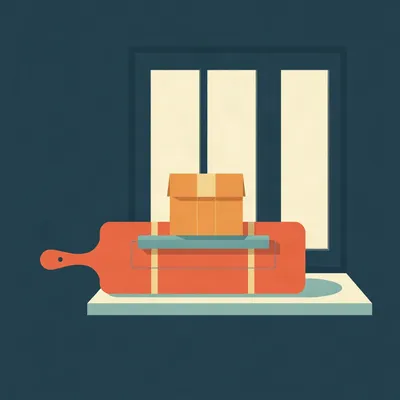
Let me build that mechanism properly because the details matter. The sill is about a metre high. Inside the safe room, you want a small wheeled cart or platform that is exactly at sill height. Not roughly. Exactly. If the cart is five centimetres below the sill, the box has to climb five centimetres and that is where it catches and tips. If the cart is five centimetres above, the box drops onto the sill and slams. So the cart height is matched to the sill. Then across the sill itself, you lay a removable roller bridge. This is the heart of the whole thing. A section of board with a row of skate wheels or casters screwed into it, maybe forty centimetres wide and long enough to span from the inside cart to the outside landing surface. The box slides onto the rollers, you give it a push, it rolls across the sill, and it lands on the surface outside. You never hold the full weight. You never climb with the box. You climb through first, get yourself settled, then slide the box across to yourself.
And the roller section lifts off in one piece. That is the safe room constraint. It stores flat against the wall inside, no tools to deploy, and it must not obstruct the window or the shutter when not in use. We will come back to why that matters.
The outside surface needs to be at the same height as the sill. And this is where the first unknown bites. If the nook floor is level with the sill, which I doubt but we should handle it, then the outside landing surface is just a small folding table or a second wheeled cart that lives out there. The box rolls across the sill and onto the table. Done. If the nook floor is below the sill, which is more likely given that the window is a metre above the inside floor and the nook is described as tall, then you need a landing platform at sill height on the outside. A freestanding platform, basically a small table or a second cart, that you place out there before you start. The box rolls across, lands on the platform, and from there you can lower it to the floor or just leave it on the platform while you sort through it.
And the second unknown, the exact length of the nook, determines whether any wheeled equipment can live out there at all. Daniel, we are going to work to the tighter dimension. The earlier figure was about a hundred and thirty centimetres deep, and that is almost certainly the correct one. He described roughly three metres long this time, but I think that is the height confusing the memory. A hundred and thirty centimetres deep means there is no room for a wheeled platform to live outside. Everything has to be deployed and removed each time. If the nook is three metres deep, then a small cart can live out there permanently and the whole job gets easier. So Daniel, measure the nook. Not with your arms. With a tape measure. The answer changes the build.
And while we are on the subject of what changes the build, let us fix his vocabulary, because his search is failing on terminology and that is the most fixable problem in the entire episode. He has been looking for the wrong things. Hatch goods transport systems is not a standard industry term. It does not exist as a product category. What he is half remembering is almost certainly a combination of a manual material lift and a roller conveyor section. So let us give him the actual names of the things he has been describing, and then tell him which ones are wrong for a one metre deep nook.
Please do. And I want the honest verdict on each one, because he has been staring at search results for what sounds like weeks and I suspect some of those results are seductive.
First, the hydraulic lift tables and scissor lift trolleys. These are the small end of the range. A scissor lift trolley is the thing you see in warehouses, a platform on an X-shaped mechanism that raises a single pallet or load to working height. Some are hand hydraulic, some are electric. They start at a few hundred dollars for the small manual ones and go up fast. The honest verdict is that a small scissor lift trolley could work if it fits through the window and the nook floor is level, but it is heavy, it is expensive, and it needs floor space and setup time that a one metre deep nook cannot really accommodate. For infrequent retrieval, the setup and takedown will make it feel like more work, not less. It earns its cost only if the retrieval frequency is high enough to justify the footprint. In a space this size, that frequency is basically never.
So the professional looking solution is the wrong solution. Good. What about the things he was actually describing when he said retractable ladder with a fold-down walkway.
That is a real thing, but it is designed for roof access and loft access, not for moving boxes through a window. A retractable ladder with a fold-down walkway is meant to get a person up and across, not to carry a load. The walkway section is usually narrow and not rated for a twenty kilo box sliding across it while a person stands on the other side. It is the wrong tool. He already has a ladder arrangement for getting himself through, from the earlier thinking. The problem is the box, not the person.
And the fantasy conveyor.
The folding conveyor is a real product, and it is glorious. You see them on loading docks and delivery trucks, a segmented roller or belt conveyor that folds up and extends out to move boxes from the truck to the dock. They cost real money, they are heavy, and they are built for a truck to dock transfer, not a window to nook transfer. The smallest ones are still overkill. But I will say this. The principle behind the folding conveyor is exactly the right principle. Rollers and gravity. He just needs the principle at a tenth of the scale and a hundredth of the cost.
Now the half remembered term. Goods hoist, sack hoist, loft hoist, dumbwaiter. What are these things actually.
A goods hoist is a powered lift for moving goods between floors. It is a small freight elevator. It requires a vertical shaft and a landing on each floor. Structurally impossible for a window aperture in an apartment. A sack hoist is a specific type of goods hoist designed for sacks, for flexible bags of grain or produce. It is designed for sacks, not for rigid sided boxes. The wrong tool. A loft hoist is a manual or electric lift for loft access, usually a platform that raises items from a floor up into a loft opening. Closer in spirit, but still built for a vertical shaft situation, not a window. A dumbwaiter is a small freight elevator for light goods between floors, the kind you see in old houses for sending food from the kitchen to the dining room. Also requires a shaft and landings. None of these work for a one metre deep nook reached through a window. They all require vertical shafts and permanent installation, and the safe room window rules out permanent installation anyway.
And the manual material lift. The thing used for lifting building materials to a first floor scaffold.
That is the closest off the shelf match to what he has been imagining. A manual material lift is a small platform on a mast, raised by a hand winch or a pulley. You see them on construction sites, lifting bricks and mortar up to a first floor scaffold. They start at a few hundred dollars for the small ones. The problem is that even the small ones are too large for a one metre deep nook. They need a footprint, they need to be braced, and they are built for lifting to a height of several metres, not for a one metre sill. It is the right idea, the wrong scale.
So the entire product landscape he has been searching is wrong for this space. Every single thing the search returned is either too big, too expensive, or built for a shaft. Which brings us to the unglamorous answer. And I want to say this as clearly as I can. The best solution is not a product at all. It is making the problem smaller.
This is the part where I put on my retired pediatrician hat, because it is the same principle as medicine. Before you prescribe a treatment, you ask whether the patient can avoid the illness. Before you buy a lift, you ask whether the box needs to be that heavy. And the answer is no. A full attached-lid container is heavy because it is full. Pack by weight limit, not by volume. A standard forty by sixty Eurobox filled to volume with dense items can easily exceed twenty kilos. That is too heavy to slide with one hand. The same box packed with a ten kilo limit is manageable. So the single highest leverage change Daniel can make is smaller containers, more of them, each one light enough to slide with one hand. Nothing exceeds eight or ten kilos. Suddenly the threshold problem shrinks to almost nothing, because a ten kilo box can be lifted, slid, and pushed with one arm while the other hand holds the window frame for balance.
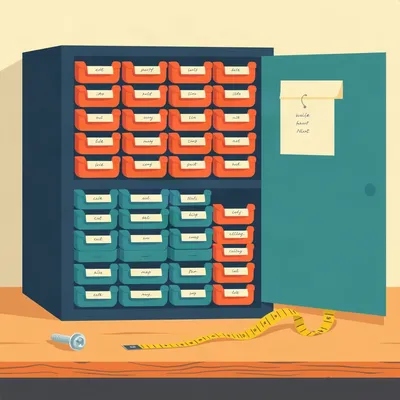
The written index. He mentioned inventory systems in the earlier thinking, but I want to tie it to this specific problem. A retrieval means moving one box, not five. If the boxes are stacked in a column and the one he wants is at the bottom, he is unstacking the whole column. A written index, a simple list of what is in each box, turns a search through a stack into a targeted retrieval. He knows exactly which box to pull. And if the boxes are shelved rather than stacked, he does not unstack anything. He slides the target box out and leaves the rest alone.
Shelve, do not stack. This is the recurring cost that will dwarf the sill problem within a year. A column of stacked containers in a narrow nook means unstacking to reach the bottom one, every single time. That recurring cost, the time and the frustration and the bending and the lifting, will add up to more than the sill problem ever was. Shelving turns the vertical space into horizontal access. A simple shelf unit, wood or metal, with each shelf at a height where a box can slide out without lifting. The nook is three metres tall. That is three or four shelves of boxes, each one reachable without moving any other box.
This is where the two things he has not asked about come in, because the shelving and the containers have to survive the space. First, weather. This is an outdoor space with an open side. Jerusalem delivers real winter rain, around five hundred and fifty millimetres a year, concentrated between November and March. That rain will blow into the open side of the nook. Attached-lid containers are weather resistant, not weatherproof. They are not sealed against moisture. Water will get in around the lids, especially in wind driven rain.
Then there is the UV. Jerusalem summer sun is intense. Polypropylene containers left in direct sun will embrittle and crack within three to five years without UV stabilizers. The containers themselves will degrade. The lids will become brittle, the sides will crack, and one day Daniel will pick up a box and the handle will snap off in his hand. The fix is to buy containers rated for outdoor use with UV stabilizers, or to accept that the containers are consumables and replace them every few years.
Condensation. This is the one people forget. Temperature swings between day and night, especially in a semi-outdoor space, cause condensation inside closed plastic containers. The warm air inside the box cools at night, the moisture condenses on the inside walls, and the contents get damp even though no rain got in. Silica gel packs inside each container are the standard mitigation. They absorb the moisture. Replace them every few months. And wrap items individually before they go into containers, so even if condensation does form, the items are protected.
Pests. Open-sided outdoor spaces in Jerusalem attract insects and rodents, especially in the warmer months. Cardboard boxes are a food source and a nesting material. They should never be used in this nook. Ever. Use plastic or metal only. And check the containers periodically for signs of chewing or nesting. A mouse can get through a gap the size of a pencil.
What actually survives out there. Metal containers with gasketed lids, or heavy-duty plastic containers rated for outdoor use with UV stabilizers. Silica gel packs inside. Items wrapped or bagged individually. And a shelf unit that is either metal or treated wood, because untreated wood will rot in the rain and the sun.
Then the second thing he has not asked about, and we will keep this brief because it is a constraint, not a lecture. This is the safe room window. The mamad, the protected room required in Israeli apartments. The window and its shutter must remain fully operable for emergency protection. Anything fitted has to be removable and must not obstruct the window or the shutter. That means no permanent roller bridge bolted to the sill. No shelf unit blocking the window. The roller section lifts off in one piece and stores flat against the wall. The shutter must be able to close fully in an emergency. This is a design constraint, and it shapes the whole build. It is also why the lift table idea fails even harder, because a lift table parked in front of the window is a safety hazard.
Let us put this together into a tiered recommendation, because Daniel asked for a solution and we have been dancing around it. Tier one, the near-free version. Smaller containers, pack by weight not volume, a written index, and a simple shelf unit. Total cost, maybe a few hundred shekels for the shelves and the containers if he does not already have them, and probably nothing if he does. This solves the problem for most retrievals, because a ten kilo box is easy to slide over a sill with one hand and the other hand on the frame.
Tier two, the modest sensible build. This is the roller bridge and the matched-height surfaces. A small wheeled cart inside at sill height, a removable roller bridge section that spans the sill, and a landing platform at sill height on the outside. Let me give a parts list. For the inside cart, a small platform trolley or a kitchen trolley with a flat top, adjusted to sill height. Search for platform trolley or service cart on AliExpress or at Home Center. Look for one with a top surface around a metre high, or one that can be raised with blocks. Roughly a hundred and fifty to three hundred shekels. For the roller bridge, a section of plywood or a sturdy board, about forty centimetres wide and long enough to span from the cart to the outside platform. Screw a row of skate wheels or small casters into it. Skate wheels are cheap on AliExpress, a set of eight for maybe forty shekels. Or use small fixed casters from Ace Hardware. The board and casters together, maybe a hundred shekels. For the outside landing platform, a small folding table or a second platform trolley at sill height. A folding work table or a small serving cart, again around a hundred and fifty to three hundred shekels. Total for the build, maybe four to six hundred shekels, and every part is available locally or on AliExpress with a two to four week delivery.
The honest verdict on the lift table. In a space this size, with infrequent retrieval, a lift table does not earn its cost or its footprint. The setup and takedown time will make it feel like more work, not less. The roller bridge and smaller containers solve the problem for a fraction of the cost and with none of the permanent footprint. If Daniel were retrieving boxes from this nook every single day, maybe the lift table starts to make sense. But he described infrequent access. So the lift table is the wrong tool.
I want to flag the two unknowns one more time, because they change the build. Daniel, measure the nook floor relative to the sill. If the floor is level with the sill, the roller bridge alone suffices and the outside landing surface can be a simple table. If the floor is below the sill, which I expect, you need a landing platform at sill height on the outside, and the box rolls onto that platform and then you lower it or leave it there. And measure the length of the nook. If it is a hundred and thirty centimetres deep, nothing wheeled lives out there, everything is deployed and removed each time. If it is three metres deep, a small cart can live out there permanently and the job gets easier. The tape measure is the first tool in this build.
The second tool is the realisation that the threshold problem shrinks to nothing when the unit of handling is small enough. A ten kilo box slides over a sill with one hand. A twenty kilo box needs a lift table, a roller bridge, and a chiropractor. The cheapest solution is the smaller box.
The storage nook is now in service, and the retrieval problem will only get worse as more items accumulate. The solution is not a single purchase. It is a system. Smaller containers, shelving, an index, and a removable roller bridge. That system solves the threshold crossing and the weather and the pests and the safe room constraint all at once.
The best solution to a threshold problem is often to make the load small enough that the threshold stops mattering. That is the reframe. Sliding. And not sliding a big load. Sliding a small one.
Hilbert, you have been quiet on this one, and I have a feeling you have moved something through a window before.
Producer Hilbert Flumingtop, for the record, spent a summer in his twenties working for a Jerusalem moving company that specialised in apartment moves in old buildings. The kind where the lift does not reach the top floor and everything goes through windows. Hilbert, what did they use.
Hilbert says the company's trick for window moves was a simple wooden ramp with a roller surface. Two planks with a row of casters screwed into them. They would bridge the window sill and slide everything across. No lifts, no hoists, just a ramp and gravity. He still has one in his garage. And the detail that matters, the ramp was never stored. It lived on the truck, and it was the first thing loaded and the last thing unloaded. The company never bought a lift because the ramp was faster to deploy than any powered equipment.
The roller bridge is not our invention. It is the standard tool of the trade for exactly this situation. A row of casters on a board, bridging a sill, sliding boxes across. The moving company version of the exact build we just described.
Hilbert also says he once tried to use the ramp to move a piano through a window and learned that rollers and pianos do not mix. The piano walked off the ramp and nearly took out the customer's rose bushes. So the ramp has limits. But for boxes, it is the tool.
Hilbert agrees with the reframe but adds the point we have been circling. The real problem is not the lifting or the threshold. It is that Daniel is treating this as a storage problem when it is actually a logistics problem. The nook is a warehouse, and warehouses are designed around the unit of handling, not the space. The unit of handling is the box. Make the box the right size, and the warehouse works.
That is the whole episode in one sentence. The nook is a warehouse. Design the unit of handling, and the space follows.
To close this out. The two open questions for Daniel. First, is the nook floor level with the sill or below it. That determines whether the roller bridge alone suffices or whether he needs a landing platform outside. Second, what is the exact length of the nook. That determines whether any wheeled equipment can live out there or whether everything is deployed and removed each time. Measure both before buying anything.
The total approximate cost. The near-free version is a few hundred shekels for shelves and smaller containers, possibly nothing if he already has them. The modest sensible build with the roller bridge, the inside cart, and the outside platform is roughly four to six hundred shekels, all parts available locally or on AliExpress. The lift table is several hundred dollars minimum and the wrong tool for the space. So the sensible build wins.
Have fun building it. Send us a picture when the first box rolls across the sill and lands on the platform. That is the moment the whole thing clicks.
Thank you to our producer Hilbert Flumingtop. This has been My Weird Prompts, the human AI collaboration podcast. Find us at myweirdprompts dot com, and if you enjoyed this, leave us a review.
Daniel, measure the nook. With a tape measure.
Goodnight everybody.