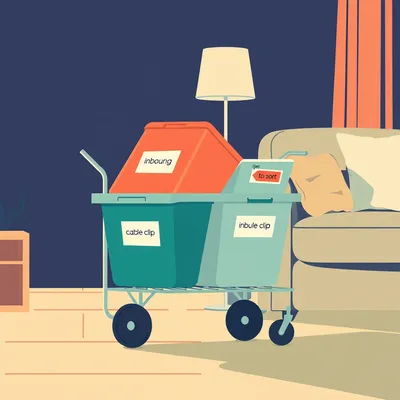
Daniel's been unpacking his new rental and hit on an organizing system that's basically warehouse logistics smuggled into a living room. He's got forward-tilting picking bins for high-use items, and a wheeled trolley with labeled staging boxes — "to car," "inbound to sort," "to return," "needs labels." The question is: what are these systems actually called in the industrial world, how do they work when they're done right, and how do you stop the "inbound to sort" box from becoming a permanent black hole of clutter?

This is one of those moments where Daniel accidentally reinvented something that industrial engineers spend entire careers optimizing. What he's built is essentially a mobile pick-to-cart system with staging lanes. The forward-tilting bins he mentioned — those are gravity-fed or spring-loaded picking bins, and they're not a gimmick. In a warehouse, they reduce pick time by thirty to fifty percent just by eliminating the search-and-reach motion. When you're mid-unpack and need a cable clip for the seventeenth time that hour, that tilt means you see it, grab it, and you're done. No rummaging.
Thirty to fifty percent is a real number. That's not marginal.
It's not. And it's because the motion itself is the bottleneck. In a standard flat bin, you're doing a two-step process — locate, then reach down and in. The forward tilt eliminates the second step. Your hand goes straight to the item. It's the same reason hotel housekeeping carts have angled upper shelves. A housekeeper doing fifteen rooms in a shift makes that motion hundreds of times. Shave a second off each one, and by the end of the day you've saved real minutes.
So Daniel's cable clip bin is doing exactly what it was designed to do in a distribution center. The question is whether the rest of his system holds up to the same scrutiny. Because I've seen the "inbound to sort" box in people's homes. It starts as a noble idea and ends as a monument to deferred decisions.
And that's where the industrial parallels get genuinely useful, because warehouses have already solved this problem. They just call it something different. Daniel's trolley setup — the four labeled bins on wheels — that's a mobile put wall. In a cross-docking operation, a put wall is where items wait for the next leg of their journey. You've got cubbies or bins labeled by destination, and items flow through them. The critical thing is that every staging zone has what's called a service level agreement — an SLA. In most warehouses, a staging lane has two to four hours max before items must be processed and moved on.
Two to four hours. That's the difference right there. At home, the SLA is "eventually" or "when I get to it," and eventually is the enemy of empty.
And the hotel housekeeping system Daniel half-remembered from his high school job — he's right, that's where a lot of this logic lives. A housekeeping cart typically carries four to six color-coded bins. You've got clean towels, dirty linens, amenity restock, guest requests, maybe a trash bin. The housekeeper loads the cart once at the start of the shift, works through fifteen or more rooms, and never returns to the supply closet. The cart is the supply closet. Every bin has a clear inbound and outbound path. Dirty linens go in, and at the end of the shift they go to laundry. There is no "dirty linens, I'll deal with it Tuesday" bin.
So the hotel system works because the shift ends. The pull signal is built into the clock. Daniel's "to car" box has a natural pull signal — someone is literally walking to the car. But "inbound to sort" doesn't have that. There's no shift change. No laundry pickup at four PM.
And that's the core failure mode. Industrial engineers call it staging creep. A temporary holding zone becomes permanent because there's no defined trigger to empty it. In a warehouse, this is prevented by slotting rules and cycle counting. Slotting means every item has a designated home location, and cycle counting means you're regularly auditing what's where. At home, the equivalent is that every bin needs a pull signal — a clear, visible trigger that says this bin is full and needs processing now.
What does a pull signal actually look like in practice? Because "I'll know it when I see it" is how we got into this mess.
There are three types. Time-based — this bin gets emptied every evening, no exceptions. Volume-based — when the bin is physically full, it gets processed. And event-based — someone is going to the car, so the "to car" bin gets carried out. The mistake most people make is they don't assign one. They just label the bin and assume the label will do the work. It won't. A label is a category. A pull signal is a commitment.
So Daniel's "needs labels" box — that's an event-based pull signal waiting to happen. The event is "Saturday morning label session." Without scheduling that session, the box just fills up with things that need labels, and now you've got a box of unlabeled things sitting next to a label maker. It's almost poetic.
It's the organizational equivalent of buying a gym membership and never going. The equipment is there, the intention is there, but the system has no forcing function. And this connects to something deeper that Daniel touched on — the aesthetic of the system itself. He mentioned the "living industrial warehouse aesthetic" and said he's vibing with it. That's not superficial. When a system looks professional, you're more likely to maintain it. It creates a psychological permission structure. You've invested in the euro boxes, the wheeled cart, the forward-tilting bins — and that visible investment makes it harder to let the system degrade.
The sunk cost fallacy, but weaponized for good.
I'd call it more of a commitment device. But yes, the principle holds. And it's why hotels don't use mismatched cardboard boxes for their housekeeping carts. The uniformity of the bins, the labeling, the cart itself — it all signals that this is a real system, not a temporary pile. When you walk past a professional-looking setup, the friction to just toss something on top of it instead of into the right bin is higher. You'd be breaking the system visually, and that feels worse than breaking an invisible system.
So the euro box aesthetic isn't just Daniel's personal taste — it's actually doing organizational work. The bins are co-parenting with him.
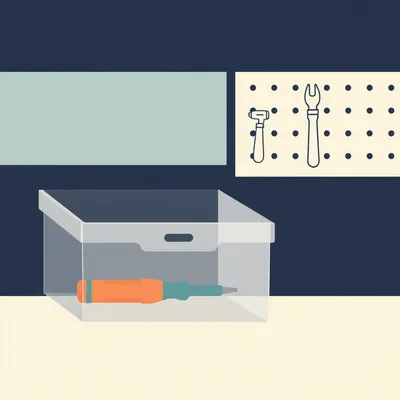
That's a generous description of plastic boxes, but I'll allow it. Now, let's talk about the specific bins Daniel mentioned. The forty by thirty centimeter ones on the trolley — those are what warehouses would call small-parts bins or tote bins. And the forward-tilting ones for cable clips and VHB — those are specifically designed for high-frequency SKU access. In a distribution center, the items you pick most often go in the most ergonomic position. It's called golden zoning. The waist-to-shoulder height, tilted forward, no bending, no reaching. Daniel's essentially golden-zoned his cable clips.
Which makes sense because during an unpack, cable clips and VHB tape are basically the highest-frequency items in the house. You're mounting things, you're routing cables, you're sticking things to walls. Every room needs them. If those items were in a flat bin at the back of a shelf, you'd waste cumulative hours over the course of a move.
And that's the industrial logic — you don't optimize for the one-time task, you optimize for the repeated task. In a warehouse, if an item gets picked three times a shift, it goes in the forward pick zone. If it gets picked once a month, it goes in deep storage. At home during a move, cable clips are getting picked dozens of times a day. They deserve the forward tilt.
Let's go back to the "inbound to sort" box, because that's the one that scares me. Daniel called it out himself — he knows it's the danger zone. What's the industrial fix?
In a cross-dock operation, the inbound staging lane has the strictest SLA of any zone. Two to four hours, and then it must be cleared. The reason is simple — if items sit in staging, they're not available for downstream processes. At home, if the "inbound to sort" box sits for three days, those items aren't in the rooms where they belong. You've created a bottleneck that didn't exist before. The box has actually made things worse by giving clutter a respectable name.
So the fix is to give it the harshest pull signal in the whole system. Not "sort when you have time," but "this box gets emptied within twenty-four hours or it gets flagged."
And a flag needs to be visible. In warehouse pick-to-light systems, a light turns on when a bin needs attention. The home equivalent could be a red sticker on the bin that you move to a "done" column when processed. Or a simple rule — if the bin isn't empty by dinner, you process it before you eat. The key is that the trigger is external. It's not "when I feel like it." It's "when this thing happens."
This is where most home organization advice falls apart. They tell you to label things and sort things, but they never tell you when. The when is the whole game. Without the when, you've just renamed your piles.
And this maps directly to the Japanese five-S methodology. You've got Sort, Set in Order, Shine, Standardize, and Sustain. Most people get through the first three or four. They sort the stuff, they set up the bins, they make it look nice, they write a standard process. But Sustain — the fifth S — is where it all collapses. Sustain means you've built audit cycles, you've assigned triggers, you've made the system self-reinforcing rather than willpower-dependent. Daniel's system has the first four S's nailed. The question is whether he can Sustain.
And sustain is harder at home than in a warehouse because in a warehouse, someone's job depends on it. At home, the only consequence of a full "inbound to sort" box is that the kitchen table stays buried. Which is a real consequence, but it's diffuse. It doesn't arrive with a manager and a clipboard.
Right. There's no accountability structure. Which is why the pull signal has to be so explicit. One approach that works well is the one-in-one-out rule for the trolley. If the trolley has four bins, and a fifth category wants to exist, something has to be eliminated or combined. That forces triage. You can't just keep adding bins — that's how you end up with a wall of labeled boxes, each containing three items and a lot of good intentions.
The trolley as a constraint. I like that. It's like the physical version of inbox zero — if it doesn't fit on the cart, it doesn't get a bin.
And that constraint is actually liberating. It forces you to decide what really needs a staging zone and what can go straight to its final location. One of the principles in lean manufacturing is that inventory is waste. Every item sitting in a staging bin is inventory that isn't where it needs to be. The goal of a good staging system isn't to hold things — it's to move things through as fast as possible.
So the measure of success for Daniel's system isn't how organized the bins look. It's how fast items leave them.
Velocity, not appearance. A bin that empties three times a day is a healthy bin. A bin that sits full for a week is a failure, no matter how nicely it's labeled. And this is the misconception that trips people up — they think any labeled bin system will automatically stay organized. It won't. The label is just a signpost. The pull signal is the engine.
Daniel also mentioned something interesting in his setup — he labeled the bins with action verbs. "To car." "To return." "To sort." Not "car stuff" or "returns." I think that matters more than it seems.
It matters enormously. Verbs trigger action. Nouns trigger storage. When you read "to car," your brain registers a task — carry this to the car. When you read "car stuff," your brain registers a category — this is where car things live. One is a command, the other is a museum exhibit. This is a well-documented principle in instructional design and wayfinding. Airport signs say "to gates" not "gate area." Hospital signs say "to emergency" not "emergency department." The preposition does the work.
So Daniel accidentally applied wayfinding psychology to his euro boxes. The man can't help himself.
He really can't. And it's correct. If you're setting up a staging system at home, label every bin with an action. "To basement." "To donate." "To file." The "to" is doing heavy lifting — it implies movement, impermanence, a destination that isn't here.
I'm now looking at my own desk and realizing my "papers" pile has been a noun for about six months.
Rename it "to shred" and see what happens to your relationship with it.
I'd probably just avoid eye contact with a different label. But I take your point. Let's talk about the hotel underworld Daniel mentioned. He worked in a hotel gym in high school and remembers the back hallways being organized according to these systems. What's actually happening back there?
Hotels are fascinating because they're essentially high-density residential logistics operations disguised as hospitality. Behind every guest room hallway is a parallel service corridor — wider than you'd expect, designed for carts, linens, room service trays. The housekeeping cart is the mobile unit, but it's resupplied from larger staging areas on each floor. Those staging areas have labeled shelving, par levels for each item, and restocking schedules. A floor pantry might hold exactly enough shampoo bottles for a full turnover of that floor's rooms, plus a twenty percent buffer. When the housekeeper's cart runs low, she doesn't go to the basement — she goes to the floor pantry. It's a two-tier distribution system.
So the housekeeper's cart is the forward pick zone, and the floor pantry is the reserve storage. Same logic as the warehouse, just with towels instead of SKUs.
And the color coding on the bins isn't decorative. It's error-proofing. When you're moving fast and you've been on your feet for six hours, you don't want to think about which bin is which. The red bin is always soiled linens. The blue bin is always clean towels. It's a visual shorthand that prevents cross-contamination and saves cognitive load. In lean manufacturing, this is called poka-yoke — mistake-proofing. You design the system so that the wrong action is harder to take than the right one.
So if Daniel wanted to level up his trolley, he'd color-code the bins. Red for urgent, green for "can wait," something like that.
Or just consistent colors by function. The "to return" bin could be a specific color that everyone in the household recognizes. Then you don't even need to read the label — you see the color and you know what it means. This is especially useful when you're exhausted, which is the default state during a move with a one-year-old.
Exhaustion is the real enemy of organization. Every system works when you're well-rested and motivated. The test is whether it works at ten PM when you've been unpacking for six hours and you're holding a mystery object you don't recognize.
And that's exactly why industrial systems are designed for fatigue. A warehouse picker on hour ten of a shift is not making careful decisions. They're running on autopilot. The system has to work on autopilot. The forward tilt, the color coding, the golden zone placement, the action-verb labels — all of it is designed to make the right action the easy action when nobody's thinking clearly.
So the question Daniel's really asking — whether he knows it or not — is how to make his home system fatigue-proof. And the answer is to borrow the same error-proofing that warehouses and hotels use. Don't rely on willpower. Don't rely on memory. Build the trigger into the physical environment.
And audit it regularly. This is the Sustain step from five-S that everyone skips. Once a week, look at every bin on the trolley. Is it empty when it should be? Is the pull signal working? If the "inbound to sort" box has been full for three days, the system is broken. Don't blame yourself — fix the trigger. Maybe the time-based rule of "empty every evening" was too ambitious. Switch to a volume-based rule — "empty when full." Or add a second processing session on Wednesday and Sunday. Tune the system instead of abandoning it.
That's a surprisingly compassionate approach to organizational failure. Most advice is just "try harder."
Try harder is not an engineering principle. If a conveyor belt keeps jamming, you don't tell the belt to try harder. You redesign the junction. Same logic applies to the "inbound to sort" box. If it keeps filling up and not getting sorted, the pull signal is wrong, not the person.
So what's the actionable version of this? If someone's listening and they've got their own version of Daniel's trolley — or they're about to set one up — what are the rules?
Three rules. Rule one: every staging bin must have a defined pull signal. Time-based, volume-based, or event-based. No bin exists without a trigger. If you can't name the trigger, the bin doesn't get created.
Rule two: limit the number of staging bins to what fits on one trolley. If it doesn't fit on the cart, it doesn't get a bin. Overflow forces triage.
And rule three: label bins with action verbs. "To car," not "car stuff." "To return," not "returns." The label should tell you what to do, not what's inside.
And if a bin doesn't have a pull signal, either give it one or eliminate it. That's the audit. Walk past your holding zones right now — kitchen table, counter, that chair in the bedroom that somehow became a shelf — and for each pile, ask what the trigger is. If there isn't one, the pile is a problem, not a system.
The chair in the bedroom that became a shelf. That's a universal human experience right there.
It's the chair where clothes go to live out their remaining days in quiet dignity.
And the fix isn't a bigger chair. It's a bin with a pull signal. "To laundry" with a trigger of "when this bin is full, it goes downstairs." That's it. That's the whole system.
Daniel's going to want to know what other industrial systems we could borrow. He's got the picking bins and the staging trolley. What's next? The kanban card system for groceries?
Honestly, kanban for household consumables is useful. A kanban card is just a visual signal that triggers restocking. When you open the last pack of paper towels, you move a card to a "buy" column, and the next time someone goes to the store, they check the column. It's the same pull-signal logic applied to inventory. But that's probably a whole other episode.
The andon cord might be more immediately useful. In a Toyota factory, any worker can pull the andon cord to stop the production line if they spot a problem. The home equivalent would be a visible signal that a system has broken down — the "inbound to sort" box has overflowed, the "to return" bin has items that are past their return window. Something that makes the failure visible instead of letting it hide.
A whiteboard next to the trolley with a red magnet. If the magnet is on the red zone, something is broken and needs attention before anything else happens. It's simple, but it works because it externalizes the problem. You're not keeping a mental list of system failures — the magnet is keeping it for you.
And as more people work from home and manage complex household logistics — kids, moves, remote work, side projects — this blurring of domestic and industrial organization is going to keep happening. The line between a home and a small logistics operation gets thinner every year.
And that's not a bad thing. The industrial systems exist because they solve real problems at scale. Borrowing them for a household of three or four people isn't overkill — it's just using tools that were designed for exactly the kind of complexity most homes now have. The euro box in your living room isn't a failure of domestic aesthetics. It's a recognition that moving a family through a rental transition is a logistics problem, and logistics problems have known solutions.
Daniel's system is basically a love letter to industrial engineering, written in polypropylene.
And like any love letter, it only works if you actually send it. The bins are the words. The pull signals are the postage.
So the question we're left with — and I think this is the one Daniel will be asking himself in a month — is whether the "inbound to sort" box is empty or whether it's become the kitchen table's successor. The system works if the triggers hold. If they don't, it's just a nicer-looking pile.
And the beauty of the system is that if it fails, you don't need a new system. You just need a better trigger. The bins are fine. The cart is fine. The labels are fine. Tune the pull signal and try again. That's what warehouses do. That's what hotels do. That's what Daniel can do.
Thanks to our producer Hilbert Flumingtop for keeping this show running. This has been My Weird Prompts. If you want to send us your own organizational epiphanies — or anything else — email the show at show at my weird prompts dot com. We'll be back soon.