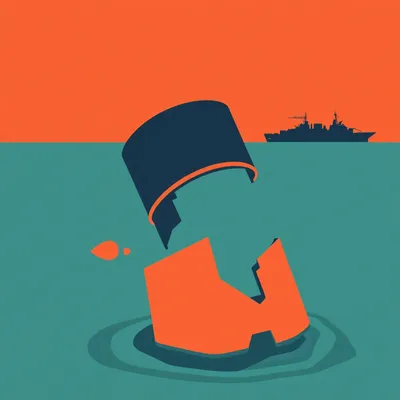
So Daniel sent us this one — and it's a big one. He's looking at the arc of the past few months with Iran and the US, and he's puzzled by something that I think a lot of people are puzzling over but haven't quite named. We started with a joint US-Israel military operation targeting Iran's nuclear program, framed as existential for Israel. And now, as of today, the US is striking Iran for a seventh consecutive night, two American troops are dead in Jordan from an Iranian missile, and Israel is watching from the sidelines. His question is essentially: how did a war about Israel's survival become a US-Iran oil war, and what does Israel's silence actually mean?

And the timing makes this urgent. The strikes on Iranian airports and bridges overnight — those aren't tactical pinpricks anymore. The US is degrading infrastructure. Meanwhile Iran is telling Hezbollah to prepare for a wider conflict that could rope Israel back in whether Israel wants in or not. So the puzzle Daniel's identified isn't academic. It's live.
Let's start with the joint operation itself, because I think the seeds of this weird divergence were planted right at the beginning. Israel and the US launched a major coordinated strike on Iran's nuclear program. Israel got what it wanted — significant degradation of enrichment capacity, centrifuge halls destroyed, the timeline to a bomb pushed back. And then almost immediately, the US pushed for a ceasefire.
Which, on its face, is strange. You've just achieved operational surprise, you've got momentum, Iran is reeling — and you stop. Why?
Because Israel's objective was never total destruction of the program. That's the first thing most commentary gets wrong. Total destruction was never achievable in a single campaign, and Israel knows that. The goal was to set the program back by years and demonstrate that Iran's air defenses cannot protect its most sensitive sites. Once that was accomplished, Israel could claim victory and step back. The ceasefire gave them a clean off-ramp.
And this is where the US strategic logic and Israeli strategic logic began to diverge, because the US saw the ceasefire not as an off-ramp but as an opening. The administration wanted to convert military success into a diplomatic framework. The thinking was: we've shown we can hit them, now let's negotiate from strength. The problem is that Iran reads that entirely differently.
Iran reads an offer to negotiate after a few days of bombing not as strength but as reluctance. The message Iran receives is: they don't have the stomach for a prolonged campaign. And once Iran believes that, the entire dynamic shifts.
So we get this strange interlude. The ceasefire is in place, negotiations begin, and somehow — and this is where it gets genuinely bizarre — the Strait of Hormuz becomes the central negotiating anchor.
Explain how that happened, because it's not obvious.
Iran's economy depends on oil exports through the Strait. The US position was essentially: we need guarantees about freedom of navigation, we need to ensure Iran can't use the Strait as a chokepoint in future conflicts. Iran's countermove was ingenious. They said: fine, if the Strait is so important to global trade, we'll treat it as a toll road. They began demanding what were effectively ransom payments from civilian tankers transiting through. Not Iranian territorial waters — the Strait itself, which is an international waterway.
So they turned a vulnerability into a revenue stream.
And they framed it as entirely consistent with the negotiations. They weren't blocking the Strait, they were regulating it. The US was trapped. If they accepted the taxation, they'd legitimized Iran's control over a global chokepoint. If they rejected it, they'd have to enforce freedom of navigation militarily. They chose the latter — imposed a blockade to prevent the taxation — and suddenly we have the bizarre spectacle of US warships blockading Iranian ports while diplomats are still meeting in Oman.
This is the incoherence Daniel's getting at. Coercive diplomacy — negotiating while maintaining military pressure — only works if the other side believes you're willing to escalate further. But Iran had already concluded the US wasn't willing to go all the way. So the military pressure wasn't coercive, it was just... there. A backdrop. And Iran kept extracting concessions at the table while the US thought the blockade was strengthening its hand.
The phrase "strategic vacuum" is exactly right. The US never articulated what the end state was supposed to be. Were we negotiating for a new nuclear deal? Freedom of navigation guarantees? A broader normalization? Iran filled that vacuum by making it about oil access and revenue, because that's what they needed most urgently. The nuclear program was degraded but not destroyed — they could afford to wait on that. The economy was the immediate threat.
So we've gone from a war about nuclear weapons to a negotiation about shipping tolls. And all through this, Israel is watching and presumably thinking: this is not our fight anymore.
Let's sit with that, because Israel's calculus here is the heart of Daniel's question. Why step back? Israel has stated repeatedly that its war with Iran is not over, that it will never accept a nuclear-armed Iran. Those aren't rhetorical positions. So if the war isn't over, why isn't Israel fighting it?
I think there are three layers to this. The first is the simplest: Israel achieved its immediate operational objective. The nuclear program was set back. The existential urgency that drove the joint operation in the first place has been reduced. Not eliminated — reduced. That gives Israel the luxury of time.
And time is what Israel needs most. Because the second layer is that Israel is almost certainly using this period to prepare for the scenario where the US campaign ends inconclusively and Iran's nuclear program survives or reconstitutes. Intelligence gathering, target refinement, strike option planning. Coordination with Gulf states that also fear a nuclear Iran and have been quietly deepening ties with Israel. This isn't passivity — it's preparation.
The third layer is the hardest to say out loud but I think it's the real one. Israel is letting the US absorb the cost of the ground-level attrition while retaining the option to strike Iranian nuclear facilities independently if and when it judges that the US has failed. That's not abandonment, it's strategic patience. And it's also a bet that the US, even in a degraded and distracted state, will continue to tie down Iranian conventional forces in a way that limits Iran's ability to threaten Israel directly.
There's a cold logic to it. If Israel had stayed in, it would be sharing the casualties, sharing the operational burden, and also sharing the blame for whatever diplomatic mess emerged. By stepping back, Israel forces the US to own the consequences of its own strategic choices — including the choice to let the Strait of Hormuz become the center of gravity.
And the US choices have been... let's be charitable and say improvisational. The ceasefire and MOU that Trump declared null and void — what actually happened there? Because the timeline matters.
The reporting from the Times of Israel over the past week has been remarkably detailed. The US entered negotiations believing that military pressure plus diplomatic engagement would produce a framework. Iran entered believing the US was weak and could be rolled. They were both half right. The US was willing to negotiate, but not willing to accept Iran's taxation scheme. Iran was willing to talk, but not willing to give up the leverage the Strait gave them. The MOU that emerged was essentially a pause that papered over the fundamental disagreement. Iran agreed to suspend the taxation in exchange for sanctions relief discussions. The US agreed to stand down the blockade. Neither side actually conceded anything.
So it was a ceasefire built on a mutual misunderstanding.
Worse. It was a ceasefire built on each side believing the other would blink first. When neither blinked, the whole thing collapsed. Trump declared it null and void, and the US resumed strikes. But now the strikes are different. They're not targeting nuclear sites — they're hitting airports and bridges. Infrastructure. The US is trying to degrade Iran's ability to project power conventionally, which is a fundamentally different mission than the one we started with.
That's mission creep in its purest form. You start by joining an ally's existential fight, you pivot to a negotiation about shipping, you end up bombing bridges because you've lost the diplomatic thread and the only tool left is airpower. And now two American troops are dead in Jordan.
That's the escalation that changes the domestic calculus. The July attacks on US bases in Jordan and Iraq — those aren't symbolic. Iran demonstrated it can reach US forces with precision missiles. Two troops killed, one missing. Khamenei threatening to teach the US "unforgettable lessons." This is no longer a contained skirmish over shipping lanes. This is a shooting war with American casualties.
And yet Israel still isn't in it. Which brings us to the strain in the US-Israel relationship. Daniel mentioned "seemingly strained ties" and I think that's putting it gently. The US has to be furious. They joined what was framed as a joint operation against an existential threat, and now they're fighting alone while Israel watches.
But Israel's counterargument — and I suspect this is being made very clearly in private channels — is that the US chose to expand the mission. Israel didn't ask the US to negotiate over the Strait of Hormuz. Israel didn't ask the US to blockade Iranian ports. Those were American strategic decisions, driven by American interests in global energy markets. If the US is now in a war over oil access, that's not Israel's war to fight.
There's a real tension here that goes beyond this specific conflict. The US-Israel alliance has always been built on a combination of shared values and shared interests. What this episode reveals is that when the interests diverge — when the US is fighting for oil and Israel is focused on nuclear weapons — the alliance becomes transactional rather than automatic.
And "transactional" is the right word. It's not a break. The US still needs Israel as a stable ally in the region, and Israel still needs the US as its ultimate security guarantor. But the assumption that both countries will automatically fight the same wars has been tested and found wanting.
Let's talk about what Israel is actually doing right now, because "sitting on the sidelines" implies passivity and I don't think that's accurate.
It's not. Israel is almost certainly running one of the most intensive intelligence operations in its history right now. Every Iranian air defense repositioning, every Revolutionary Guard unit movement, every nuclear scientist relocation — Israel is watching and mapping. The goal is to have a complete target set and strike plan ready for the moment when — not if — Israel judges that the US campaign has failed to eliminate the nuclear threat.
And there's a second track. Israel is deepening coordination with Gulf states. The Abraham Accords created the diplomatic framework, but the shared fear of a nuclear Iran is what's driving operational cooperation. Saudi Arabia, the UAE, Bahrain — none of them want a nuclear-armed Iran any more than Israel does. And all of them are watching the US campaign with a mixture of hope and dread. Hope that it succeeds, dread that it fails and leaves them exposed.
This is the quiet realignment that's happening beneath the headlines. While the US is bombing bridges, Israel and the Gulf states are building the architecture for a post-US Middle East. Not because they want the US to leave, but because they're hedging against the possibility that the US either loses or withdraws inconclusively.
So the picture we have is: Israel is not passive, it's repositioning. The US is not winning, it's escalating without a clear endgame. And Iran is not losing — it's absorbing strikes while preparing to widen the conflict.
Which brings us to the Hezbollah piece. The Times of Israel reported this morning that Iran has told Hezbollah to prepare for a wider conflict. This is the most dangerous development in the entire arc. Hezbollah's rocket and missile arsenal is aimed at Israel. If Iran activates that front, Israel is back in whether it wants to be or not.
And here's the strategic logic from Iran's perspective. The US strikes are degrading Iran's conventional infrastructure — airports, bridges, power grids. Iran can absorb that for a while, but not indefinitely. At some point, the domestic pressure becomes unbearable. When that happens, Iran has two options: sue for peace from a position of weakness, or escalate horizontally to change the narrative and force a ceasefire on better terms.
Horizontal escalation means opening new fronts. Hezbollah against Israel. Shia militias against US forces in Iraq and Syria. Houthi attacks on Saudi oil infrastructure. Cyber attacks on Gulf financial systems. The goal isn't to win on all fronts — it's to create enough chaos that the US faces a choice between a wider regional war and a negotiated settlement that leaves Iran with something to show for it.
And the cruel irony is that Israel, which deliberately stepped back to avoid being dragged into a US war of choice, could be dragged back in precisely because the US campaign is failing to achieve its objectives. Iran doesn't need to defeat the US militarily. It just needs to make the cost high enough that the US accepts a deal that preserves the regime and, critically, preserves enough of the nuclear infrastructure to rebuild.
That's the nightmare scenario Israel is preparing for. A US-Iran deal that freezes the conflict without eliminating the nuclear threat. The US gets to declare victory and go home. Iran gets sanctions relief and a breathing space to reconstitute its program. And Israel is left facing a nuclear-capable Iran in three to five years, having burned through international goodwill and with a strained relationship with its primary ally.
So let's zoom out to the global picture, because the Strait of Hormuz dimension connects this to something much bigger than Middle East geopolitics. About twenty percent of the world's oil transits through that strait. The US blockade, the Iranian taxation scheme, the resumed hostilities — all of this is disrupting global energy markets in ways that are going to ripple for months.
Shipping insurance rates for tankers transiting the Gulf have reportedly spiked. Some carriers are rerouting around the Cape of Good Hope. Oil prices are up, and they're going to stay up as long as the strait remains contested. This creates economic pressure on every country that imports oil, including US allies in Europe and Asia.
Which means the US is fighting a war to secure oil access that is, in the short term, making oil more expensive and less accessible. There's a contradiction there that the administration hasn't resolved. You're bombing Iran to keep the Strait open, but the bombing itself is what's making the Strait dangerous.
And that contradiction is going to intensify the pressure for a diplomatic off-ramp. The problem is that neither side currently wants one. The US can't accept a deal that leaves Iran in control of the Strait after two American troops have been killed. Iran can't accept a deal that looks like capitulation after seven nights of US strikes. Both sides are trapped by their own escalation.
This is where the next thirty days become critical. If the US strikes continue to degrade Iranian infrastructure, Iran's domestic calculus shifts. If Hezbollah enters the fight, Israel's calculus shifts. If oil prices keep climbing, the global economic calculus shifts. Any one of those variables could force a resolution. All three together create a level of unpredictability that should make everyone nervous.
Let me give you three frameworks for tracking where this is heading, because Daniel asked how to read the situation and I think that's the right question.
Go ahead.
First, watch the oil price and shipping insurance rates. Those are the leading indicators. If they're rising, the strait is effectively contested regardless of what the official statements say. If they stabilize or fall, it means the market believes the US has established enough control to guarantee transit. The military situation will lag behind the market signals by days or weeks.
That's a good one. Second framework?
Watch Israeli statements about red lines on Iran's nuclear program. Israel has been relatively quiet publicly, but that will change the moment Israeli intelligence assesses that Iran is using the chaos to accelerate nuclear work. Any Israeli official who starts talking about "unacceptable timelines" or "the window closing" — that's the signal that independent Israeli action is imminent.
And the third?
Watch for the Hezbollah mobilization. If Iran activates that front, it won't be subtle. Troop movements in southern Lebanon, rocket repositioning, evacuation orders for Hezbollah families — those are the signs that Iran has decided to widen the war. Once that happens, Israel's period of strategic patience is over.
So to pull this together for Daniel's core question: how did we start with an existential war for Israel and end with a US-Iran oil war while Israel watches? The answer is that Israel achieved what it needed in the opening phase, recognized that the US was about to expand the mission in ways that served American interests more than Israeli ones, and made the calculated decision to let the US own the consequences of its own strategic choices. That's not abandonment. It's not passivity. It's a cold-eyed assessment that the best way to ensure Iran never gets a nuclear weapon is to preserve Israel's independent strike capability while the US absorbs the attrition.
And the US? The US walked into this with the assumption that military pressure plus diplomacy equals leverage. Iran flipped that equation. By making the Strait of Hormuz the negotiating anchor, Iran turned the US's military presence into a liability — every day the blockade continued was a day the global economy felt the pain. The US is now fighting a war it didn't intend to fight, over an issue it didn't intend to prioritize, without the ally whose interests supposedly started the whole thing.
The phrase that keeps coming to mind is "strategic incoherence." The US never defined what victory looked like. Degrading Iran's nuclear program? Securing the Strait? Regime change? Each of those requires a different strategy, a different force posture, a different diplomatic framework. The US tried to do all three simultaneously and ended up doing none of them well.
And the cost of that incoherence is now measured in American lives. Two troops dead in Jordan. That's not an abstraction. That changes the domestic politics of this conflict in ways that are going to constrain the administration's options going forward. You can sustain a bombing campaign with low public attention. You can't sustain American casualties without a clear explanation of what they died for.
So where does this leave us? The next thirty days are going to answer the question Daniel is really asking, which is whether Israel gets drawn back in. The Hezbollah preparation suggests yes, but on Israel's terms and Israel's timeline. If Iran opens that front, Israel will respond with overwhelming force — and it will do so having spent months preparing precisely for that scenario.
And if Hezbollah stays out? Then Israel continues to wait, watch, and prepare. The war with Iran is not over from Israel's perspective. It's just being fought on a different timeline — one that Israel controls rather than one dictated by American operational tempo.
The larger question, the one that's going to occupy strategists for years, is what this does to the US-Israel alliance. Not whether it survives — it will. But whether it returns to being the kind of alliance where both countries assume they're fighting the same fight. This episode has revealed that when the US expands a mission beyond Israel's core interests, Israel will step back. That's a new dynamic, and it's not going away.
And for the US, the lesson ought to be that coercive diplomacy only works if you're willing to walk away from the table and sustain the military campaign indefinitely. Iran called that bluff. The US is now paying the price for having made a threat it wasn't prepared to follow through on — and then having to follow through anyway, but on worse terms and without the ally that made the fight make strategic sense in the first place.
One final thought. There's a version of this where the US and Iran eventually reach a deal — not because either side wins, but because both sides run out of options. The US runs out of domestic patience for casualties. Iran runs out of infrastructure to lose. And Israel is left facing the question of whether that deal eliminates the nuclear threat or merely postpones it. If it's the latter, Israel's independent option becomes not just a contingency but an inevitability.
And that's the scenario that should keep everyone awake. A US-Iran deal that the US celebrates as a victory, that Iran uses to rebuild, and that Israel views as an existential betrayal. The current divergence between US and Israeli interests is manageable. That scenario would be something else entirely.
So for listeners trying to track this: oil prices, Israeli red line statements, Hezbollah mobilization. Those are your three indicators. If all three start moving at once, the next phase of this conflict is going to look very different from the current one.
And now: Hilbert's daily fun fact.

The katabatic winds of the Tibetan Plateau were once so fierce that an entire species of high-altitude juniper, thought extinct since the fourth century, was rediscovered in nineteen ninety-three growing horizontally along the ground — having evolved to survive winds that can exceed two hundred kilometers per hour by simply refusing to stand up.
...a tree that learned to lie down.
Honestly, relatable.
This has been My Weird Prompts. Thanks to our producer Hilbert Flumingtop. If you want more episodes, you can find us at my weird prompts dot com. We'll be back soon.