You know the moment. You're standing in the frozen aisle, holding a four-hundred-gram bag of chicken schnitzel that costs eleven dollars, and you do the math in your head. That's maybe six schnitzels. Your family of four needs eight. So you're buying two bags, twenty-two dollars, for one meal. Meanwhile, the restaurant down the street is serving the exact same schnitzel, from the exact same manufacturer, and they paid about a dollar per piece. Daniel wants to know how we crack that gap. Where does a regular person go to buy frozen goods at the scale restaurants and institutions access?

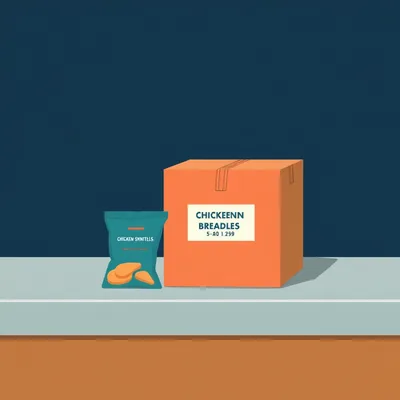
And the gap is realer than most people realize. I pulled the numbers. A five-pound box of frozen breaded chicken breast patties at a restaurant supply store runs about twenty-two to twenty-eight dollars. That's roughly twenty to twenty-five schnitzels. The supermarket equivalent, those little four-hundred-gram bags, works out to about ten to twelve dollars per pound. You're paying sixty to seventy percent more for the privilege of a colorful cardboard box and a zipper seal you'll never actually reseal properly.
The zipper seal that betrays you by meal three.
Every time. So the question isn't really whether the savings exist, it's why there are two completely separate supply chains for the same frozen chicken, and how a determined civilian gets through the door of the cheap one.
And the answer to why there are two chains is basically that supermarkets have spent decades training us to think the frozen aisle is where value lives, when it's actually where margin lives. The frozen food aisle is a convenience play dressed up as a value proposition. They know you're tired, they know you need dinner in twelve minutes, and they know you're not comparison-shopping against a Sysco truck.
Right. So let's map the two channels, because once you see the split, you can't un-see it. Channel one is retail. That's your supermarket distribution center feeding into store shelves. The product is packaged in small units, colorful boxes, "family size" which is a meaningless term, by the way. Channel two is foodservice. That's the broadliners, Sysco, US Foods, Performance Food Group, delivering to restaurants, hospitals, schools, cafeterias. Same manufacturers, Tyson, Bell and Evans, Pilgrim's Pride, are producing for both channels. But the packaging, the SKU, and the pricing are completely different. A five-pound plain brown box versus a glossy four-hundred-gram bag.
Same chicken, different reality.
Same chicken. And the pricing structure reflects who's buying. A restaurant orders by the case, every week, for years. They get volume pricing. A consumer wanders into a supermarket and grabs one bag. They get the "I need this right now" pricing.
So the obvious question is, why can't I just walk into a Sysco warehouse and buy a case of schnitzels? What's actually stopping me?
Several things, and they're all designed to keep the channels separate. First, minimum order quantities. Sysco, the largest foodservice distributor in North America, typically requires a minimum order of two hundred fifty to five hundred dollars for delivery. Second, you need a business account. They're not set up for walk-in retail, they don't take credit cards from individuals, they invoice businesses on net-thirty terms. Third, delivery only. There is no counter where you browse. You place an order, a truck shows up at a loading dock, not your driveway.
So the entire system is architected around the assumption that you're a commercial kitchen with a receiving bay and an accounts payable department.
And for a long time, that was a pretty effective wall. But here's where it gets interesting. There's a whole category of businesses that sit in between, the cash-and-carry restaurant supply stores, and many of them are open to the public despite the wholesale branding.
This is the back door.
This is the back door. Let me give you the lay of the land. Restaurant Depot, over one hundred ninety locations in the US, is the big one. They do require a membership, but here's the thing, it's trivially easy to get. Any business card, any EIN, even a resale certificate from an eBay store qualifies you. If you've ever sold anything on the internet and registered as a business, you're in. If you have a friend with a business card, you're in. I've heard of people walking in, filling out a form at the desk, writing "freelance catering" as their business, and walking out with a membership card five minutes later.
It's the "I occasionally cook for people" loophole. But it gets even easier. Chef'Store, formerly Cash and Carry, over seventy locations mostly in the western US, requires no membership at all. Anyone can walk in and buy. Gordon Food Service Store, over one hundred seventy locations in the Midwest, Northeast, and Florida, also open to the public, no membership required. Smart Foodservice, same deal. These are full-scale warehouse stores selling the exact same institutional boxes that go to restaurants.
So the wall is basically a suggestion. The gatekeepers are checking for a pulse and a vague gesture toward commerce.
At the cash-and-carry level, absolutely. The real barrier isn't legal or regulatory, it's awareness. Most people don't know these stores exist, or they assume they can't shop there. The stores don't advertise to consumers. They don't need to. Their core business is small restaurants and caterers. Walk-in consumers are gravy.
Let's get specific about schnitzel. You walk into one of these places, what are you actually buying, and what does it cost?
So the institutional frozen schnitzel market is dominated by a few key players. Sysco has their Classic line, which is their house brand. Gordon Food Service has their own label. Then you've got the big poultry producers, Tyson, Pilgrim's, who sell foodservice packs. A five-pound box of breaded chicken breast patties, which is essentially a schnitzel, runs about twenty-two to twenty-eight dollars at Restaurant Depot. That box contains roughly twenty to twenty-five pieces, depending on the size specification.
Versus the supermarket where you're paying ten to twelve dollars for a one-pound bag with maybe five or six pieces.
So your per-schnitzel cost drops from about two dollars and fifty cents at retail to roughly a dollar at wholesale. For a family of four eating schnitzel once a week, that's about three hundred dollars a year in savings on that one product alone.
And the average American household spends about five to six hundred dollars a year on frozen poultry products, so this is not a trivial line item.
Not trivial at all. And here's a knock-on effect that surprised me when I started digging into this. The institutional product is often higher quality than the retail version.
Explain that, because the instinct is to assume the opposite. Big brown box equals generic, colorful bag equals premium.
That's exactly the misconception. Restaurants demand consistency. They need every schnitzel to be the same size, the same thickness, the same breading adhesion, the same cook time. If a schnitzel is too thick, it's raw in the middle. If the breading falls off in the fryer, the plate looks terrible. Foodservice products are engineered for performance in a commercial kitchen, which means they're optimized for high-heat cooking, which is exactly what your air fryer is doing. Retail products are optimized for shelf appeal, the box looks good, and shelf life, they sit in your freezer for six months. The actual protein quality can be lower because the purchase decision is made with the eyes, not the mouth.
So the restaurant is buying a product designed to be cooked well, and the home cook is buying a product designed to be photographed well.
That's the split in one sentence. And it applies across the board, not just to schnitzel. Frozen fish fillets, french fries, vegetables, the institutional pack is almost always the better-performing product.
Alright, so you know where to go. But before someone rushes out and buys a ten-pound box of schnitzels, there are some practical realities to contend with. Storage, for one.
This is where the bulk-buy fantasy meets the freezer-burn reality. A five-pound box of schnitzels takes up about half a cubic foot of freezer space. That's manageable for most households. But a ten-pound box, which is where the real per-unit savings kick in, that's a cubic foot, and you're committing to roughly forty to fifty schnitzels. If you're a single person or a couple, you might not get through that before freezer burn sets in, which would wipe out your savings.
So the math only works if you actually eat the food before it degrades.
And this is the misconception a lot of people have about bulk buying. Buying in bulk always saves money, except when it doesn't. You need to account for consumption rate. The solution is straightforward, though. Vacuum seal and portion before freezing. Take the ten-pound box, split it into meal-sized portions, seal them properly, and they'll last months without freezer burn. Or, split the box with a friend or neighbor. Which brings us to an angle I think is underexplored.
The group buy.
The group buy. This is how small restaurants actually operate. A tiny café can't meet Sysco's five-hundred-dollar minimum on its own, so they pool orders with other businesses. There's no reason a neighborhood can't do the same thing. A schnitzel co-op. Four or five families on a street, one person with a Restaurant Depot membership, everyone chips in, you split a case of schnitzels, a case of fish fillets, a case of fries. Everyone saves, nobody's freezer is overwhelmed.
The cul-de-sac supply chain.
The cul-de-sac supply chain, exactly. And it's not just a cute idea. It's how immigrant communities have been shopping for decades. Go to any ethnic grocery store and you'll see bulk buying and splitting is standard practice. The frozen schnitzel crowd just hasn't caught up.
Now, what about online? Because not everyone lives near a Restaurant Depot or a Chef'Store. Can you do this from your couch?
You can, with some caveats. There are online restaurant supply retailers, WebstaurantStore is the big one, KaTom is another, that sell to anyone with a credit card. No membership, no business license, no questions asked. You search for "frozen breaded chicken breast" or "chicken schnitzel," filter by pack size, and order. A ten-pound box of breaded chicken breast patties on WebstaurantStore runs about forty-five dollars.
But the shipping.
The shipping is the catch. Frozen goods require overnight or two-day shipping with dry ice, and that typically runs fifteen to thirty dollars depending on distance and order size. So your forty-five dollar box becomes sixty to sixty-three dollars delivered, which is about six dollars and thirty cents per pound. The supermarket equivalent is nine to twelve dollars per pound. You're still saving thirty to forty percent, but it's not the sixty to seventy percent you get walking into a cash-and-carry.
So the online play makes sense for larger orders, a hundred dollars plus, where the shipping cost amortizes across more product. For a single box, you're better off finding a physical store.
That's the calculus. And this is where the group buy gets even more powerful online. If four households pool a two-hundred-dollar order, the shipping is the same fifteen to thirty dollars, and suddenly your per-unit cost drops dramatically.
Let me throw out a more audacious strategy, because Daniel asked for strategies a determined consumer might use, and I think determined is the operative word.
I'm listening.
You mentioned the business account barrier with Sysco and US Foods. The official line is you need a restaurant or institutional affiliation. But what counts as a business is remarkably flexible. If someone registers a small catering operation, even a micro-caterer doing weekend events, that's a legitimate business. An EIN from the IRS is free and takes ten minutes online. A business license from your city might cost fifty dollars. For a hundred dollars and an afternoon of paperwork, you are now a commercial entity in the eyes of the foodservice industry.
And you've just opened the door to the entire Sysco and US Foods catalog.
The entire catalog. And here's the thing, the minimum order is two hundred fifty to five hundred dollars. If you're doing a group buy with four or five families, you hit that minimum in one order. You're not committing fraud, you're not misrepresenting anything. You are a small food business that occasionally cooks for its members. The fact that your "clients" are your neighbors and the "events" are Tuesday dinner is between you and your conscience.
I want to be careful here, because I'm not suggesting anyone misrepresent themselves. But the line between a home cook who occasionally caters a friend's party and a micro-catering business is genuinely blurry. If you're buying institutional quantities of frozen food and distributing them among a group, you're operating a buying club, which is a real thing. Food co-ops have existed for a century. The legal structure exists.
And the foodservice industry doesn't actually care. Sysco's minimum order exists because it's not profitable to deliver a single case to a residential address. If you're ordering five hundred dollars of product to a commercial address, or even a residential address with a business name attached, you're a customer like any other. The gatekeeping is economic, not moral.
That's a fair point. The barrier is operational, not ethical. They're not trying to keep schnitzels out of the hands of civilians. They just don't have the logistics for small residential drop-offs.
Let's talk about another angle, the Gordon Food Service Store model, because I think it's the best-kept secret in this whole space.
GFS is fascinating. So Gordon Food Service is a major broadliner, they deliver to restaurants across the Midwest, Northeast, and Florida. But they also operate retail-adjacent stores, Gordon Food Service Stores, that are open to the public with no membership. You walk in, you buy the exact same five-pound and ten-pound boxes that their delivery trucks drop at restaurants. The per-unit price is slightly higher than what a restaurant with a negotiated contract would pay, but it's still dramatically below supermarket pricing.
So it's the institutional supply chain with a consumer-facing storefront. They've already done the work of bridging the two channels.
And it's not just GFS. Chef'Store, Smart Foodservice, these are all essentially the same model. The broadliner realized there's a market of small operators, food trucks, church kitchens, and yes, determined home cooks, who want institutional product but can't meet delivery minimums. So they opened stores.
Which suggests the industry is already adapting. The wall between retail and foodservice isn't some sacred divide, it's just a logistics problem that's gradually being solved from the supply side.
And from the demand side, you've got the air fryer revolution. Air fryer adoption is at an all-time high. These appliances are essentially small convection ovens that excel at cooking frozen breaded products. A frozen schnitzel in an air fryer comes out better than a frozen schnitzel in a conventional oven, closer to deep-fried texture. The home cook now has a tool that performs like commercial kitchen equipment, which makes the institutional product suddenly relevant to the home kitchen in a way it wasn't ten years ago.
The air fryer is the bridge technology. It makes the foodservice product make sense in a residential context.
And the manufacturers are noticing. Tyson and Pilgrim's are starting to put air fryer instructions on their retail packaging. But the institutional boxes have always been designed for high-heat convection cooking, which is what a commercial kitchen uses and what an air fryer essentially is. So in a weird way, the home cook with an air fryer is better served by the foodservice product than the retail product.
Let me give a concrete example for someone who wants to try this. You live in Chicago. You go to the Restaurant Depot on Pulaski Road. You bring a friend's business card, or you register online with an EIN you got in ten minutes from the IRS website. You walk in, you find the frozen section, you grab a five-pound box of breaded chicken breast fillets for twenty-five dollars. You go home, you open the box, you portion the schnitzels into freezer bags, four per bag, and you stack them in the freezer. That's five to six meals for a family of four, at about four dollars per meal in protein cost. The same meal from Jewel-Osco would cost you about ten to twelve dollars in schnitzels alone.
And the quality is better. The breading is more consistent, the chicken is more uniform, the cook time is predictable. You put it in the air fryer at three-ninety for twelve minutes, flip halfway, and it comes out restaurant-quality.
The entire restaurant experience, minus the markup, minus the tip, minus the drive.
Minus the server asking if everything's okay when your mouth is full.
Now, scale this logic beyond schnitzels. What else does this apply to?
Everything in the frozen aisle. Frozen fish fillets, the institutional packs are typically individually quick frozen, which means they don't clump together, and the portion sizes are consistent. Frozen vegetables, a five-pound bag of broccoli florets at a cash-and-carry costs about the same as a one-pound bag at the supermarket. French fries, a thirty-pound case of foodservice fries is about twenty-five to thirty dollars, versus four dollars for a two-pound bag at retail. The math is the same across the board.
Ice cream.
Ice cream is a great one. A three-gallon tub of institutional ice cream, the kind they scoop at a cafeteria, is about twenty to twenty-five dollars. That's roughly thirty-two four-ounce servings, or about seventy-eight cents per serving. A pint of premium ice cream at the supermarket is five to six dollars for four servings, a dollar fifty per serving. And the institutional stuff is often made by the same dairies.
So the meta-lesson here is that the consumer packaged goods industry relies on you not knowing about the institutional supply chain. Once you know the back door exists, you can apply this logic to almost any frozen food.
And it extends beyond frozen. Canned goods, dry goods, paper products, cleaning supplies. The institutional channel exists for all of it. But frozen is where the price gap is most dramatic, because frozen logistics are expensive and the retail markup reflects that.
Let's address the elephant in the room, which is that frozen schnitzel is not health food. Daniel acknowledged this in his prompt. This isn't about optimizing your micro-nutrient profile. This is about the reality of feeding a family when you're exhausted.
And that's a real reality. The difference between skipping a meal and eating something is not trivial. A frozen schnitzel with a side of frozen vegetables, which you can also buy in bulk from the same cash-and-carry, is a perfectly reasonable Tuesday dinner. It's protein, it's calories, it's food on the table in fifteen minutes. The alternative for a lot of families isn't a farm-to-table organic spread. It's takeout, which is more expensive and often less nutritious.
Or it's nothing. And nothing is worse than a schnitzel.
Nothing is definitely worse than a schnitzel. So the practical playbook. Step one, find your nearest cash-and-carry restaurant supply store. Restaurant Depot, Chef'Store, Gordon Food Service Store, Smart Foodservice, or a regional equivalent. Call ahead to confirm their public access policy, but in most cases, you can just show up. If they require a membership, ask what qualifies. The bar is almost always lower than you think.
Step two, for online ordering, use WebstaurantStore or KaTom. Search for frozen breaded chicken breast or chicken schnitzel, filter by pack size. Calculate the total cost with shipping before you commit. Frozen shipping is the hidden cost, and it only makes sense for orders above roughly a hundred dollars.
Step three, start a neighborhood bulk-buy group. Find three or four families on your street or in your building. Pool orders. One person does the run to Restaurant Depot, or one person places the online order, everyone Venmos their share. You get the volume discount without the storage burden.
And step four, if you're truly determined, consider the micro-caterer route. An EIN is free. A basic business license is cheap. You're not building a restaurant empire, you're creating a legal framework for accessing the wholesale supply chain. The fact that your catering business primarily serves your own dinner table is nobody's business but your own.
I'll add a step five. Invest in a vacuum sealer. They're forty to sixty dollars, and they'll pay for themselves in prevented freezer burn within a few months. Portion your bulk schnitzels into meal-sized bags, seal them, and they'll last six months or more without degradation.
So let's pull this together. The institutional frozen food supply chain is not a locked vault. It's a building with an unlocked side door that most people walk past because they assume it's alarmed. The cash-and-carry stores are the side door. The online retailers are the window you can climb through if you're willing to pay shipping. And the micro-business route is basically asking the front desk for a key.
And once you're inside, the economics are transformative. You're paying forty to sixty percent less for the same or better product. For a family that goes through a lot of frozen food, we're talking hundreds of dollars a year in savings. That's real money.
The question I want to leave listeners with is, what happens when more people figure this out? The cash-and-carry model works right now partly because consumer traffic is a rounding error in their business. If suddenly ten percent of their customers are home cooks loading up on frozen schnitzels, do they tighten access? Do they raise prices for non-commercial buyers?
Or do they lean in? The GFS model suggests there's a middle ground. A consumer-facing store that stocks institutional product at slightly higher margins. We're already seeing direct-to-consumer bulk food delivery services emerge, though the big one, Boxed, went under. The demand is clearly there. I could see a Costco-for-foodservice model emerging, a membership warehouse that explicitly targets the home bulk buyer with institutional packs.
A Schnitzel Costco. I'd join.
You'd be the founding member.
On the record. Within two years, at least one major broadliner, Sysco or US Foods, will pilot a consumer-facing retail store or a direct-to-consumer delivery option with no business license requirement. The economics are too compelling to ignore, and the air fryer has created the demand signal. They'd be leaving money on the table.
I'll go further. Within eighteen months, we'll see a startup explicitly built around group-buy logistics for frozen foodservice products, an app that connects neighbors who want to split cases of institutional frozen goods. The schnitzel co-op as a service. The unit economics work, the infrastructure exists, and the cultural moment is right.
So the future is bulk schnitzels, delivered to your door, split among your neighbors, cooked in your air fryer. That's the world we're building.
That's a world I want to live in. Try the cash-and-carry approach this week. Buy one box of frozen schnitzels from a restaurant supply store. Compare the price and quality to your supermarket brand. We want to hear how it goes, what you paid, what you found, whether the membership process was as trivial as we claim. Email the show at show at my weird prompts dot com.
Our producer Hilbert Flumingtop thanks you for listening. This has been My Weird Prompts. Find us at my weird prompts dot com. We'll be back soon.