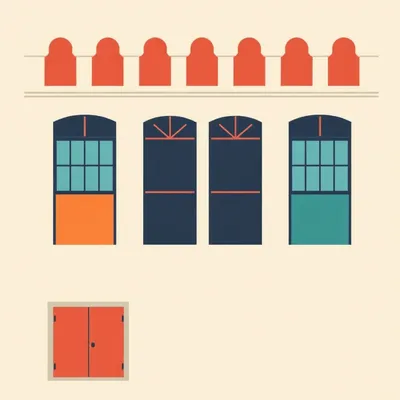
This week we got a prompt from Hannah — she's an architect, and she's been sending us a series of really thoughtful questions about how to bring architecture back to something human. She's asked about getting developers on board, getting cities on board. Now she's asking the design question. If we want a new architectural movement that picks up where Art Deco left off — classical proportions, human scale, actual ornament — but integrates what's genuinely useful from modernism, and grounds itself in a specific place like Jerusalem, where do you even start? What are the elements? How do you build a style guide for something that doesn't exist yet?

This is the question I've been waiting for. Because the policy stuff matters, but at some point someone has to draw the building. And right now, if you're an architect who wants to design something beautiful and traditional but not a copy of a Georgian townhouse, there's no agreed-upon visual language. You're on your own.
You're essentially a cover band playing to an audience that forgot the original songs exist.
And Hannah's framing is smart because she's not asking "should we revive Art Deco?" She's asking what a twenty-twenties equivalent would look like. Art Deco was the last movement that managed to look forward without burning down the past. It said yes to steel frames and elevators and mass transit, and yes to symmetry and proportion and ornament. It treated the machine age as a source of motifs, not a reason to abandon beauty.
The thread broke.
And understanding why it broke is the first thing we have to get right, because if we don't understand the failure mode, we'll just repeat it. So let's do that. But first, let me say what I think makes a movement a movement, rather than just a collection of nice buildings.
A movement has a shared proportional system, a shared material palette, a shared approach to ornament, and a shared attitude toward the street. You can look at a building in Miami and a building in Mumbai and say "those are both Art Deco" even though one is pastel stucco and the other is carved stone with Indian motifs. The skeleton is the same. The tripartite vertical massing — base, shaft, capital. The emphasis on the corner. The geometric ornament derived from nature but not directly mimicking it. The belief that a building should meet the street like a person meets you — with a face.
Base, shaft, capital. That's straight out of classical columns.
And it works at every scale. A column has a base, a shaft, and a capital. A building has a ground floor that reads as a base, middle floors that read as a shaft, and a top that reads as a capital or a crown. A city block has the same hierarchy if it's done well. It's not mystical — it's just how our eyes read vertical stacks. We expect a beginning, a middle, and an end.
Modernism deliberately broke that.
Le Corbusier's Five Points from nineteen twenty-seven — pilotis, roof garden, free plan, horizontal windows, free facade — those were designed to destroy the tripartite system. Pilotis lift the building off the ground so there's no base. Horizontal windows stretch across the whole facade so there's no vertical rhythm. The free facade means the exterior doesn't reflect the structure. It's a manifesto of negation.
The result is buildings that photograph beautifully from a helicopter and feel hostile when you're standing next to them.
That's the V&A Dundee problem. Kengo Kuma's museum in Scotland — it uses rough stone and layered massing that references Scottish cliffs, and the aerial shots are stunning. But at street level, the proportions are deliberately off-human-scale. There's no base to anchor you, no rhythm of windows to tell you where you are. Walking past it is disorienting. And that's a building by a talented architect who cares about materiality. Imagine the average glass box by someone who doesn't.
The modernist rupture wasn't just aesthetic. It was a systematic dismantling of the proportional grammar that made buildings legible to humans.
But here's the thing — modernism also got some things right, and we shouldn't discard those just because the movement was aesthetically hostile. Structural expression, letting materials do the work honestly — that's good. Large glazing for daylighting — that's good when it's done thoughtfully. Open floor plans for flexibility — that's useful. Flat roofs that can hold green roofs and solar panels — that's a sustainability win. And the entire Passivhaus energy standard is a triumph of building science.
That's the German-origin standard where a building uses no more than fifteen kilowatt-hours per square meter per year for heating.
And here's what's wild — thick masonry walls, which traditional architecture already used, are excellent for Passivhaus performance. Thermal mass, deep overhangs for shading, operable windows for natural ventilation — these are all traditional techniques that got abandoned when we switched to sealed glass curtain walls. Modern glass towers often require immense HVAC systems to compensate for terrible thermal performance. A well-designed traditional building with thick walls and properly sized windows is inherently more passive.
The synthesis isn't contradictory at all. You can have a classical tripartite facade with a Passivhaus envelope.
You absolutely can. And that's the design challenge Hannah is pointing at. How do you design a building that has a base-shaft-capital composition, human-scaled street frontage with ornament, triple-glazed windows, and a green roof? These things haven't been done together at scale since the nineteen thirties. But they're not incompatible. They just haven't been combined because the architectural profession split into traditionalists who reject modern technology and modernists who reject traditional proportion.
The Daily Express Building in London.
Nineteen thirty-two. Black glass curtain wall — it still looks futuristic. But it has classical pilasters expressed in the glass. It's a curtain wall with vertical rhythm. That hybrid approach was completely abandoned after the war. We just stopped exploring what glass and steel could do when disciplined by classical proportion.
Let's get practical. If Hannah wants to design in this language tomorrow, what does she actually need? You mentioned proportional systems. Walk me through that.
The core tool is the golden ratio — roughly one point six one eight to one. It's not mystical. It appears in the human body, in plant growth, and in basically every classical order. The human eye finds it pleasing because it's the ratio of our own proportions. A building where the middle section is roughly one point six times the height of the base, and the crown is roughly one point six times smaller than the middle — that building will feel right even if you can't articulate why.
Art Deco used this explicitly.
The Chrysler Building's vertical ribs are spaced according to golden ratio divisions. The setbacks follow Fibonacci-like sequences. And here's a concrete thing Hannah can use — the column spacing equals the building height divided by six. That's not a random rule. It's derived from the golden ratio applied to a typical urban mid-rise. When the vertical bays are one-sixth the total height, the rhythm reads as neither too dense nor too sparse. You can apply that formula to a five-story building or a thirty-story tower.
You start with proportion, not style. The proportion is the skeleton.
And then you dress the skeleton with materials and ornament. But the proportion comes first. If the proportion is wrong, no amount of beautiful stone will save it. If the proportion is right, even a modest building with inexpensive materials will feel dignified.
That's the thing about the Mamilla development in Jerusalem.
Mamilla is a rare example of a new district that uses Jerusalem stone, traditional massing, and modern floor plans. It's commercially successful. People love living there. The proportions are right — the buildings step down the hill, the street widths are human-scaled, the ground floors have shops that open onto the sidewalk. It's not a pastiche of an ancient village. It's a modern shopping and residential district. But it feels like Jerusalem.
Hannah mentioned that Jerusalem has layers — Herodian ashlar stonework, Byzantine mosaics, Mamluk muqarnas, Ottoman domes, British Mandate stone ordinances, Israeli Brutalism. How do you extract principles from all that without just copying motifs?
This is the hard part, and it's where most attempts at regional architecture fail. They take a specific arch shape or a dome profile and reproduce it endlessly until it becomes Disneyland. The better approach is to extract principles, not motifs. Jerusalem has a principle of "mountain-top silhouette" — every building steps down the hill, nothing breaks the skyline arbitrarily. That's a design rule you can apply regardless of whether your building has arches or flat lintels. Another principle is "stone as the binding material" — the nineteen-eighteen Jerusalem Stone Ordinance mandated that all buildings be clad in local limestone. It's still in effect. It's one of the oldest form-based codes in the world.
Form-based codes. That's the planning approach that regulates proportion and materials rather than use.
And Jerusalem stumbled into one in nineteen eighteen, long before the term existed. The stone ordinance doesn't care if a building is a hospital or a hotel or an apartment. It cares that the exterior is local limestone. That single rule has done more for Jerusalem's visual coherence than any design review committee ever could.
If Hannah's building a style guide for a new Jerusalem movement, she starts with the stone ordinance and the silhouette principle.
She needs a window-to-wall ratio. This is where sustainability and traditional proportion converge beautifully. Passivhaus standards work best when glazing is no more than about forty percent of the facade. Traditional architecture, before curtain walls, rarely exceeded thirty to forty percent glazing. Solid walls with punched windows. Modern glass towers are often seventy to ninety percent glazing, which creates a greenhouse effect that requires enormous cooling loads. So a rule of never more than forty percent glazing on a facade is simultaneously more traditional, more energy-efficient, and more humane — because windows become framed views rather than overwhelming sheets of glass.
The window itself becomes an ornamental opportunity.
A window surround, a sill, a lintel, a keystone — these are places for ornament. And ornament is where digital fabrication changes everything.
Let's talk about that. Because the standard objection to all of this is cost. Ornament is expensive. That's why it died.
That objection was true in nineteen fifty. It is not true now. A CNC router can carve a two-meter classical cornice from a block of glass-fiber-reinforced concrete in under thirty minutes. Material cost roughly two hundred dollars. A hand-carved stone equivalent would take days and cost two thousand dollars or more. We can now produce ornament at the cost of plain stucco. The cost barrier is gone. What remains is a cultural barrier — architects don't specify ornament because they were trained not to, and contractors don't bid on it because they assume it's expensive.
The first firm that builds a digital fabrication pipeline for ornamental elements is going to have a massive competitive advantage.
It doesn't require inventing new technology. CNC routers are standard equipment in any cabinet shop. Three-D printing of concrete is advancing rapidly. You can design a set of ten ornamental elements — cornice brackets, window surrounds, keystones, door hoods — and produce them from recycled concrete aggregate with a local stone finish. Publish the files open-source. Let other architects use them. That's how a movement spreads.
The pattern book approach.
This is how most architectural movements actually spread — not through genius architects designing masterpieces, but through pattern books that builders and developers could use directly. The Prince's Foundation has been doing this for decades, but their pattern books tend to focus on pure revival styles — Georgian, Classical, vernacular. What Hannah is proposing is a pattern book for a new synthesis. One that includes proportional rules, a material palette of eight to twelve materials that work together, window-to-wall ratios, and ornamental templates that can be digitally fabricated.
A Jerusalem-specific version would include local stone, a palette drawn from the city's architectural layers, and rules about how buildings meet the street and the skyline.
Here's something concrete she could do. Document the ten best buildings in Jerusalem from nineteen hundred to nineteen forty. That's the last period of coherent traditional design before modernism took over completely. Extract their proportional rules — column spacing, floor heights, window-to-wall ratios, cornice depths. Document their material palettes. Document how they handle corners, entrances, and rooflines. That becomes the starting vocabulary.
The British Mandate period produced some remarkable buildings in Jerusalem. Rockefeller Museum, the King David Hotel, the central post office.
All of them use Jerusalem stone with classical proportions but with a kind of stripped-down modern sensibility creeping in. The King David Hotel has symmetrical massing and a strong base-shaft-capital composition, but the ornament is restrained — it's not a copy of a European palace. It's already a regional adaptation.
The raw material for a pattern book is already there, built and standing. Hannah just needs to extract the rules.
Then push them forward. The next step is to design a building that's eighty percent traditional in proportion and twenty percent modernist in detail. A classical tripartite facade with a Passivhaus envelope and a green roof. Deep overhangs for shading that read like classical eaves. Triple-glazed windows with ornamental surrounds. A CNC-routed cornice at the roofline. Get it built, even if it's a small infill house or a shopfront. Movements start with built examples, not manifestos.
There's an Israeli architect named David Kroyanker who proposed something he called "Stone and Steel" — local limestone with exposed steel frames, referencing both the Herodian period and the industrial age. Never built, but the drawings exist.
That's exactly the kind of conceptual synthesis we're talking about. The Herodian period in Jerusalem used massive ashlar stonework — those enormous blocks at the Western Wall are Herodian. The industrial age gave us steel frames that can span large openings. Combining them isn't a contradiction. It's a conversation between structural honesty and material continuity.
It immediately reads as Jerusalem, not anywhere else.
That's the test. A new movement should be globally coherent but locally legible. Art Deco in Miami used pastel colors and nautical motifs because it was Miami. Art Deco in New York used dark brick and vertical emphasis because it was New York. Art Deco in Mumbai used carved stone with Indian floral patterns. Same skeleton, different skin.
Hannah's Jerusalem version would use the same proportional system and tripartite massing as a hypothetical New York or London version, but the material palette and ornamental motifs would draw from local traditions — Herodian stone courses, Mamluk geometric patterns, Ottoman dome proportions, British Mandate restraint.
Here's where she needs to be careful. The Mamluk muqarnas — those honeycomb vault transitions — are stunning. But you can't just stick a muqarnas on a steel-frame building. That's pastiche. The question is what principle the muqarnas embodies. And the answer is: a geometric transition between a square base and a dome above. That's a structural problem with a geometric solution. A modern version might use a CNC-routed geometric transition between a rectangular window and an arched top. Same principle, new expression.
Don't copy the motif. Extract the rule.
That's the whole game.
You mentioned the Chrysler Building earlier. There's a detail about that building I've always loved.
The spire was assembled inside the building and raised through the roof in ninety minutes. Nineteen thirty engineering.
It's not just an engineering flex. The spire completes the composition. Without it, the Chrysler Building is a nice staggered tower. With it, it's a crown. It's the capital in the base-shaft-capital system. And it's ornament that serves a visual function — it terminates the vertical thrust. Your eye travels up the shaft and lands on the spire and rests.
Could you do a solar-panel-integrated spire that serves the same visual function?
Solar panels don't have to be flat rectangles hidden on a roof. They can be integrated into vertical surfaces, into shading devices, into ornamental elements. A spire clad in dark photovoltaic panels would read as a crown while generating power. That's the kind of synthesis that makes a new movement exciting rather than just nostalgic.
We have proportion, material palette, ornament via digital fabrication, sustainability as a selling point. How do you package all of this into something other architects can use?
The pattern book. But a twenty-twenties pattern book, not a nineteenth-century one. It needs to be digital, parametric, and open-source. Here's what I'd put in it. One — a proportional system. Column spacing equals building height divided by six. Golden ratio divisions for vertical massing. Maximum forty percent glazing. Two — a material palette of eight to twelve materials that work together and are locally available. In Jerusalem, that's limestone, terracotta, glass, copper, timber, and recycled concrete aggregate. Three — a set of window types, each with proportional rules and ornamental surrounds. Four — ornamental templates, ten to fifteen elements, that can be CNC-routed or three-D-printed. Publish the CAD files. Five — construction details for Passivhaus-compatible wall assemblies using those materials.
That's a document a developer could hand to a contractor and say "build me one of these.
That's how you scale a movement. Not by waiting for a genius architect to design a masterpiece that wins awards and gets published in architectural journals. By making it easy to build beautiful buildings. The reason ugly buildings proliferate isn't that developers love ugliness. It's that ugly is the default setting of the current construction industry. Change the default.
Like adopting a feral cat.
I'm not sure that metaphor works, but I take your point.
The cat is the construction industry. It's feral. You don't train it with manifestos. You leave food out.
The food is a pattern book with CAD files and cost estimates.
Herman: Alright, let me pull on a thread you mentioned earlier. The cost question. Because even with digital fabrication, someone is going to say "but ornament is still more expensive than no ornament." And technically that's true in the narrowest sense — a plain wall is cheaper than an ornamented wall. But that's the wrong comparison.
What's the right comparison?
The right comparison is total lifecycle cost. A building with thick masonry walls, properly sized windows, and deep overhangs costs more upfront in materials but dramatically less in heating and cooling over fifty years. A building with ornament and human scale commands higher rents and resale values because people actually want to live in it. A building that's loved gets maintained rather than demolished. The cheapest building to construct is often the most expensive building to own.
The ugliest building is the first one to get torn down.
How many Brutalist buildings from the nineteen sixties and seventies have been demolished in the last twenty years? Major works by major architects. Torn down because nobody loved them enough to maintain them. Meanwhile, nineteenth-century buildings with ornament and proportion get renovated and adapted and cherished. The ornament pays for itself in longevity.
The sustainability argument and the economic argument and the aesthetic argument all converge on the same design principles.
That's what's so frustrating about this conversation. Every single factor points toward traditional proportion and human scale. The only thing pointing the other way is architectural fashion. And fashion changes.
Fashion has been pointing the other way for about a hundred years.
It's exhausted. The last major architectural movement that captured the public imagination was probably Deconstructivism in the nineteen nineties — Gehry's Bilbao, Libeskind's Jewish Museum. Since then, we've had what? None of it has produced a building that ordinary people love the way they love the Chrysler Building or the Flatiron or a Georgian terrace.
The glockenspiel of corporate approachability.
I need you to explain that one.
You know when a corporate headquarters wants to seem friendly, so they commission a building with a wavy glass facade and a lobby with a living wall and maybe a sculpture that looks like a melted paperclip? It's architecture signaling "we're innovative" without actually innovating anything. It's the glockenspiel — the instrument you add when you want to sound whimsical without learning how to write a melody.
That's painfully accurate. And it connects to something Hannah said in her prompt — most architects are not that creative. They're copying contemporary ugly buildings. They might as well be copying traditional buildings that work. And I think that's a liberating observation. If you're an architect who just wants to do competent work and get paid, a pattern book of proven traditional designs is a gift. You don't have to be a genius. You just have to follow the rules.
If you are artistically inclined, the rules give you a framework to be creative within. Constraints produce better art than total freedom.
Every great architect in history worked within constraints — proportional systems, material limitations, budget, site, climate. The idea that creativity requires total freedom is a modernist myth and it's produced some of the most self-indulgent buildings ever constructed.
Hannah's question about where to begin — you've outlined the pattern book, the proportional system, the material palette. But she also asked about how to draw from Jerusalem's specific traditions. Let's go deeper on that.
Jerusalem is possibly the most layered architectural city on Earth. You've got Herodian ashlar from two thousand years ago — those massive stone blocks with the distinctive marginal drafted edges. You've got Byzantine mosaic floors and column capitals. You've got early Islamic domes and arches. You've got Crusader vaulting. You've got Mamluk muqarnas and ablaq — alternating colored stone courses. You've got Ottoman domes and minarets. You've got British Mandate stone ordinances and neo-classical civic buildings. You've got Israeli Brutalism from the sixties and seventies. And you've got contemporary glass and steel.
That's not a palette. That's an encyclopedia.
The task is not to use everything. The task is to extract the principles that recur across all those traditions. And I think there are three big ones. First, the primacy of stone. Every culture that built in Jerusalem built in stone. It's the local material, it's the color of the hills, it's what makes Jerusalem look like Jerusalem. Second, the importance of the wall as a defining element — Jerusalem architecture is about enclosure, courtyards, thresholds. It's not about transparency and blurring inside and outside. Third, the modulation of light — deep reveals, small openings on the exterior, shaded courtyards on the interior. It's a hot climate with intense sun. The architecture manages light, it doesn't surrender to it.
Those three principles would push a Jerusalem movement in a very different direction than, say, a Miami movement, even with the same proportional skeleton.
A Jerusalem Art Deco successor would have thick stone walls with deeply recessed windows, shaded loggias, courtyard plans, and a warm limestone color palette. Ornament would draw from geometric traditions — Mamluk patterns, Herodian stone dressing, maybe Byzantine mosaic accents. But the vertical tripartite massing, the golden ratio proportions, the Passivhaus envelope — those are universal.
The silhouette principle you mentioned — buildings stepping down the hill.
That's non-negotiable in Jerusalem. The city is built on ridges and valleys. A tower that punches through the skyline doesn't just look wrong — it breaks the visual relationship between the built environment and the topography. Every great Jerusalem building, from the Dome of the Rock to the Hebrew University on Mount Scopus, works with the hill, not against it.
A Jerusalem pattern book would include a rule about maximum building height relative to the ridge line.
Probably a rule about roof forms. Flat roofs with parapets are the Jerusalem vernacular — they create a clean silhouette against the sky. Pitched roofs read as European imports. That's fine for certain neighborhoods, but a new Jerusalem movement should probably default to flat roofs with green roof systems and solar panels integrated behind parapets.
Hidden from the street but functional.
That's the Passivhaus integration again. A flat roof with a green roof system and photovoltaics behind a stone parapet — it reads as traditional from the street and performs as a twenty-first-century building.
Let's talk about the open question Hannah's prompt raises. Can a movement be intentional, or does it have to emerge organically?
The historical evidence says intentional works. The Arts and Crafts movement was intentional — William Morris and John Ruskin wrote manifestos and built demonstration projects. Art Deco was semi-intentional — the nineteen twenty-five Exposition Internationale des Arts Décoratifs et Industriels Modernes in Paris was explicitly convened to showcase a new style. That's where the name comes from. Modernism was extremely intentional — the CIAM congresses, the Athens Charter, Le Corbusier's books. These were organized campaigns.
A single architect with a pattern book and a built example could be the seed.
And Hannah is in a position to do that. She's trained, she's thinking about this systematically, and she's in Jerusalem — a city where every stone has meaning. If a new architectural language can be born there, it can be born anywhere.
The thread is still there. We just have to pick it up.
The tools are better than they've ever been. Digital fabrication makes ornament affordable. Passivhaus science makes traditional massing energy-efficient. Form-based codes are gaining traction in planning departments. The cultural resistance is real, but the technical obstacles are gone.
If you're an architect listening to this — or a developer, or an urbanist, or just someone who cares about what gets built in your city — what do you actually do?
If you're an architect, start the pattern book. Document the ten best buildings from nineteen hundred to nineteen forty in your city. Extract their proportional rules. Design one building — even a small one — that uses those rules with modern materials and Passivhaus performance. Get it built. If you're a developer, commission that building. The market is there — people pay premiums to live in beautiful places. If you're neither, advocate for form-based codes in your city. Many US and UK cities now allow them. Push your planning department to regulate proportion and materials, not just use.
The Jerusalem stone ordinance is over a hundred years old and it still works. Your city could have one too.
It doesn't have to be stone. It could be brick in Boston, stucco in Santa Fe, timber in Portland. The point is to pick the material that makes your place look like itself, and mandate it. That single rule does more for visual coherence than any design review committee.
To wrap this back to Hannah's core question — how do you create a new traditional-but-contemporary movement? You start with proportion. You build a pattern book. You use digital fabrication to make ornament affordable. You integrate Passivhaus standards as a selling point. You extract principles from your local traditions, not motifs. And you get a building built.
Movements start with built examples. Not manifestos, not competition entries, not theoretical projects. Buildings that people can walk past and touch and live in. The first Art Deco building wasn't called Art Deco — it was just a building that did something new with classical principles. The name came later.
The name is always the last thing.
So don't worry about what to call it. Worry about getting the proportion right on that first facade.
Now: Hilbert's daily fun fact.
Now: Hilbert's daily fun fact.

In the nineteen fifties, a small deaf community on Hokkaido developed a local sign language variant that included a unique color-classification system — signs for pigments were organized not by hue but by the chemical source of the dye, meaning "iron-oxide red" and "cochineal red" were entirely different signs with no shared root, even though hearing people would call both "red." The dialect disappeared by the nineteen seventies and was never formally documented.
I don't know what to do with that.
A pigment-based sign language. That's — that's actually kind of beautiful.
This has been My Weird Prompts, with me, Corn.
Me, Herman Poppleberry. Produced by Hilbert Flumingtop. If you have a weird prompt for us, send it to myweirdprompts dot com.
Leave us a review if you enjoyed this. We'll be back next week.