Daniel sent us this one — he wants us to walk through the full life cycle of an imaginary international shipment, Storrs Connecticut to Jerusalem, kitchen goods, split between air and sea. Tracking how modular units like Euro boxes consolidate onto pallets, then into containers, how customs works on both ends, what Incoterm we're shipping under, and how the whole thing breaks back down at the destination. It's basically the logistical equivalent of one of those cutaway diagrams of a submarine.

Which I love. This is the kind of thing where you read about pallets and containers and customs in isolation, but you never see how they actually fit together in sequence. And split shipments are the norm once you're moving anything more than a few boxes — you air-freight the SKUs you need tomorrow and sea-freight everything else. So this isn't a contrived teaching example, this is Tuesday.
Let's start in the warehouse. We've got a shipment of kitchen goods — let's say we're a small direct-to-consumer brand that's expanding into the Israeli market. We've got about two cubic meters of product total. Some of it's small and dense — knife sets, silicone spatulas, ceramic measuring spoons. Some of it's bulky — we've got a few stand mixers in retail packaging, and six countertop ice cream makers. Those big ones are going to need to be palletized directly.
This is where the Euro box enters the picture. So the standard Euro container system is built on a four hundred by six hundred millimeter footprint — that's the base module. You've got boxes in different heights, but they all nest and stack on that same footprint. The beauty of it is that a Euro pallet, which is twelve hundred by eight hundred millimeters, fits exactly eight of those four-by-six boxes per layer. No wasted space, no overhang, nothing shifting in transit.
If you've been running a warehouse on that system, which I happen to know a thing or two about, you've already got everything slotted. The spatulas are in Euro boxes on shelf A-three. The knife sets are in stackable four-by-sixes on shelf B-one. When the order comes in, you're not scrambling for cardboard — you're pulling standardized units off the shelf.
So step one in our imaginary shipment: we do what's called pick and pack, but it's more like pick and stage. For the small dense items, we're pulling filled Euro boxes and staging them on the floor near the dock. For the larger items — the stand mixers and ice cream makers — those are going to travel in their own retail packaging, but we need to get them onto pallets. So we're building two streams here. Stream A is the air freight: high-priority SKUs, small volume, things we need in Jerusalem fast because we're launching and we can't have empty shelves. Stream B is the ocean freight: everything else, including all the bulky items.
Let's talk about what goes air versus what goes sea, because the logic isn't just "send the expensive stuff by air." It's about inventory sequencing. If you're launching a product line in a new market, you need enough variety on day one to make the shelves look full. So your air shipment might be one of each SKU plus whatever your forecast says will sell out fastest in the first two weeks.
And the cost calculus is brutal. Air freight right now, mid two thousand twenty-six, is running somewhere around four to six dollars per kilogram on the transatlantic plus Middle East leg. Ocean freight for a less-than-container-load shipment from the US East Coast to Israel is maybe a hundred fifty to two hundred dollars per cubic meter. You're paying twenty to thirty times more for air. So you air-freight the stuff that would cost you more in lost sales than the freight premium. The ice cream maker that retails for three hundred dollars? That's going air if you only have two units and you need a demo model in Jerusalem. But the case of fifty spatulas? Those can take the slow boat.
We've staged our two streams. Stream A, the air freight: maybe six Euro boxes of small goods, plus one stand mixer in its retail box. Stream B, the sea freight: forty Euro boxes, plus five ice cream makers and four stand mixers in original packaging. Now we need to palletize.
This is where it gets tactile. For Stream A, the air freight, your Euro boxes are already standardized, so you stack them on a pallet — probably not a full Euro pallet, actually. Air freight often uses smaller pallets or even just shrink-wrapped stacks because you're paying by dimensional weight and every cubic centimeter matters. You might use what's called a half-pallet or even just build a custom stack, wrap it in about fifteen layers of industrial cling film, and call it done.
Dimensional weight — explain that quickly.
Airlines charge by whichever is greater: actual weight or volumetric weight. Volumetric weight is length times width times height in centimeters divided by six thousand, and that gives you a number in kilograms. So a box of feather pillows that's physically large but light gets charged as if it weighs a lot. It's why air freight boxes tend to be dense and compact — you're penalized for shipping air.
Which is an excellent metaphor but also literally true.
For the sea freight stream, we're building full pallets. Each pallet gets a layer of eight Euro boxes, then another layer, maybe four or five layers high, wrapped and strapped. The bulky retail boxes get palletized on their own — the ice cream makers might sit two per layer on a standard Euro pallet, three layers high, strapped down. Everything gets a pallet label with a unique identifier, destination address, and a barcode that ties back to the packing list.
Now, here's a question: at this point, are we doing anything with customs? Or is that downstream?
Customs starts now. Before anything leaves our warehouse, we need to provide our freight forwarder with a commercial invoice and a packing list. The commercial invoice lists every item, its harmonized system code — the HS code — its country of origin, its value, and the terms of sale. The packing list shows exactly what's in each box and on each pallet. The freight forwarder uses these to file what's called the Electronic Export Information through AES, the Automated Export System, which is the US Customs and Border Protection system. Any shipment valued over two thousand five hundred dollars per item code requires an AES filing. Our kitchen goods are definitely over that threshold in aggregate.
The HS code — this is the six to ten digit number that classifies every product for tariff purposes?
And getting it right matters enormously. A silicone spatula might be three nine two four point one zero — that's tableware and kitchenware of plastics. A stand mixer is eight five zero nine point four zero — electromechanical domestic appliances with self-contained electric motor. If you misclassify, customs on either end can hold your shipment, fine you, or both. The freight forwarder usually handles classification, but the shipper is legally responsible.
We've handed our paperwork to the freight forwarder. What's a freight forwarder actually doing for us here?
The freight forwarder is the central nervous system of international shipping. They're not the carrier — they don't own the ships or planes. What they do is consolidate, coordinate, and navigate. For our shipment, they're going to take our pallets, combine them with pallets from other shippers heading to the same region, book space on a vessel or aircraft, handle the export filing, and manage the handoff to a customs broker on the Israeli side. Think of them as a travel agent who also packs your bags and handles your visa.
Our pallets leave Storrs, probably on a truck, heading to... What's the actual port of exit?
For ocean freight from Connecticut bound for Israel, the most likely routing is truck to the Port of New York and New Jersey — that's the largest port on the East Coast and about a two and a half hour drive from Storrs. The freight forwarder's consolidation warehouse is typically near the port. Our pallets arrive there and enter what's called a container freight station, a CFS.
This is where the consolidation magic happens.
This is where it gets interesting. Remember, we're shipping less than a container load — LCL. Our two pallets of kitchen goods are not filling a forty-foot container. That container costs maybe three to four thousand dollars to ship to Israel right now, and we're only using a fraction of it. So the freight forwarder combines our pallets with cargo from other shippers — maybe someone's shipping bicycle parts to Tel Aviv, another company's sending textile machinery to Haifa. All of it gets loaded into a single container, and we only pay for the cubic meters we use.
Which is the shipping equivalent of splitting an Uber.
And just like splitting an Uber, you don't control the route or the other passengers. Your pallet of spatulas might be sitting next to a crate of industrial lubricant. That's why packaging matters — everything gets wrapped and strapped to survive a neighbor it wouldn't have chosen.
For the air freight stream, the process is similar but faster and more expensive. Our small pallet goes to a forwarder's air consolidation facility, probably near JFK. Air freight consolidators are the masters of a dark art called "building up an air waybill." They combine our six Euro boxes with other shippers' cargo onto a unit load device — a ULD — which is the aviation equivalent of a shipping container, shaped to fit the curve of an aircraft fuselage.
The time difference is stark. Our air freight pallet might leave Storrs on a Monday, be at JFK by Monday afternoon, get consolidated Monday night, fly out Tuesday morning, and land at Ben Gurion Airport by Wednesday. Customs clearance in Israel can happen within twenty-four hours for air freight. Our ocean freight is looking at three to four weeks.
Let's pause on the export customs moment. The AES filing happened. What actually gets checked?
For most consumer goods, nothing physically gets checked. The AES filing is processed electronically. US Customs runs it through a risk assessment algorithm — they're looking for red flags: mismatched values, goods going to sanctioned entities, HS codes that don't match the declared commodity. Our shipment of kitchen goods is low-risk, so it clears automatically. The container gets a customs release, and it can be loaded onto the vessel.
There's a random inspection possibility.
US Customs targets something like three to five percent of containers for physical inspection. If your number comes up, they open the container, they may unload it partially or fully, they inspect, and then it all has to be reloaded. That can add three to five days and cost you hundreds of dollars in inspection fees, not to mention the delay. It's a lottery nobody wants to win.
Our ocean container is loaded, sealed, and on a ship. What's the actual route from New York to Israel?
The standard routing is transatlantic to a Mediterranean transshipment hub, then onward to Israel. The most common hubs are Piraeus in Greece, Limassol in Cyprus, or sometimes Gioia Tauro in southern Italy. The vessel leaves New York, crosses the Atlantic in about eight to ten days, offloads at the hub, and our container gets transferred to a feeder vessel — a smaller ship — that runs the eastern Mediterranean loop. That feeder calls at Ashdod or Haifa, Israel's two main container ports. Total transit time: eighteen to twenty-five days port to port, plus a few more days for consolidation and deconsolidation on either end.
Ashdod versus Haifa — which one are we heading to?
For Jerusalem, Ashdod is the closer port — about an hour's drive. Haifa is further north. Most containers bound for the Jerusalem area come through Ashdod. So our container is discharged at Ashdod port, and now we enter the Israeli customs process.
Which I've experienced.
Israeli customs is known for being meticulous. The process starts before the ship even arrives. Our freight forwarder has a partner in Israel — a customs broker — who receives the bill of lading, the commercial invoice, and the packing list. The broker files an import declaration with the Israeli Customs Authority, classifying everything under the Israeli tariff schedule, which is harmonized with the international HS system but has its own rates and regulations.
Here's where the Incoterm we chose becomes the thing that determines who pays what and when.
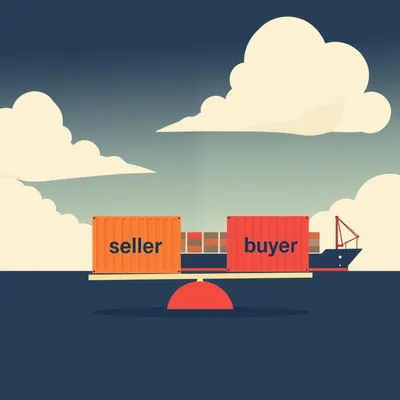
Let's talk about Incoterms, because this is where a lot of small shippers get burned. Incoterms are the International Commercial Terms published by the International Chamber of Commerce. They define who pays for transport, who bears risk, and where responsibility transfers from seller to buyer. There are eleven of them, but for our scenario, the most likely choice is either FOB — Free On Board — or DAP — Delivered at Place.
Walk me through the difference.
If we ship FOB, our responsibility as the seller ends when the goods cross the ship's rail at the Port of New York — or in modern terms, when they're loaded onto the vessel. The buyer in Israel pays for the ocean freight, insurance, and handles import clearance. If we ship DAP, we as the seller are responsible for everything up to delivery at the named place in Jerusalem — we pay freight, we handle export clearance, but the buyer handles import clearance and pays duties.
In practice, for a small brand entering a new market, DAP is probably what you want. You control the logistics chain. You're not asking your new Israeli distributor to figure out how to get a container out of Ashdod.
And DAP gives you cost predictability. You quote a landed price to your buyer, and they're not surprised by freight charges or port fees they didn't anticipate. The trade-off is you're carrying the risk during transit. If the container falls off the ship — which happens more than people realize, about fourteen hundred containers are lost at sea annually — that's your loss under DAP, unless you've purchased cargo insurance, which you absolutely should.
Always get the insurance. So our container arrives at Ashdod. The customs broker files the import declaration. What happens next?
Israeli customs reviews the declaration. They're looking at the declared value — is it consistent with market prices for kitchen goods? They're checking the HS codes — do the duty rates match the classification? They're verifying that the goods aren't subject to any import restrictions or special permits. Kitchen goods are straightforward, so this is usually a paperwork exercise. But Israel does have mandatory standards for certain categories — electrical appliances need to meet Israeli standards institute requirements. Our stand mixers and ice cream makers, if they're being sold commercially, may need specific approvals.
This is where a lot of people get caught out — they assume that if something is legal to sell in the US, it's legal to import everywhere.
That's absolutely not true. Every country has its own standards regime. Israel's is particularly detailed for electrical goods. If our stand mixer doesn't have the appropriate testing certification, it could be held at the port indefinitely. The smart move is to check this before you ship, not after.
Let's say we did our homework. The import declaration clears. Customs assesses duties and VAT.
Israel's VAT is currently seventeen percent, applied to the cost of the goods plus the cost of freight and insurance — the CIF value. Duties vary by HS code. Kitchen utensils might be eight to twelve percent. Small electrical appliances might be six to fifteen percent. The customs broker calculates the total, we pay it — or our broker pays it on our behalf and bills us — and the shipment is released.
Now we have a container sitting at Ashdod port that's been customs-cleared. But we're not taking delivery of a whole container. We're LCL.
So the container goes to a deconsolidation warehouse — a CFS on the Israeli side. The freight forwarder's partner opens the container, separates out all the different shippers' pallets, and ours get staged for pickup. This is the mirror image of what happened in New York. Our two pallets of kitchen goods are extracted from the shared container, and they sit in a warehouse in Ashdod waiting for us.
Meanwhile, our air freight has already arrived. Let's rewind and track that parallel stream.
The air freight stream moves much faster, but the process is structurally similar. Our pallet went to JFK, got consolidated onto a ULD, and flew — probably on a passenger flight, actually. Most air freight moves in the belly of passenger aircraft. The Tel Aviv route is well-served: El Al, Delta, United all fly direct from the New York area. Our kitchen goods are probably in the hold underneath someone's checked luggage.
Which is a wild thing to picture. Someone's watching a movie in business class while our spatulas are three meters below them in a pressurized cargo hold.
The flight is about ten to eleven hours. The ULD lands at Ben Gurion, gets offloaded, and goes to the air cargo terminal. The air waybill — the AWB — is the controlling document, and it moves electronically. The Israeli customs broker files an import declaration for the air shipment separately from the ocean shipment, even though they're part of the same commercial order.
Air customs clearance is faster?
Air freight is time-sensitive by definition. Israeli customs prioritizes it. Clearance can happen within hours. The broker files electronically, duties and VAT get assessed, payment is made, and the goods are released. The whole thing from touchdown to available-for-pickup can be under twenty-four hours.
Now we have two streams converging. The air freight has been in Jerusalem for two weeks already — we've unpacked it, shelved it, maybe already sold through some of it. The ocean freight has just cleared Ashdod. How does it get from Ashdod to Jerusalem?
The freight forwarder arranges what's called final mile delivery — or in this case, final fifty kilometers. A trucking company picks up our two pallets from the deconsolidation warehouse in Ashdod and drives them to Jerusalem. This is usually a straight truck with a lift gate. The driver has a delivery order that matches our shipment. The drive is about an hour, depending on traffic on Route One.
Then the pallets arrive at our warehouse or fulfillment center in Jerusalem. This is the moment where all that standardization pays off.
This is the payoff. The pallets come off the truck. Because we used Euro boxes on Euro pallets, everything is dimensionally predictable. The pallets slot directly into standard racking. The boxes are labeled with the same SKU system we used in Storrs. We cut the shrink wrap, pull the boxes off the pallet, and they go straight onto shelves. No repacking, no relabeling, no "what's in this box" guesswork.
The stand mixers and ice cream makers in their retail packaging get broken down differently. Those go to a separate staging area where they're either cross-docked for immediate delivery to retail partners or slotted into larger shelving units.
This is where the split shipment strategy really proves itself. While the ocean freight was in transit for three weeks, the air freight was already on shelves, generating revenue, proving the market. By the time the bulk shipment arrives, we have actual sales data — we know which SKUs are moving fast and which are slow. We can adjust our shelving plan accordingly. The air freight wasn't just a bridge shipment, it was a market test.
Let's circle back to something we glossed over: the cost breakdown. What does this whole operation actually cost?
Let's rough it out. Our ocean shipment is about one and a half cubic meters, maybe three hundred kilograms. LCL ocean freight from New York to Ashdod: roughly three hundred to four hundred fifty dollars. Export customs filing: maybe fifty to seventy-five dollars. Insurance: maybe one percent of declared value, so if our goods are worth ten thousand dollars, that's a hundred dollars. Israeli customs broker fee: around two hundred to three hundred dollars. Duties and VAT: that's on the goods value, but let's say roughly fifteen hundred to two thousand dollars all in. Final mile trucking: maybe two hundred fifty dollars. Total ocean leg: somewhere around twenty-five hundred to thirty-five hundred dollars, not including the actual duties and VAT which are a pass-through.
The air freight?
Air freight for our priority stream — maybe sixty kilograms, a third of a cubic meter — is probably running eight hundred to twelve hundred dollars. The customs broker fee is similar, maybe a bit less because the entry is simpler. Final mile is cheaper because it's smaller. Total air leg: maybe fifteen hundred to two thousand dollars.
Combined, we're looking at four to five thousand dollars in logistics costs to move maybe fifteen thousand dollars worth of kitchen goods from Connecticut to Jerusalem. That's a significant percentage.
It is, and this is why scale matters. If we were shipping a full container load, the per-unit cost drops dramatically. A forty-foot container to Israel might cost four thousand dollars all-in, but if you fill it with sixty cubic meters of goods worth a hundred fifty thousand dollars, your logistics cost as a percentage of goods value drops from thirty percent to under five percent. LCL is convenient but expensive per cubic meter.
Which is the classic small-importer trap. You're paying a premium for flexibility.
There's another cost we haven't mentioned: demurrage and detention. Demurrage is what the port charges you if your container sits at the terminal beyond the free time, which is typically three to five days. Detention is what the shipping line charges if you keep their container beyond the allowed free days after pickup. For LCL, demurrage on your pallets sitting in the CFS works similarly — you get a few free days, then storage charges kick in. If your customs clearance gets delayed, those fees add up fast.
The clock is ticking from the moment the ship docks. Your broker needs to be on it.
A good broker is worth their weight in gold. They know the customs officers, they know which HS codes are getting scrutiny this month, they know when to push and when to wait. The difference between a shipment clearing in two days versus two weeks is often the broker.
Let's talk about what can go wrong, because the smooth path we've described is aspirational.
Where do you want to start? The container misses the transshipment connection in Piraeus and sits on the dock for a week. The customs officer decides the declared value looks low and requests a valuation review. The standards institute flags the ice cream maker as requiring additional testing. The truck from Ashdod breaks down on the Jerusalem road. The pallet gets damaged during deconsolidation and three Euro boxes are crushed.
The air freight — the flight gets delayed, the ULD gets misrouted, the customs broker's system goes down on a Friday afternoon before Shabbat and nothing moves until Sunday.
Every single one of these has happened to someone I know. The key is building buffer into your timeline and budget. If your launch date depends on the ocean shipment arriving in exactly twenty-one days, you're already in trouble. Plan for thirty, celebrate if it's twenty-one.
The Incoterm we chose — DAP — also means we're carrying the risk for all of those failure modes during transit. If we'd shipped EXW — Ex Works — the buyer would bear all risk from our warehouse door. But for a small brand entering a new market, EXW is basically saying "good luck" to your buyer. Not a great relationship-builder.
There's a middle ground that's becoming more popular, especially for e-commerce brands: DDP — Delivered Duty Paid. The seller handles everything, including import duties and taxes, and the buyer just receives the goods. It's the most buyer-friendly term, but it requires the seller to be registered for VAT in the destination country, which is an administrative hurdle.
For our hypothetical kitchen goods brand, DAP is the sweet spot. We control the logistics, we pay the freight, we get the goods to Jerusalem, and the buyer handles import duties. It's clear, it's fair, it's standard.
It's what most freight forwarders are comfortable with. They can quote you a DAP rate without blinking.
Let's zoom out. What's the big lesson from tracking this entire lifecycle?
The big lesson is that international shipping isn't one process — it's about fifteen processes that have to happen in sequence, each dependent on the one before it, spread across multiple companies, multiple countries, and multiple modes of transport. The reason standardization matters — Euro boxes, ISO pallets, shipping containers, HS codes, Incoterms — is that without it, the handoffs between those processes would be chaos.
Every handoff is a point of failure. Standardization reduces the surface area of those handoffs.
When you hand a Euro box to a freight forwarder, they know exactly what they're dealing with. It fits on their pallets, it fits in their racking, it stacks predictably. When you use a recognized Incoterm, the responsibilities are unambiguous. When you classify with the correct HS code, customs on both ends processes it without friction. The entire system is built on mutual recognition of standards.
The split shipment strategy — air plus sea — is really a recognition that time and cost are both dimensions of logistics, and you can optimize across them if you plan carefully. The air freight buys you speed and market intelligence. The ocean freight buys you scale and margin. Together, they're a complete go-to-market logistics strategy for a small brand.
One last detail that's worth mentioning: the documentation doesn't end when the goods arrive. You need to retain all of this — the commercial invoice, the bill of lading, the air waybill, the import declaration, the customs payment receipts — for at least five years. Israeli tax authority can audit import records, and if you can't produce the paperwork, you're in trouble.
The least exciting part of international shipping, and somehow the most important.
That's logistics in a sentence, really.
Now: Hilbert's daily fun fact.
Now: Hilbert's daily fun fact.
Hilbert: In the seventeen eighties, French naturalists exploring the seamounts off Djibouti documented over eighty species of reef fish found nowhere else on Earth — an early glimpse of seamount endemism, driven by the same geological isolation that had, entirely by accident, turned those underwater mountains into de facto marine nature reserves centuries before anyone thought to protect them.
The French accidentally created marine parks by just... not being able to reach them.
Conservation through inconvenience. I'll take it.
This has been My Weird Prompts. Thanks to our producer Hilbert Flumingtop. If you enjoyed this, do us a favor and leave a review wherever you listen — it genuinely helps other people find the show. We're back next week.