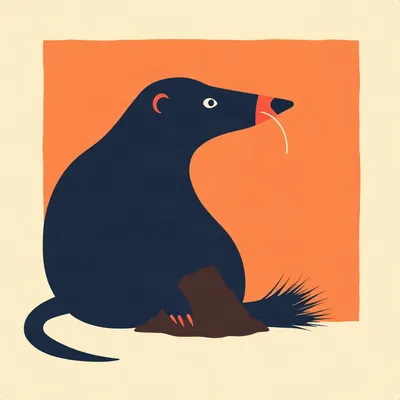
A hundred and fifty times a minute. That is how often a giant anteater can put its tongue out and pull it back in while it's feeding. Two and a half flicks a second, for a tongue that is about sixty centimetres long.

Longer than its head. Considerably longer than its head.
And the reason I know that is that Daniel wrote in with a complaint about our own show. Hilbert has been producing this thing for years, he turns up in nearly every episode, everyone knows he's an anteater, and nobody has ever once asked him what that's actually like. What does he eat. When does he sleep. How does a man with those claws work a mixing desk. Daniel wants it done properly, grounded in real anteater biology, and he wants the two of us to do the interview.
A donkey and a sloth, interviewing an anteater about the anteater experience. Rigorous journalism.
Daniel also pointed out something I'd have been happy to leave alone, which is that sloths and anteaters are close relatives. Zoologically. Same order.

Pilosa.
He was listening.
I'm always listening. It's the job. Pilosa means hairy, by the way. Somebody looked at the two of us, a long time ago, and that was the best he could do.
That's not unfair, Hilbert. Pilosa is anteaters plus sloths, and Pilosa sits inside Xenarthra, along with the armadillos. The split between your line and Corn's line is usually put at somewhere around sixty million years ago. Give or take a few million, depending on whose molecular clock you trust.
Sixty million years. And still the same table.
Same chairs, I notice. You moved yours.
I moved it for the sound.
You moved it eleven centimetres. I know where the marks on the carpet are.
Let's do the basics, because I don't think listeners actually know which anteater you are. There are four genera, and they are wildly different animals.
Giant. Myrmecophaga tridactyla. The one people draw.
The big one. Up to around two metres including the tail, the long tube of a face, the brush of a tail. Then you've got the tamanduas, which are about half the size and spend a lot of time in trees, they've got a prehensile tail. And then the silky anteater, which is tiny. A few hundred grams. Lives entirely in the canopy, comes out at night, and as of a few years ago it turned out not to be one species but at least seven.
Seven species of something nobody had seen properly in the first place.
The silkies are fine. They keep to themselves. I've never had any trouble from a silky.
Are you saying you've had trouble from a tamandua?
I'm saying the tamandua has a smell, and he knows he has a smell, and he does nothing about it.
That one's real, actually. Tamanduas give off a strong odour when they're threatened. Field guides are not kind about it.
Herman, before we go any further, give me the thing that I suspect you've been waiting to say since Daniel's prompt came in.
Which is what?
Where the donkey sits on this tree.
Hm. Fine. I'm nowhere near either of you. Xenarthra is one of the four great branches of placental mammals, and it peeled off very early. The horses and donkeys are over on a completely different branch, the one with the bats and the carnivores and the whales. So genetically speaking, I am closer to a humpback whale than I am to either of you.
That explains a great deal about the way you sing in the kitchen.
It explains nothing about my singing. My singing is my own.
The whale would be a better producer. Doesn't need a chair.
Daniel's real curiosity is the day to day. Hilbert, what do you actually eat? Because I have shared a fridge with you on recording days and I have never seen an ant in it.
You wouldn't. The ants don't go in the fridge. That's the first rule.
There are rules.
There are always rules. The termites are delivered on a Tuesday by a man called Avner, who has a business in Talpiot that is mostly bathroom tiles. The termites are a side arrangement. I've been buying from him for nine years, and in nine years he has not once got the weight right. He rounds up. Every week, he rounds up, and then he charges me for the rounding.
Real giant anteaters go through an enormous number of insects. The figure you see quoted is up to around thirty thousand a day, and some sources go higher.
Avner would like that figure. He'd put it on the invoice.
The more interesting part, to me anyway, is how they feed. They don't wreck the nest. A giant anteater rips a hole, feeds for maybe a minute, sometimes less than that, and then it walks away and goes to the next mound. Ants and termites fight back, soldiers bite, some of them spray chemicals, so the anteater takes a little and leaves before the colony gets organised. Then it comes back to the same nest another day.
So you're not a predator. You're a regular.
I'm a regular everywhere. One minute. Never more than one minute. Not at a nest, not at a buffet, not at a counter. You get what you can get in a minute and you leave before anyone mobilises.
You've stood at the bakery for longer than a minute. I've seen it.
I left and came back. Four times. To the girl behind the counter it looks like one visit. It isn't.
That's genuinely how the colony would experience it, honestly. Lots of short raids that never quite add up to an attack.
Herman, does it bother you that he has a system and you don't?
I have a system.
You graze. You open the cupboard, you take a cracker, you close the cupboard, you open the cupboard. That isn't a system, that's a door hinge with a hobby.
It's a hindgut fermenter's lifestyle, Corn. Donkeys are built to eat a lot of rough, fibrous, low-quality food, in small amounts, nearly all day. I'm doing what I evolved to do.
Crackers are not rough, fibrous food.
The ones you buy are.

Close your eyes. Now open them. Slower. Xenarthra. The extra joint. The joint you never knew you had. Sixty million years in the making, and now, at last, for your home. Xenarthra. For the cupboard door that whispers instead of creaks. Silicone hinge spray, two hundred millilitres. Strange joints deserve to be heard. Or rather, not heard.
The teeth are the other thing people don't realise. Hilbert, you don't have any.
None.
Not one. Giant anteaters have no teeth at all. The mouth opening at the end of that long snout is tiny, it's often compared to the width of a pencil. So the tongue does the collecting, it's coated in very sticky saliva and covered in little backward-pointing spines, and then everything gets swallowed whole. The grinding happens in the stomach. They swallow grit and sand along with the insects, and the stomach, which is muscular, does what teeth would have done.
So you chew with gravel.
I don't chew. Chewing is something that happens to me later.
For comparison, I've got a full set of big grinding molars, that's the whole donkey business model. And Corn, you've got teeth, but they're strange teeth.
My teeth are fine.
Sloth teeth have no enamel. None. They're simple pegs that keep growing, and there are no proper incisors at the front, so you crop leaves with your lips.
I prefer to think of it as a minimalist arrangement.
That's the first thing he's said about his own body this year that wasn't a complaint about the chair.
Here's where I'd expected us to be completely different, Hilbert, and it turns out we aren't. The temperature thing.
Go on.
I run cold. Sloths have some of the lowest and most variable body temperatures of any mammal, we drift with the weather. And I'd assumed an anteater, out on the grassland, walking about, would be a normal warm mammal like Herman.
You'd think so. But a giant anteater runs at around thirty-three degrees when it's active, which is a good three or four below what you'd expect for a mammal that size. And its metabolic rate is roughly a third of a typical placental mammal of the same weight. The usual explanation is the diet. Ants and termites are a lot of chitin and formic acid and not much energy per bite, so the whole animal is tuned to spend as little as it possibly can.
So we're both running on economy mode, from completely different directions. I'm on leaves, he's on ants.
Leaves are terrible food too, to be fair. Tough, full of defensive chemicals, very little energy. Sloth digestion is about the slowest of any mammal. One meal can sit in there for days.
That's why the studio is kept at twenty-six degrees.
The studio is not kept at twenty-six degrees.
The studio is kept at twenty-six degrees on the side of the room where Corn and I sit. Your side is a separate climate. I worked that out years ago. The ducting does what I ask it to.
I did wonder why there's a fan pointed only at me.
It's a courtesy.
What do you do when you're cold, though? Properly cold.
The tail.
This is a real behaviour. Giant anteaters sleep curled up with the head tucked between the forelegs, and they pull that huge bushy tail over the top of the body like a blanket. It's insulation. Some measurements suggest their temperature drops several degrees during sleep, a kind of shallow torpor.
How long do you sleep?
Fourteen hours. Fifteen if Avner is late.
Which is right in the range people quote for giant anteaters, up to around fifteen hours a day of rest.
Fifteen hours. That's a good night, for me. That's not a lifestyle.
You two are the only people I know who argue about who sleeps more and both think they're winning.
I am winning. I'm just winning slowly.
Corn, I want to ask you something, because I think you'll answer it differently from Hilbert. If you had to name the single biggest thing the two of you share, the thing that actually makes you cousins rather than two animals who happen to be slow, what would you pick?
Honestly? The lower back.
That's the right answer.
It's the name of the whole group. Xenarthra means strange joints. All of us, sloths, anteaters, armadillos, have extra little joints between the vertebrae in the lower back, extra points of contact that nobody else has. Which is either an ancient structural reinforcement or the reason I need a cushion.
Both. It's both. You need the cushion.
The usual idea is that those extra joints stiffen and brace the lower spine. For an anteater, that matters, because you're tearing into termite mounds that can be hard as concrete.
Harder. Some of them are harder than the bathroom tiles. I've asked Avner about it. He doesn't sell the mounds.
And then the claws.
The claws are the other thing.
Big ones. On the giant anteater, the long front claws are around ten centimetres. So big that the animal can't walk flat on its palms. It folds the claws in and walks on its knuckles, which keeps them sharp and out of the way.
I hang from mine. You walk on top of yours. Same equipment, completely opposite approach.
And I walk on one toe per foot. A hoof is a single enormous toenail. So at this table we have knuckles, hooks and tiptoes.
Which is why nothing in this building fits. You have any idea what a mixing desk is like with these? The faders are a centimetre wide. I do the whole show with the second knuckle on the left hand. The right hand I keep for emergencies. The mute button is the size of a lentil.
How do you type?
I don't. I dictate to the computer. It has opinions about my accent.
That's the other thing those claws are for, by the way, which people forget. Giant anteaters are not pushovers. When something threatens one, it can rear back on the hind legs and the tail, like a tripod, and slash with those front claws. There are documented cases of a jaguar coming off worse.
I'll file that next to all the other reasons I keep my chair where it is.
Eleven centimetres.
Eleven centimetres is a respectful distance between colleagues.
It's the width of one claw and a bit. I measured.
Can I raise the eyesight question, because I think it's the most practical one for the job. Hilbert, how well can you see the studio?
Badly. Anteaters have poor eyesight. I see the board as shapes. Big shape is Herman. Smaller shape that doesn't move is Corn. If the smaller shape hasn't moved for forty minutes, I check the levels anyway, in case it's asleep.
The sense of smell, on the other hand, is enormous. That's how they find the nests in the first place.
I know what everyone had for lunch. I know when Herman's been at the crackers. I know the gentleman who delivers the coffee capsules has a cat he's lying to us about.
I'm going to push on the part that's actually different between us, because Daniel was right that it's not all convergence. The big split is where we live. I'm up a tree. You're on the ground.
The giant anteater is a ground animal. It lives in grassland, savanna, open forest edges. The silky anteater and the tamanduas are the climbers. So the anteaters cover the whole range, from the ground up into the canopy, and the sloths, today, are only up in the canopy.
Today.
Today. There were ground sloths. Huge ones, some the size of an elephant, walking about the Americas. The living tree sloths are what's left of that whole group. And the current thinking is that the two living kinds, the two toed and the three toed, aren't actually each other's closest relatives. They seem to have taken up life in the trees separately.
So my family went up the tree twice.
More or less.
That's the least surprising thing anybody has said today. If one ancestor can find a good branch, another one will.
And mine stayed on the ground and got on with it.
That's the fair... no. Let me put that differently. The thing your lot didn't do, Hilbert, is the bit Corn's lot did. Sloths come down from the tree about once a week, at real risk, to go to the toilet at the base of the tree. There's a moth that lives in sloth fur and lays its eggs in the dung, and the moths seem to feed an algae that grows in the fur, which the sloth then eats a bit of.
That's a lot of arrangements for one week.
It's a closed loop. It's very elegant. I wish we'd stop describing it on air.
I don't have any of that. My fur's my fur. Nobody lives in it.
It isn't a competition about who has the most tenants.
You'd win.
Social life is the last comparison, and on this one the two of you are frankly the same animal. Giant anteaters are solitary. They come together to mate and that's it. The mother carries the baby on her back for months, and then it goes off on its own.
I like people.
You do not like people.
I like people in one-minute increments.
Sloths are about the same. Solitary, quiet, slow. And donkeys are the opposite. Donkeys bond hard. A donkey on its own gets miserable.
Which is why you live with us.
It's why I put up with the two of you.
The tile shop is closed on Thursdays. I want to say that now, because Herman has been talking about the termite mounds for twenty minutes as though the ants are the hard part. The ants aren't the hard part. The supply is the hard part. You can't get termites in this city. You get them from Avner, or from his cousin Shmulik in Bet Shemesh, who is cheaper and sells you the ones with wings. The winged ones go straight up into the lighting rig. There were nine hundred of them in the rig last spring, and Avner charged me for those as well, on the grounds that they had left his premises.
Winged termites are the reproductive caste. They're the ones that leave the colony to start a new one. So in fairness, they did leave his premises.
That was his argument too.
What does the one-minute rule do to a relationship with a supplier like that? You can't haggle in a minute.
No. You can't. Which is why I haven't haggled in nine years. I go in, I pay what the scale says, I'm out before anyone mobilises. Avner thinks I'm the easiest customer he has. I am not. I've been visiting four times a day. To Avner it's one customer. To me, it's a campaign. The price per kilo has gone down eleven agorot since I started. He hasn't noticed. He thinks it was inflation going the other way.
You've been farming him. You've done to Avner exactly what a giant anteater does to a termite mound. Take a little, never enough to provoke a defence, come back tomorrow. The colony never notices it's being managed.
I hadn't put it that way.
The trouble is, Hilbert, a termite colony doesn't have a cousin in Bet Shemesh. The moment Avner works out what's been happening, he can send you to Shmulik, and Shmulik sends you the winged ones.
Mm. Fair. I'd still go. The winged ones are fine. You keep the rig switched off.
I think what's struck me, doing this, is how much of the anteater life is about not spending. Every single trait points the same way. Low temperature, low metabolism, short visits, long sleeps, the tail as a blanket. Nothing is wasted.
Mine hangs still in a tree and lets the leaves sit for a week. His walks for miles and never stays anywhere more than a minute. And somehow we've both ended up cold in the same corner of the room.
While the whale's cousin sits by the fan.
Hilbert's whole method with Avner is the giant anteater's method with a termite mound: little and often, and leave before anyone notices. Which makes me wonder how many of the people we deal with every week are doing the same thing to us, one minute at a time.
That is going to bother me at the bakery.
It should. Thanks, as always, to our producer Hilbert Flumingtop, who kept the levels in order today with one knuckle.
This has been My Weird Prompts. If you've enjoyed it, a review on Spotify really does help people find the show.
We'll be back soon.