Ten million people. That's the whole argument against it. Every export manager in the world looks at Israel, sees ten million people, and moves on to the next row of the spreadsheet.

And every importer in Israel is very happy that he does.
That's Daniel's point, more or less. He's said it before and he's said it again this week. The quiet fortune in this country is the exclusive import deal. One family has the letter from the brand, and for thirty years nobody else gets to bring it in. His question is the hard version. You find a product you love, it isn't sold here, you think Israelis would buy it, and you have no relationship with the brand and no background in the industry. Every card is stacked against you. How do you get the letter anyway?
He wants the whole thing, start to finish, including what you say when they tell you no. And there's one man in this building who has been told no by more companies than anyone alive, and he's in the guest chair again.

Zojirushi.
Herman Poppleberry, and I think Hilbert has already picked the product.
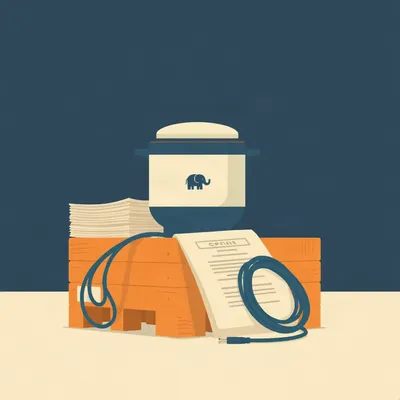
Rice cookers. The Japanese ones. The elephant on the box.
That's what the name means, isn't it? Elephant brand.
Elephant mark, roughly. It's a lovely old company. Osaka, founded in nineteen eighteen by two brothers, the Ichikawas, and they started out making the glass liners for vacuum flasks by hand. The elephant became the corporate logo when they renamed the company in the sixties, and the first electric thing they made was a rice warmer, around nineteen seventy. Now they're the rice cooker people have heard of. The fuzzy logic ones, the induction ones, the pressure ones that cost more than my first car.
Your first car was a bicycle with a dented basket.
It had gears, Corn.
You can't buy one here. Not properly. You can buy one off a website in America and have it forwarded, and then you've got a hundred and twenty volt cooker in a two hundred and thirty volt kitchen, and you find out what that means about four seconds after you plug it in.
Dinner and a show.
Or you buy one the man in Bnei Brak brought in a suitcase. No warranty. Manual in Japanese. That's the market. That's the gap. Daniel's right that it's sitting there.
I'll give the case for it before we get clever. Rice is not a side dish in this country. You've got Persian families, Iraqi families, Bukharan, Yemenite, Kurdish, all with serious opinions about rice. And then you've got Shabbat. A machine whose entire personality is keeping something warm, safely, for a very long time, in a country where half the population needs food kept warm from Friday afternoon to Saturday lunch. I think the product sells itself.
Nothing sells itself. That's step zero.
There's a step zero.
Step zero is you stop thinking about the brand. Everybody who wants to be an importer starts by writing to the brand. They find the email on the website and they write, dear Zojirushi, I am very passionate about your rice cookers. That email goes to a room in Osaka where emails from passionate people go, and nobody has ever come out of that room.
So what's step one?
Step one is the sacrificial pallet.
I'm going to need that one explained.
You buy the stock yourself. Before you've spoken to anyone. Forty units. Not from America, from Europe, because Europe runs on the same voltage we do and the European models carry the European markings. You land them, you pay the duty, you sell them. You sell them to people you've never met, at full price, in under a month. That pallet is going to die for the cause. You may not make a shekel on it. It isn't there to make money. It's there so that when you finally speak to the brand, you are not a man with an idea. You're a man with forty customers and their phone numbers.
The European sourcing is cleverer than it sounds, actually. Israel changed the rules recently. There's a reform the government sells under the slogan, what's good for Europe is good for Israel. The electrical part came in during late twenty twenty-four, and the standards side from January twenty twenty-five. The short version is that a product which complies with the European regulations Israel has adopted can come in on the importer's own declaration of compliance, instead of sitting at the port waiting for the Standards Institution to test it.
Which used to take how long?
Long enough that it was a business model to be the person who'd already been through it. That was one of the hidden moats of the old exclusive importers. Not the letter from the brand. The fact that they'd survived the testing, and you hadn't.
The catch is it's on you now. The declaration's your name. If the thing catches fire in Petah Tikva, nobody at the port signed for it. You did.
So the sacrificial pallet comes with a sacrificial signature.
It comes with a product file, Corn. Documents. You keep every piece of paper. You keep the European paperwork the distributor sends you, and you keep it somewhere a cat can't get at it.
Corn, would you buy a rice cooker off a stranger on a Facebook group? Forty of these have to go to someone.
I'd buy it if a stranger had already cooked rice in it in front of me. Which is the actual marketing plan, isn't it? Not ads. A man in a kitchen in Holon making a pot of rice on camera and then not touching it for nine hours while it's still perfect.
You do it on Friday. You film it at two in the afternoon and you film it again on Saturday at noon. Same pot. Same rice. You don't say anything. You don't need to.
That's genuinely good. That's a better ad than the brand runs.

Are YOU tired of NOT being an exclusive importer? Introducing Exclusive Distribution In A Box, the only kit that grants you the sole and permanent rights to import any brand on earth, just by opening the lid! Normally ninety-nine ninety-nine, but if you call in the next ten minutes, sixty-nine ninety-nine! No, forty-nine! No, twenty-nine ninety-nine, and we'll throw in a sacrificial pallet, a customs broker who is legally also a notary, a rice cooker that cooks EUROPEAN rice, a laminated letter from a brand of your choosing, two parallel importers to keep as pets, and a lifetime supply of fuzzy logic! Eight ninety-nine! Four ninety-nine! This offer has now expired. This offer expired before you heard it. Terms and conditions are in Japanese.
Well, the first problem is that you can't license exclusivity to a brand you don't...
Herman. It's in a box.
Fine. Where were we? Forty cookers, sold, and a man with phone numbers.
Step two is finding the right person. Not the brand. The person at the brand whose job Israel is.
Who is that? Does anyone even have that job?
Usually nobody, which is the point. A company like this sells through regional distributors. There's somebody for Europe, somebody for the Gulf. You can buy their cookers in Dubai, in the department stores there, two hundred and thirty volt models, the lot. So somebody in that company already makes the hot-country, high-voltage version. Somewhere in their export department there is a man with a spreadsheet, and Israel is a row on it, and the row is blank.
The blank row.
You're not asking him for a favour. You're offering to fill in his row. Nobody ever got a bonus for a blank row. And he's got a number he's been told to hit, and you're arriving with forty units of sales he didn't have to do anything for.
How do you actually get to him, though? Corn, you've done a bit of this, cold approaches to people who don't owe you anything. How would you find the man with the spreadsheet?
I'd find out who the regional distributor is for the nearest market, and I'd buy something from them. A real order, small. Then I'm not a cold email, I'm a customer with an account number asking a question. And the question is, who at head office handles markets you don't cover?
That's it. You go in through the shop door. Everybody tries the front door and the front door is the room in Osaka.
That's the sacrificial pallet doing double duty, actually. If you buy your forty from the European distributor, you've just become their customer.
And they've seen your name on an invoice. An invoice is a better introduction than any letter you could write.
Step three, presumably, is the meeting where they say no.
Step three is the objections. There are six. There are always six. I've heard them from rice cookers and I've heard them from people selling things a great deal less respectable than rice cookers.
Go on, the first one has to be experience.
The first one is, you've never done this. They'll say it nicely. They'll say, we usually work with established partners in the housewares category. What they mean is, who are you. And the answer is not your CV. You don't have one. The answer is three names. Your customs broker, your warehouse, and your repair man. You put three named people on the table who've done this a thousand times, and suddenly you're not the inexperienced one. You're the man who hired the experienced ones.
The repair man is doing a lot of work in that sentence.
The repair man is the whole sentence. I'll get to him.
Second objection. The country's too small.
They say, ten million people. You say, ten million people who keep food warm for twenty hours every single week by law. Show me another market where the main thing your product does is a religious obligation.
I love that. I do think there's a caveat, though, for the Shabbat crowd specifically. People who keep it strictly don't want a machine that's doing anything clever on Saturday. A keep-warm setting is one thing. A fuzzy logic chip deciding to adjust the temperature on its own is a question for a rabbi, and I'm genuinely not sure how the answer comes out.
You'd need a rabbi to bless the algorithm.
You'd need a certification. There are bodies here that certify appliances for Shabbat. You get the cooker looked at, you get the sticker. That's a cost. You put it in the sums.
Herman, there's a bigger cultural problem and you know what it is. You were heading straight for it with the Persian families.
The crust.
The crust. A Persian family wants tahdig. The crispy bottom. A Japanese rice cooker has spent a hundred years of engineering trying to make sure there is no crispy bottom.
There are Persian rice cookers built for exactly that, and they're already here. So you're right, that's a segment you probably don't win.
Then you don't sell to that segment. You don't need everybody. You need the forty, and then the four hundred. You sell to the people who want the rice to be the same at noon on Saturday as it was at four on Friday. That's not the crust people. That's the Thursday people.
The Thursday people.
People who cook on Thursday. You'll know them when you see them.
Third objection.
Exclusivity. You want it, and that's the one thing you must not ask for. Not at the start. If you open with, give me Israel for ten years, they hear a stranger asking for a country. You ask for a letter. Authorised distributor. Non-exclusive. One year. And you write your own targets into it. You say, if I don't sell this many in twelve months, you can give it to anyone you like. Nobody in that office has ever had a stranger offer to be fired.
There's a twist on this here, and it's one of the more interesting things in Israeli competition law right now. The exclusive letter isn't worth what it used to be. Under an amendment to the Economic Competition Law from twenty twenty-three, an official importer isn't allowed to use contractual restrictions to block parallel importers. The Competition Authority can fine an importer for it, up to a hundred million shekels, and they've been using it. They proposed a fine of about fifteen point seven million shekels against the importer of KYMCO scooters. There was a case where an importer was photographing the frame numbers on motorbikes that came in through parallel importers and sending the pictures to the manufacturer.
Snitching on scooters. That's a career.
And one where a Samsung importer reported specific products that came in through a parallel importer back to Samsung. The authority treats that as blocking competition. So the old fortune Daniel's describing, where you hold the letter and nobody else can bring the thing in, is a lot leakier than it was ten years ago.
Which raises the obvious question. If the letter doesn't stop anybody, what's actually lucrative about being the official importer?
My guess, and I think it's the right one, is the warranty. When the parallel importer sells you a cooker and it breaks, who fixes it? The brand honours the warranty through its official channel. The Competition Authority went after Carasso Motors on exactly this point, because they were making it hard to get service on cars that came in through parallel importers. Service is where the leverage moved.
Which is objection four. Who fixes them.
The repair man.
His name is Yuval, he has a workshop in Ramla behind a falafel place, and he can open anything with a screw in it. You don't ask him if he can fix a Zojirushi. You give him one from the sacrificial pallet and you let him take it apart and put it back together. Then when the brand asks who services the warranty, you say Yuval, and you send them a photograph of Yuval holding the inner pot. That photograph is worth more than the forty sales.
That's backwards from how people think about it. Everyone thinks the brand cares about how much you can sell. What it's actually worried about is the cooker that breaks in Israel and makes the elephant look bad.
Nobody in Osaka is losing sleep about Israel. But somebody would lose sleep over a bad review in Hebrew they can't read.
Five?
Money. They'll want payment up front, or a letter of credit through a bank. You say yes. You don't argue. You're a stranger, they're right to want the money first. Arguing about payment terms on the first order is how you tell them you haven't got it.
And six?
Six is Hebrew. Labels, the safety instructions, the manual. They'll say, we don't have materials in Hebrew. You say, I've already translated it. And you have. You did it during the sacrificial pallet, because the forty people who bought it needed to know which button is which.
The Hebrew safety instructions are one of the bits the importer's on the hook for regardless, so you were going to have to do it anyway. Corn, do you buy this? As a playbook. Is it actually doable by somebody with no background?
I think it's doable, and I think the reason it's doable is that none of the six objections is about rice cookers. They're about whether you'll embarrass the brand. Every answer Hilbert gave is a different way of saying, I've already done the work, here's the proof. The sacrificial pallet, Yuval, the translated manual. The only thing you can't prove in advance is that you'll keep doing it.
That's what the targets are for. You offered to be fired.
Which I'll admit is a strong move. I've never once offered to be fired from anything.
You've never once been hired for anything.
I've been on this podcast for years, Herman.
Nobody hired you. You were on the sofa when we started recording.
Herman, every time you say fuzzy logic your voice goes soft. Like it's somebody you used to go out with.
It's a lovely phrase. It's a lovely idea, a controller that works in degrees rather than yes or no.
I emailed them.
Emailed who?
Zojirushi. During your bit about the Iraqi families. Not Osaka. I found the European distributor, the one with the two hundred and thirty volt models, and I placed an order. One cooker. Account number, invoice, the lot. Then I wrote back on the same thread and asked who at head office handles markets they don't cover. I did it in the order I said. I'm not going to do it out of order on my own podcast.
And?
They replied twelve minutes later. A man called Dieter. Very polite. He said he'd pass the enquiry to the export team, and could I confirm the name of my company and my warehouse address. So I registered a company. You can do it online now. It took about as long as Herman's explanation of the reform. Flumingtop Elephant Trading. I didn't want the elephant at first, I thought they'd take it as cheek. Then I thought they'd take it as respect.
A warehouse is the one thing you don't have.
The warehouse is my brother-in-law's. Aurelio. He has a unit in the industrial zone outside Ashdod. I gave Dieter that address. The difficulty is that Aurelio's unit currently has forty-one rice cookers in it already. Not Zojirushi. A Korean brand. Two years ago I ordered one from a wholesaler and filled the quantity box in on the wrong line, so it said forty-one cartons instead of one. They arrived on a lorry. Aurelio's had them since. He uses them. He's not a rice man, he's a beekeeper, he keeps the cookers on the warm setting at the back of the unit, in a row, because he says the bees in the spare hives stay calmer in the winter if it's a few degrees warmer near the door. I've asked for them back. He says they're structural now.
Forty-one cookers on keep-warm, running all winter. The electricity alone...
That's the dispute. He wants me to pay half the bill, because they're my cookers. I say they're his heaters, because they're heating his bees. It's been going since last November. I sent him a message this morning saying the unit was about to become an official Zojirushi warehouse and could he clear a shelf. He sent back a photograph of the forty-one cookers with the little orange lights on, and underneath he wrote, which shelf.
So the sacrificial pallet already exists. It's just from the wrong country and it's keeping bees warm.
Dieter wrote again at the top of the hour. He's asked for a photograph of the warehouse.
You can't send that photograph, Hilbert.
I've already sent it. He said the unit looks very well organised, and asked how many units of floor space I'd need for a first order of two hundred.
Two hundred is a real number from a real export department, though. That's not a polite brush-off. That's a man asking where to put a pallet.
Which is the part of this I'd hold on to. The thing that got Hilbert a reply in twelve minutes wasn't a pitch. It was an invoice for one cooker, and a question asked through the shop door.
And everything after that was just answering the objections before anyone raised them. If Daniel actually does this, the bit I'd watch is that order of two hundred. Somebody always asks what the first real order is, and nobody asks where it goes until a lorry turns up.
Thanks, as ever, to our producer Hilbert Flumingtop, who kept the levels clean through a frankly unreasonable amount of rice.
This has been My Weird Prompts. If you've enjoyed this one, you'll find the whole back catalogue at my weird prompts dot com.
See you tomorrow.