You can like your own voice more when you don’t know it’s yours. Daniel’s asking why the recorded version makes people wince, whether doing radio or podcasts eventually fixes that, and what changes when an artificial copy can read words you never said.

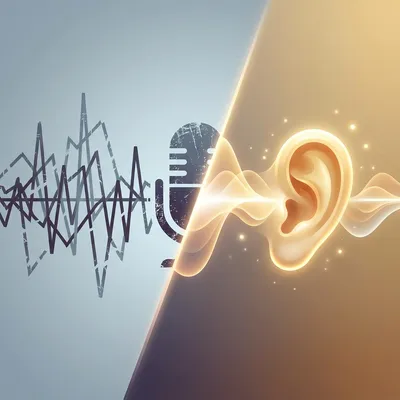
That first part sounds like a simple acoustic mismatch. It isn’t simple, but the mismatch is real. You hear your own voice through the air and through the bones of your skull. A recording gives you only the sound travelling through the air.
The recording has less bass and more evidence.
That’s the immediate shock. Your inward voice has a lower, richer quality. The outward voice can sound thinner, higher, and oddly unfamiliar. But the cringe isn’t just your ears complaining about the mix. Psychologists had a name for the reaction by 1966: voice confrontation.
A strong name for hearing a voicemail.
Holzman and Rousey were interested in the discomfort of hearing qualities in your voice that you hadn’t intended to express. You might hear strain, uncertainty, sadness, irritation. The sound arrives as evidence of you, but it doesn’t match the version of you that you were experiencing while you spoke.
So the recording catches the voice you were using, not the voice you thought you were using.
It’s not merely, “My voice is higher than I expected.” It’s, “I sounded unsure,” or, “I thought I was being clear.”
I have been confidently unclear on tape.
Most of us have. There’s a four-filter account Rebecca Kleinberger uses to explain why your internal experience of your voice is so different. The first filter is bone conduction. The other three are quieter, but they build the gap.
Bone conduction gets blamed first because it has a diagram.
It deserves some blame. When you speak, sound travels through the air into the ear canal, vibrates the eardrum and middle ear, and reaches the cochlea. At the same time, vibrations from your voice travel through your skull directly to the cochlea. Your brain combines those routes.
A private audio system. No invoice.
The bone route carries rich low frequencies that don’t arrive in the same way through the air. So the voice you hear while speaking sounds deeper and more resonant. A microphone captures the air-conducted sound, not what your skull is doing to your hearing.
The microphone has declined to fit inside my head.
Sensible engineering decision. The result is that your recorded voice sounds thinner and higher than the voice you’re accustomed to hearing. Kleinberger’s second filter is mechanical. When you vocalize, a protective mechanism helps shield the inner ear from the sound you’re producing.
Your body turns itself down.
In a way. That protective partition has been documented in frogs loud enough to risk deafening themselves. A frog can make a very loud call and still needs its ear to function.
Frogs have a better monitor mix than I do.
Their mechanism reduces the impact of their own vocal output. The sound arriving while you speak has already been filtered by your body. A recording doesn’t go through that same process.
So playback isn’t just missing the bass. It’s also missing a little protection.
Yes. Then there’s the biological filter. Cochlear hair cells respond less to a sound that’s constantly present. They habituate. Your own voice is one of the most familiar sounds in your life, and your hearing system doesn’t treat every moment of it as fresh information.
My voice is ambient music.
Your voice is so constant it can become part of the background. You speak, and your brain gets a familiar signal it has learned to discount.
I’ve been background music for years. No one has asked for the album.
The fourth filter is neurological. When you prepare to speak, your brain predicts the sound you’re about to make and reduces its response to your own vocal output. Your voice is heard, but your brain doesn’t attend to it as closely as it does an unexpected sound from someone else.
It has already heard the rehearsal.
Your brain predicts the sound and dampens its response. A recording plays back without that prediction, without bone conduction, and without the same mechanical and biological filters. The voice arrives as if it belongs to another person.
A stranger who has your vocabulary.
And your pauses. Which may be worse.
The pauses have lawyers.
The mechanics explain why it sounds wrong, not why it can feel so exposing. Holzman and Rousey called it a “sudden confrontation with expressive qualities” you didn’t mean to reveal. You might have thought you sounded calm and hear yourself sounding unsure. Or you thought you were joking and the recording has a sharp edge.
The voice reports what the sentence says and what the rest of you was doing.
Yes. You hear timing, breath, emphasis, vocal fry, the little rise at the end of a phrase. Those things carry social meaning. A recording isolates them from your posture, face, intentions, and the response of the person you were speaking to.
The voice arrives without its supporting cast.
Marc Pell makes that point: when you hear your voice isolated from the rest of your behaviour, you evaluate it as you would a stranger’s. Then you imagine other people making the same evaluation. That second step makes a private recording feel like a social verdict.
My phone says, “You sound odd.” My mind adds, “And everyone else has noticed.”
That’s the leap. Yale Cohen puts it plainly: it’s not necessarily that people think their voice is bad. It goes against their perception of what they think it sounds like. The mismatch alone can trigger the reaction.
A small difference can feel like a character reference.
Especially because voice is part of identity. Silke Paulmann’s point is that our voice plays a large role in forming identity, and nobody likes discovering they’re not quite who they thought they were. You hear your voice every day from the inside, but you don’t routinely encounter the outside version.
You know how you intended to sound. You don’t know how you sounded until someone presses play.
And even that isn’t the whole story. A 2013 study with eighty students played eighteen voices, including their own. When a participant’s voice was mixed in without them knowing, they rated it more attractive than the other voices. Most didn’t recognize it.
So they liked it until it became personal.
That’s the striking part. Kleinberger says, “When we don’t know that it’s our voice, we actually like our voice quite a lot.” Recognition changes how we interpret it.
The voice passes the audition, then the name is announced.
And you start scoring it differently. You know the flaws, know what you meant to say, and compare the sound to your self-image. A 2005 study of people with voice problems also found that they rated their own recorded voices more negatively than clinicians did.
The clinician hears a voice. The patient hears a biography.
A clinician might listen for strain or hoarseness. The person listening to their own voice can hear every social worry attached to it: “I’m bad at explaining things,” or, “People will think I’m nervous.”
So there’s a useful distinction between noticing a real feature and condemning the whole voice.
Yes. Maybe you do rush the ends of sentences or sound irritated when you’re tired. But the leap from “I didn’t expect that” to “I sound awful” is often the inner critic expanding its jurisdiction.
The inner critic has a very generous job description.
It also gets little neutral listening time. Most people hear their recorded voice under conditions designed to make them self-conscious: waiting for a mistake, listening alone, knowing it’s them. A stranger might hear the same recording as perfectly ordinary.
I once listened to a recording looking for one word. I found the entire person objectionable.
You have a talent for widening the scope.
I was being thorough.
The counterintuitive thing is that your voice can sound better when you don’t recognize it. The cringe isn’t a reliable voice-quality test. It’s partly an identity test, and you already know the subject too well.
I’d trust the recording more if it were less accurate about who it belonged to.
That gets awkward in professional voice work. Familiarity tends to make people like their voices more. Voice coach C.J. Critt says practice and experience can help almost anyone get past the initial reaction. Engineers can spot new speakers because they begin speaking in a hushed, self-protective way, as if trying to hide from their own sound.
A microphone is a poor place to whisper for cover.
Experienced performers have usually stopped doing that. They know the sound is going to be there and can focus on the performance instead of monitoring their own existence.
“Usually” is doing useful work there.
It is. John Rennie hosted radio and podcasts for decades and never fully got over it. His reaction shifted from loathing to deep disappointment and then weary acceptance. He wrote that his actual voice makes a mockery of everything he wants and imagines his speech to be.
That is not the voice-coach brochure.
No. Repeated exposure can reduce the shock, but it doesn’t guarantee affection. Some people still dislike their sound after a long career. Laurie Tarkan, who has worked with recordings, still fast-forwards over her own voice when transcribing. Rocki Holder, a speech teacher for thirty-eight years, said she had never met anyone who liked the sound of their own voice, herself included.
Thirty-eight years teaching speech. Still no fan club.
There are other ways to get past the initial reaction. Rose Eveleth immersed herself in her recordings and treated the voice as an alter ego, someone a lot like her but not exactly her. She eventually came to like it.
She gave her voice a little room to be someone else.
Yes. That’s close to what the self-enhancement study suggests. If you stop treating the sound as a direct verdict on your identity, you can hear it more normally. Kleinberger also points out that we’re not entirely used to hearing our own voices. The inward voice still dominates our experience.
We do not get a clean, neutral introduction to ourselves.
A professional may become comfortable recording every day without finding the sound pleasant. Those are separate outcomes. You can stop flinching and still dislike a take, or accept your voice as a tool without deciding it’s beautiful.
I’ve accepted several tools without developing feelings for them.
Your relationship with the microphone is unusually guarded.
It is pointed at me.
That is generally how microphones work.
I maintain my position.
There’s another complication. Women and minorities are often judged for vocal fry, uptalk, accent, or simply sounding too forceful or too hesitant. Rose Eveleth has described being told that her voice makes men want to vomit. She also said she doesn’t know a man in radio who hears the same things constantly.
That’s not feedback. That’s an attempt to set the permitted range.
If someone is repeatedly told their voice is irritating, the advice to “get used to it” misses the social pressure. The recording can become a mirror with other people’s standards attached. Those standards often contradict one another: be confident, but not aggressive; sound natural, but not too informal.
A narrow target with moving walls.
A voice coach can help with clarity or breath support. That’s different from sanding away every quality someone else dislikes. And that distinction becomes more important when the voice is no longer just the person’s own instrument.
You mean the clone.
Yes. Voice cloning gives that strange split between inward and outward voice a second life. A model can produce a voice that sounds recognizably like you but says something you never said. You aren’t only hearing yourself as others hear you. You’re hearing a version of yourself make a choice you didn’t make.
A familiar voice with an unfamiliar alibi.
And the recognition boundary is surprisingly measurable. In a study called VoiceMorph, participants heard their voices gradually morphed toward matched target voices. The change advanced in one-percent steps. Self-recognition collapsed around thirty-five-point-two percent morphing.
That is not much room for the voice to move before the owner stops signing for it.
The average threshold was about thirty-five percent. Older participants tolerated more morphing before losing recognition, though that’s a finding from this experiment, not a universal rule about age. Participants took longest to decide when they heard cloned versions of their own voices. People also described broad discomfort with voice manipulation.
The clone gets under the skin before it gets past the ears.
A clone can be close enough to trigger recognition, but different enough to make you hesitate. In work by Rosi, Soopramanien and McGettigan, people were good at distinguishing clones from recordings when the voice belonged to themselves or a friend. Unfamiliar listeners performed around chance.
You know the tiny habits. The stranger only knows the general sound.
The study gives a detection score of two-point-one-three for self-recognition, one-point-nine-one for a friend, and minus zero-point-one-four for unfamiliar listeners. You and your friends have a better chance of noticing something is off. A stranger may not detect the clone at all.
That gives a person a peculiar advantage and a peculiar burden.
The same listeners who knew the voice rated clones as less trustworthy, attractive, and competent than real recordings. Unfamiliar listeners rated clones more highly. So the clone may be most persuasive to the person least equipped to know the original.
A stranger hears polish. A friend hears the missing breath.
Or a timing pattern that’s slightly wrong. People are generally poor at identifying AI-generated voices when they don’t already know the speaker. A perfect clone isn’t required for a scam. It needs to sound plausible long enough for the listener to act.
Seconds of audio can be enough to make a voice people recognize.
The cost has fallen dramatically. A convincing clone can run for about a penny a minute. That changes the economics of impersonation: an attacker doesn’t need a studio or a long recording session. A few seconds of someone talking can be enough to produce something recognizably close.
The voice used to be the expensive part. Now the expensive part is whoever believes it.
That’s a good way to frame the risk. There have been reported losses from voice scams, including an Italian private bank reportedly losing ninety-five million euros. In Spain, scammers used a cloned bishop’s voice to solicit donations. The mechanism is simple: a trusted person appears to call, gives an urgent instruction, and the recipient has to decide before verifying it.
Familiarity becomes leverage.
Yes. People who know a voice best may detect a clone better, but a clone can still exploit the social meaning of the voice. If a close relative or manager asks for something urgent, you’re not running a forensic audition. You’re responding to a relationship.
The voice arrives wearing the relationship.
And the recording can be unsettling even when you know it’s artificial. A paper on the risks of AI clones to selfhood and relationships uses the term “doppelganger-phobia.” It also discusses identity fragmentation and living memories. Those phrases are speculative, but they point to a real discomfort: the voice can remain recognizable while the agency behind it is absent.
It sounds like you, but you are not there to take responsibility for it.
That’s it. With a normal recording, you can remember the room, the conversation, the person you were speaking to. With a generated sentence, there may be no original moment. The voice is familiar, but the memory attached to it is synthetic.
A memory-shaped object with no memory inside.
Voice is bound up with identity and social trust. We’ve had this problem with images, but people may not be prepared for a voice that arrives in a live call and sounds personal. The frightening part isn’t only that a clone can fool a stranger. It’s that hearing your own voice say a sentence can make you wonder whether you’d recognize yourself in it.
I would know if I said it.
You’d know your habits better than a stranger. But an edited or synthesized voice could preserve some habits and change others. You may hear the recognizable cadence and still feel something is wrong.
The ear can say “mine” and “not mine” at the same time.
Yes. VoiceMorph found a recognition threshold, but that doesn’t mean identity itself switches off at thirty-five percent. It measures a decision in a listening task. The emotional response may not map neatly onto the number.
A border on a graph is not a border in the mind.
There hasn’t been a dedicated study of the emotional experience of hearing an AI clone of your own voice, distinct from hearing a recording. We have clues from discomfort around manipulated voices and concerns about identity, but not a settled account of what it feels like over time.
So the clone may be both easier to spot and harder to live with.
That’s where the familiarity flip matters. A stranger may trust a polished clone more than a real voice, while you or a friend may hear the seam and trust it less. The person who can identify the voice is also the person most likely to feel the violation.
My voice, according to the recording, may not be the voice I like. The clone could make that worse by giving it opinions.
And consequences. The practical safeguard is not to treat a familiar voice as proof that the person is actually speaking. A voice can establish identity only as one piece of evidence. The more urgent the request, the more valuable it is to confirm through another route.
That sounds less dramatic than a voice clone. It is also less likely to lose ninety-five million euros.
Much less dramatic. A separate message or a call back to a known number can interrupt the spell. The hard part is that the voice is designed to make that interruption feel unnecessary. It says, “You know me.” And the whole trick is that you do.
The voice that used to embarrass you now has access to your trust.
Daniel’s concern is precisely that a clone might read words he never said. The threat isn’t just someone imitating him to another person. It’s encountering his vocal identity detached from his intention. We don’t yet know how people will adapt. Some may find the clone uncanny and reject it immediately; others may be startled by how readily they accept it.
And some will recognize the voice, hate the recording, and still believe it.
That’s possible. Recognition isn’t authentication. Familiarity improves detection, but doesn’t make it perfect. A close friend is better placed than a stranger, not magically protected from deception.
No one gets a guarantee from a familiar vowel.
There’s a strange asymmetry here. You may be an unusually strong detector of your own voice because you know its little habits. For a stranger’s voice, even a polished clone may pass. But if the clone is good enough to make you hesitate, that hesitation itself can become stressful. You’re being asked to judge whether your own sound belongs to you.
I know a man who has tried to settle that by committee.
The committee has a rule about voice recordings?
The committee has a rule about everything. Why did they spend forty minutes on a voice note?

The voice note was from the treasurer. It said the raffle receipts had been moved to a second account. The treasurer had not said that. He had been in the room with me when it played, and he said it sounded like him, which was not helpful.
The committee has eleven members. We meet in the back room of the Beit Hakerem chess club, though only three members play chess. The rest are there because the club’s minutes are kept in a ring binder and nobody has found a way to stop the minutes being amended after they are approved.
I moved a motion that a recording could not be entered into the minutes unless the speaker was present. The secretary, Mr. Avraham Lurie, said that defeated the purpose of minutes. We argued until the caretaker locked the outer door. He has a key. We do not.
You had the person in the room and still needed a rule for the recording.
The rule was necessary because the treasurer kept insisting the voice sounded like him. He had received a message in his own voice telling him to transfer the raffle money. He had transferred it. The bank stopped the payment before it cleared, but the committee still wanted to know whether the message counted as a statement by the treasurer.
I have spent money on this. The club wanted a telephone system that could record incoming calls, and I paid four hundred and eighty shekels for the installation. The seller said it could identify callers by voice. It could not. It identified the same three people correctly, then called Mr. Lurie “the caretaker” for the rest of the afternoon.
That system had a limited social circle.
It was a limited system. I asked the seller for the installation money back. He gave me a new microphone and said the old one was probably dusty. The old microphone was not dusty. I had taken the grille off and cleaned it with a toothbrush because the screws were too small for my claws.
The club now has a voice-authentication rule. The treasurer must say a phrase chosen at the meeting. The phrase changes every month. Last month it was “the blue envelope is under the clock.” This month it is “Mr. Lurie has the key.” Mr. Lurie does have the key, but he will not say the phrase because he says it sounds like an accusation.
A changing phrase helps if someone is replaying an old recording. It doesn’t help if the caller can hear the new one and answer in real time.
I told them that. They added a second rule that the treasurer must call back from the club office. The office phone has been disconnected since the electrician removed the socket. The committee minutes say it was removed by unanimous vote. I was the only person at that meeting, and I did not vote.
The minutes are developing a voice of their own.
The club has spent two hundred and ten shekels on replacement paper because the secretary prints every correction separately and staples it over the previous page. There are four versions of the raffle account in the binder. Each one says the money is safe. The latest version says it in blue ink.
The useful detail is that the bank stopped the transfer before it cleared. There was a window to interrupt the instruction even after the voice had convinced the treasurer.
The bank manager called me back. It took nineteen minutes. He said the transfer had not cleared. That was the whole call.
Nineteen minutes is enough time for a committee to appoint a subcommittee.
They did. Mr. Lurie is chairing it. He has asked me to provide a recording of the phrase. I sent him a blank file. He says the file has no voice. I told him it was the most reliable recording the club owns.
The call-back rule works best when the number is one the person already knows, not one supplied during the suspicious call. The office phone being gone is inconvenient, but it’s not a reason to trust the incoming voice.
The electrician says the socket can be restored for one hundred and thirty shekels. The committee has deferred the decision until the next meeting. They are still discussing whether the treasurer’s voice note belongs in the minutes.
A real recording can be evidence of what was played. It cannot, by itself, make the treasurer the author of the words.
That distinction is the part the committee has to keep. They heard a familiar voice. They still needed a separate way to establish who was speaking and what happened.
I should have said the socket is one hundred and thirty shekels before the committee added the paper.
That is a more useful amendment.
The phone line can wait. The transfer had nineteen minutes before it cleared, and the manager stopped it. A familiar voice may make a request feel immediate, but a callback takes less time than a committee meeting.
Even a very well-documented committee meeting.
The voice can be familiar, polished, and wrong about who is speaking. Your own recording may still make you cringe, and that doesn’t mean the voice is objectively bad. It may mean you’re hearing yourself without the filters you normally rely on. With a clone, the unfamiliar part is no longer just the sound. It’s the intention.
And the oddest finding is still that you may like your voice perfectly well until you know it’s yours. Thank you to our producer, Hilbert Flumingtop, for keeping the show moving.
If you want more of this, try episode four, If Your Voice Ages, Does Your Fine-Tune Become Useless; episode fifteen, AI Gets Personal; and episode ten, How ASR Went From Frustration To ... Whisper Magic. This has been My Weird Prompts, the human-AI collaboration podcast.
If you enjoy the show, leave us a review. We’ll be back soon.