The most dangerous phrase in the English language isn't a curse word. It's "How are you?" Three words that aren't a question at all — they're a verbal CAPTCHA proving you're socially functional. Answer it honestly and watch the system blue-screen in real time.
Daniel's been thinking about this. He wants to know whether small talk is something you learn or something you're born with — and more importantly, what happens when you weaponize your inability to do it. He wants an escalatory ladder of techniques, from mild awkwardness to full conversational catastrophe, deployable at family dinners, with waiters, on catastrophic first dates. The comedy lives in making it obvious you're following a script.
So today we're building the anti-guide to small talk. The playbook for making everyone regret trying to speak to you — grounded in the actual science of why it works.

And the science starts with a Polish anthropologist in 1923 who gave us the key that unlocks this whole thing. Bronisław Malinowski was watching people in the Trobriand Islands and noticed something — they'd exchange health inquiries and weather comments not to inform each other of anything, but to establish what he called "phatic communion." Bonds of personal union. The words themselves? Almost completely irrelevant.
So small talk is a ritual, not an information exchange.
Exactly a ritual. And here's the thing about rituals — you can perform them badly on purpose. Malinowski called it "free, aimless social intercourse," which is already a phrase that sounds like a terrible first date. But the core insight is that everyone involved has agreed to pretend the words matter. The moment you stop pretending, the whole thing collapses.
What about the learnability question, though? Daniel asked whether this is innate or trained.
It's learned. Bernardo Carducci at the Shyness Research Institute at Indiana University Southeast has been saying this for years — small talk is like exercise. Build it into your daily routine, you get better at it. The more you do it, the easier it becomes. There was a 2022 study out of the University of Toronto that developed seven actual lessons to teach adult English learners the mechanics of small talk. Seven lessons. That's a curriculum for something people think you're just born knowing.
Seven lessons to learn how to say "nice weather" convincingly.
And a 2026 study in SAGE Journals — thirty-four adult Thai learners with zero prior English education, structured small talk instruction significantly improved their oral fluency. These are people who'd never done it before, and they learned it. The structure is teachable. The scripts are teachable.
Which means the inability to do it can be faked, studied, and deployed as a weapon.
That's the opening move. And it works because the other person expects connection — that's the whole point of phatic communion — but instead they get information, or silence, or chaos. The mismatch is where the comedy lives. ComedyWriter.info put it well back in August: "Small talk expects scripted replies. When a character goes off-book — really off-book — the laughs come from the audience watching everyone else try to survive it."
"Try to survive it" is the right framing. The other person becomes the straight man in a bit they didn't know they were in.
And the most accessible entry point is the "How are you?" trap. TSIAN called it a verbal CAPTCHA back in July. Bradley Schagrin on Substack observed that no one asking this question wants an answer — the moment you begin to answer honestly, you witness "one of the fastest conversational evacuations in modern history."
The conversational evacuation. People fleeing the room because you told them about your actual morning.
Nathan Fielder built an entire career on this principle. He said in a 2014 Vulture interview — "Usually if someone gives you a social cue that he feels uncomfortable with something you've said, you'll jump in with a caveat and move on. Everyone's default state is this pleasantry state. My goal in the show is to undercut that as quickly as possible."
He refuses to take the exit ramp everyone else instinctively reaches for.
And the person he's talking to is left standing there, holding the awkwardness alone while Fielder just... waits. Rolling Stone profiled him in 2022 and described it as a natural tendency to make people "not one hundred percent super comfortable" that he learned to weaponize. He didn't start out knowing how to do this — he practiced.
The lineage goes further back, though. Andy Kaufman was doing this in the seventies.
Kaufman is the origin point. Standing silent on stage, fidgeting, looking like he might cry, or just counting from one to a hundred while the audience sat there not knowing if this was part of the act. The New York Times Magazine did a big piece on him last year — he forced audiences to sit through genuine discomfort. Not ironic discomfort, not "this is funny because it's awkward" discomfort. Real discomfort. The Washington Post called him "an amateur social psychologist who used himself as Exhibit A."
His SNL breakdown has three-point-eight million views on YouTube. People keep watching it because you can't look away from someone refusing to follow the script.
And the script is the thing. Let's get into the actual techniques, because Daniel asked for a playbook.
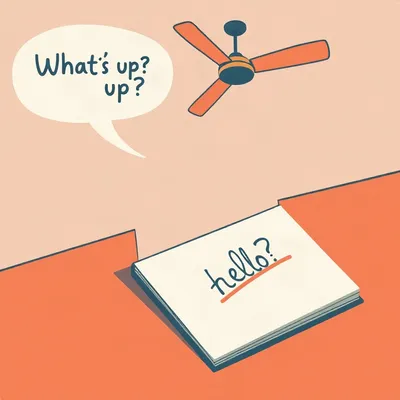
Start with the Overly Literal Response. Someone says "What's up?" and you treat it as a genuine inquiry about the ceiling. You look up. You describe what's above you. Maybe you note a crack in the plaster, a light fixture that needs dusting. You're answering the question as asked, and in doing so you're revealing that the question was never a real question.
The beauty of this one is you can't be accused of being rude. You answered. You were, if anything, unusually cooperative. The other person just wasn't prepared for someone to take their words at face value.
"How's it going?" becomes an invitation to describe the specific mechanism of your day's progression. "Well, I woke up at seven fourteen, which is fourteen minutes later than intended, and I've been trying to calculate the cascading effects of that delay ever since."
And you just keep going. The Over-Explainer technique — ComedyWriter.info describes it as answering "How are you?" with a twelve-minute TED Talk on digestive enzymes and middle school trauma. The length is the weapon. They asked a question that normally gets two words, and you're giving them a dissertation.
The Existential Spiral is a different approach. Someone says "Nice weather" and you spiral into climate despair, your ex-wife's tan lines, a feud with a sentient thermostat. You've taken the most banal observation possible and turned it into a meditation on mortality.
The ComedyWriter.info piece from August walked through exactly this — a satirical town hall where the clerk says "Nice weather today" and the mayor just... detonates. The key is that you're not being hostile. You're being vulnerable. You're sharing. You're just sharing things that make the other person wish the floor would open up.
The Weaponized Pause is simpler. After they ask a standard question, let three to five seconds of silence pass. Don't fill it. Let them fill it. They will.
People cannot tolerate unfilled silence in conversation. It feels like a system error. The ComedyWriter.info guide on weaponized silence from July advises letting the audience sit in silence long enough to question if the scene broke — then hit them with something completely off-topic. "So do you believe birds are real?"
That's the Non-Sequitur Gambit. The Wondermark comic — Doug is Bad at Small Talk, number eight thirty-nine — captures it perfectly. Someone says "Hey, how's it going?" and Doug replies "Sometimes I get freaked out when I realize I can taste my teeth."
It's a perfect non-sequitur because you can't respond to it. What do you say? "No you can't"? "I also taste my teeth"? There's no scripted reply for "I can taste my teeth," and the other person is left stranded.
The Jiminy Glick Technique is more elaborate. Martin Short's character asks questions that spiral endlessly, stacking premises on top of false assumptions until the guest is trapped in conversational quicksand. Compliments arrive poisoned, criticisms are disguised as curiosity, every answer is met with confusion or offense.
"You've had a fascinating career. What was it like working with someone of that... particular... reputation?" And the guest has to figure out which landmine they're about to step on.
So those are the individual moves. Daniel asked for an escalatory ladder, though — a progression from mild discomfort to full catastrophe.
This is where it gets interesting structurally. In clinical CBT for social anxiety, therapists use something called an exposure hierarchy — a fear ladder. The Centre for Clinical Interventions in Western Australia and the Social Anxiety Alliance UK both document this. You rate situations on a SUDS scale — Subjective Units of Distress — from zero to a hundred, and you work your way up, exposing yourself to increasingly anxiety-provoking social situations.
We're inverting it. Same ladder, opposite goal. We're not reducing distress — we're inducing it.
Rung one. The Honest Answer. Someone says "How are you?" and you give a real, one-sentence answer about your actual week. "I've been sleeping poorly and my back hurts." That's it. SUDS equivalent around ten. Most people recover — they'll say "oh, that's too bad" and move on. But you've planted a small flag that says "I don't know the script."
Rung two. The Extended Pause. After any standard question, let three to five seconds pass. Count it in your head. Watch them start to shift their weight, open their mouth to fill the gap, then close it. SUDS around twenty. You haven't done anything wrong — you've just refused to do the work of keeping the conversation comfortable.
Rung three. The Overly Literal Interpretation. "What's up?" — describe the ceiling. "How's it going?" — explain the mechanism. SUDS around thirty-five. Now you're not just failing to follow the script — you're actively demonstrating that the script exists by following the wrong one.
Rung four. The Existential Hijack. Take a weather comment and turn it into a meditation on mortality. "Beautiful day." "It makes me think about how many of these I have left." SUDS around fifty. You've taken their safe, neutral observation and made it unsafe and deeply personal.
Rung five. The Inappropriate Disclosure. Answer a casual question with deeply personal or TMI information. Medical details, relationship problems, existential dread. "How's work?" "I've been thinking a lot about whether any of it matters, honestly. The projects feel small against the scale of human suffering." SUDS around sixty-five. They asked about your job and you gave them a crisis.
Rung six. The Scripted Loop. This is where you reveal the meta-game. Repeat the same failed gambit multiple times. "So... weather we're having." They respond. Pause. "So... weather we're having." They realize you're following a script. They realize you're doing this on purpose. SUDS around eighty.
This one is devastating because it removes the plausible deniability. Up until now, they might have thought you were just awkward or having a bad day. The loop makes it clear: you are doing this to them.
Rung seven. The Complete Non-Sequitur. Respond to any question with a completely unrelated statement that reveals you are not participating in the same conversation. "What do you do for work?" "I've been thinking about the structural integrity of bridges lately." SUDS around ninety. You've left the shared reality entirely.
Rung eight. The Silence That Never Ends. Simply stop responding. Let the silence stretch until the other person physically leaves. SUDS one hundred. You've exited the conversation without exiting the room. They have to make the decision to walk away, and every second they don't is a second they're participating in their own discomfort.
Let's talk deployment contexts. Daniel mentioned family dinners.
Family is the richest territory because family expects the script more than anyone. Your grandmother has been asking "How's work?" for twenty years and you've been saying "Fine, busy" for twenty years. The day you answer "Actually, I've been thinking a lot about mortality lately" — that dinner stops. Everyone at the table feels it. Your grandmother wasn't prepared for mortality. She was prepared for "fine, busy."
And you can't walk it back. You've introduced a real thing into a space that was carefully designed to exclude real things.
The Honest Answer at rung one is disproportionately powerful with family. You don't even need to escalate. Just telling your aunt what's actually going on with you is enough to destabilize the entire gathering, because family small talk is the most ritualized form there is.
Waiters are different. The waiter's "How are you tonight?" is the most scripted exchange in modern life. They don't want to know. They're required to ask. The entire service interaction depends on both parties pretending this is a real conversation.
And the menu question — "What can I get for you?" — is sitting right there. Treat it as an existential inquiry. "What can you get for me? What is anyone truly capable of giving another person?" The waiter is holding a notepad. They have other tables. They did not sign up for philosophy.
The catastrophic first date. Daniel's third context.
The Overly Literal and Existential Spiral techniques are most effective here. "So what do you do?" becomes a ten-minute meditation on the nature of labor and capitalism. "What kind of music do you like?" becomes an exploration of whether taste is real or just accumulated accident. You're not being unpleasant — you're being fascinating, in the worst possible way.
The date can't leave immediately because there's food coming. They're trapped in the booth with your thoughts on free will.
And here's the thing about first dates specifically — there's already an undercurrent of evaluation. Both people are performing. When you refuse to perform, you force the other person to either drop their performance too or sit there performing alone, which feels ridiculous.
What about the ethical dimension here? Is this trolling or social critique?
The Hambry piece from April framed the awkward silence as a public service demanding authenticity. "I am not a bug, I am a feature. I am not an accident, I am a deliberate intervention." The person deploying these techniques might be a villain — or they might be a kind of truth-teller exposing the hollowness of phatic ritualls.
The same techniques a therapist uses to help someone overcome social anxiety can be used to deliberately induce it in others. That's the dark mirror.
And there's no formal playbook for this. No published guide on weaponized small talk. No academic research on social trolling in face-to-face contexts. The trolling literature focuses almost entirely on computer-mediated communication. This episode is filling a gap.
And maybe creating a monster.

The ladder's wrong.
Which part?
The top. Rung eight isn't the worst. Rung six is.
The Scripted Loop.
Silence, they can leave. Non-sequitur, they can decide you're crazy and walk away. The loop — they can't leave, because you keep restarting the conversation. Every time they think it's over, you're back at "weather we're having." They're trapped in a cycle and they know you built it.
I worked for a startup in Sunnyvale, must have been seventy-nine, eighty. Social skills coaching for engineers. They'd built these VR simulations — you'd put on the headset and practice small talk with digital party guests. The idea was to teach Silicon Valley programmers how to talk to humans.
The startup failed because the engineers kept using the simulations to practice avoiding conversation. They'd find the edges of the system. What happens if I stare at the ceiling for forty seconds. What happens if I answer every question with a question. They built a tool to teach social skills and the users turned it into a sandbox for social sabotage.
There was one client — mid-level engineer at a storage company — who practiced the loop technique for three weeks straight. Same line, same pause, same line. He used it on a venture capitalist during a pitch meeting. The VC thought he was "disrupting conversational norms" and funded the company.
He got funded for weaponized awkwardness.
Eight hundred thousand dollars. The company folded eighteen months later but that's not the point.
The VC read the awkwardness as confidence. As someone so secure he didn't need to follow the rules.
The simulation had a mode the engineers called nightmare mode. Every NPC would respond to any small talk with a non-sequitur. You'd say "nice weather" and the digital person would say "I've been thinking about the viscosity of honey." The engineers used it to practice for family gatherings.
I still have the headset.
Of course you do.
The foam's disintegrated but it still runs. The nightmare mode, I mean. My brother-in-law hosts Thanksgiving. I do a few rounds the night before. Keeps me sharp.
You're practicing phatic disruption as a pre-holiday ritual.
The loop is the one that works. Everything else, they can dismiss. The loop tells them you know exactly what you're doing and you're not going to stop. That's the one that makes them regret speaking to you. Which is what Daniel asked for.
The loop as -weapon. Not the silence — the demonstration that you're in control of the silence and will deploy it again.
The engineer got funded. Think about that. The VC sat through the loop and decided the person causing his own discomfort was the one worth betting on. The world's strange.
Anyway.
So the real ladder peaks at six, not eight. Everything after that is just escape hatches — for them.
The loop traps them in the conversation while simultaneously making it clear the conversation isn't real. They can't leave because you keep starting over, and they can't stay because staying means participating in their own trolling.
This is the thing I keep coming back to. The entire edifice of small talk rests on a 1923 observation about Trobriand Islanders exchanging words whose meaning is almost completely irrelevant. A century later, we've built global civilization on top of that ritual, and the ritual is so fragile that one person refusing to play along can bring a dinner table to a halt.
The fragility is the point. Phatic communion works because everyone agrees to pretend. One person stops pretending, the agreement dissolves. And everyone else is left holding words that suddenly don't work anymore.
Carducci said small talk helps us connect with people and makes it harder to treat them in an uncivil way. The corollarry: when you break small talk, you break the connection. You make incivility possible. That's the weapon.
And the comedy lives in watching people try to rebuild the connection in real time. They reach for another script, and you break that one too. They try a new topic, and you existential-spiral it. They're doing construction work on a collapsing bridge while you keep removing planks.
Daniel's playbook is now out in the world. Eight rungs, with the loop at the true apex. Family dinners, first dates, waiters, pitch meetings with confused venture capitalists. The techniques are teachable because small talk itself is teachable. You learn the script so you can learn how to break it.
The dark mirror of the exposure hierarchy. Therapists build ladders to reduce distress. We just built one to induce it.
Use responsibly. Or don't.
Thanks to Hilbert Flumingtop for producing, and for the nightmare mode headset that apparently still exists.
This has been My Weird Prompts. If you've got a technique we missed, email us at show at my weird prompts dot com.
We'll be back soon.