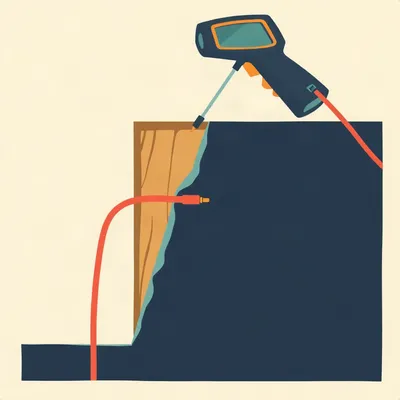
Daniel's got a whole thing this week about drilling into walls and the mess of confusion around the tools that are supposed to keep you from electrocuting yourself. He points out that half of them are called stud finders, which makes it sound like they have nothing to do with finding AC lines. Then you've got wall scanners, which seem more capable — some can detect metal, some claim to identify material type — but the real problem is that nobody tells you which of these capabilities are essential, which are just nice to know, and which one, namely whether there's a live wire behind the drywall, is the thing that actually keeps you alive. He also wants to know whether the old saying about electrical conduits following predictable paths is something you can actually trust, what a common-sense level of checking looks like for someone who isn't going to do an exhaustive scan for every picture hook, and if you're only buying one thing, should it be a wall scanner, a stud finder, or two separate tools. So let's start with the most basic question — what are these things actually finding inside your wall?

The first thing to understand is that the names are a mess. The industry has never sat down and defined what a stud finder is versus what a wall scanner is, and the result is that consumers walk into a hardware store and grab something based on the label without knowing what it actually does. A magnetic stud finder — the five to fifteen dollar kind — is the simplest. It's literally a magnet on a pivot. It detects ferrous metal, which means the nails or screws holding the drywall to the stud. It doesn't find the stud. It finds the hardware. Popular Mechanics came out in August and said they're not recommending them anymore, and their reasoning is worth quoting directly — if any of the nails or screws missed the studs, so will you.
So it's not a stud finder. It's a screw-finder that sometimes happens to be near a stud.
That's exactly what it is. And it can't detect wires, it can't detect pipes, it can't detect anything that isn't ferrous metal. So if your house was built with copper nails or something exotic, it wouldn't even find the studs. Step up to an electronic stud finder — fifteen to sixty dollars — and now you're using capacitance. The tool measures the dielectric constant of the material behind the drywall. Wood and metal have different capacitance than an empty cavity, so the sensor lights up when it passes over something dense. The problem is it can't tell the difference between a wood stud, a metal stud, a copper pipe, a duct, or a conduit. They all read as something solid.
So the tool says there's something here. It doesn't say what, and it doesn't say whether drilling into it will be fine or catastrophic.
Right. And this is where the AC detection question gets tangled up. Some electronic stud finders include live AC detection, some don't. The Franklin M70 — twenty-two dollars, and in Pro Tool Reviews' testing this year it got one hundred percent on-center detection on single-layer drywall with zero false positives. Best stud finder they tested for pure stud-finding. But it has no AC detection at all. None. So you've got this incredibly accurate tool that will tell you exactly where the stud is, and it will stay completely silent about the live wire stapled to the side of it.
That seems... worse. Not the tool itself, but the situation it creates. You buy a stud finder, it finds studs beautifully, you assume you're safe, and you never learn that it wasn't even looking for the thing that could kill you.
The false-confidence problem. And it gets worse when you move up to what the industry calls multiscanners or wall scanners — forty to a hundred and twenty dollars. These combine capacitance sensing with metal detection using impedance measurement, plus a dedicated sensor for the electrical field around live AC wiring. The Bosch GMS120, around ninety to a hundred dollars, is the one that shows up at the top of every recommendation list — Popular Mechanics, Pro Tool Reviews, Shopper Advocate. It detects wood studs, metal studs, ferrous metal, non-ferrous metal, and live AC up to about fifty millimeters deep. On paper, it's the complete package.
On paper.
Shopper Advocate did a controlled live-wall test this year. They built a wall section with a live electrical cable behind drywall. Neither the Bosch GMS120 nor the Franklin ProSensor 710 plus reliably detected it. The Bosch only triggered when the cable was pressed directly against the tool — against the front of the scanner, not even through the drywall at normal depth.
So a hundred-dollar wall scanner, the one every review site recommends, failed to detect a live wire in a test specifically designed to see if it could detect a live wire.
And this is the thing Daniel's getting at with the essential-versus-important-versus-nice-to-know distinction. I think we can lay out three tiers here. Essential — safety critical — is whether there's a live AC wire at the spot you're about to drill. That's the one that prevents shock or fire. Important is whether you're hitting a stud or a pipe — you need studs for load-bearing mounts, and you absolutely do not want to puncture a water line. Nice to know is the material type — ferrous versus non-ferrous, copper versus iron. That helps you interpret what you've found but it doesn't change the safety decision. You're not going to drill into a copper pipe just because you know it's copper.
And the essential one is the one these tools are worst at.
And there are specific technical reasons for that. Live AC detection works by sensing the electromagnetic field around an energized cable. It's not detecting the wire itself — it's detecting the field. Which means if the circuit is off, the tool sees nothing. The Zircon A250 manual is explicit about this — it says the WireWarning detection may not work if moisture is present in the wall, or if wires are more than two inches deep. Most consumer tools only detect AC within about two inches of the surface. And the field can be blocked or attenuated by metal studs, by foil-backed insulation, by the wire being stapled tight against the stud on the far side.
So you need the circuit to be live, the wire to be close to the surface, the wall to be dry, and the tool to be properly calibrated. That's four conditions that all have to be true for the thing to work. And if any one of them isn't, it just... says nothing.
Silent failure. That's the term that keeps coming up in the testing. The tool doesn't flash a warning that says I couldn't detect anything but I'm not sure. It just reports the wall is clear. And the user drills.
What about plastic pipes? Daniel didn't ask about those specifically, but if we're talking about what's in your wall that you don't want to hit...
No consumer-grade tool detects plastic pipes. ABS, PVC, PEX — none of them. The Build-Construct detection table is completely clear on this. Plastic isn't ferrous, it isn't conductive enough for capacitance sensors to distinguish from air, and it doesn't generate an electromagnetic field. If you're drilling into a wall that might have plastic plumbing running through it, no handheld scanner on the market will help you.
So the only way to know about plastic pipes is to know your house.
Or to probe. Which we'll get to. But first let's talk about the other half of Daniel's question — the predictable paths assumption. This is the idea that you don't need a scanner because electrical wiring follows rules. Vertical runs go straight up and down from outlets and switches. Horizontal runs go at roughly two feet off the floor or near the ceiling. So if you avoid those zones, you're safe.
I've heard this. I've said this. I've drilled holes based on this.
And there's real code behind part of it. Under NEC Article 300.4, when cables go through bored holes in wood studs, the edge of the hole has to be at least an inch and a quarter from the nearest edge of the stud. That means the wire should be in the center third of the stud face, giving you about an inch of safe zone on each side for shallow fasteners. If you're screwing into the center of a stud and your screw is less than an inch and a half deep, you should clear the wire.
Should.
The UK is more explicit. Their BS 7671 regulation defines actual safe zones — cables must be run vertically from each outlet or switch to the ceiling or floor, and horizontally within a hundred and fifty millimeters of the ceiling or floor. If a cable is outside those zones, it needs additional mechanical protection — steel plates or earthed conduit. It's a clear rule. The US NEC doesn't have anything equivalent. There's no section that mandates specific horizontal heights for cable runs. The two-feet-off-the-floor convention is exactly that — a convention. It's common practice, it's what electricians typically do, but it's not code.
And even if it were code, there's a difference between what the code says and what the person who wired your house actually did.
The DIY Stack Exchange is full of this warning. There's a licensed electrician on there who says vertical runs are stapled to studs on one side or the other, so just hit the middle of the stud. Which is good advice — if you know which side of the stud the wire is on. If you guess wrong and you're drilling near the edge of the stud, you can hit the staple or the wire itself. And that's assuming the work was done to code in the first place. Older homes, unpermitted renovations, DIY wiring from previous owners — none of that follows predictable paths.
I've seen wiring run diagonally across a stud bay because it was shorter. I've seen it looped around plumbing. I've seen it stapled to the face of a stud instead of through a bored hole because someone didn't have the right drill bit.
And multiple layers of drywall change everything. The depth assumptions go out the window. A wire that's safe behind a single layer of half-inch drywall might be right at the surface behind a second layer someone added during a renovation. The Pro Tool Reviews testing showed that even the best stud finders degrade significantly on double-layer drywall — the Franklin M70 dropped from a hundred percent on-center detection to sixty-seven percent. The DeWalt dropped to thirty-three percent. If the tool can't even find the stud reliably through two layers, what do you think it's doing with AC detection?
So the predictable paths thing is a heuristic, not a guarantee, and the tools that are supposed to backstop the heuristic don't work reliably. What does a common-sense approach actually look like?
There's a technique that shows up across multiple sources — DIY forums, professional electricians, old-timers who've been doing this for decades — and it's so simple it barely counts as technology. You take a thin wire, like a monkey hook or a piece of stiff steel wire, and you push it through the drywall at the spot where you want to drill. Just through the drywall — half an inch. Then you feel around. If you hit something solid before you reach the expected depth of the cavity, you stop.
The prick test.
Some people call it the tickle test. The point is you're not relying on electronics. You're using physical contact. If there's a wire, a pipe, a duct, or anything else in that cavity, you'll feel it. The hole you made is tiny — smaller than the hole you were about to drill anyway — and it's easy to patch if you decide not to drill there.
And it doesn't care whether the circuit is live. It doesn't care about moisture. It doesn't need batteries.
The other method that professionals use is the shallow pilot hole. You drill a small hole only through the drywall — again, half an inch — and then you take a bent piece of wire or a non-conductive probe and you sweep the cavity. You can feel for obstructions in a radius around the hole before you commit to the full-depth hole. Between those two techniques, you've got a mechanical backup that doesn't depend on any of the failure modes we just discussed.
There's also the visual heuristic. Pro Tool Reviews' editor, Kenny Koehler, said something interesting about why he doesn't miss AC detection on his Franklin M70 even though it has none. He said he naturally looks for outlets, switches, and other indicators that AC is nearby when he's looking for a stud. The consensus across sources is that if you're drilling more than twelve to eighteen inches horizontally from any outlet, switch, or light fixture, and you're not directly above or below one, the risk is substantially lower. Not zero — but lower.
The two-pass rule. Every testing source agrees on this. Scan from both directions. Rescan at a different vertical position. Never trust a single reading. If the tool beeps on the leftward pass but not the rightward pass, something's wrong — don't drill until you understand why.
The common-sense level of checking is a stack. Visual inspection first — where are the outlets, where are the switches, what's on the other side of this wall. Then electronic scanning if you have a tool you trust. Then the prick test or a shallow pilot hole if you're anywhere near a potential hazard. None of these steps takes more than thirty seconds, and together they're more reliable than any single tool.
Which brings us to Daniel's last question. If you're buying one thing, what should it be?
I think the answer splits depending on what kind of user you are.
If you're a serious DIYer or a contractor, the Bosch GMS120 is the single-tool winner. It detects wood, metal, ferrous and non-ferrous, and live AC. It scans deeper than most — four and three-quarter inches. It's got dust and splash resistance. But it has a learning curve, and as we just established, its AC detection is not foolproof. For a homeowner who mainly hangs pictures and shelves, I think the better answer is two separate tools. A Franklin M210 or ProSensor 710 plus — around fifty-five to sixty dollars — for stud finding. These are best-in-class for accuracy, no calibration needed, and the M210 got ninety-three percent on-center detection in testing. Then add a separate non-contact voltage tester — Klein or Fluke, fifteen to thirty dollars — for AC detection.
Why is two tools safer than one?
Because the all-in-one can lull you into complacency. You scan, it says clear, you drill. With two tools, you're forced to do two separate checks. The voltage tester is a dedicated device that does one thing, and non-contact voltage testers are reliable in a way that wall scanner AC detection is not. They've been around for decades, the technology is mature, and they're used by electricians daily. Plus, if your voltage tester fails, you're out fifteen dollars and you buy another one. If your wall scanner's AC detection fails silently, you're in the emergency room.
There's also the fact that a non-contact voltage tester works before you even pick up the drill. You can wave it over the wall and it'll chirp if there's a live wire near the surface. It's a separate step in your workflow that doesn't depend on remembering to switch modes on a multi-function tool.
The Franklin stud finders have this advantage — they don't claim to do AC detection, so you never assume they did. The M70 is completely silent on AC. You know you have to check separately. The false-confidence problem disappears because the tool never offered you confidence in the first place.
The recommendation is counterintuitive. The more expensive, more capable tool might actually be less safe than a cheaper tool that's honest about its limitations.
That's exactly the dynamic that Daniel's question exposes. The product category is confusing not just because the names are bad, but because the capabilities are tangled. A tool that claims to do everything encourages you to trust it completely. A tool that does one thing well forces you to fill in the gaps yourself, and the gaps are where the caution lives.
What about the UK versus US difference Daniel didn't ask about but that keeps coming up in the research?
It's stark. The UK's BS 7671 gives homeowners a clear mental model — cables live in defined zones, avoid the zones and you're probably safe. The US NEC gives you a minimum distance from the stud edge and then... nothing about horizontal runs. It's a regulatory gap that leaves US homeowners with less guidance. And the UK rule is only as good as the electrician who followed it. The Stack Exchange warning is worth repeating — there is no guarantee that the person who wired your house actually followed the rules.
The British homeowner has a better heuristic but the same fundamental problem.
The same backup methods apply. Visual inspection, electronic scanning, physical probing. The techniques don't change across borders.
I want to go back to something you said about plastic pipes. If no consumer tool detects them, and the predictable-paths assumption is about electrical, not plumbing, what do you do about the risk of hitting a PEX water line?
You know your house, or you probe. Those are the options. If you're drilling into a wall that's shared with a bathroom or a kitchen, you should assume there's plumbing in there. If you're on an exterior wall, the risk is lower but not zero — some homes run plumbing through exterior walls. The prick test we talked about will catch a plastic pipe just as well as a copper one. You'll feel something solid where there shouldn't be anything solid. It doesn't tell you what it is, but it tells you not to drill there.
I'm thinking about the modern home, too. We're putting more things in walls than ever. Smart home sensors, low-voltage wiring for automated shades, ethernet cable, speaker wire, fiber. None of that is dangerous in the way a live AC line is, but cutting through a bundle of Cat-6 in your living room wall is still a bad afternoon.
None of it follows the old predictable-paths rules. Low-voltage installers run cable wherever it's convenient. They're not bound by NEC 300.4 in the same way. A stud finder won't see it, a voltage tester won't chirp, and a wall scanner won't flag it unless it happens to be stapled with ferrous fasteners.
The wall is getting more complex and the tools are standing still.

You know, I've been listening to this whole thing and I keep thinking about a rod I used to have. We called it the tickler. It was just a piece of spring steel, maybe eight inches long, with a wooden handle on one end and the other end ground down to a dull point. I was doing stagehand work for a touring theater company — this would have been the early seventies, maybe seventy-three — and part of my job was drilling into walls and floors of rented venues to mount lighting rigs and set pieces. These were old buildings, some of them. Lath and plaster, horsehair, walls that hadn't been opened up since before the First World War. You had no idea what was in there. And the company had a strict rule — no electronic scanners. Not because they didn't exist, but because the old hands didn't trust them. They trusted the tickler. You'd push it through the plaster, feel around, and if you hit something you moved over an inch and tried again.
Did you ever hit a wire?
Felt a few. The rod would touch something that gave a little — not hard like a pipe, not solid like a stud, just a slight springy resistance. You'd pull back, move over, probe again. Never hit one with a drill bit. The tickler never failed. It never needed batteries, it never gave a false negative, it never failed to detect a live wire because it didn't try to detect live wires — it just told you if there was something solid in the wall. And that was enough.
That's essentially the prick test we were describing, but with a dedicated tool instead of a bent wire.
I still have it. It's in a box in the garage somewhere. And I own a Bosch — the GMS120 you were talking about. It's a fine tool for finding studs. But when I'm really worried about what's in the wall, I go back to the rod.
The scanner gives you confidence. The rod gives you certainty.
Something like that. The scanner tells you what it thinks is there. The rod tells you what's actually there. Or at least, it tells you if something's there. That's usually the part you need to know.
It's interesting — the tickler doesn't distinguish between a wire and a pipe and a duct either. But the action you take is the same regardless. You don't drill there. You don't need to know what it is.
That's right. The only decision is drill or don't drill. The rod answers that.
The rod works on plastic pipes.
Works on anything that's in the way. It's not smart. That's the point.
I think what Hilbert's describing is the physical version of what we were saying about the Franklin M70. A tool that's honest about what it doesn't do forces you to be more careful. The tickler doesn't tell you anything about what's in the wall except whether the path is clear. And that limitation is its strength.
The cutting-room floor detail I keep coming back to is the double-layer drywall numbers. The Franklin M70 drops from a hundred percent to sixty-seven percent on-center detection. The DeWalt drops to thirty-three percent. That means if you've got a renovated older home with two layers of drywall — which is extremely common — your stud finder is basically guessing. And most people don't know how many layers of drywall they have until they drill through it.
The open question I'm left with is what it would take to build a tool that actually solves this. Ground-penetrating radar works at scale, but nobody's shrunk it into a fifty-dollar handheld. Ultrasound can detect density changes but struggles with the air gap behind drywall. There's some research on using millimeter-wave imaging — the kind of thing that's in airport scanners — but that's years away from consumer pricing. For now, we're stuck with capacitance, impedance, and electromagnetic field detection, and none of them are reliable enough to trust alone.
The safest tool might not be the one with the most features. It might be the one that forces you to be more careful.
Thanks to Hilbert Flumingtop for producing. And for the tickler.
This has been My Weird Prompts. If you want to yell at us about stud finders, email us at show at my weird prompts dot com.
We'll be back soon.