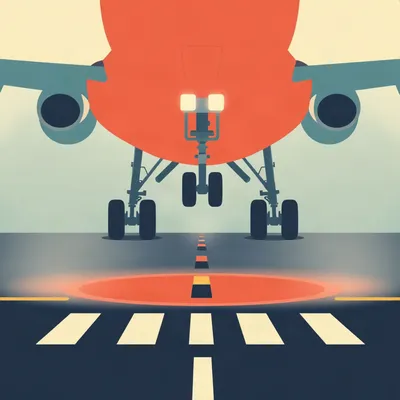
Daniel's been watching those Patagonian crosswind videos again — the ones where a commercial jet comes in at what looks like a forty-five-degree angle to the runway, straightens out at the last second, and touches down with the landing gear screaming. He asked three things. One, why manufacturers don't just use wind tunnels or computer models to certify crosswind limits. Two, who are the pilots who volunteer to fly these validation flights — who employs them, what's their background. And three, do they literally chase storms. Not metaphorically. Do they look at a weather map, see a gale, and fly toward it.

Yes. Yes they do. And I want to talk about all three, but that third question is the one where the answer is just a flat yes and then the interesting part is everything that happens around it. The waiting, the logistics, the psychology of sitting in a hotel in southern Chile for two weeks waiting for the wind to hit thirty-five knots from exactly the right direction.
So let's start with the first one, because it's the question that makes the other two make sense. Why can't you just model this?
The short answer is that crosswind certification isn't about proving the wing generates enough lift in a crosswind. It's about proving the entire aircraft system works — flight controls, landing gear dynamics, tire-ground interaction, and the pilot's ability to respond — under gusty, non-uniform wind conditions. Wind tunnels give you clean, steady-state airflow. A real crosswind at Rio Gallegos is anything but clean. You get gusts, lulls, wind shear at fifty feet, sudden directional shifts. The tunnel can't replicate a thirty-eight-knot gust that hits you three seconds before touchdown and then drops to twenty-two knots two seconds later.
And the simulator?
Simulators are only as good as the data you feed them. To build an accurate crosswind model, you need to know how the aircraft actually behaves in those conditions — which you don't know yet, because that's what you're trying to measure. It's circular. The FAA and EASA both require real-world demonstration for certification. The regulation says the aircraft must demonstrate safe handling in crosswinds up to the certified limit, and "demonstrate" means with a real aircraft, real runway, real wind. No regulator on Earth will sign off on a purely simulated crosswind certification.
So the stakes are existential for the aircraft program. If you can't demonstrate the crosswind limit, you can't certify it. And if you can't certify it, the limit printed in the flight manual is lower, which makes the aircraft less competitive.
Right. The crosswind limit isn't a marketing number. It's a certified operational limit. If an airline crew exceeds it, they've violated the aircraft's type certificate, which voids insurance and triggers regulatory action. Airlines care deeply about this number because a higher crosswind limit means fewer diversions, fewer canceled flights, less money lost. So the pressure on the test team to hit the target is enormous.
Which brings us to the people who actually fly these missions. Who are they, and how do they end up in a cockpit over Patagonia with a forty-knot crosswind?
They are almost exclusively experimental test pilots. Not airline captains, not senior first officers who got tapped for a special assignment. These are people whose entire career is flight test. Most hold a degree in aeronautical engineering — not just flight training, an actual engineering degree — and they've graduated from one of the military test pilot schools. The big three are the U.S. Air Force Test Pilot School at Edwards, the Empire Test Pilots' School in the UK, and EPNER in France. There are a few others — the Naval Test Pilot School at Patuxent River, the National Test Pilot School in Mojave — but those are the main pipelines.
Military backgrounds, then.
Almost always. Not exclusively, but the test pilot school requirement creates a strong military pipeline because those schools were built for military flight test. Civilian test pilot schools exist — the National Test Pilot School is civilian — but the culture and the curriculum descend directly from military flight test. A typical crosswind certification pilot might have fifteen years as a fighter test pilot or a heavy aircraft test pilot before they ever touch a commercial certification campaign.
So you're not talking about someone who flew 737s for United for a decade and then got a cool side gig.
No. The skill set is completely different. An airline pilot is trained to operate the aircraft within its certified envelope, smoothly and efficiently. A test pilot is trained to explore the edges of that envelope and describe exactly what the aircraft does when it gets there. They use a formal handling qualities rating system — the Cooper-Harper scale — to quantify things like "how hard was it to keep the nose aligned" and "did the rudder authority feel adequate." These are subjective judgments that carry enormous engineering weight. A test pilot's rating of "unsatisfactory" on a handling qualities task can force a redesign of the landing gear geometry or the rudder power system.
And who employs them? Are they freelance storm chasers with a website and a GoPro?
They're salaried employees. They work directly for the aircraft manufacturer — Boeing, Airbus, Embraer, Bombardier — or for specialized flight test organizations like Flight Research Incorporated, the National Research Council Canada, or QinetiQ in the UK. Their job title is something like Experimental Test Pilot or Flight Test Engineer. They're not contractors who show up for a week and leave. They're embedded in the engineering team, sometimes for years, through the entire development and certification cycle.
So Daniel's third question — do they literally seek out adverse weather — the answer is yes, but it's more deliberate than "chasing storms" makes it sound. They're not storm chasers. They're weather hunters with spreadsheets.
Test teams monitor global wind forecasts and METAR data — that's the standard aviation weather report — to position aircraft at specific airports when conditions are predicted to hit the target crosswind component. A Boeing test team might sit in Punta Arenas for two weeks waiting for the right thirty-five-knot gusty crosswind from the correct angle. And the angle matters. A crosswind from ten degrees off the runway heading is a completely different test condition than one from ninety degrees. They need specific vectors.
Why Patagonia, specifically?
Geography. The Andes act as a funnel. Prevailing westerlies get squeezed between the mountains and accelerate, creating consistent, predictable, strong crosswinds at airports like Rio Gallegos and Punta Arenas. These aren't the only locations — Boeing has used Keflavik in Iceland for crosswind testing, and there are other windy airports — but Patagonia is famous in the flight test world because the wind is statistically reliable. You can plan a two-week campaign and have a high probability of getting the conditions you need. Manufacturers don't go there for tourism. They go because the probability math works.
What does a campaign actually look like on the ground?
The Airbus A350 crosswind certification at Rio Gallegos in 2014 is a good case study. The test team positioned the aircraft there and waited for conditions. When the wind hit — and they eventually flew approaches with thirty-eight-knot crosswind components — the aircraft was instrumented with hundreds of sensors. Real-time telemetry streamed to ground engineers who monitored every parameter. Every approach had defined go-around triggers: if the aircraft exceeded a bank angle limit, if the drift angle got too high, if the pilot called it. The pilot is not winging it. Every single approach is briefed, flown to a specific test point, and debriefed.
Thirty-eight knots. What does that look like from the outside?
It looks like the aircraft is flying sideways. At a thirty-eight-knot crosswind component, the crab angle — the angle between where the nose is pointing and where the aircraft is actually going — can be fifteen to twenty degrees. The aircraft is essentially pointing at the grass next to the runway while traveling straight down the centerline. Then, in the last few seconds before touchdown, the pilot kicks the rudder to align the nose with the runway while dropping the upwind wing to stop the aircraft from drifting sideways. It's called the de-crab maneuver, and doing it smoothly with a thirty-eight-knot crosswind in a wide-body aircraft is... I mean, it's one of the hardest things a pilot can do.
And the test pilots describe it as fun.
Multiple interview subjects have called it "the most fun you can have with your clothes on." One described it as "terrifying in a controlled way." The pre-flight briefing is reportedly more intense than the flight itself — they spend hours walking through every possible contingency, every abort criterion, every test point. By the time they get in the cockpit, they've already flown the mission a dozen times in their head.
That's the psychological profile that interests me. These aren't adrenaline junkies. They're methodical risk managers who happen to find extreme conditions enjoyable.
That's the distinction. The cowboy test pilot is a myth — or at least, it's a myth that died with the 1950s. Modern test pilots are engineers who fly. They're risk-tolerant but deeply methodical. The culture is about preparation, not bravado. Several test pilots have said in interviews that the most important quality for the job isn't stick-and-rudder skill — it's the ability to precisely describe what the aircraft is doing in technical language that engineers can act on.
So we know who they are and that they chase weather. But what does this actually mean for the aircraft that ends up carrying passengers?
This is where it gets interesting. The crosswind certification results directly influence aircraft design. Landing gear geometry, nosewheel steering authority, rudder power requirements, autoland system logic — all of these are shaped by what the test pilots discover at the edges of the envelope. If a test pilot reports that rudder authority feels marginal at thirty-five knots, the engineering team might need to increase the rudder size or boost hydraulic pressure. That's a major design change that ripples through weight, balance, fuel consumption, and cost.
And a failed certification campaign can delay the entire aircraft program.
By months, and at a cost of hundreds of millions of dollars. An aircraft program is a finely scheduled machine. The certification phase is already tight. If you fail to demonstrate the crosswind limit, you have to go back, redesign something, retest, and reschedule the whole campaign. Meanwhile, airlines are waiting for deliveries, and competitors are filling the gap.
There's another tension here that I think is worth pulling on. The certified crosswind limit is often lower than what the aircraft can physically handle. The limit is set where a statistically average pilot can safely land, not where the best test pilot can.
Yes. This is a fundamental point that most people miss. The test pilots might demonstrate that the aircraft can handle a forty-two-knot crosswind. But the certified limit might be set at thirty-five knots because that's where the average line pilot — someone who flies this aircraft type maybe a few times a month, in all conditions, at the end of a long duty day — can consistently land safely. The limit is a human factors limit, not an aircraft limit.
Which creates an interesting dynamic. The test pilots know they're demonstrating capabilities that won't make it into the manual. They're flying to prove the aircraft can do X, knowing the certification will be set at X minus some margin.
And that margin is itself a subject of debate. How much margin is appropriate? The Bombardier CSeries — now the Airbus A220 — had an interesting case. During certification, the test pilots demonstrated higher crosswind capabilities than what was initially certified. Later, after more operational data came in, the certified limit was expanded. So the margin isn't always permanent. Sometimes the test pilots' demonstrated capability eventually becomes the certified limit, once the regulators have enough confidence in the operational data.
The 737 MAX certification versus the A320neo — different approaches to crosswind validation?
The fundamental requirements are the same — both have to demonstrate the certified limit in real-world conditions. But the implementation details differ. The A320neo family uses fly-by-wire with flight envelope protection, which means the flight control computers can actively help the pilot manage crosswind conditions. The 737 MAX retains a more conventional control system with some automated protections but less envelope authority. So the test pilots are evaluating different things. On the Airbus, they're evaluating how well the fly-by-wire system handles the crosswind. On the Boeing, they're evaluating how much pilot workload is required.
And the future — are we moving toward automated crosswind assistance that could raise certified limits?
Some manufacturers are exploring it. The idea is that a crosswind assist mode could use the fly-by-wire system to automatically apply the optimal de-crab inputs, reducing pilot workload and potentially allowing higher certified limits. But regulators are skeptical. The FAA and EASA have both signaled that they're not ready to certify crosswind limits based on automated systems alone. The real-world validation requirement isn't going away. The test pilot in the cockpit over Patagonia — that's going to be part of certification for the foreseeable future.
So the human element remains central, even as the automation gets more sophisticated.
And that's the tension that makes this whole field fascinating. The aircraft is more capable than ever, but the certification still comes down to a human being in a cockpit saying "I can handle this." The Cooper-Harper rating — that subjective number on a scale from one to ten — still carries more weight than any simulation output.
Hilbert, you've been quiet.
I spent six months in Punta Arenas in 2003. Flight test instrumentation engineer for a regional jet program that never made it to market. I was the guy in the ground station watching telemetry while the test pilots did their thing.
What was the program?
Fairchild Dornier 728. They went bankrupt before certification. The aircraft was good. The company wasn't. Anyway, the thing nobody talks about is how boring it is. You sit in a hotel for two weeks watching wind forecasts on a laptop that takes forty-five seconds to load a single METAR. When the weather finally hits, the flight lasts forty-five minutes and you're back on the ground filling out test cards. The pilots are incredibly professional, but the waiting drives everyone insane. I learned to knit.
You learned to knit in Punta Arenas.
There's a lot of time. The test pilots would fly simulated approaches in the hotel room using laptop-based part-task trainers to stay sharp. Just a joystick and a screen, running through the de-crab maneuver over and over. One pilot had a ritual — same meal before every crosswind flight. Lamb stew with pumpkin, from a place called La Luna on Avenida Colón. He ate it before every single crosswind sortie for the entire campaign. One day the restaurant was closed and he ate something else. Aborted the first approach. Said the aircraft felt wrong. The aircraft was fine. He just wasn't.
Did the ritual become part of the test plan?
Unofficially. The flight test director made sure someone picked up the lamb stew before every crosswind day after that. It wasn't in the test cards. But it was in the schedule.
That's... I mean, that's superstition, but it's also workload management. If the ritual puts you in the right headspace, and the right headspace is what keeps you precise when you're kicking the rudder at thirty feet with a thirty-five-knot crosswind, then the ritual is doing real work.
That's what the flight test director said. He was a former U.S. Navy test pilot. Very practical man. He said he didn't care if the pilot needed to recite the Lord's Prayer backward before every flight, as long as the data was good.
What was the instrumentation setup like on the ground?
We had a telemetry trailer parked near the runway. Racks of equipment, mostly surplus from a military program. The data came down in real time — control surface positions, engine parameters, landing gear loads, about three hundred channels total. I watched the rudder position trace on a CRT monitor while the aircraft came in sideways. When the pilot kicked the rudder for de-crab, you'd see the trace spike and then oscillate for a second or two while the yaw damper caught up. That oscillation — the damping ratio — that's what the engineers were really watching. Too much oscillation and the aircraft is hard to control. Too little and it feels sluggish. The sweet spot is a damping ratio of about zero point seven.
That's the standard engineering target for a second-order system. Critically damped is one point zero, but zero point seven gives you the fastest response without overshoot.
Right. And the pilots could feel a difference of zero point one in the damping ratio. They'd land and say "the rudder felt a little loose today" and the engineers would look at the trace and see the damping ratio had dropped from zero point seven to zero point six three. The pilots were that calibrated.
Did the program get any useful data before the company folded?
We completed about sixty percent of the crosswind test points. The data went into a archive somewhere. I think Embraer bought some of it when they acquired the remains. The aircraft had a T-tail and rear-mounted engines, so the crosswind behavior was different from a low-wing design. More susceptible to weathervaning. The rudder authority was good, though. We got it up to thirty-two knots demonstrated before the money ran out.
The Fairchild Dornier 728 was a fascinating design. Five-abreast seating, fly-by-wire, a lot of advanced features for a regional jet in the early 2000s. It's one of those what-if aircraft — what if the company had survived, what if the market had been different.
The test pilots loved it. Said it handled like a fighter. One of them told me it was the best aircraft he'd ever flown, and he'd flown F-16s at Edwards. Coming from a fighter test pilot, that's about the highest praise an aircraft can get.
The aircraft that never was.
There are a lot of those. You fly them, you certify what you can, and then the program dies and the data sits on a hard drive somewhere. The pilots go back to their employers — most of ours were from Flight Research Incorporated — and get assigned to the next program. They don't get sentimental about it. It's a job.
The unsentimentality is something that comes up in interviews with test pilots. They're deeply professional about the aircraft. They evaluate it, they report on it, and then they move on. The emotional attachment is to the discipline of flight test, not to any specific aircraft.
The lamb stew pilot kept a logbook of every aircraft type he'd flown. When the 728 program ended, he wrote the date and the total hours in the logbook and closed it. Didn't say anything. Just closed the book and went to the hotel bar. Next morning he was on a flight to Wichita for a Cessna Citation certification campaign.
How many test pilots like him are there in the world? People qualified to do crosswind certification on transport-category aircraft?
The number I've seen cited is fewer than five hundred. That's globally, across all manufacturers and test organizations. It's an extraordinarily small community. They all know each other. They've all worked together at some point. The test pilot schools graduate maybe a few dozen per year, and not all of those go into civil certification work. Many stay in military flight test. So the pool of people who can do what we've been describing — fly a wide-body aircraft to its crosswind limit and provide engineering-quality handling qualities data — is tiny.
And they chose to be there. That's the thing Daniel was getting at with his question about volunteers. Nobody gets assigned to crosswind certification against their will. These pilots sought out this career. They went to test pilot school knowing it would lead to exactly this kind of work.
And the selection process for test pilot school is brutal. You need an engineering degree, typically with high grades. You need a strong operational flying record. You need letters of recommendation. The U.S. Air Force Test Pilot School accepts something like ten to fifteen pilots per year. The Empire Test Pilots' School is similarly selective. These are people who have been at the top of every cohort they've ever been in, and they've chosen to specialize in the most demanding corner of aviation.
The next time you see a viral crosswind landing video, remember — that pilot might be one of fewer than five hundred people on Earth qualified to do what they're doing, and they actively chose to be there. They watched the weather forecast, flew to the windiest place they could find, and waited two weeks for the chance to land sideways in a gusting crosswind.
Then they filled out paperwork about it.
Then they filled out paperwork about it.
That's the part the YouTube videos don't show. The test cards, the debriefs, the engineering reports. The glamour is about five percent of the job.
Where does this leave us? The certification process isn't changing anytime soon — regulators are skeptical of purely simulated validation, and for good reason. But the technology around the pilot is evolving. Fly-by-wire systems are getting more sophisticated. Crosswind assist modes are being explored. The question is whether the human test pilot's role shifts from primary control to supervisory oversight, or whether the unpredictable nature of real crosswinds keeps the human firmly in the loop.
I think the human stays central for a long time. Not because the automation can't handle a steady crosswind — it can — but because certification is about the edge cases. The gust that hits at exactly the wrong moment. The wind shear at fifty feet. The combination of crosswind and wet runway and a slightly misaligned approach. Those edge cases are where human judgment still matters, and where the test pilot's ability to say "that felt wrong" in a way that engineers can quantify is irreplaceable.
The lamb stew ritual, in other words. The thing that isn't in the test cards.
The thing that isn't in the test cards.
Thanks to Hilbert Flumingtop for producing, and for the knitting lesson we didn't know we needed. This has been My Weird Prompts. If you want to send us your own questions — about aviation, about certification, about anything else you've been wondering — email the show at show at my weird prompts dot com. We'll be back soon.