Moving is the only major life event where you get to make the exact same mistake twice. Pack the bread maker you haven't touched in three years, unpack it, put it on a shelf, repeat. And most people do exactly that, move after move, because they never capture what they learned in the seventy-two hours when the lessons are still burning in their brain.

Eleven point seven times. That's how often the average American moves in a lifetime, according to the Census Bureau. Eleven point seven Kaizen cycles that most people just...
Daniel sent us this one, and he's pointing at something that seems obvious once you say it — the packing and unpacking grind is actually a double opportunity. You get two clean shots at every keep-or-discard decision in your house. Once when you're boxing things up, once when you're pulling them out on the other end. And that second pass is the one with actual data, because you've just lived without the item for days or weeks. You know whether you missed it.
He's connecting it to the Kaizen approach we've talked about — the Plan-Do-Check-Act cycle. Each move is a Do phase, the seventy-two hours after is your Check phase, and if you don't document what you learned, you never reach Act. You just loop back to Plan with the same bad assumptions.
We're going to build this out. A decision tree for the keep-or-discard moment that fires twice — once when boxing, once when unboxing. And a post-move debrief protocol that takes twenty minutes and actually makes the next move measurably easier instead of just...
The repetition is the asset. That's the thing most people miss. Moving is repetitive suffering, but repetition is exactly what you need for a feedback loop. You just have to close the loop.
Let's back up and ask what makes moving uniquely suited to this. Because there are plenty of painful recurring life events — tax season, dental cleanings, family reunions. Why does Kaizen fit moving better than those?
Two reasons, and they're both structural. First, moving has a built-in measurement phase that most recurring pains don't. You literally handle every single object you own, twice. That's an inventory audit you can't avoid. Tax season doesn't force you to touch every receipt — you can shove half of them in a drawer. Moving doesn't give you that option. The audit happens whether you want it or not.
The second reason?
The fresh start effect. There's a 2014 paper by Dai, Milkman, and Riis that looked at what they call temporal landmarks — New Year's Day, birthdays, the start of a new week. These moments create a psychological break between a past self and a future self. People are two to three times more likely to initiate behavioral changes right after crossing one of these thresholds. Moving into a new home is basically the biggest temporal landmark in adult life short of having a kid.
You've got this window where your brain is actually willing to rewrite its own habits, and at the exact same moment you're physically touching every possession you own. That's not just a coincidence — that's an alignment you don't get with, say, renewing your driver's license.
And the seventy-two hour figure Daniel's pointing at — that's not arbitrary. The Dai paper shows that the motivation spike decays fast. After about three days, the new normal sets in. Your brain stops seeing the new apartment as a fresh start and starts seeing it as just... where you live. The dishes go in the same wrong cabinet and you stop noticing.
Which means if you don't capture the lessons while the friction is still stinging, you won't capture them at all. You'll walk past that box you should have labeled better and by day four it's just part of the furniture.
That connects directly to the double-declutter insight. The first pass — when you're packing — that's compromised. You're under time pressure, you're exhausted, the moving truck shows up in four hours. Your keep-or-discard decisions in that state are terrible. You default to keeping everything because it's faster.
I've packed a half-eaten bag of trail mix because the decision cost of throwing it out was higher than just... putting it in a box.
That's the exhaustion talking. But the second pass — the unpacking pass — that's fundamentally different. You've just lived without the item for days or weeks. You have data. You didn't miss the bread maker. You didn't even remember you owned a bread maker. That's not a guess anymore, that's empirical evidence.
The packing pass is the rough sort, and the unpacking pass is the precision cut. One's done under duress, one's done with actual information. The trick is designing the decision criteria to match the conditions of each pass.
Which is exactly what we're going to build next. The packing-pass decision tree has to be fast — you can't be doing deep philosophical reflection on every spatula. But the unpacking pass can be stricter, because you're not racing a clock and you've got the data from living without the thing.
That stricter test — the one Daniel's hinting at — is basically: would I pay actual money and spend actual minutes to move this again? Because if the answer's no, you're just deferring the decision to a future version of yourself who will be equally tired and equally annoyed.
Let's build the packing-pass tree first, because that's the one people actually face. You're standing in your kitchen at eleven PM, the truck comes at eight AM, and you've got forty-seven spatulas and a waffle iron you haven't opened since Obama's first term.
Keep, Discard, and the one that saves you from yourself — Maybe.
The Maybe bucket is the key innovation here, and I want to defend it because it sounds like procrastination. It's not. It's a deliberate holding zone for items where you genuinely lack data. You're not sure if you need the waffle iron because you haven't made waffles in two years, but you also haven't had a kitchen that could fit a waffle iron on the counter. Maybe the new kitchen changes the equation. You don't know yet.
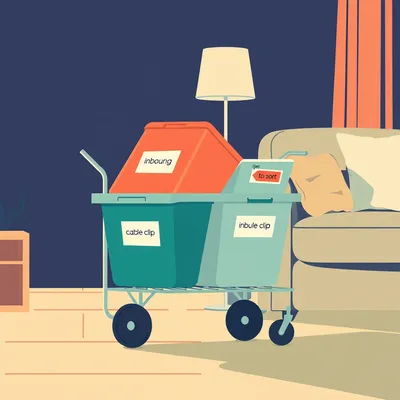
The Maybe bucket buys you the right to decide later, when you have better information. But the trick is — it can't be infinite. You label every Maybe box with a review-by date thirty days after the move. If you haven't opened that box by day thirty, you don't open it at all. It goes straight to donation.
That deadline is what separates a Maybe bucket from a storage unit you're paying rent on. And the thirty-day mark isn't random — it's long enough that you've settled into the new place, but short enough that you haven't normalized the box sitting in the corner. After thirty days, an unopened Maybe box is just a Discard box you haven't admitted to yet.
What are the criteria for each bucket during the packing pass? Keep has to be fast — you can't deliberate.
Keep is simple: you used it in the last six months, or it's seasonal and you used it last season, or it's irreplaceable — legal documents, the one photo of your grandmother. That's it. If you have to think about it for more than ten seconds, it's not Keep.
Discard is equally fast. Broken, expired, duplicates where you already have a better version, or anything you forgot you owned until this exact moment. If the item surprises you by existing, it goes.
Maybe is everything else. The waffle iron. The bread maker. The third set of sheets. The bread maker is practically the mascot of the Maybe bucket.
Which brings us to the unpacking pass, where the test gets stricter. Because now you've lived without the bread maker for three weeks. You have data.
The question you ask on the unpacking side isn't "do I want this?" — it's "would I pay to move this again?" I want to operationalize that. Moving a standard box costs about two dollars and fifty cents in materials — tape, the box itself, labels. And roughly fifteen minutes of labor across the full lifecycle: pack it, tape it, label it, load it, unload it, unpack it, break down the box.
If an item takes up about ten percent of a box, its hassle cost is twenty-five cents and a minute and a half of your life. A five-dollar vase you bought at a thrift store that you feel nothing about — that fails the test. You're spending more in hassle than the thing is worth.
That's just the financial side. The mental overhead is worse. Every item you keep is a decision you're deferring to your next exhausted self. The question "would I pay to move this again" is really asking: is this object worth inflicting itself on future-me?
This is where Swedish death cleaning connects. Margareta Magnusson's whole framework — and she wrote the book on this in twenty-seventeen — is built around the idea that you don't let your loved ones deal with your clutter. But the principle generalizes. Don't let future-you deal with your clutter either. Future-you is just as busy and just as tired as present-you, and they didn't even get the dopamine hit of buying the thing.
Magnusson's method was designed explicitly for older people downsizing into smaller spaces or care facilities — people who know a move is coming. But the logic applies to anyone who knows they'll move again. Which, statistically, is almost everyone.
The unpacking pass asks three questions. One: did I miss this? Two: would I pay to move it again? Three: is the memory attached to this thing separable from the thing itself?
That third question is the sentimentality escape hatch, and we'll get deeper into it later. But for now, the point is that if an item fails questions one and two, and question three doesn't apply, it goes. You gave it a fair trial — you lived without it for weeks.
Now, both of these decision trees only work if you're tracking what you decided and why. Which means we need an inventory system that doesn't require becoming a person who enjoys spreadsheets.
That's it. Item name, box number, destination room, a verdict column that stays blank until thirty days after unpacking, and an optional notes field. You can do this in a spreadsheet, in Airtable, on a piece of paper taped to the box — the format doesn't matter. What matters is that the verdict column exists and that you actually fill it in.
The verdict column is where the feedback loop closes. Thirty days after the move, you go through every Maybe box, every item you were uncertain about, and you mark it: Kept and Used, Kept and Didn't Use, or Discarded. Sort by verdict and suddenly you can see your own failure patterns.
Daniel mentioned this in the prompt — the serial renter who moves every eighteen months, uses the Maybe system, and after three moves realizes kitchen gadgets are their failure category. Fourteen specialized tools discarded, zero missed. So they implement a hard rule: no single-purpose kitchen tool unless it's used weekly. That rule didn't come from a decluttering guru. It came from their own data.
Which is more persuasive than any book, because it's your own track record staring back at you. You're not guessing that you're bad at kitchen gadgets — you have a spreadsheet that proves it.
That connects to the seventy-two-hour debrief protocol. The inventory tracks the stuff; the debrief tracks the process. Three questions, twenty minutes, done before the end of the third day.
Question one: what was the single most time-wasting thing during this move? Could be anything — a box you packed badly, a room you should have done first, a piece of furniture that didn't fit through a doorway.
Question two: what item did I pack that I immediately regretted not having accessible? This is almost always something stupid — the phone charger, the coffee maker, the one pair of scissors. But knowing your specific regret pattern means you pack an essentials box differently next time.
Question three: what did I not use in the first week that I was sure I would? This is the aspirational-self trap. You thought you'd need the full spice rack by day two. You used salt and pepper. Write that down.
These three answers go into a Moving Lessons document — same folder as the inventory spreadsheet. Next time you're planning a move, you open that document first. You don't have to remember what went wrong. It's right there.
Here's where the inventory system starts doing something bigger than just tracking boxes. After three or four moves, that spreadsheet stops being a packing tool and becomes a life audit. You're not guessing what you need anymore — you have longitudinal data. Move one you kept the ice cream maker. Move two you kept it again. Move three the verdict column says "Kept and Didn't Use" for the third straight time. That's not a Maybe anymore. That's a pattern.
Which is more powerful than any one-time declutter because it's empirical, not aspirational. You're not standing in the Container Store telling yourself you'll definitely use the pasta roller this time. You have three data points that say you won't.
The patterns reveal things about yourself that are surprising. You might discover that you're not actually bad at kitchen gadgets — you're bad at kitchen gadgets that plug in. Manual ones you use constantly. That's a distinction no decluttering book would make for you, because the book doesn't know you.
The organization payoff is the flip side of this. A lean, well-documented inventory makes the next move faster in ways that compound. You can pre-assign boxes to rooms before you even pack them, because you know from last time exactly what goes where. You can pre-label with the destination room. You can even pre-plan the loading order so the first boxes off the truck are the ones you need first.
This is basically the US Army's After Action Review process, which got formalized in the nineteen-seventies. The AAR asks three questions: what was supposed to happen, what actually happened, and why was there a difference. But the crucial thing people miss about AARs is that you don't just document failures — you document successes so you can replicate them. If you discovered that packing the bathroom last and unloading it first was genius, that goes in the Moving Lessons document. Next move, you do it again on purpose.
The debrief isn't just a postmortem of what went wrong. It's also preserving what went right, which is just as easy to forget. Three moves later you're standing in a new kitchen thinking "didn't I figure out a better way to do this?" and the answer is yes, you did, and you wrote it down.
There's a psychological dimension here that I think gets overlooked. The seventy-two hour window isn't just when lessons are fresh — it's also when move regret peaks. That sinking feeling that you've made a terrible mistake, that the new place is wrong, that you've lost control of your life. It's surprisingly common and surprisingly intense.
I've absolutely been there. Standing in a new room that doesn't smell like home yet, convinced I've ruined everything.
The research on the fresh start effect shows that this regret spike is actually part of the same psychological mechanism. The temporal landmark creates a break, but that break cuts both ways — you're separated from your old routines, which is liberating, but you're also separated from everything familiar, which is destabilizing. Using that window for structured reflection, rather than spiraling, is a genuine coping mechanism. The act of documenting lessons gives you a sense of agency. You're not just a victim of the move — you're extracting value from it.
The debrief isn't just about the next move. It's about surviving this one. Twenty minutes of writing down what worked and what didn't is twenty minutes you're not spending staring at a wall of unopened boxes feeling like you've made a catastrophic error.
Now, let's address the objection I know is coming. What about items with sentimental value that fail the hassle test? The china set from your grandmother that you've moved four times and never used. The box of letters from someone you haven't spoken to in fifteen years. These things fail every rational test we've built, but discarding them feels wrong.
The solution is digitization, and I want to be specific about this because "just take a photo" is advice people give and nobody follows. The actual protocol is: photograph the item properly, not in a rush. Write one paragraph — literally three or four sentences — about the memory attached to it. Who owned it, why it matters, the moment it crystallizes. Then let the physical object go.
The paragraph is the key. A photo alone is just a picture of a thing. The paragraph is what preserves the meaning. And here's what's interesting — once you've written the paragraph, you often realize the physical object was just a trigger for a memory you already have. You don't need the trigger anymore. The memory is preserved.
A family heirloom china set moved four times, used zero times. Photograph each piece, write the story of who owned it and why it mattered, then sell it or donate it. The digital archive takes up zero boxes, zero hassle, and zero guilt. You haven't discarded the memory — you've extracted it.
This is not a vague "just declutter your sentimental items" suggestion. It's a specific, actionable rule with a deliverable at the end. You're not throwing away your grandmother's china — you're creating a digital archive of your grandmother's china that you can actually access, unlike a box in a closet.
Which brings us to the meta-lesson underneath all of this. The real improvement isn't about the stuff. It's about the process. Each move should take less time, cost less money, and cause less stress than the last. The inventory and the debrief are the tools that make that measurable.
After five moves using this system, you should be able to predict your packing time within ten percent and your box count within five boxes. That's not aspirational — that's just what happens when you stop guessing and start tracking. The first move is chaos. The third move you've eliminated the Maybe items that kept failing their thirty-day review. The fifth move you know exactly how many boxes you need, exactly how long it'll take, and exactly what goes where.
Compare that to someone who moves without any system. Move five is just as chaotic as move one. Same last-minute panic, same box of mystery cables, same realization that they packed the coffee maker at the bottom of a box labeled "miscellaneous." The repetition doesn't help them because they never closed the loop.
Let's make this concrete. Three things you can do before your next move that cost nothing and save everything.
First, create a Moving Lessons document and a simple inventory spreadsheet. The document has exactly three questions — what wasted the most time, what did you pack that you immediately regretted not having accessible, and what did you not use in the first week that you were sure you would. The spreadsheet has five columns — item, box number, destination room, verdict, and notes. That's the whole system. If you're adding a sixth column, you're over-engineering.
The verdict column stays blank until thirty days after the move. That's the discipline. You're not allowed to fill it in early because you think you already know. You wait for the data.
Second, implement the Maybe bucket system. Label every Maybe box clearly with "Review by" and a date thirty days post-move. When that date hits, you have permission to discard without guilt. You gave the item a fair trial — it had thirty days to prove it mattered, and it didn't.
The permission is the important word there. Most people don't declutter because they feel guilty about waste or bad decisions. The Maybe system gives you a structured way to say "I tested this, the test is complete, the result is clear." That's not waste — that's data collection.
Third, schedule the seventy-two-hour debrief as a calendar event before the move even starts. Treat it as non-negotiable — same as the truck reservation or the lease signing. The research on the fresh start effect shows the window closes fast. If you don't capture the lessons within seventy-two hours, you lose most of the actionable insight. Not some of it — most of it.
Here's the thing about scheduling it in advance — you're making a commitment to your future self before that future self is exhausted and wants to just order pizza and ignore the boxes. The calendar invite is a contract. You wouldn't skip the moving truck. Don't skip the debrief.
The -takeaway underneath all three is this: moving is not a one-time trauma you survive. It's a recurring process you can optimize. The goal isn't to eliminate the pain — that's unrealistic, moving will always be hard. The goal is to make it predictable, measurable, and incrementally better. That's Kaizen in practice.
Predictable is the word I want to sit on for a second. Most of the stress of moving comes from uncertainty — you don't know how long it'll take, you don't know what you'll forget, you don't know what will go wrong. After two or three moves with this system, the uncertainty collapses. You know your box count within a handful. You know your time. You know your failure categories. The pain doesn't disappear, but the panic does.
That's the difference between a move that feels like a crisis and a move that feels like a project. Projects have timelines and checklists and known variables. Crises are just things happening to you. The inventory and the debrief turn the crisis into a project.
That's the system. But I want to leave you with a bigger question. What happens when you apply this same framework — double-declutter plus post-event debrief — to other recurring life pains? Tax season, holiday travel, annual performance reviews. The Kaizen principle doesn't care about the domain.
Tax season is actually the cleanest parallel. You handle every document once a year, you're under time pressure, and the mistakes you make — missing a deduction, forgetting a form — repeat year after year because you never do a post-filing debrief while the frustration is fresh.
Holiday travel too. You pack the same too-many shoes, you forget the same charger, you arrive at the same relative's house and realize you didn't need half of what you brought. A twenty-minute debrief on the flight home would eliminate most of that by the third trip.
The pattern is the same everywhere: recurring pain that you treat as a one-off every single time, because stopping to reflect feels like a luxury you don't have. But twenty minutes of reflection saves hours of repeated mistakes. That math is brutal and nobody does it.
There's a future angle here that I think makes this whole framework more interesting. AI tools are getting good at inventory management — photo recognition, automatic categorization, object identification from a single frame. The friction of maintaining the inventory spreadsheet is already dropping, and it's going to keep dropping.
The next generation of movers might have an AI that watches what you pack and what you discard, tracks the verdicts automatically, and suggests optimizations before you even start packing the next time. "You've moved this bread maker three times and never used it.
The AI doesn't judge you. It just shows you your own patterns. Which is basically what the spreadsheet does, except the spreadsheet requires you to actually type things. When the friction hits zero, the only remaining barrier is whether you're willing to look at the data.
Which brings me to the final thought I want to land on. The most expensive thing you move is not your furniture. It's not the piano or the couch or the boxes of books. It's your habits. You pack them up, you carry them to the new place, you unpack them exactly as they were. The move changes your address and nothing else.
The seventy-two-hour window is the one moment where your habits are actually malleable. The fresh start effect means you can rewrite them — or you can let them settle back into the same grooves. That's the choice. Not whether the move is hard. Whether it changes you.
Use the move to change the habits. That's the whole thing.
If you found this useful, rate and review the show — it helps. And send us your best moving hack. We're collecting these for a future episode and I want to know what weirdly specific thing you've figured out that nobody else talks about.
Thanks to our producer Hilbert Flumingtop. This has been My Weird Prompts. Find us at my weird prompts dot com, or email the show at show at my weird prompts dot com. We'll be back soon.
Don't pack the bread maker.