Daniel sent us this one — a war game scenario. Total collapse of international support for Israel. Not a slow erosion, not a diplomatic chill. Sanctions, trade embargo, travel bans, financial exclusion from SWIFT, the works. The question is: how does the state rewire itself to survive? And this isn't a political debate. It's a logistics problem. An engineering problem. Where does the system break first, and what does the playbook look like?

The thing that makes this worth war-gaming seriously is that Israel, for all its military and technological reputation, is shockingly import-dependent in ways most people don't think about. Seventy percent of its grain is imported. Nearly all its crude oil. Most vehicle fuel. A huge fraction of industrial inputs. The country has strategic stockpiles, but those are measured in weeks to months, not years. This isn't a theoretical exercise — it's a stress test of a modern trade-dependent economy shoved into a quarantine no modern state has actually experienced. I mean, think about that. No modern state has actually gone through this. We have fragments — Cuba in the nineties, Iran under sanctions, North Korea — but none of them started from Israel's level of integration into global supply chains. The fall is steeper here.
The higher the integration, the harder the landing. So let's define the scenario parameters, because "total collapse" can mean a lot of things. What are we actually modeling? And I want to be precise about this, because I think people hear "total isolation" and their minds go straight to military invasion or nuclear escalation, and that's not what we're doing here.
We're not modeling a military invasion, nuclear escalation, or internal civil war. This is purely economic and logistical survival under diplomatic quarantine. The trigger event could be anything — a UN Security Council resolution with unanimous enforcement, a coordinated EU and US embargo, a financial cutoff from SWIFT and correspondent banking. The operational result is the same. Container traffic at Israeli ports drops by eighty percent or more. Ben Gurion Airport becomes a ghost hub. Fuel imports stop. Grain shipments stop. Industrial components stop. Travel restrictions mean Israeli passport holders can't enter most countries. The country is sealed, not by a physical blockade, but by a financial and logistical one. And that distinction matters, because a physical blockade implies naval forces and military confrontation. This is quieter. It's paperwork and compliance departments and banks de-risking themselves out of doing business with you.
This isn't a gradual thing. This is a synchronized collapse — everyone cutting ties at once, within days or weeks. Which is actually the most realistic version of this nightmare, because sanctions regimes tend to cascade. Once the first major bloc moves, the reputational pressure on everyone else is enormous. You see this with Iran. Once the US Treasury starts designating entities, European banks don't wait to be told twice. They just exit. The compliance cost isn't worth the business. So within a month, you've gone from full integration to near-total isolation. That's the scenario.
So let's walk through the timeline. Phase one, weeks one through four. The immediate shock. And I want to go system by system here, because the cascades are what make this interesting. It's never just one thing breaking.
What breaks first?
It's almost always fuel in these scenarios. Israel imports essentially all its crude oil. The refineries in Haifa and Ashdod process about three hundred thousand barrels a day. Strategic fuel reserves, according to the Ministry of Energy, hold roughly three months of normal consumption. But "normal consumption" is the key phrase. The moment those reserves are the only source, the government has to triage. Within the first week, you'd see emergency powers activated under the 1975 Emergency Economic Regulations. Private vehicle use restricted. Public transit prioritized. Military and emergency services get first claim.
The cascades start immediately, because fuel isn't just about transportation. It's about logistics. Trucks that move food from farms to cities. Generators that back up hospitals. The entire supply chain runs on diesel. You can't just electrify it overnight. I'm thinking about a concrete example here: the cold chain. Israel's food distribution depends on refrigerated trucks and warehouses. Those run on diesel. If fuel rationing hits the trucking sector, you don't just lose mobility — you lose food safety. Refrigerated warehouses start warming up. Perishable goods spoil before they reach markets. You could have food in the country but no way to get it to people in edible condition.
And it's exactly the kind of knock-on effect that's easy to miss. The cold chain is invisible until it fails. And it fails fast. Most refrigerated warehouses have backup generators, but those generators run on — what? So you're burning your strategic fuel reserve to keep food from rotting, which means less fuel for everything else. The triage gets recursive.
And the electricity grid itself is a mixed picture. Israel runs about sixty-five percent on natural gas from the Tamar and Leviathan offshore fields, about twenty-five percent on coal, and roughly ten percent on renewables. The gas fields are domestic — that's the good news. The bad news is that coal reserves last about thirty days, and the gas platforms require imported drilling components and specialized maintenance. You can keep extracting for a while, but if a compressor fails or a turbine needs replacement, you're in trouble without foreign parts.
The energy triage looks like this: you've got maybe three months of liquid fuel, thirty days of coal, and natural gas that's flowing but on borrowed time. The government has to decide — who gets power and who doesn't. Desalination plants, we'll get to those. But what about food refrigeration? What about manufacturing? The decisions get ugly fast. And I want to pause on the coal thing for a second, because thirty days is almost nothing. The coal-fired plants at Hadera and Ashkelon provide about a quarter of the country's electricity. When those go offline, you've got a twenty-five percent supply gap that has to be filled by natural gas and whatever solar capacity you can spin up. But solar is intermittent. You need storage, and battery storage at grid scale requires lithium-ion cells, which are imported.
You're patching holes with materials you don't have. This is where the Sri Lanka crisis in 2022 is a useful partial analog. Sri Lanka ran out of foreign currency to buy fuel, and the cascades were brutal. Fuel shortages led to power blackouts, which crippled water pumping, which caused cascading public health failures. People were lining up for days for cooking gas. The economy contracted by nearly eight percent in a single year. Israel's grid and institutional capacity are far more robust than Sri Lanka's, but the dependency profile is structurally similar. The same dominoes, just higher-quality dominoes.
Sri Lanka is instructive in another way: the political cascades. When the power goes out and the cooking gas runs dry, people don't just sit at home stoically. They storm government buildings. The president fled the country. In Israel's case, the political system is already fractious. You'd see immediate blame games. Who lost the international community? Who failed to build enough stockpiles? The internal political pressure would be enormous, and it would constrain the government's ability to make rational triage decisions.
The 1973 oil embargo is the other historical reference point, but it's almost misleading in how mild it was compared to this scenario. During the Yom Kippur War, Israel survived about three months of reduced supply through rationing and emergency imports — and critically, Iran was still shipping oil. That lifeline stayed open until 1979. In our scenario, there are no friendly ports. No backchannel imports. The isolation is total. No Iran in the wings. No Operation Nickel Grass airlift. Just a sealed border and a ticking clock on the fuel reserves.
That's fuel. Let's talk about food, because this is where it gets genuinely alarming. Phase two, months two through six. And I want to start with a statistic that always surprises people.
Israel produces something like ninety-five percent of its fresh produce domestically. The country is a net exporter of fruits and vegetables. You walk through a shuk in Tel Aviv and the produce is stunning — tomatoes, cucumbers, peppers, citrus, avocados. It looks like a country that could feed itself. But that's the wrong metric to look at. The question is caloric self-sufficiency, and there the picture flips.
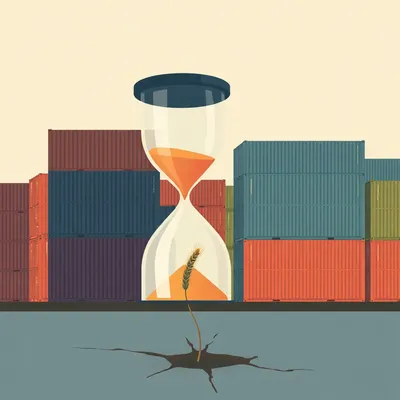
Israel imports approximately seventy percent of its grain consumption — primarily wheat from Ukraine, Russia, and the United States. The country also imports most of its animal feed and virtually all of its soy. Strategic grain reserves, according to the USDA data I've seen, cover about four weeks of normal consumption. That's it. After that, you're baking bread with whatever you can grow domestically, and the domestic grain harvest is a fraction of consumption.
That's terrifyingly thin. So bread, which is a staple food in Israel, becomes the first crisis point. Wheat reserves dwindle within the first month. Bread prices spike. The government has to impose a national bread ration, which hasn't happened since 1951, during the austerity period of the early state. And I want to be concrete about what that looks like. In 1951, Israel had the "tzena" — the austerity regime. Ration coupons for basic foodstuffs. Black markets for bread. People lining up at bakeries before dawn. The social memory of that period is still present in Israeli culture. It's not a distant abstraction. People remember their grandparents talking about it.
It's not just bread. The dairy and poultry sectors collapse without imported feed. Israel's dairy industry is famously efficient — Israeli cows produce among the highest milk yields in the world — but they eat imported grain and soy. No feed, no milk. The protein supply chain unravels within two to three months. You go from a country with a thriving dairy culture — cottage cheese is practically a national obsession — to a country where milk is a luxury item. The psychological impact of that is hard to overstate.
You've got a country that grows gorgeous cherry tomatoes and bell peppers and avocados for export, but can't produce enough calories to feed its population. The substitution playbook becomes critical. The government has to convert idle agricultural land from export crops to staple grains — wheat, barley, legumes. But that takes six to twelve months minimum, and it requires massive reallocation of water rights from the National Water Carrier. You're essentially ordering farmers who've spent decades perfecting high-value export crops to rip them out and plant wheat. The agronomic knowledge is there, but the transition time is brutal.
There's a question here: how much arable land does Israel actually have? The Negev is desert. The Galilee is fertile but limited. The total cultivated area is about four hundred thousand hectares. That's not nothing, but it's not the American Midwest either. You can't just double wheat acreage overnight. There are soil constraints, water constraints, equipment constraints. The tractors and combines run on diesel, which is already rationed. So you're trying to expand grain production while fuel is scarce and the existing grain reserve is dwindling. The timelines don't line up.
Which brings us to water. The common misconception is that desalination solves everything. Israel operates five major seawater reverse osmosis desalination plants — Sorek, Ashkelon, Hadera, Palmachim, and Ashdod. Together they provide about eighty-five percent of domestic water consumption. It's an extraordinary achievement. Sorek alone is one of the largest desalination plants in the world. But here's the circular dependency: desal plants require imported membranes, anti-scalants, and specialized chemicals. The stockpiles for those are estimated at about six months. They also require massive amounts of electricity. If you're rationing power, do you keep the desal plants running at full capacity, or do you divert electricity to food refrigeration and hospitals?
The triage gets Byzantine. You're choosing between water, food storage, and medical care. And the answer depends on the season. In summer, water demand spikes. If a desal plant goes offline in August, you've got a public health emergency within days. In winter, maybe you can stretch the reserves longer. But here's the thing — the desalination plants aren't just about drinking water. They feed the National Water Carrier, which supplies agriculture. If you cut desal output, you're not just telling people to take shorter showers. You're telling farmers they can't irrigate. And if you're trying to ramp up domestic grain production, you need more irrigation, not less. So there's a direct conflict between the water strategy and the food strategy.
There's another layer. The desal plants are coastal. In a scenario of total international isolation, the security environment probably isn't great either. The plants are vulnerable to attack. If one gets taken offline by hostile action, the water math gets even tighter. Sorek is right on the coast near Palmachim. Ashkelon is a few kilometers from Gaza. These are not hardened military installations. They're industrial facilities with large above-ground infrastructure. A single cruise missile or drone swarm could take a plant offline for months.
Let's map the failure points in order. Week one: fuel rationing begins, private vehicles are restricted, the cold chain starts feeling pressure. Week two to four: bread prices spike, grain reserves dwindle, the government imposes food rationing. Month two: dairy and poultry sectors collapse as feed imports run out. Month three to four: coal reserves are exhausted, the grid runs entirely on natural gas and whatever solar has been deployed. Month six: desalination chemical stockpiles reach critical levels. Somewhere in there, the high-tech sector — which accounts for about fifteen percent of GDP and fifty percent of exports — has already collapsed because foreign markets are closed and chip fabrication requires imported equipment.
The high-tech collapse is actually one of the most painful but least discussed aspects of this scenario. Israel's economy has been built around the "Startup Nation" identity for two decades. But high-tech exports require global supply chains. You can't fabricate semiconductors locally. You can't import the lithography equipment. The sector's revenue model depends entirely on selling to foreign markets. When those markets close, the sector doesn't just shrink — it effectively ceases to function as an export industry. And this happens fast. Within weeks of the sanctions hitting, multinational corporations with R&D centers in Israel — Intel, Google, Apple, Microsoft — they're not going to keep operating in a sanctioned country. The compliance risk is too high. They pull out. Thousands of engineers are suddenly unemployed.
Which means a huge portion of the country's engineering talent suddenly has no commercial application. The question is whether that talent can be redirected. And I think this is actually the most interesting part of the scenario, because it's not obvious that the answer is yes. These are people who've spent their careers optimizing ad algorithms and designing mobile apps and building enterprise software. Can you retrain a React developer to maintain a water pump? Can a machine learning engineer pivot to optimizing crop rotation schedules? The skills are adjacent but not identical. There's a translation problem.
That's exactly the pivot we need to talk about in phase three, months six through twelve. The industrial reconfiguration. The "Startup Nation" becomes the "Subsistence Nation." And I think you're right that the skills translation isn't automatic, but I'm more optimistic about it than you might be. The underlying aptitude — systems thinking, optimization, rapid prototyping — that transfers. An engineer who's spent five years optimizing database queries has the mental model to optimize a supply chain. It's not the same domain knowledge, but the cognitive toolkit is surprisingly portable.
I like that framing. It's not that the talent disappears. It's that the output changes from high-margin software and chips to basic survival infrastructure. The Technion and Weizmann Institute essentially become national logistics planners. Engineering teams that were building machine learning models for ad targeting are now figuring out how to manufacture water pump impellers domestically. And there's a historical precedent for this. During World War II, automotive engineers retooled to build aircraft engines. Consumer electronics factories switched to radar components. The transition is painful but possible when the institutional will is there.
This is where 3D printing and local manufacturing become strategic. Israel has a reasonably sophisticated manufacturing base for a country its size, but it's not set up to produce everything. The playbook involves open-source designs for critical components — water pumps, solar inverters, medical ventilators — adapted for local production with available materials. It's not going to be as efficient. The tolerances won't be as tight. But it keeps the lights on and the water flowing. And 3D printing is particularly interesting here because it allows you to produce complex geometries without the full supply chain that traditional manufacturing requires. You don't need a forging plant and a machine shop and a quality control lab. You need a printer, feedstock, and a digital design file. The feedstock is still a problem — metal powders and polymer filaments are imported — but it's a smaller, more manageable problem than rebuilding an entire industrial base.
The defense dimension is also critical in this phase. The Iron Dome and other missile defense systems continue operating, but spare parts become a bottleneck. Without US parts for F-35s and advanced systems, Israel has to accelerate indigenous production of simpler, maintainable platforms. The Merkava tank is already largely domestic, which helps. The Ofek satellite program provides some intelligence capability. But the loss of real-time US satellite data and foreign intelligence sharing is a significant degradation. You go from having near-perfect situational awareness to having good-but-gappy awareness. And in a hostile neighborhood, that gap is dangerous.
The qualitative military edge that Israel has relied on for decades depends heavily on technology transfers and component imports. Without those, the military doesn't collapse — Israel has a large domestic defense industry, IAI, Rafael, Elbit — but it becomes a less precise, more attrition-based force. That changes the strategic calculus significantly. Instead of precision strikes with minimal collateral damage, you're looking at more conventional warfare with higher ammunition consumption, higher casualties, and less discrimination. The deterrent effect shifts. Adversaries who were previously deterred by Israel's technological superiority might recalculate.
Let's talk about phase four — year two and beyond. What does the new equilibrium look like? Because the country doesn't just collapse. What's the shape of that adaptation?
This is where the adaptation starts to produce results, but it's a radically different country than what existed before. Food self-sufficiency reaches maybe sixty percent. The rest comes from intensive greenhouse agriculture, vertical farming in urban centers, and lab-grown protein from companies like Aleph Farms. It's not the Israeli diet anyone is used to. Meat becomes a luxury. Bread is available but expensive. The cuisine shifts heavily toward what can be produced locally — vegetables, legumes, some grains, fish from aquaculture. Hummus and falafel, ironically, are mostly made from chickpeas, which can be grown domestically. So the street food survives. But the European-style dairy and meat-heavy diet that many Israelis have adopted over the past thirty years? That's gone.
The energy grid stabilizes around a mix of natural gas from the remaining reserves, aggressively deployed solar, and possibly experimental small modular reactors if any are operational. Rooftop solar becomes a national mobilization effort — every available surface gets panels. But manufacturing those panels requires polysilicon and inverters, which are imported. So you're either scavenging from existing stockpiles or developing domestic alternatives, which are less efficient. You might see a shift toward solar thermal rather than photovoltaic, because mirrors and pipes are easier to manufacture domestically than high-purity silicon wafers. It's less efficient per square meter, but it's producible with local materials.
The population picture is also part of the equilibrium. Foreign workers leave. Emigration spikes among Israelis with dual citizenship or the means to leave. The population shrinks and stabilizes at a lower, more austere standard of living. GDP per capita drops significantly — think Cuba's Special Period as a rough benchmark, though Israel starts from a much higher baseline. And I want to be clear about what that means. Cuba's GDP dropped by thirty-five percent. If Israel's GDP dropped by thirty-five percent, you're looking at a per capita income going from roughly fifty-five thousand dollars to around thirty-five thousand. That's still middle-income by global standards, but it's a catastrophic drop for a population accustomed to Western European living standards.
Cuba is the case study that keeps coming up in this kind of analysis. After the Soviet Union collapsed in 1991, Cuba lost about eighty percent of its trade overnight. GDP contracted by thirty-five percent between 1991 and 1995. Caloric intake dropped by about thirty percent before stabilizing. The average Cuban adult lost about ten to fifteen pounds. The country survived through urban agriculture, bicycle transport, extreme energy conservation, and a radical reorientation of the economy toward subsistence. It was brutal, but it wasn't collapse. The state didn't fail. The public health system, remarkably, continued functioning. Infant mortality actually improved during the Special Period. There's a resilience story there that's instructive.
Israel has far more technical capacity than Cuba did. The engineering talent pool is deeper. The agricultural technology is more advanced. The starting point is wealthier. But there's a flip side to that: baseline expectations are much higher. Israelis are not accustomed to power outages or food rationing. The psychological and political adjustment to a Special Period-style existence would be enormous. The social contract would be tested in ways it hasn't been since the founding of the state. And I think this is where the Cuba comparison is most useful — not the technical details, but the social psychology. Cuba made it through the Special Period partly because of technical ingenuity, but mostly because of a shared national narrative of resistance and sacrifice. Does Israel have that narrative available? It did in 1948. It did in 1967. Does it still?
That's the wildcard in any resilience model. Technical capacity gets you far, but social cohesion is the ultimate limiting factor. If people don't accept the rationing, if black markets proliferate, if political factions start blaming each other for the crisis, the whole adaptation playbook falls apart. And Israel's political culture is not exactly known for unified sacrifice in recent years. You've got deep divisions between secular and religious, between left and right, between Jewish and Arab citizens. A crisis of this magnitude either forges unity or shatters along existing fault lines. There's no guarantee which way it goes.
There's another wildcard worth discussing: diaspora support. Even in a scenario of total state-level isolation, private Jewish communities worldwide would organize. Financial transfers through cryptocurrency. Technical expertise transfers through encrypted channels. It's not state-level support, but it creates a gray-market lifeline that's extremely difficult for sanctions to fully close. Historically, diaspora networks have been remarkably effective at maintaining flows of capital and knowledge under hostile conditions. The Iranian Jewish community maintained connections during decades of hostility. The Soviet Jewry movement organized massive material and political support. These networks are real and they're resilient.
It's not going to replace container ships full of wheat, but it might keep critical medicines flowing or provide foreign currency for targeted purchases. Think of it as a capillary system that keeps the absolute worst outcomes at bay. You can't feed a country through diaspora donations, but you can prevent a hospital from running out of insulin. You can keep a desalination plant's critical spare parts flowing through a network of small shipments routed through third countries. The sanctions regime would try to close these channels, but the history of sanctions enforcement suggests that total closure is almost impossible. There's always leakage.
Let's pull together the key insights from this war game, because the exercise is useful beyond just the Israel scenario. And I think there are three big ones.
The first and most counterintuitive insight: Israel's survival in this scenario depends less on military strength and more on the speed of industrial reconfiguration. The first six months are the danger zone. If the country can get through those six months without a cascading failure in food, water, or energy, the substitution effects and conservation measures start to buy time. The curve bends from collapse toward adaptation. But those six months are brutal, and the margin for error is thin. One bad decision in the energy triage, one delayed conversion of agricultural land, one political crisis that paralyzes decision-making — and the cascades accelerate instead of slowing.
The second insight: the most vulnerable systems are not the ones most people would guess. Water is surprisingly resilient because of the desalination infrastructure, even with the chemical supply problem. Energy is a medium-term problem solvable with aggressive solar deployment — painful but not existential. Food is the real Achilles' heel. Specifically, grain and animal feed. The caloric dependency on imports is the single hardest problem to solve quickly, because agricultural conversion takes growing seasons, not weeks. You can't engineer your way out of a wheat deficit in six months. You can't 3D-print bread. The biophysical constraints of agriculture are the hardest to hack.
The third insight: the "Startup Nation" brand is a double-edged sword. On one hand, high-tech exports are a massive vulnerability when foreign markets close — fifteen percent of GDP evaporates almost overnight. On the other hand, the engineering talent pool is the single most valuable asset for domestic reindustrialization. The country's real resilience is in its human capital, not its stockpiles. Silicon wafers don't feed people, but the people who know how to design silicon wafers can figure out how to optimize a hydroponic system or retrofit a solar inverter. The question is whether the institutional infrastructure exists to redirect that talent quickly enough. You need a mechanism to match engineers with survival problems. A national talent clearinghouse. Something like a domestic DARPA focused entirely on import substitution.
Which leads to a broader point about resilience in any modern economy. The exercise of mapping critical import dependencies reveals vulnerabilities that most countries have never seriously stress-tested. What are the top five imports your country can't live without? How long do the stockpiles last? What's the substitution timeline? Most governments have done this analysis for military scenarios, but few have done it for comprehensive economic isolation. And the military analysis often misses the civilian cascades. The Pentagon might know exactly how many tank shells it has, but does it know how many reverse osmosis membranes the country has?
The geopolitical context makes this more than an academic exercise. As fragmentation accelerates — US-China decoupling, regional trading blocs, sanctions becoming a standard tool of statecraft — the ability to survive isolation becomes a strategic asset. Countries are quietly building resilience into their supply chains. Domestic semiconductor capacity. Israel's experience, hypothetical or otherwise, is a case study with global applicability. Every country should be running this exercise for itself. What happens if the Strait of Hormuz closes? What happens if the South China Sea becomes a no-go zone for commercial shipping? What happens if your primary grain supplier has a multi-year drought? These aren't science fiction scenarios.
There's also a question worth sitting with: would the international community actually allow a UN member state to starve? The scenario assumes total isolation, but in practice, humanitarian carve-outs and backchannel deals would almost certainly emerge. Even North Korea and Iran have some trade. Complete, hermetic isolation is probably impossible to sustain indefinitely. The model is a stress test, not a prediction. It shows where the breaking points are, not that breaking is inevitable. And I think that's an important distinction. The purpose of this kind of analysis isn't to predict doom. It's to identify vulnerabilities so they can be addressed before they're tested.
And that's what makes this kind of war game useful. It's not about predicting doom. It's about understanding the system well enough to know where the reinforcements need to go. If you know the grain reserve is the weakest link, you build bigger silos. If you know the desalination plants depend on imported chemicals, you invest in domestic chemical production or alternative technologies. If you know the high-tech sector is a single point of economic failure, you diversify. The exercise reveals the architecture of vulnerability. And once you see the architecture, you can reinforce it.
For listeners, the takeaway isn't "be afraid of sanctions." It's "map your dependencies." Think about your own country or region. What are the critical imports that would break first? Where does your food come from? Most people have no idea, and that ignorance is itself a vulnerability. The exercise of tracing supply chains is intellectually demanding but useful. Go look up where your electricity comes from. Not just "the grid" — which power plants, which fuel sources, which transmission lines. Go look up where your water comes from. Which aquifer, which reservoir, which treatment plant. Go look up where your food comes from. Which countries, which ports, which distribution centers. Once you start tracing these chains, you see the fragility everywhere.
If you enjoy this kind of analytical war-gaming, send us your own weird prompts. We simulate the scenarios you're curious about but can't easily model yourself. Geopolitical what-ifs, technology disruption scenarios, system collapse thought experiments. If it's weird and it involves mapping complex systems under stress, we're interested. We've done asteroid impacts, we've done AI takeoff scenarios, we've done pandemic modeling. This Israel scenario came from a listener, and it's one of the most interesting ones we've done. So keep them coming.
The open question we'll leave you with: what's the scenario you're not modeling that you should be? What's the dependency you're not tracking? Because the history of crises is that they rarely come from the direction you're watching. The thing that breaks your system is not the thing you've been preparing for. It's the thing you didn't think to check.
Now: Hilbert's daily fun fact.

In Korean, the 1920s saw the near-total collapse of the complex pre-modern speech level system in everyday use, but the formally deferential "hapsyo-che" style survived as a fossilized artifact in broadcast news and public announcements — meaning millions of Koreans today use a speech register that linguistically belongs to their great-grandparents' generation every time they hear the evening news. The same broadcaster who chats with friends in casual "hae-che" style switches to a form that was already archaic when their grandparents were young. It's a living linguistic fossil, preserved in the amber of broadcast convention.
The news speaks in great-grandparent. There's a metaphor in there somewhere. Systems that outlive their original context, preserved by institutional inertia. Kind of like strategic stockpiles that everyone forgot about until they're suddenly the only thing standing between a country and collapse.
And weirdly on-theme. This has been My Weird Prompts. Thanks to our producer Hilbert Flumingtop. If you want more scenarios like this one, head to myweirdprompts.com and send us your own weird prompt. We'll see you next time.