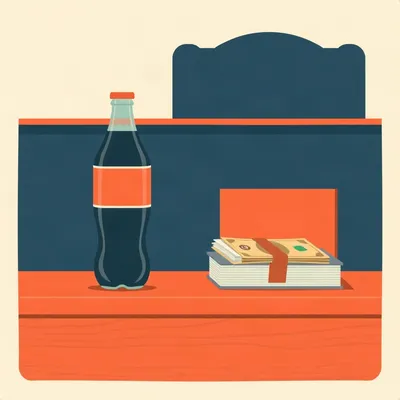
United States versus Forty Barrels and Twenty Kegs of Coca-Cola. That is a real federal case, argued in front of the Supreme Court, published at volume two forty-one of the United States Reports.

And it is not the strangest caption in this episode.
Daniel sent a prompt about in rem jurisdiction, the quirk of American law where the government sues the thing instead of the person. He named the Coca-Cola case, the clacker balls, Ulysses, and he asked what each object was actually accused of and who won. Then he went somewhere else with it, which is the part I keep turning over. He wrote that the same trick, in civil asset forfeiture, produces a defendant like one hundred twenty-four thousand seven hundred dollars in United States currency, and that this is a lot less funny for the person who owned it.
Two moods, one mechanism. A book on trial for obscenity, a crate of vinegar on trial for not being vinegar, and then a family's savings on trial for being near a traffic stop.
So we start where the barrels are.
In rem means "about or against the thing." The court's power runs over the property itself. Normally a court needs jurisdiction over a person, in personam, and if the person is out of reach the case stops. Here the object is the defendant. The government files against forty barrels of soda, the court asks whether the soda is liable, and the owner's conduct is almost beside the point.
The owner can exist. The owner just is not the accused.
There is a cousin concept, quasi in rem, where a state grabs an absent person through property they hold there. The Supreme Court cut that back hard in Shaffer versus Heitner in nineteen seventy-seven. What survives, and what we are talking about today, is the pure thing: the government versus an article.
And the deep root is admiralty. Suing a ship, because a ship cannot be served with papers but can be seized in port.
The whole apparatus descends from "we cannot get the sailor, but we have the vessel." Once you accept that a thing can answer for itself, barrels of soda and books of poetry follow.
Whose side was the vinegar on, do you think.
The vinegar was the defendant. The vinegar did not get a say.
I would like the record to show I asked.
Let me do the greatest hits in order, because the comedy really is the caption. Forty Barrels and Twenty Kegs of Coca-Cola, nineteen sixteen. One Book Called Ulysses, nineteen thirty-three. Ninety-five barrels of vinegar, nineteen twenty-four. And my personal favorite for sheer accumulation, an article consisting of fifty thousand cardboard boxes, more or less, each containing one pair of clacker balls.
More or less. The government hedged its boxes.
The caption includes the label text. Kbonger. It's fun. Test your skill. It bounces, it flips, count the hits. Specialty Manufacturing of Seattle.
A toy with a marketing department.
The marketing department mattered, because the whole theory of the case was that the toy, as sold and as designed, was itself the hazard. The government did not need to show a particular child was hurt. It needed to show the article, in the abstract, created an unreasonable risk. That is the in rem move in miniature: the danger is a property of the thing, not a fact about a person.
So the caption is not just funny. It is doing legal work.
The caption is the jurisdiction. Name the thing, and the court's power attaches to it.
But how does that work in practice for the owner? If the barrels are the defendant, does the Coca-Cola company even get a lawyer?
It does, and that is the odd part. The owner appears as a claimant, not a defendant. It can defend the thing, argue the thing is innocent, and appeal if the thing loses. But the case caption never names the company. The company's fate rides on the fate of an object it no longer controls.
Which is fine when the object is soda. It gets strange when the object is a savings account.
That is exactly the seam Daniel found.
Now, what were they all accused of. The Coca-Cola case starts in nineteen oh-nine. The government seized those barrels under the nineteen-oh-six Pure Food and Drug Act and argued two things. Adulterated, because caffeine was an added ingredient that might be deleterious. And misbranded, because the name promised coca and cola while the drink, as the government put it, contained no coca and little if any cola. The alleged dose was one point two one grains of caffeine per eight ounce serving.
Seventy-eight milligrams. Roughly a shot of espresso in a soda.
Justice Charles Evans Hughes wrote it. He held caffeine was indeed an added ingredient, but whether it was harmful was a jury question, and remanded for retrial. So nobody won cleanly. Coca-Cola cut its caffeine and offered to pay all legal costs to settle. The government took the money, partly because Harvey Wiley, the crusader behind the whole action, had resigned in nineteen twelve.
The prosecutor quit before the defendant did.
Wiley was the head of the Bureau of Chemistry and the driving force behind the Pure Food and Drug Act. He had built his career on the idea that additives were a public health menace. When he left, the case lost its champion inside the government, and the settlement became possible.
So the barrels were never convicted of anything.
No verdict. No final holding on the caffeine question. Just a remand, a reformulation, and a check.
Fun fact tangent: the original formula really did include coca, as in coca leaf, with the cocaine removed by processing. The "no coca" accusation was about the label's promise, not a hidden drug. The case was about the word, not the plant.
Which loops right back to the vinegar. The charge is the name on the can.
The vinegar is my favorite for the logic. Ninety-five barrels labeled Excelsior Brand Apple Cider Vinegar, Made from Selected Apples. The vinegar was fine, equally wholesome, similar in taste and composition. It was made from dried apples rehydrated with water instead of fresh cider. Dehydration strips about eighty percent of the water. Justice Butler held that even a perfect product is misbranded if it is not the identical thing the label describes. Government won, reversing the Sixth Circuit.
So the charge was not harm. The charge was a broken promise on the label.
That is in rem in miniature. The thing's status is the case.
And the clacker balls, which is the one where I most want to know what the government actually said out loud.
Two balls on a cord you swing together to clack. The government sought seizure, condemnation and destruction of fifty thousand boxes of them under the Federal Hazardous Substances Act, arguing an unreasonable risk of injury from fracture, fragmentation, disassembly, and from propulsion of the toy or its parts. The court granted summary judgment. The toys were condemned and destroyed.
Fifty thousand boxes, destroyed by the state.
And inside, the driest fight imaginable over whether an affidavit was admissible. The comedy is the caption, the substance is procedural.
That is the pattern across all four. The headline is a thing on trial, and the actual opinion is about evidence and procedure.
Which is why the rooster is so tantalizing. At least the others left opinions.
Ulysses is the elegant one.
Random House deliberately imported Joyce's novel and had Customs seize it to force a test case under the Tariff Act of nineteen thirty. The United States proceeded in rem against the book, not the author, not the publisher. Judge John Woolsey ruled on December sixth, nineteen thirty-three, that the novel was not obscene. His line: whilst in many places the effect of Ulysses on the reader undoubtedly is somewhat emetic, nowhere does it tend to be an aphrodisiac.
Emetic, not an aphrodisiac. The most literary verdict ever handed down about a book's effect on the libido.
The Second Circuit affirmed two to one, Learned Hand and Augustus Hand in the majority, Chief Judge Manton dissenting. And Woolsey's opinion is reproduced in every Random House printing, said to be the most widely distributed judicial opinion in history.
A judge's reasoning shipped with the product.
Which is the whole tradition in one image. The thing stands trial, and the opinion travels with it.
But what about the practical effect? Did the ruling free other books, or just this one?
It opened the door. Woolsey's "not aphrodisiac" test gave importers a usable standard, and the Second Circuit's affirm made it precedent in that circuit. Other modernist works moved more freely after that. The book's trial ended up functioning like a rulebook for the border.
The dissent, by the way, is worth a beat. Manton thought the book was obscene in places and that the majority was being too charitable about the effect on readers.
He would have kept the book out. The majority let it in, and the novel's legal journey ended at the border it was deliberately carried to.
I want the rooster.
The rooster.
Cornell's legal information institute lists a case called United States versus One Solid Gold Object in Form of a Rooster. It appears as a passing citation. Nobody I have seen can say what the rooster was accused of or who won.
That is the problem with this genre. The funny captions often hide dry procedural fights, and a few of them hide nothing at all, just a name and a docket number.
A gold rooster, awaiting trial, possibly forever.

Good evening, friends. Are you a person who has recently been sued as an object? Introducing Removalin, the new once-daily capsule that helps you stop being the defendant and start being the plaintiff. Just one Removalin with water, and within weeks your caption shortens, your docket clears, and you may once again enjoy being a witness in your own life. Side effects include mild drowsiness, a metallic taste, an unearned affinity for maritime law, sudden conviction that your own furniture is contraband, a persistent belief that you are the rooster, and in rare cases, a full and irreversible transfer of legal personhood to a household appliance. Removalin. Ask your judge if your thing is ready.
I knew Herman booked that.
I did not book that. I have never booked anything. I have been practicing law in my head for eleven minutes and I would never schedule a capsule ad inside a forfeiture segment.
Your denial is suspiciously specific.
It is a denial. They have features.
So the barrels and the book and the clacker balls are funny because no human is being punished. But the same mechanism, the same in rem logic, gets aimed somewhere else entirely.
The government does not have to prove you did anything wrong. It only has to prove the thing is connected to a crime. And that is where the one hundred twenty-four thousand seven hundred dollars comes in.
Nebraska, Interstate eighty, a traffic stop on May twenty-eighth, two thousand three. A trooper finds seven rubber-banded bundles wrapped in aluminum foil inside a cooler.
Emiliano Gomez Gonzalez is the claimant. The district court ruled for him, calling the explanation plausible and consistent. Then the Eighth Circuit reversed. Bundling and concealment of large amounts of currency, combined with other suspicious circumstances, supports a connection between money and drug trafficking.
Judge Donald Lay dissented.
Judge Lay dissented: I cannot agree that the government has proven, by a preponderance of the evidence, the requisite substantial connection between the currency and a controlled substance offense.
Which is the whole thing in one sentence. The majority thinks the foil proves something. The dissent thinks the government has proven exactly nothing about a person.
And that is the machine. In civil forfeiture the government proceeds against the property, not the owner, in what a Congressional Research Service report cheerfully calls an in rem proceeding, which results in awkward captions such as United States versus fifty-two thousand dollars, more or less, in United States currency. The owner's guilt is not in question, because often there is no criminal prosecution at all.
The money stands trial so the person never has to.
The scale is the part I keep coming back to. The Institute for Justice's Policing for Profit, fourth edition, puts forfeiture revenue nationwide since two thousand at a minimum of eighty-two billion dollars. Federal forfeiture has run somewhere between two and three billion a year since fourteen. Thirty-four states report three hundred to three hundred fifty million.
And most of it never sees a courtroom.
Seventy-one percent of Justice Department forfeitures are administrative, meaning no hearing. In three states with data, between sixty-two and seventy-six percent of seizures end in forfeiture by default. The owner never contests it.
Because the median currency forfeiture across twenty-four states is worth less than sixteen hundred and seventy-eight dollars.
And an attorney to fight it costs an estimated thirty-three hundred dollars. Nearly twice the median. In half the states the deadlines leading to a hearing add up to a hundred eighty-eight days, more than six months.
So the rational move is to walk away, and the entire system depends on the rational move.
That is the quiet engineering of it. The law does not need to be harsh on paper. It just needs to make fighting cost more than surrendering.
Bennis versus Michigan, nineteen ninety-six, is the precedent that makes it legal to take from the blameless. Tina Bennis's family car was seized after her husband was caught in it with a prostitute. The Supreme Court held the Due Process Clause does not forbid taking property from blameless people for other people's crimes.
The car was guilty of being present.
Congress created a federal innocent owner defense in the Civil Asset Forfeiture Reform Act of two thousand. But the Institute for Justice notes that twenty-five states plus the federal government still make third-party owners prove their own innocence. The burden is flipped, which is the quiet horror inside the funny captions.
The flip is the whole story. In a criminal case the state must prove guilt. In these forfeiture cases the owner must prove innocence, and prove it about a thing that was named instead of them.
In the Ulysses case the book gets to be the defendant and the author goes free. In the cash case the cash is the defendant and the owner is the one fighting for his life.
The mechanism is identical. The stakes are not.
That tonal whiplash is what Daniel was poking at, and it is real. The barrels are funny because nothing human is on trial. The dollars are the same procedure with a person's savings standing in for the barrel.
And the difference between a book and a bag of money is that a book can be reprinted. A person's money, once forfeited by default, is gone.
I would like to say, for the record, that I sympathize with the vinegar.
The vinegar had a label problem. The cash had a foil problem. Neither had a lawyer at the scene.
Nobody in that cooler was read their rights, because the cooler was not a person.
The cooler was the defendant. The cooler did not show up.
I have been waiting for the right moment.
The rooster is the only undefeated party in this entire branch of the law.

Corn, Herman, if a court seizes a thing and the thing is destroyed before the hearing, does the case go on, or does the government have to sue whatever is left. Because I have a situation.
It is a real question. The case can proceed against the substitute proceeds, or the thing itself if the thing survives. Why, what happened.
In the mid eighties I had a neighbor, a man named Gerald Pyle, who ran a bait and tackle shop out of a converted garage on Delancey Street. He had a freezer, a Connors and Sons, Model F-41, and inside that freezer he kept, at any given time, between three and four hundred nightcrawlers in a damp coffee can. One morning the can tipped. The worms got into the insulation. The freezer had to be destroyed.
The worms won.
The worms were not sued. The freezer was seized by the city under a sanitation ordinance because it was, and I am quoting the notice, a potential vector. My neighbor, Gerald Pyle, did not fight it. He paid forty-six dollars and he signed a paper that said he would not acquire another freezer on that premises for a period of two years. He observed the two years. Then he bought a second freezer.
A second one.
A Connors and Sons, Model F-41, identical to the first, bought from a man in Abington for sixty-two dollars. He put it in the same garage. The city came back, and this time they took the worms as evidence, all of them, and they filed against the worms themselves, in rem, as a nuisance. I read the caption myself. It named the coffee can.
The coffee can was the defendant.
And the worms were described in the pleading as the contents. Gerald lost. The can was condemned and the worms were flushed. Gerald's response was to buy a third freezer, a Model F-41 again, and a metal coffee can, and he kept the worms in it from that day forward, and I believe he still does. He is eighty-one now.
A metal can changes the analysis.
A metal can changes the pleading. That was his line. He said it to me on Delancey Street in front of the third freezer. He was very calm about it. He has been an anteater, in the way that he is, and he cannot help the worms. They keep getting into things.
And the city never came after him personally.
They came after the can. He respected that. He said a can can pay a fine but a man has to answer questions. I have thought about that a great deal, Herman, because I once had forty dollars of mine held for eleven months and I still think about it in a way that is not proportionate to forty dollars.
That is the truth of it, and it is the honest answer to your question. The thing goes on trial precisely so the person does not have to answer questions.
The coffee can never testified.
That is the design.
One thing Daniel's prompt left loose: the rooster. Cornell lists United States versus One Solid Gold Object in Form of a Rooster, and nobody seems able to say what the rooster was accused of or how it ended.
Which tells you something about this corner of the law. The funny captions usually hide dry procedural fights, and the fight almost never happens at all. Seventy-one percent of federal forfeitures are administrative. The trial of the thing that makes the barrels famous is a rarity. For an ordinary owner, the hearing is the exception, not the rule.
The quirk that tried a book and a barrel of vinegar now tries a bag of cash, and the burden flip means the owner is often the real defendant in practice, without ever being named.
Default is the engine. The caption is the decoration.
If you have a case name that belongs in this tradition, or a better rooster, we want to hear it. Rate and review us wherever you listen, or come to my weird prompts dot com.
Thanks to our producer, Hilbert Flumingtop, who keeps the docket in order.
If you enjoyed this one, try episode sixteen, On Deepfakes, SynthID, And AI Watermarking; episode twenty-one, Is Your AI Secretly American; and episode four, If Your Voice Ages, Does Your Fine-Tune Become Useless. This has been My Weird Prompts.
See you tomorrow.