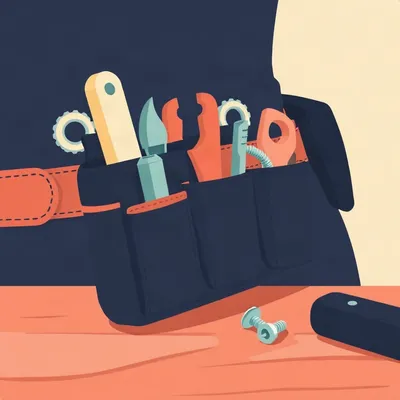
Daniel sent us this one, and I have to say, it's the kind of question that makes me genuinely glad we do this show. He's been on a bit of a journey — first the headlamp, then clip-on speakers — and now he's asking: why do we carry everything in our pockets? What if we moved the tool belt of daily life onto our heads? He wants to know if anyone has seriously tried to devise daily carrying belts around the head, whether there's a commercial solution, and if not, how you'd prototype one yourself. He also acknowledges you'd need to give "sufficiently zero" — his words — about what people think to pioneer this. So we're talking head-mounted everyday carry.

I love this. I love this. Because it's absurd on its face, but the moment you actually think about it, you realize the pocket monopoly is completely unexamined. We've all just accepted that the lower half of the body is where things go. And Daniel's onto something with the headlamp revelation — once you experience hands-free illumination, pockets feel primitive.
The pocket monopoly. Sounds like a regulatory capture case from the nineteen thirties.
It kind of is. Think about it — we've had pockets for what, five hundred years? They migrated from external pouches to sewn-in fabric slits around the seventeenth century. And since then, innovation has been entirely about making them flatter and less noticeable. Nobody asked whether they should be somewhere else entirely.
Where do we even start with this? Has anyone actually tried to put a tool belt on their head?
Okay, so here's where it gets interesting. There's no direct commercial product that does what Daniel's describing — a general-purpose daily carry head harness. But the components exist scattered across different domains. The most obvious ancestor is the military and tactical headband. Companies like Thyrm and a few others make what are essentially headbands with integrated pouches for batteries, small tools, lights. They're designed for night operations where you need counterweight for night vision goggles.
So the military already has pockets on the back of their heads and none of us knew.
And they're purely functional — no aesthetic consideration whatsoever. But here's the thing: those are purpose-built for a single use case. What Daniel's describing is more like a modular system. A head-mounted tool belt where you can swap out what you carry based on the day.
I'm picturing a bandolier for the scalp. Which, honestly, sounds like something a cyberpunk extra would wear in the background of a movie set in two thousand forty.
That's the cultural barrier, right? The technology isn't the problem. A headband with pockets is incredibly simple to manufacture. The barrier is that we've decided heads are for hats and hair, not for storage.
We already put things on our heads. We just don't put things in things on our heads.
And if you look at the clip-on speaker Daniel mentioned — that's actually a really good gateway. He's talking about something like the JBL Clip or the Bose SoundLink Micro, those little speakers with a carabiner that you attach to your bag or belt loop. But people have started clipping them to shirt collars, to headbands, to backpack straps near the ear. There are whole Reddit threads about optimal clip-on speaker placement for podcast listening while doing chores.
The head-mounted audio layer is already happening in the wild. People are just doing it ad hoc.
The headlamp too. Ten years ago, if you wore a headlamp outside of a campsite or a mine, people thought you were eccentric. Now you see runners with them, dog walkers, people doing home repairs. The normalization is happening piece by piece. Daniel's just asking: what if we go all the way?
The thing that strikes me is that he's not wrong about the advantages. A head-mounted wallet means you never sit on it. A head-mounted power bank solves the cable-dangling problem. And if you're already wearing a headlamp and clip-on speakers, you've got two anchor points. Adding a third pouch is incremental.
Let's actually break down what a head-mounted everyday carry system would need to solve. First, weight distribution. The human head weighs about ten to eleven pounds. Adding more than a few ounces starts to strain the neck. So you can't just strap a loaded tool belt up there — you need to think about weight placement.
Which is where the counterweight pouch idea from the military comes in. Front to back balance.
If you've got a headlamp in front, you want something of similar weight in back. The ideal setup probably looks like a lightweight, breathable band with mounting points — maybe MOLLE webbing, that modular webbing system the military uses — running around the circumference. You attach pouches where you need them.
MOLLE on your melon. Say that five times fast.
Here's where I get excited. There's a whole biomechanics literature on head-borne weight. Studies from the US Army Research Laboratory, going back to the early two thousands, looked at how soldiers perform with different head-mounted loads. The sweet spot for extended wear seems to be under four hundred grams total — that's about fourteen ounces. Beyond that, you get measurable fatigue within two hours.
You've got a weight budget. Fourteen ounces to play with.
Which is actually plenty. A modern smartphone weighs about six to seven ounces. But you wouldn't put a smartphone up there — that's what pockets are for. You'd put the things that benefit from head-level access. A slim wallet — maybe an ounce and a half. A small power bank — there are lipstick-sized ones that weigh two ounces and hold enough for a phone top-up. Clip-on speaker, three ounces. Headlamp, maybe two ounces with batteries. You're at eight and a half ounces. Room to spare.
I'm doing the math and I don't hate it. Which is a dangerous place to be.
There's a safety argument that nobody talks about. Pickpocketing from a headband is basically impossible without the wearer noticing. You're not going to get your wallet lifted from your temple without feeling it.
That's actually a real point. In crowded urban environments, head-level storage is inherently more secure than hip-level. You'd have to be absurdly bold to reach toward someone's face.
There's a whole subculture around what's called "body stash" carry — people who hide valuables in belts, ankle holsters, hidden pockets. Head mounting is just the next elevation, literally.
The crown stash. So we've established it's physically feasible, it's got a weight budget that works, and there are security advantages. The real question is whether anyone could actually wear this in public without being perceived as completely unhinged.
This is where I think Daniel's framing is actually brilliant, even if he's being playful. He's not asking about the engineering. He's asking about the social frontier. Who gets to define what's an acceptable place to carry things? Because it's completely arbitrary.
It really is. I mean, think about the history of the wristwatch. Before World War One, men carried pocket watches. Wristwatches were considered feminine, a fad. Then soldiers in the trenches needed hands-free timekeeping, and within a decade, the pocket watch was basically dead for men. A world war had to happen to move timekeeping four feet up the arm.
That's a perfect analogy. And the fanny pack — sorry, the "crossbody sling" as we now call it to preserve dignity — went through the same cycle. Ridiculed in the nineties, then streetwear brands resurrected it, and now it's completely normalized. You see them in corporate offices.
The crossbody sling is the stealth bomber of parenting carry and the tool belt is the cargo plane. We've discussed this.
The headband carry is what — the drone? Lightweight, always overhead, slightly unsettling to people who aren't used to it?
I was going to say it's the helicopter. Highly visible, people will stare, but undeniably practical for the right mission.
If we take this seriously as a DIY project — and I think we should — where do you start? Daniel asked specifically about prototyping.
You don't need a factory. The base layer is essentially a running headband or a lightweight beanie with attachment points. There are running belts that are basically elastic tubes with zippered pockets — you could adapt one of those to head circumference.
I was thinking about this. The easiest entry point is actually a product category that already exists: the running headband with pockets. There are a few on the market — mostly designed for keys and a single credit card during a marathon. Nathan Sports makes one, a couple of smaller brands on Amazon. They're not designed for all-day wear, but they prove the concept.
There are already headbands with pockets?
Yeah, they've been around for years. But they're marketed exclusively to runners, and the pockets are tiny — key-sized. Nobody's positioned them as everyday carry. The marketing is all "keep your car key safe during your 5K." It's a failure of imagination, not engineering.
The product exists in embryo. It just needs someone to say: what if this wasn't just for jogging? What if this was my wallet?
If you're going the full DIY route, here's what I'd do. Start with a wide elastic headband — four inches or so, something that won't roll. Sew or attach small zippered pouches at the temples and the back. The temple pouches are for frequently accessed items — earbuds, a small multitool, cash. The back pouch is for the power bank and cables. Keep the weight symmetric.
The temple pouch is interesting because it's basically where glasses arms already rest. We're already accustomed to having something there. It's the least socially jarring location on the head for a small object.
There's actually a whole genre of "tactical beanies" that have hidden pockets. They're marketed toward the concealed carry crowd and outdoors people. Small pockets sewn into the fold of a beanie, big enough for a pocket knife or a folded bill. Again, nobody's saying "this is my wallet now." But the hardware exists.
A tactical beanie. Of course there are.
The beanie pocket dates back to at least the early two thousands. There are patents for "headwear with integral storage compartment" from around two thousand three. One of them describes — and I'm paraphrasing — "a pocket disposed within the crown of the hat, accessible via a concealed opening.
Disposed within the crown. That's the most dignified description of stuffing cash into your hat I've ever heard.
Here's what I find compelling. If you look at the trajectory of wearable technology, we're already moving computation and interface elements toward the head. Smart glasses, augmented reality headsets, bone conduction headphones. The head is becoming an interaction surface. Adding storage to that same location is actually the most boring part of the equation — it's just fabric and zippers.
The argument is: the head is already the next frontier for tech. Why not put your wallet there too while you're at it?
The power bank argument is actually the killer app. Phone batteries are still terrible. Everyone carries a power bank or wishes they did. But power banks in pockets mean cables running up your body to your ears or your hands. A head-mounted power bank with a short cable to clip-on speakers and a headlamp? That's cable management that actually makes sense.
The cable routing problem is real. I've seen people walking around with charging cables running from their pants pocket, under their shirt, up to their collar for their earbuds. It's like they're being harvested for bioelectricity.
And a head-mounted battery solves that. Six-inch cable from the back of the head to the earbuds. No snaking wires through clothing.
What you're describing is less a tool belt for the head and more of a head-mounted command center. Power, audio, illumination, and wallet — all above the neck.
You know what else goes up there? The stuff you reach for constantly. Daniel mentioned the headlamp for vacuuming. Think about how many times a day you reach into your pocket. Keys, phone, wallet, earbuds. If the most frequently accessed items migrate upward, you're not breaking stride. Your hands go to your head instead of your hips.
Which is ergonomically interesting. Hip-level access requires looking down or fishing blindly. Head-level access is in your peripheral vision. You can see what you're doing.
There's a whole human factors argument here that nobody's made. The head is the most sensorily rich part of the body. It's where your eyes, ears, and mouth are. Centralizing tools near those inputs is actually rational. It's why pilots wear headsets and why surgeons wear headlamps.
Why miners wear helmet lights and why divers wear mask-mounted everything. The head is the control center. We've just never extended that logic to civilian daily life.
Which brings us to the social barrier. And I think this is what Daniel's really poking at. He said you need someone who gives "sufficiently zero" about what people think. And he's right — the first adopters are going to look strange. But every new carry method looked strange at first.
The backpack was once considered an affectation for schoolchildren. Adults carried briefcases. Now you look weird if you carry a briefcase and you're not a lawyer from nineteen eighty-five.
The smartphone belt holster. For about five years, it was the mark of the dad. Then phones got too big, and now everyone just carries them in hand or pocket. The social norms shift faster than we think.
I do think there's a distinction, though. The belt holster was at waist level — it was still within the established zone of acceptable carry. The head is different. The head is where we express identity. Hats, glasses, hair, makeup. Adding storage to the head is like adding a utility function to a display surface. It feels category-defying in a way that bothers people.
That's exactly what makes it interesting as a design provocation. Daniel's prompt is basically asking: what if we stopped treating the head as sacred display space and started treating it as useful real estate? It's the same argument people made about wrists before watches, or faces before sunglasses.
The sacred display space. I'm going to use that. So if someone wanted to actually do this — not just think about it, but prototype it at home — what's the shopping list?
Okay, practical build guide. Step one: the base. I'd start with a wide elastic headband, something like the ones used in yoga or for post-surgery dressing retention. You want four to six inches of width, enough to sew pouches onto without it rolling. Alternatively, a lightweight running beanie with a folded brim gives you a natural pocket right there.
The folded brim is actually clever. It's a pre-existing cavity that nobody questions.
Step two: pouches. You can buy small zippered pouches with MOLLE straps on Amazon for a few dollars each. They're designed for tactical belts, but they'll attach to any strap. Or if you're sewing, ripstop nylon is lightweight and durable. Make two temple pouches, roughly two by three inches, and one rear pouch maybe three by four inches.
You're attaching these how?
Velcro is the easiest. Sew one side of industrial Velcro to the headband, the other to the pouch. That gives you modularity — swap pouches depending on what you're carrying that day. Going to the gym? Clip on the earbud pouch and leave the wallet at home. Going to work? Wallet pouch, pen loop, whatever.
Modular head storage. The tactical sloth approach.
Step three: weight management. Put a few coins in the pouches and wear it around the house for an hour. Figure out where it pulls, where it slides. Adjust the Velcro placement. You want the weight centered over your ears — that's the head's natural balance point.
You'd want the band to be snug but not tight. A tension headache is a quick way to abandon the whole experiment.
And here's where the at-home testing is crucial. You can't buy this off the shelf and expect it to fit. Everyone's head is different. The DIY approach lets you customize the placement in a way that no mass-market product could.
Which is actually an argument for why this hasn't been commercialized. A headband with pouches is so dependent on individual head shape and weight tolerance that it's hard to make a one-size-fits-all version. It's a tailor-made product by nature.
Yet, we have adjustable baseball caps that fit millions of heads. The adjustment mechanism exists. A snapback or Velcro closure at the back of the headband solves the sizing problem. Add elastic pouches that stretch to fit contents, and you've got a pretty adaptable system.
We've got a build guide. We've got a weight budget. We've got a social analysis. What about the actual use cases? Daniel mentioned vacuuming with a headlamp as a revelation. What else gets better when your carry moves upward?
Think about it — you're moving around the kitchen, your hands are covered in flour or raw chicken, and you need to check a recipe or answer a call. A head-mounted phone mount exists — they're used for POV filming — but nobody's positioned it as a kitchen tool.
Head-mounted recipe display. That's actually brilliant.
Dog walking at night. You've got a leash in one hand, a poop bag in the other, and your phone flashlight is awkward. Headlamp plus head-mounted treat pouch plus clip-on speaker for podcasts. Hands completely free.
The fully optimized dog walk. You're a one-person operation.
Then there's the parent angle. Daniel mentioned clip-on speakers for parents listening to podcasts. A parent with a toddler has their hands full constantly. A head-mounted system that holds a pacifier, a small toy, a wipe, and plays audio? That's a genuine quality of life upgrade.
The head as a parenting dashboard. It's weird, but I can't argue with the logic.
This is where I think the social acceptability question gets interesting. New parents get a pass on looking ridiculous. You can wear a baby carrier that looks like a parachute harness, a spit-up cloth over your shoulder, and no one judges you. The head-mounted carry might find its first mainstream adoption among parents precisely because the utility trumps the aesthetics.
The parenting exception. It's how Crocs came back.
Crocs were a joke until nurses and parents realized they were comfortable and washable. Then they became a billion-dollar brand. The headband carry system could follow the same path — start with the people who have exhausted all other options, then slowly normalize.
The adoption curve is: tactical users, then runners, then night-shift workers, then parents, then eventually people who just don't want to carry a bag.
There's a wildcard here: fashion. If a streetwear brand decides that head-mounted pouches are the next thing, it happens overnight. Supreme or Off-White puts a logo on a headband pouch and suddenly it's a thousand dollars on the resale market.
Supreme head pouch. I can see it. It would be inexplicably hyped and sell out in twelve seconds.
That's not even a joke. Fashion has absorbed military and utility aesthetics for decades. Cargo pants, combat boots, tactical vests. The head is the last unconquered territory for the utility-as-fashion movement.
The last unconquered territory. I like that framing. So Daniel's prompt, beneath the playfulness, is really asking: what would it take to conquer it?
The answer is: not much, technically. The materials exist. The use cases are real. The weight math works. It's purely a social threshold. Someone needs to wear it in public first.
Daniel's volunteering in the prompt. He said he's already a headlamp advocate. Adding pouches is the logical next step.
He's dangerously close to becoming the prototype tester. And I think he knows it. The prompt reads like someone who's already decided and is looking for permission.
Permission granted, honestly. If you're going to be the weird headlamp guy, you might as well be the weird headlamp with pockets guy. Own it fully.
Here's the thing — once you've crossed the headlamp threshold, the pouch threshold is actually smaller. The headlamp is the statement piece. The pouch is just... accessorizing the statement.
Like adding a spoiler to a car that already has racing stripes. You've committed.
And if we're being serious for a moment, I think there's something admirable about the spirit of the prompt. It's asking: why do we accept the defaults? Why do pockets belong at the hips? Who decided that, and should we revisit it?
The defaults are invisible until someone points at them. That's what Daniel's doing here. He's pointing at the pocket assumption and saying: what if not?
The history of design is full of people pointing at defaults and getting laughed at. The first person to wear a wristwatch was probably mocked. The first person to use a rolling suitcase — invented in nineteen seventy by Bernard Sadow, by the way, who put wheels on a suitcase and was told it was ridiculous — now nobody carries luggage without wheels.
We put a man on the moon before we put wheels on luggage. The defaults are stubborn.
That's an incredible fact. The Apollo program predates wheeled suitcases.
And it makes you wonder what other obvious innovations are sitting right in front of us, waiting for someone to be the first person willing to look a little strange.
If someone wanted to Kickstart this — which Daniel specifically asked about — what would the product actually be? What's the minimum viable head-carry system?
I'd call it something like the Crown Kit. Modular headband, three attachment pouches, a headlamp mount, and a clip-on speaker loop. All in lightweight ripstop nylon, available in neutral colors so it doesn't scream "tactical." Market it as "hands-free daily carry for active lifestyles." Avoid the word "head pouch" entirely in the marketing.
The branding challenge is real. "Head pouch" sounds like a medical condition.
"Cranial carry system." "Above-neck storage solution." "Crown utility band." You've got to finesse the language.
" Wait, that's already a car safety feature.
" Actually, that's not bad. "The Aura — everyday carry elevated." Literally and metaphorically.
I hate how much I don't hate that.
The Kickstarter video would be pure gold. Show someone cooking, walking the dog, changing a tire, doing home repairs — all hands-free, everything they need right there on the headband. The comments section would be a war zone, but that's good for engagement.
The comments section would be fifty percent "this is the dumbest thing I've ever seen" and fifty percent "I need this immediately.
Which is exactly the ratio you want for a successful crowdfunding campaign. If nobody hates it, it's not different enough.
The price point? What's realistic?
The bill of materials is low. Elastic band, nylon pouches, zippers, Velcro. Maybe fifteen dollars in materials. Sell it for forty-nine ninety-five as a kit. Premium version with integrated power bank and headlamp for eighty-nine ninety-five.
That's impulse-buy territory. People spend more on phone cases.
And the phone case comparison is apt. We spend billions of dollars accessorizing our phones. Why not accessorize our heads with the same enthusiasm?
Because phones are objects we display. There's something more intimate about head-mounted anything.
Hundreds of millions of people walking around with little white stalks protruding from their ears. That was weird for about six months, and now it's background noise. The head is already accessorized. We're just adding pockets.
AirPods normalized the head as a tech platform. You're right. The door is already open.
If you look at the broader wearable market, it's growing fast. Smartwatches, fitness rings, smart glasses. The body is becoming a platform. The head is just the next zone to develop.
Daniel's prompt is less a joke and more a prediction with a comedic delivery system.
I think that's exactly right. The best prompts on this show are the ones that sound absurd but contain a genuine insight. And the insight here is: our carry defaults are arbitrary, the head is underutilized real estate, and the social barriers are lower than they've ever been.
Which brings us to the practical question. If a listener wanted to try this at home, this week, what's the absolute simplest version?
The zero-cost prototype: take a beanie you already own. Fold the brim up to create a pocket. Put your ID and a credit card in there. Wear it around the house for an evening. See how it feels.
If you don't own a beanie?
A wide headband or a folded bandana tied around the head. The pirate approach. Tuck small items into the fold. It's not elegant, but it'll tell you within an hour whether head-mounted carry is for you.
The pirate carry. This is the episode where we recommend people put their wallets in bandanas on their heads.
We're not recommending it. We're saying the experiment is worth doing. There's a difference.
Is there, though?
There's a difference in tone. We're saying: try it at home, see if it works, report back. We're not saying show up to a job interview with your wallet strapped to your temple.
Give it eighteen months.
The thing is, I think there's a segment of people who would benefit from this. People with mobility issues who find it hard to reach pockets. People who work in environments where hip-level storage gets in the way. People who just hate the feeling of full pockets pulling their pants down.
The suspender-averse. A head-mounted wallet solves the sag problem permanently.
For cyclists, it's actually perfect. You're bent forward, your hip pockets are compressed, your jacket pockets are hard to reach. A headband with a key pouch and a credit card slot?
Cyclists already wear helmets. Integrate the storage into the helmet strap system and you've got a product that doesn't even look weird.
Helmet-integrated storage. That's actually a thing — there are a few companies making helmet-mounted pouches for action cameras and batteries. But nobody's doing it for daily items. Another missed opportunity.
The more we talk about this, the more it seems like the pieces are all there and nobody has assembled them.
That's the mark of an idea whose time is coming. The components exist. The use cases are real. The social norms are shifting. It just needs someone to put it all together and be the first to wear it proudly.
That someone might be Daniel, wandering the streets of Jerusalem with a headlamp, clip-on speakers, and a prototype head pouch, looking like a man from the future.
A man from the future, or a man who's simply stopped caring about the arbitrary judgments of the present. Which is basically the same thing.
I think that's the core of the prompt. It's not really about head pouches. It's about whether you're willing to look strange in pursuit of something better. And most people aren't.
The people who are? They're the ones who change the defaults for everyone else. The first wristwatch wearer. The first rolling suitcase user. The first person to clip a speaker to their collar.
We're issuing a challenge, in a way. If you've read this far into the head-carry rabbit hole, you might be the person who should try it.
That's the key. The Kickstarter needs a real person demonstrating real use. Not a model, not a render. Someone actually living with head-mounted carry and reporting back honestly.
The honest review is critical. "Day one: my neck is slightly sore and my neighbor stared at me. Day three: I forgot I was wearing it and found my keys instantly.
That's the adoption curve in miniature. Discomfort, social friction, then normalization. It happens with every new thing.
Alright, so to bring this around — Daniel asked if there have been serious attempts at head-mounted daily carry, and whether a DIY approach is viable. The answer is: scattered attempts exist in niche categories, nothing comprehensive is on the market, and the DIY path is not only viable but probably the best way to figure out what actually works before anyone tries to commercialize it.
The materials are cheap, the build is simple, and the testing can be done in private. If you're curious, start with a beanie and a credit card. If that works, graduate to a headband with sewn pouches. If that works, you're the pioneer Daniel's looking for.
If it doesn't work, you've lost maybe twenty dollars and an afternoon. The stakes are comically low.
Which is the best kind of experiment. Low stakes, high potential, and a good story either way.
I do want to circle back to one thing. The prompt mentions that this could be an at-home thing for someone who doesn't feel comfortable enough to do it in public. And I think that's worth sitting with. There's a version of this that's purely domestic. You come home, you swap your pants for comfortable ones, and you put on your head carry system. It's your home uniform.
The home headband. That's actually a lovely idea. You're not performing for anyone. It's just for you. Maximum utility, zero social cost.
Over time, the home use builds comfort. You get used to reaching for your temple instead of your hip. The muscle memory develops. And one day you forget to take it off before going to the store, and you realize nobody actually cares.
That's how norms change. Someone forgets to be self-conscious, and the world doesn't end.
I hope this episode rallies a new era of headwearers. That's a sentence I never thought I'd say.
The headwearer movement. We're coining it here. Episode two hundred and one, the birth of a revolution.
A very small, very weird, possibly very practical revolution.
I'm here for it. If even one listener tries the beanie wallet and writes in, this was worth it.
And now: Hilbert's daily fun fact.
Now: Hilbert's daily fun fact.
Hilbert: In the eighteen forties, naturalists exploring the Caspian basin discovered a species of brine shrimp they named Artemia salina, which they believed could survive being boiled alive. For over a century, textbooks repeated this claim as an example of extreme thermal tolerance. It was corrected in nineteen seventy-two when researchers demonstrated the shrimp were actually dying instantly in hot water — the observers had simply confused post-mortem muscle spasms for signs of life.
...right.
Confusing death throes for vitality is a bold error to publish for a hundred and thirty years.
Kind of puts our head pouch speculations in perspective. At least we're not claiming dead shrimp are thriving.
This has been My Weird Prompts. Thanks to our producer Hilbert Flumingtop, and thanks to everyone who listens and occasionally tries the strange things we suggest.
If you enjoyed watching us take a head-mounted wallet seriously for thirty minutes, you can find more at myweirdprompts dot com. And if you feel so moved, leave us a review wherever you get your podcasts. It helps other people find the show and wonder what they've stumbled into.
Until next time, keep your carry close and your defaults questionable.
Maybe clear some space on your headband.