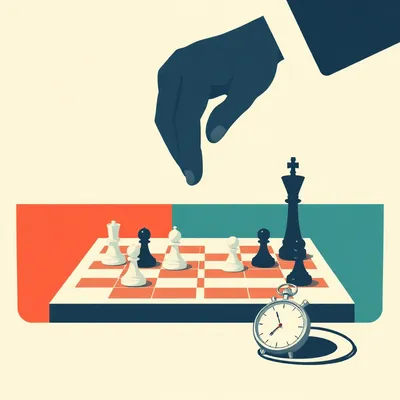
Daniel sent us this one — he's asking about something I suspect a lot of people feel in their bones but don't always name out loud. He's got ADHD, and he describes this familiar discomfort with rapid decision-making. When a big life choice comes up, he goes deep into analysis mode, takes his time, and eventually lands somewhere he's comfortable. But he looks at business executives and government leaders making dozens of significant calls daily and wonders — what actually distinguishes the people who are unusually good at rapid-fire decisions from those who lean slower and more analytical? And do both styles have real strengths inside organizations?

This is a fantastic question, because it cuts straight through the usual self-help framing of "just decide faster" and gets at something neurological. You're talking about two fundamentally different cognitive architectures here.
I appreciate that he's not framing the slow approach as a defect. He's saying, this works for me, I get to the right answer — it just takes time. So what's happening under the hood that makes someone else's process run at a different clock speed?
Let's start with the actual mechanism. When someone makes a rapid decision — and I mean genuinely rapid, under sixty seconds, high stakes — they're not doing a compressed version of analytical reasoning. They're using a completely different cognitive pathway. The key structure here is the anterior cingulate cortex, the ACC. It handles conflict monitoring — when you're weighing two incompatible options, the ACC flags the tension. But in fast deciders, the ACC doesn't stay activated for long. It hands off quickly to the orbitofrontal cortex, which does value-based selection under uncertainty.
The ACC is like the brain's "something doesn't add up" alarm, and in fast deciders that alarm has a shorter snooze button.
And the orbitofrontal cortex is essentially running a compressed valuation — it's not calculating expected utility the way a spreadsheet would, it's pattern-matching against stored experiences. This is where Gary Klein's work becomes central. He's a research psychologist who spent decades studying how people make decisions under extreme time pressure. In his 1998 book Sources of Power, he developed what he called the Recognition-Primed Decision model.
Recognition-Primed Decision. So the decision is primed by recognizing something.
Klein studied firefighters — people making literal life-and-death calls in burning buildings. He found that an experienced fireground commander doesn't generate a list of options and compare them. They walk into a situation, recognize a pattern from maybe a hundred to two hundred stored experiences, and the first workable course of action that matches the pattern just feels right. They mentally simulate it once — maybe two or three seconds — to check for major flaws, and if it passes, they act. The whole thing takes under a minute.
A hundred to two hundred stored experiences is the library. That's surprisingly compact for something that produces life-saving decisions.
It's compact because the experiences aren't stored as raw memories — they're chunked. This is the "chunking" phenomenon that chess researchers first documented with grandmasters. A novice sees individual pieces on a board. A grandmaster sees configurations — "this is a Sicilian defense position with an exposed kingside." One chunk encodes maybe fifteen pieces and their tactical relationships. The grandmaster isn't thinking faster per unit of information — they're processing fewer units because each unit is denser.
Which explains something I've always found interesting about chess. Grandmasters can play speed chess and make brilliant moves in seconds, but if you scramble the board into a configuration that would never occur in real play, their accuracy plummets.
That's exactly the finding. Chase and Simon demonstrated this in the 1970s. When the board positions were random, grandmasters performed no better than intermediates. The pattern library only works when the patterns are actually there. And that's the first big insight about fast decision-makers — their speed isn't a personality trait. It's the visible output of a well-stocked and well-organized mental library.
We should distinguish between someone who's fast because they've built that library through deliberate practice, and someone who's fast because they're impulsive.
That's the misconception that drives me a little nuts. People assume fast equals reckless. But Klein's firefighters weren't reckless. They were running a highly structured heuristic process — just not a consciously analytical one. The heuristic is: "match the pattern, simulate once, act if no showstoppers." That's not impulsivity. That's a decision algorithm optimized for speed.
Like the difference between a chef who can taste a sauce and instantly know it needs more acid, versus someone just dumping in vinegar and hoping.
The chef isn't guessing. She's pattern-matching against thousands of previous sauces. Her palate is the library.
What's happening on the other side? What's the neuroscience of the slow analytical approach?
This is where working memory capacity becomes the bottleneck. Slow analytical thinkers tend to hold more variables in working memory simultaneously. They're keeping multiple options active, comparing them across multiple dimensions, and running conscious simulations for each one. Working memory is a limited resource — most people can hold about four chunks of information at once, maybe plus or minus two. If you're trying to evaluate six job offers across eight criteria each, you're thrashing.
ADHD adds another layer here.
There's a robust literature showing that ADHD affects working memory function and executive control — not intelligence, but the ability to efficiently manage what's in your mental workspace. Someone with ADHD might have a harder time discarding irrelevant variables, so the working memory gets cluttered. The result is what looks like analysis paralysis but is actually a kind of cognitive traffic jam. Too many signals, not enough throughput.
I've experienced this myself. It's not that I'm being indecisive because I'm afraid of being wrong. It's that I haven't finished processing yet. The decision isn't stuck — it's still loading.
That's a crucial reframe. A lot of organizational psychology treats slow decision-making as a motivational problem — "they're avoiding the decision." But for many people, it's a capacity problem. The processor is working at full tilt, the job is just computationally expensive.
There's another axis here we haven't touched yet — risk tolerance. Are fast decision-makers just more comfortable with being wrong?
This is where it gets nuanced, because "comfort with risk" is actually two different things neurologically. Ambiguity tolerance — comfort with not having complete information — is processed largely in the insula. Risk tolerance — comfort with potential loss — is more amygdala-driven. You can be high in one and low in the other.
Someone could be perfectly fine making a decision with seventy percent information but deeply uncomfortable if the downside is catastrophic.
And that combination would produce a very specific decision profile. They'd decide quickly in most situations but freeze up when the stakes involve irreversible loss. Meanwhile, someone else might need ninety-five percent information before they're comfortable, but once they have it, they'll bet big.
This explains some of the executives I've read about who seem to operate on pure instinct but also have these strange, rigid risk boundaries they won't cross.
The "gut feel" is pattern recognition. The boundaries are the risk tolerance circuit putting guardrails around where the pattern matching is allowed to operate. It's not one unified "decision-making skill." It's multiple systems that can be calibrated differently.
Let me pull on a thread here. You mentioned that a 2019 meta-analysis found intuitive decisions are about 85 percent as accurate as analytical ones but take a tenth of the time.
Yes — Wood and Highhouse, published in Psychological Bulletin. They aggregated decades of studies comparing intuitive versus analytical decision strategies across multiple domains. The accuracy gap was about fifteen percentage points, but the time gap was an order of magnitude.
Fifteen percent less accurate but ten times faster. In a lot of environments, that's an extremely favorable trade.
It depends entirely on the cost of error. If you're deciding what to have for lunch, a fifteen percent error rate is trivial. If you're deciding whether to launch a spacecraft with astronauts on board, that fifteen percent might be catastrophic. The environment dictates which strategy is rational.
This is where the dynamic environments you mentioned come in. Stock markets, emergency rooms, combat.
The OODA loop is the classic framework here. It was developed by Air Force Colonel John Boyd in the 1950s. OODA stands for Observe, Orient, Decide, Act. Boyd's insight was that in a competitive environment — he was thinking about aerial dogfights — the pilot who cycles through the OODA loop faster gains a compounding advantage. Every time you complete a loop, you've changed the situation your opponent has to respond to. If you're cycling twice as fast, your opponent is constantly responding to a reality that no longer exists.
Speed isn't just about getting to the decision sooner. It's about making the opponent's decisions obsolete before they're even made.
That's the velocity premium. And it applies far beyond combat. Startups use OODA loop thinking to outmaneuver larger competitors. A big company might take six months to decide to enter a new market. A startup enters in two weeks, learns what's actually true about the market, and pivots before the incumbent even finishes their PowerPoint deck.
Which creates the compounding effect you mentioned earlier. Fast deciders get more reps. More reps build better pattern libraries. Better pattern libraries enable faster and more accurate decisions. It's a virtuous cycle that widens the gap.
The flip side is the hidden cost of slow analysis. In a dynamic environment, the delay itself has a price. If you spend three months analyzing a market opportunity and your competitor enters in week two, your analysis is now about a market that no longer exists in the form you were studying. The decision you finally make is answering a question nobody's asking anymore.
There was a study I came across — Kocher and Sutter, 2015 — that looked at traders under pressure. They found that traders with higher cortisol reactivity actually made faster decisions, but worse ones. So speed alone isn't a signal of quality.
That's the cortisol finding, and it's important because it distinguishes between two kinds of speed. There's speed that comes from expertise — the Klein firefighter model — and speed that comes from physiological stress response. Cortisol impairs prefrontal function. It pushes you toward more primitive decision circuits. So a stressed trader isn't accessing their pattern library — they're essentially making decisions with parts of their brain that evolved for escaping predators, not evaluating financial instruments.
The "deer in headlights" decision protocol.
Except the deer freezes. The stressed trader acts, but acts badly. It's the action bias that Patt and Zeckhauser documented in 2000. When people feel pressure, they have a strong preference for doing something over doing nothing, even when inaction is the optimal strategy. They found this across domains — policymakers, investors, doctors. The impulse to act feels like competence, but it's often just noise.
Which brings us to the organizational question. How do you structure a team so the fast deciders don't steamroll the slow analytical thinkers, and the analysts don't paralyze the organization?
This is where Boyd's OODA loop becomes a team design tool, not just an individual framework. You can break the loop across roles. The "Observe" and "Orient" phases are where slow analytical thinkers create enormous value. Observing means gathering data rigorously. Orienting means building the mental model, questioning assumptions, identifying what's actually going on. These phases reward thoroughness and skepticism. They're where you want someone who's uncomfortable making snap judgments because their discomfort is a quality control mechanism.
Then the "Decide" and "Act" phases are where the fast pattern-matchers operate.
In a well-structured team, you don't need everyone to be fast. You need the orientation to be rigorous enough that when the decision-maker gets the ball, they can trust the framing and run with it.
Aviation does this structurally with crew resource management.
CRM is a perfect case study. After a series of crashes in the 1970s where junior crew members had critical information but didn't speak up because the captain was the unquestioned authority, the aviation industry rebuilt cockpit protocols. The captain still makes the fast decisions — they're the ultimate decision authority — but the first officer is explicitly trained and expected to challenge. They have scripted phrases: "I'm uncomfortable with this approach," "we need to go around." These aren't suggestions. They're decision interrupts built into the workflow.
It's a slow check on fast action, baked into the protocol rather than relying on individual personality.
CRM is one of the major reasons commercial aviation became so astonishingly safe. It's not that captains stopped being fast deciders. It's that the system was redesigned so their speed operates inside a channel with guardrails.
Bridgewater Associates does something conceptually similar with their radical transparency system.
Yes — every decision is logged with the reasoning and a confidence level. So a fast decider can make a call quickly, but the reasoning is exposed. Other people in the organization can audit it after the fact. The fast decider gets to maintain their velocity, but there's accountability. And the slow analytical thinkers get to contribute without becoming bottlenecks — they review decisions asynchronously rather than being in the critical path.
Which solves the problem of the analyst who wants to weigh in on every decision in real time and accidentally becomes the organization's speed limiter.
The analyst's contribution is still valuable — sometimes they catch a catastrophic error that the fast decider's pattern library missed because the situation was novel in a way that looked familiar. But they don't have to be in the room for every call.
Let's talk about the hidden cost on the fast side that doesn't get enough attention. Confirmation bias amplification.
This is the dark side of the virtuous cycle. Fast deciders build pattern libraries through experience, but if those patterns are systematically biased — if they've been reinforced by an environment that rewards certain kinds of errors and punishes others — the pattern library becomes a bias amplifier. They get faster and more confident, but not more accurate.
In a high-speed culture, there's also the groupthink risk. If everyone's rewarded for decisiveness and speed, who's going to be the person who says "wait, we haven't thought about this"?
There's a term for what happens when nobody plays that role: "the action bias cascade." One person acts, which creates pressure for the next person to act, and pretty soon you've got an entire organization making rapid, confident decisions in a direction nobody actually chose. They just fell into it through momentum.
Like a convoy where every driver is accelerating because they think the car in front wants to go faster, but the lead car is just trying to keep ahead of the one behind it.
That's exactly the dynamic. And it's why organizations need institutionalized friction. Not bureaucracy for its own sake, but specific interrupt mechanisms — like the aviation go-around call — that can stop the cascade without requiring a personality conflict.
Let's get practical. If someone's listening and they recognize themselves as a slow analytical thinker — maybe with ADHD, maybe just constitutionally deliberate — what should they actually do?
The worst advice is "just decide faster." That's like telling someone with a different native language to "just speak faster." The cognitive architecture isn't built for it, and the attempt will produce worse decisions, not faster good ones.
What's the alternative?
Decision pre-work. The idea is to front-load the analytical process so that when the decision moment arrives, the heavy lifting is already done. One powerful technique is pre-committing to criteria. Before you're facing the actual choice, you define what a good decision looks like. "I'll accept any job offer that meets these three criteria at these thresholds." Then when the offer comes, you're not analyzing — you're checking against a pre-built rubric.
You're doing the slow thinking in advance, when there's no time pressure, so the fast decision in the moment is actually just a pattern match against your own pre-written rules.
It's borrowing the fast decider's mechanism — pattern matching — but populating the pattern library deliberately rather than through experience. Another technique is the decision journal, which Annie Duke popularized in Thinking in Bets in 2018. You write down every significant decision, your reasoning, your confidence level, and what you expect to happen. Then you review it later.
This appeals to me because it treats decisions as a skill to be calibrated rather than a test to be passed.
That's the core insight of Duke's approach, which she adapted from poker. In poker, you can make the right decision and lose, or make the wrong decision and win. The outcome doesn't tell you whether the decision was good. The only way to improve is to separate decision quality from outcome quality, which requires recording your thinking at the moment of the decision, before you know how it turns out.
Over time, you can look back and say, "my eighty percent confidence decisions are actually right about seventy percent of the time — I'm overconfident at that level," or "my sixty percent confidence calls are right sixty-five percent of the time — I'm underconfident.
That calibration is what shifts you toward being able to make faster, more accurate decisions. You're building a personal pattern library of how good your judgment actually is, which lets you trust it more when speed matters.
There's another technique I've come across — the pre-mortem.
Gary Klein developed this in 2007. Before making a major decision, you run a thought experiment: imagine it's a year from now, and the decision was a complete disaster. What went wrong? This forces you to surface risks and blind spots that optimism and momentum would otherwise suppress.
It's like giving your inner skeptic a scheduled appointment rather than letting them interrupt you constantly during the decision process.
That's psychologically easier for a lot of analytical thinkers. You're not being negative in real time, slowing things down. You're doing a structured exercise that everyone agrees is valuable. It channels the analytical impulse into a productive window.
What about on the fast decider side? What should they install as countermeasures?
Decision friction is the key. A simple rule like "if this decision has an impact above a certain threshold — say, ten thousand dollars, or affects more than fifty people — wait twenty-four hours." It's not about becoming slow. It's about recognizing that some decisions don't benefit from speed, and the fast decider's own pattern library might not be well-calibrated for high-stakes, low-frequency choices.
Because the pattern library was built on frequent, lower-stakes decisions where speed was the primary advantage.
The executive who makes fifty operational decisions a day has a great library for those fifty types of decisions. But the once-a-year strategic pivot might look like a pattern it's not actually an instance of. The twenty-four-hour rule forces a different cognitive mode for those outlier decisions.
I want to circle back to something Daniel mentioned in the prompt — the sheer volume of decisions that leaders face. He noted that business executives and government leaders make more significant decisions daily than most people make in a week or a month. There's something about that volume that changes the relationship to decision-making itself.
Decision fatigue is real, but what's interesting is that experienced leaders often report the opposite — they find the volume liberating. Each individual decision feels lower-stakes because it's one of many. If you make fifty decisions a day and two are wrong, that's a four percent error rate. If you make three decisions a week and one is wrong, that's thirty-three percent. The volume creates a statistical cushion.
The high volume actually reduces the emotional weight of any single decision, which paradoxically might improve decision quality by reducing the anxiety that clouds judgment.
There's evidence for this. When decisions feel momentous, the amygdala activates more strongly, and that emotional charge can distort the valuation process. The same decision made in a high-volume context might be evaluated more clearly because the stakes feel normalized.
Which is another entry in the "virtuous cycle" column for fast deciders. They don't just get more reps for pattern building — they also experience less decision-specific anxiety, which improves the quality of each rep.
Slow deciders face the opposite dynamic. Each decision feels weighty because there are fewer of them. The weight creates anxiety. The anxiety slows things down further. It's a vicious cycle that can be hard to break without structural interventions.
Let's talk about where this is all heading. We're in 2026, and AI decision-support tools are becoming embedded in organizational workflows. Real-time risk scoring, predictive models that update continuously. How does that change the fast-versus-slow dynamic?
It could go either way, and I think which way it goes depends on design choices we're making right now. One possibility is that AI narrows the gap. If a slow analytical thinker can offload some of the working memory burden to an AI system — "here are the six variables I'm tracking, flag any that cross these thresholds" — they might be able to reach decisions faster without sacrificing their analytical rigor.
The AI becomes an external working memory expansion.
And for someone with ADHD, that could be transformative. The cognitive traffic jam isn't happening entirely inside their head anymore. Part of the processing is outsourced.
The other possibility is that AI widens the gap. Fast deciders who are already comfortable acting on incomplete information might integrate AI tools more aggressively, getting even faster while the analysts are still evaluating whether the AI's recommendations are trustworthy.
That's the scenario I worry about. If the OODA loop is being compressed by AI, and the fast deciders are the ones driving that compression, the slow analysts might find themselves not just slower but irrelevant — answering questions that were resolved two loops ago.
There's a new term floating around — "decision intelligence." Organizations are starting to treat decision velocity and decision accuracy as measurable KPIs the way they'd track sales conversion or customer retention.
Decision intelligence is emerging as a legitimate field. It combines data science, behavioral economics, and organizational design to improve how organizations make choices. And one of its core insights is that most organizations don't actually know how good their decisions are. They measure outcomes, but as Annie Duke's poker framework shows, outcomes and decision quality are correlated but not identical. A good decision process can produce bad outcomes through bad luck, and a terrible process can produce good outcomes the same way.
The first thing decision intelligence does is make the invisible visible — it logs decisions, tracks confidence levels, and compares them to results over time.
Once you're doing that, you can start to answer the question Daniel is really asking: in my organization, who should be making which kinds of decisions? You might find that your fast deciders are brilliant at operational calls but systematically overconfident on strategic ones. Or that your slow analysts are incredibly accurate but their time cost means they should only be deployed on decisions above a certain impact threshold.
It's like assigning pitchers based on the batter rather than having one pitcher throw every inning.
Baseball figured this out decades ago. Nobody expects a closer to pitch nine innings. Nobody expects a starter to come in with the game on the line in the ninth. Different decision contexts call for different cognitive styles, and the sophisticated organizational move is to match the style to the situation rather than trying to make everyone a generalist.
Before we start wrapping up, I want to make sure we deliver on the practical side. If someone's listening and wants to calibrate their own decision-making, what's the simplest thing they can do starting tomorrow?
A decision log for one week. It doesn't need to be elaborate. Every time you spend more than five minutes deliberating on something, write down the decision, what your options were, what you chose, your confidence level on a scale of one to ten, and why you chose it. Then — and this is the critical part — set a reminder to review it in thirty days.
What do you do at the thirty-day review?
You check whether your confidence tracked with outcomes. Were your nine-out-of-ten confidence decisions actually good ones? Were your five-out-of-ten decisions coin flips, or were you underconfident? Most people discover patterns they didn't know they had. Some discover they're overconfident in domains where they have lots of experience — the pattern library is stale. Others discover they're underconfident in domains where they're actually quite good — they could decide faster without sacrificing quality.
That seems almost too simple to be useful, but I can see how the data would accumulate into something revealing.
The simplicity is the point. Decision journals fail when they're too elaborate. If it takes fifteen minutes to log each decision, you'll do it for two days and quit. Five minutes of logging, once a day, for a week, with a single thirty-day review. That's a total time investment of maybe two hours to get a personal calibration curve that most people go their entire lives without ever seeing.
For the fast deciders who might be listening — the ones who are thinking "I don't deliberate for five minutes on anything" — what's their version of this?
Their log looks different. Instead of capturing deliberation, they capture snap judgments. "Faced with X situation, my immediate instinct was Y. I acted on it. " Then the same thirty-day review. What they often discover is that their eight-out-of-ten confidence decisions are accurate maybe sixty percent of the time — they're systematically overconfident. That's the first step toward installing the decision friction we talked about.
The twenty-four-hour rule for high-impact calls.
Or even just a ten-minute rule. "If the decision involves more than a certain amount of money or affects more than a certain number of people, I will talk to one other person before finalizing it." That alone breaks the action bias cascade often enough to catch the worst errors.
Alright, let's pull this together. What distinguishes fast decision-makers from slow analytical ones isn't recklessness or courage or some vague "decisiveness" trait. It's a combination of a well-stocked pattern library built through deliberate practice, a cognitive architecture that relies on implicit pattern matching rather than conscious variable juggling, and a set of heuristics that compress complex evaluations into manageable chunks.
The slow analytical approach isn't a defect. It's a different architecture — higher working memory load, more exhaustive evaluation, more comfort with ambiguity but often less comfort with acting on incomplete information. The strength is accuracy and thoroughness. The cost is time, and in dynamic environments, time is expensive.
Organizations need both. The OODA loop framework shows how to structure this: let the analysts dominate Observe and Orient, let the fast deciders own Decide and Act, and build institutional guardrails — CRM-style challenge protocols, decision logs with confidence levels, pre-mortems — so that speed and rigor reinforce each other rather than fighting for dominance.
For the individual listener, the actionable takeaway isn't "change who you are." It's "understand your calibration and build systems around it." If you're slow, do your thinking in advance through pre-commitment criteria. If you're fast, install friction for the decisions where speed is actually a liability. Either way, start logging.
The open question I'm left with — and I think this is where the next few years get really interesting — is whether AI decision-support tools will serve as a bridge between these two cognitive styles or a wedge that drives them further apart. If the fast deciders adopt AI more aggressively and the analysts remain skeptical, the velocity gap could become a chasm.
Or AI could become the external working memory that lets analytical thinkers operate at a speed that was previously inaccessible to them. I think the outcome depends on whether we design these tools for the fast decider's workflow or for the analyst's workflow. Right now, most AI decision tools are optimized for speed — real-time dashboards, instant recommendations. There's an underserved market for AI tools that are optimized for rigor — tools that surface assumptions, flag uncertainty, and make the analytical process faster without making it shallower.
That's a product category I'd like to see exist.
Give it eighteen months.
Now: Hilbert's daily fun fact.
In the late 1600s, tenant farmers on the Isle of Barra in the Outer Hebrides cultivated a landrace barley called "bere" that required roughly one and a half acres of hand-tilled soil to produce enough grain for a single barrel of ale — which works out to about two thousand seven hundred square meters per twelve gallons, or the equivalent of tilling half a football pitch for an amount of beer that wouldn't fill a standard home brewing carboy.
I don't know whether to be impressed by the agricultural dedication or concerned about the beer-to-land ratio.
That's a lot of tilling for not a lot of ale.
This has been My Weird Prompts. Thanks to our producer Hilbert Flumingtop, and thanks to all of you for listening. If you enjoyed this episode, leave us a review — it helps more people find the show. We'll be back next week.