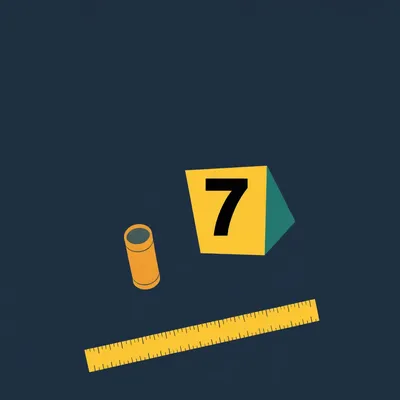
Daniel sent us this one — he was watching the footage from today's terrorist attack in Israel, attacker neutralized on the scene, and he noticed something that shows up in every one of these videos. The little numbered yellow placards scattered across the ground. Shell casings get one, the weapon gets one, sometimes even the attacker's body gets one. And he's asking two things. First, what exactly are those little number markers for, mechanically? And second — and this is the one that sticks with you — when the attacker is dead and the threat is over, why is the whole area still treated like an active crime scene?

These are the questions that separate watching the footage from understanding what you're actually seeing. And you're right, the second one is the one that really gets at something most people never think about. The short version is that a dead attacker doesn't close a case — it opens about six different investigations simultaneously. But to get there, we have to start with those yellow triangles.
What exactly are these little numbered placards, and why do they matter more than most people realize?
Let's start with the object itself. Standard evidence markers are these small plastic triangles or flat placards, four to six inches per side, bright yellow or sometimes white, with a raised black number on them. They're designed to be visible in photographs from multiple angles — overhead drone shots, ground-level wide shots, close-ups. You want to be able to read the number even if the photo is slightly blurred or taken in bad light. And here's a detail that matters: the marker is always placed adjacent to the evidence, not on top of it. The FBI's Evidence Response Team protocol specifies at least six inches away. You don't put the marker on the shell casing, because then you've contaminated the casing. You put it next to it.
Adjacent but not touching. Like standing next to someone on a crowded bus without making eye contact.
And the number on the marker — this is the part people get wrong all the time — the numbers are sequential in the order of discovery. One, two, three, four. Not by importance. Not by category. Marker one is simply the first piece of evidence the investigator spotted during the grid search. Marker forty-seven is the forty-seventh. There is no hierarchy in the numbering. A shell casing that turns out to be the key to the entire case might be marker thirty-one, and a piece of torn clothing that turns out to be irrelevant might be marker two. The numbers don't tell you what's important. They tell you what was found when.
Which is counterintuitive. If you're watching the footage, you assume the placards are like a ranking system. The lower the number, the more significant the item.
That assumption leads to real problems in court. Defense attorneys will sometimes argue that the numbering implies the evidence was prioritized before it was fully analyzed, suggesting investigator bias. But the protocol is designed precisely to avoid that. The evidence officer — and this is a specific role, by the way, usually a crime scene investigator or a specially trained patrol officer — they start from a designated entry point and work outward in a systematic grid search. They don't run toward what looks important. They go square by square, marking everything as they find it.
The grid search is the thing that prevents the human instinct to sprint toward the most dramatic piece of evidence.
And in a terrorist attack scene, that instinct is enormous. You've got a weapon, you've got a body, you've got shell casings from the police response, you've got personal effects, you've got potential secondary devices. The chaos is off the charts. But the protocol demands that you treat it like a grid. The first responding officer's job is not to collect evidence — it's to secure the perimeter. Keep people out. Preserve the scene exactly as it is. Then the evidence officer arrives and begins the systematic documentation.
What does that documentation actually look like, step by step?
Photography first, before anything is touched. Wide shots from multiple angles showing the entire scene in context. You want to establish where everything is relative to everything else before a single item is moved. Then you start the grid search. As each item is identified, you place a numbered marker next to it, photograph it with the marker visible, then photograph it again with a scale ruler for size reference. The scale ruler is crucial — it lets analysts and, later, jurors understand the actual dimensions of the item in the photo.
Because a photo of a shell casing without scale reference could be anything from a grain of rice to a artillery round.
And then every marker gets logged. The evidence officer maintains a written log — and increasingly a digital one — that records the marker number, a description of the item, and its position. In sophisticated operations, position is recorded using a coordinate system that can be overlaid with 3D scans and drone footage. So marker fourteen might be logged as nine-millimeter shell casing, coordinates X seven point three, Y twelve point one, photographed at fourteen hundred hours, collected by officer so-and-so, entered into chain of custody.
This log becomes the backbone of everything that follows.
It is the backbone. Every piece of evidence that ends up in court has to have an unbroken chain of custody from the moment it was logged at the scene to the moment it's presented to a judge. If there's a gap — if the log says the evidence was collected but there's no record of who transported it to the lab, or who stored it overnight — a defense attorney can argue it was tampered with. And in a terrorist prosecution, where the stakes are literally life and death, chain of custody is everything.
Let me make sure I've got the workflow. Perimeter secured, grid search begins, items marked sequentially, photographed with marker, photographed with scale ruler, logged with coordinates, collected, chain of custody initiated. And all of this before anything leaves the scene.
The scene stays active until every single marker is accounted for. In a typical domestic homicide, you might see ten to fifteen markers. In a terrorist attack, the count can easily exceed a hundred. I'm thinking of the 2017 Jerusalem truck-ramming attack. Investigators placed eighty-three evidence markers across a fifty-meter stretch of road. Everything from the truck's tire marks to fragments of the attacker's phone. Eighty-three separate items, each one photographed multiple times, each one logged, each one tracked through chain of custody.
That road is a major artery. You're shutting down a chunk of Jerusalem for hours while this happens.
Eight to twelve hours is typical for a thorough forensic documentation of a terrorist attack scene. And that's where the public tension comes in. People want to return to normal. Shopkeepers want to reopen. Traffic needs to flow. But the forensic team can't rush, because every marker they skip is a potential gap that could collapse a prosecution or leave an intelligence lead unexploited.
Let's talk about the Israeli-specific context here, because the protocols aren't invented from scratch. Where does the Israeli forensic approach come from?
The Israel Police's Identification and Forensic Science Division — sometimes called the criminal identification division — was established in 1948, right at the founding of the state. Its protocols are largely derived from British and American forensic standards, which makes sense given the mandate period and the close institutional ties that followed. But there's an adaptation for counterterrorism that makes Israeli scenes different. The markers are placed more aggressively because the evidentiary stakes are higher.
What does "more aggressively" mean in practice?
In a standard criminal scene, you're documenting evidence for a single prosecution. The suspect, the crime, the trial. In a terrorist attack scene, you're documenting evidence for multiple simultaneous investigations. The attacker's weapon isn't just evidence of the attack — it's evidence of a sourcing network. Where did the weapon come from? Who manufactured it? Who smuggled it? Who provided it to the attacker? The attacker's phone isn't just a personal device — it's a node in a communication network. Every fragment, every document, every receipt in the attacker's pocket potentially leads to a handler, a financier, a trainer.
The marker count goes up because the definition of what constitutes evidence expands.
In the 2023 Jerusalem bus stop attack, scene photos showed forty-seven numbered markers across a thirty-meter radius. One of those markers was for the attacker's discarded backpack, which contained a secondary device that hadn't detonated. Without the systematic grid search, without the discipline of marking everything regardless of whether it looked immediately important, that backpack might have been overlooked in the chaos. And if it had been overlooked, it could have detonated later, or its components could have been lost to intelligence analysis.
A secondary device that didn't go off is an intelligence gold mine. You can trace the components, the construction method, the triggering mechanism.
And that's why the marker system matters so much. It forces investigators to treat everything as potentially significant, even when the immediate threat is over. Which brings us to the body itself.
In today's attack, the terrorist was neutralized. Dead on the scene. And yet there were markers placed around the body. Why is a dead attacker still evidence?
The body is one of the most important pieces of evidence on the scene. Markers are placed around it to document its exact position relative to everything else. The position of the body relative to the weapon tells you whether the attacker was holding it at the moment of neutralization. The position relative to shell casings from police fire tells you the trajectory of the engagement. The position relative to bystander injuries helps reconstruct the sequence of events. The body is not moved until the medical examiner or forensic pathologist arrives, and even then, the removal itself is photographed and documented.
The body is treated with the same forensic rigor as the shell casings.
Exactly the same. It gets a marker. It gets photographed in situ. Its position is logged. And then when it's removed, the removal is documented, the transport is logged, and the chain of custody continues all the way to the autopsy table. The body is evidence.
Which feels cold, but it's actually the opposite of cold. It's the mechanism that makes the entire investigative process defensible.
And this is where we get to the deeper question — the one Daniel was really asking. Why is the scene still a crime scene when the attacker is dead? The public perception is that a dead suspect equals a closed case. No one to prosecute, nothing left to investigate. But that perception is legally naive in about three different directions.
Walk me through them.
First, criminal prosecution of accomplices. The attacker might be dead, but who provided the weapon? Who drove the attacker to the scene? Who financed the operation? Who provided ideological or logistical support? The evidence from the scene — the attacker's phone, documents, the weapon's serial number — feeds directly into investigations of the broader network. I'm thinking of the 2016 Tel Aviv shooting. The attacker was killed at the scene, but evidence from his phone and a handwritten note found on his body led to the arrest of three accomplices who had provided the weapon. The markers documenting the phone's position relative to the attacker's body were critical in establishing that the phone was in his possession at the time of the attack. Without that forensic record, a defense attorney could argue the phone was planted.
The markers protect against the planted-evidence defense.
They protect the prosecution's ability to say, this item was here, at this exact position, photographed before anyone touched it, and here is the unbroken chain of custody from the scene to the courtroom. That is very hard to argue against.
That's the first reason. Criminal prosecution of the network.
Second, civil liability and oversight. The family of the attacker can sue the police for excessive force. The families of victims can sue for inadequate response. Both of these are real legal risks. The forensic record protects the officers by documenting exactly what happened. The position of the attacker's weapon. The trajectory of bullets. The distance between the attacker and the responding officers. If you don't have markers, if you don't have the photographs and the coordinate logs, these cases devolve into competing narratives. He was armed, he wasn't armed. He was advancing, he was retreating. The forensic record replaces he-said-she-said with spatial data.
In a world where every incident is filmed on a dozen phones and shared globally within minutes, the forensic record becomes the institutional counterweight to the viral narrative.
The forensic record is the thing that says, here is what actually happened, documented with the rigor that will survive cross-examination. Not what the viral clip appears to show from one angle. Not what the most emotional witness remembers. Here is the spatial truth.
The third reason?
In counterterrorism contexts, the scene is not just a crime scene — it's an intelligence collection opportunity. The attacker's phone gets extracted. The attacker's documents get analyzed. The specific model of weapon gets traced through sourcing networks. Even the attacker's clothing can reveal where they were before the attack. The forensic markers ensure that every item is accounted for before intelligence analysts begin their work. If you skip this step — if you just clear the scene because the attacker is dead — you lose leads that could prevent the next attack.
The dead attacker is a dead end criminally, but an opening to the network that enabled them.
Sometimes the network is more important than the individual attacker. The individual attacker is the tip of the spear, but the network is the arm that threw it. You want to find the arm.
I want to dig into something you mentioned earlier about the time this takes. Eight to twelve hours of a neighborhood cordoned off. That's a real cost.
It's a massive cost. Businesses lose revenue. Residents can't get home. Traffic backs up through half the city. And there's always pressure — from politicians, from the public, from the media — to reopen the area as quickly as possible. But the forensic team has to resist that pressure, because the cost of a rushed scene is far higher than the cost of a delayed reopening. A rushed scene means missed evidence. Missed evidence means failed prosecutions, lost intelligence leads, or successful civil suits against the police.
That tension is especially acute in Israel, where attacks happen in dense urban areas. You can't cordon off a Jerusalem street without affecting thousands of people.
In the 2017 truck-ramming attack I mentioned, the scene stretched across fifty meters of a major road. That road was closed for over ten hours. But those ten hours produced eighty-three markers, each one representing a piece of evidence that fed multiple investigations. If they'd rushed it and done it in three hours, they might have gotten forty markers and missed the fragments of the phone, or the tire marks that showed the exact path of the truck.
How does this compare to other countries? Is the Israeli approach distinct?
The protocols are similar — the FBI's Evidence Response Team uses the same numbered marker system, the same grid search, the same photography workflow. The FBI deployed this at the 2018 Pittsburgh synagogue shooting, where over two hundred markers were placed across the scene. But the Israeli context adds a layer of urgency that changes the calculation. In the US, a domestic terrorism scene might be processed over two or three days. In Israel, the pressure to reopen is more intense because the country is smaller, the attacks are more frequent, and the public expectation is that life returns to normal as quickly as possible. So Israeli forensic teams have to be faster without being less thorough.
The marker system helps with speed, doesn't it? Because it's standardized. Every officer knows exactly what to do.
Standardization is the key to speed under pressure. When everyone knows the protocol — grid search, sequential numbering, photograph with marker, photograph with scale ruler, log coordinates, collect, chain of custody — the work proceeds methodically even when the scene is chaotic. The markers create a visual checklist. If you see a marker, you know that item has been documented. If you don't see a marker, it hasn't. It's almost impossible to lose track of what's been processed.
There's a study you mentioned — something about evidence admissibility rates with markers versus without.
A 2022 study in the Journal of Forensic Sciences found that scenes documented with numbered markers had a forty percent higher rate of evidence admissibility in court compared to scenes documented without markers. That's the difference between a prosecution that holds up and one that collapses on a technicality. The markers are not cosmetic. They are the difference between evidence that a judge accepts and evidence that gets thrown out.
That forty percent number gets at something important. The markers aren't really for the investigators. The investigators know what they found. The markers are for the court. They're for the defense attorney who's going to try to get the evidence excluded. They're for the judge who needs to be convinced that the chain of custody is intact.
The markers are a preemptive defense against the argument that the evidence is unreliable. Every marker says, this item was found here, at this time, documented in this way, and you can trace its entire journey from the street to this courtroom. That is very hard to impeach.
Let me ask about something that probably happens more often than anyone admits. What if a marker gets kicked? In the chaos of a scene, with dozens of people moving around, it seems inevitable.
And the protocol accounts for it. The photographs are taken before anything is moved, so even if a marker gets displaced later, the original position is documented. The coordinate log provides a backup. And in modern scenes, 3D scans and drone footage create a permanent spatial record that doesn't depend on the physical markers at all. The markers are a visual aid for the photographs and the log, but the spatial data is captured in multiple redundant systems.
The marker is the visible layer of a much deeper documentation stack.
When you see a yellow triangle on the news footage, what you're actually seeing is the tip of an iceberg. Below it is the photograph, the scale-ruler shot, the coordinate log, the chain-of-custody form, the 3D scan, the drone footage, and eventually the lab analysis and the court exhibit. The marker is the one part of the system that's designed to be visible to the public. Everything else is invisible.
Which is why people look at the footage and think the markers are the whole story. They don't see the iceberg.
That's why this conversation matters. Because the next time someone sees those yellow placards and asks why the scene is still cordoned off, the answer is not just "they're collecting evidence." The answer is that a dead attacker is the beginning of multiple simultaneous investigations — criminal prosecution of the network, civil liability defense for the officers, intelligence gathering for future prevention — and every single one of those investigations depends on the rigor of what happens in those eight to twelve hours.
Let me push on something. You said the markers are placed even when the attacker is dead. But what about when the attacker is captured alive? Does the protocol change?
It doesn't change the scene protocol. The scene is still a crime scene, processed the same way. The difference is that a living attacker can be interrogated, which means the evidence from the scene can be cross-referenced with their statements in real time. Did they claim they were unarmed? The markers show the weapon's position. Did they claim they acted alone? The phone extraction shows their communications. But the forensic documentation of the scene is identical regardless of whether the attacker is alive or dead.
Because the scene doesn't know the attacker's status. The scene is just a spatial record of what happened.
The scene is indifferent to the attacker's pulse. It's a three-dimensional puzzle that needs to be solved, and the markers are the first step in solving it.
Let's pull out the practical takeaways. What should someone understand the next time they see footage from an attack scene with those yellow placards?
First, the markers are not random and they're not ranked. They're sequential in order of discovery during a systematic grid search. Marker one is not more important than marker forty-seven. Second, every marker represents a piece of evidence that has been photographed, logged, and entered into a chain of custody designed to survive legal scrutiny for years. Third, the time it takes to clear the scene — those hours of cordoned-off streets — is not inefficiency. It's the price of a defensible investigation. If the scene is cleared in two hours, something was almost certainly missed.
The practical advice? If someone ever finds themselves at the periphery of a crime scene?
Do not touch or move any markers. This sounds obvious, but people do it. A journalist trying to get a better angle. A bystander trying to help. A first responder who doesn't realize what they are. The markers are the backbone of the forensic record. Moving one — even accidentally — can compromise the spatial documentation and give a defense attorney grounds to challenge the evidence. If you see a marker, stay away from it.
Like adopting a feral cat. Admire from a distance, do not engage.
And the other practical takeaway is about understanding why the scene takes so long. The next time you're stuck in traffic because a scene hasn't been cleared, you know what's happening behind the cordon. It's not bureaucracy. It's not indifference to public convenience. It's the methodical construction of a record that will be challenged in court for years, and every gap in that record is a potential collapse point.
Before we wrap, there's one open question worth thinking about. All of this depends on physical markers — plastic triangles placed by hand. But forensic technology is moving fast. Drones with real-time 3D reconstruction. AI-powered scene analysis. Digital twin models that can recreate a scene down to the millimeter. Will physical markers become obsolete?
I think about this a lot. The next evolution is probably digital markers — QR-coded placards that automatically log GPS coordinates and timestamps when placed, reducing human error in the logging process. But the fundamental principle — creating a permanent, defensible, spatially accurate record of a chaotic scene — that doesn't change. Whether the marker is a yellow plastic triangle or a QR code or a digital overlay in an augmented reality headset, the purpose is the same. Chain of custody.
The medium might change, but the legal logic is timeless. You need to be able to say, this item was here, at this time, and here is the proof.
That legal logic is why a dead attacker doesn't close a case. The attacker might be beyond prosecution, but the network isn't. The civil liability isn't. The intelligence leads aren't. The forensic record serves all of them simultaneously. That's what those yellow placards are doing.
If this episode changed how you see those numbered markers — if you'll never look at a crime scene photo the same way — share it with someone who asks "why is that still a crime scene" the next time an attack makes the news. It's one of those questions where the answer is genuinely more interesting than most people expect.
And now: Hilbert's daily fun fact.

In 1787, a French explorer in Timbuktu documented a meteorological manuscript by a local scholar that described the optical properties of Saharan dust halos — rings of refracted light around the sun caused by suspended sand particles — noting that the halos appeared in specific color sequences depending on the size of the dust grains, a phenomenon that European optics would not formally describe for another forty years.
A Saharan dust halo color wheel, mapped in the 1780s, decades ahead of European optics.
That is impressive. I had no idea.
This has been My Weird Prompts. Our producer is Hilbert Flumingtop. Find us at myweirdprompts dot com, and if you got something out of this, leave us a review wherever you listen. We'll be back soon.