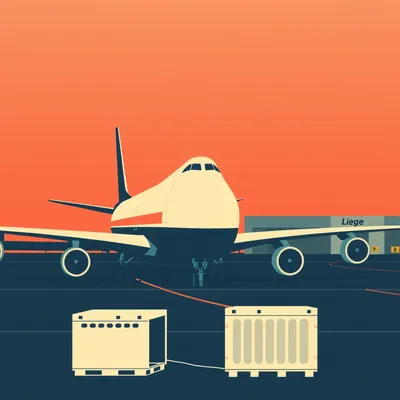
So we did a whole episode on ZIM and Israel's sea freight lifeline — the shipping company that keeps the country connected when things get complicated. And building on that, Daniel sent us the air-side counterpart. He stumbled across something on YouTube — a pilot's cockpit channel — and realized there's a second Israeli airline almost nobody has heard of. Not El Al. A dedicated cargo airline called CAL Cargo Air Lines, now rebranded Challenge Airlines IL. He wanted to know the story: how it came to be, what it actually carries, and whether its existence is just a niche business — or another expression of Israel's doctrine of non-dependence, keeping an air cargo lifeline under national control.

And what I love about this is that Daniel — who lives in Jerusalem, works in logistics-adjacent tech — had never heard of this airline. He found it through a YouTube aviation channel where CAL pilots post cockpit videos. Even an Israeli logistics enthusiast didn't know his own country had a dedicated freighter. That tells you how obscure this operation is.
Which is precisely what makes it interesting. You've got an airline that's been flying for nearly fifty years, moves tanks and elephants and COVID vaccines, and most Israelis couldn't name it. So what exactly is CAL Cargo Air Lines, and how did it end up on our radar?
CAL — which originally stood for Cargo Air Lines — was founded in June 1976 as a fifty-fifty joint venture between El Al and Swissair. The idea was straightforward: Israel needed a dedicated freighter capability separate from passenger belly cargo. El Al's passenger planes could carry standard freight in their holds, but if you needed to move something that didn't fit through a passenger jet's cargo door — a tank, a helicopter, a factory production line — you were out of luck. Swissair brought the operational expertise and the European network. El Al brought the local knowledge and the political cover. They started with a single Boeing 707-320C freighter.
A single airplane. That's the entire airline in 1976.
One airplane. And it mostly flew to Liege in Belgium and Basel in Switzerland — those were the early hubs — with some expansion to JFK later. From the beginning, the airline was deliberately small and focused. They weren't trying to compete with FedEx or Cargolux. The niche was cargo that couldn't go any other way.
Which is a very Israeli approach to aviation, honestly. Don't build a giant — build a scalpel.
And the scalpel worked. They operated that way through the eighties and into the nineties. Then in 1996, a group of Israeli investors bought out Swissair's stake and took full control. That's when things shifted. They moved from the 707 to the 747-200 freighter — dramatically more capacity — and that's when CAL really started developing its specialty in outsized and unusual cargo.
Because that's the only place a small player can compete against the giants, right? You can't out-volume FedEx. But you can be the only airline that says yes when someone needs to fly a giraffe from Tel Aviv to Liege.
And that's not hypothetical. They've done it. But I want to pause on the ownership structure, because this matters for the non-dependence question. In 2010, the airline was purchased privately by an Israeli businessman named Offer Gilboa. Still private, still Israeli-controlled. Then in 2022, it was acquired by the Challenge Group — a global cargo network based in Malta — and rebranded as Challenge Airlines IL. The "IL" is important. They kept their Israeli Air Operator Certificate, their Israeli identity, and their base at Ben Gurion Airport. The Challenge Group now operates freighters across three entities: Challenge Airlines in Malta, Challenge Air Cargo in Belgium, and Challenge Airlines IL in Israel.
So the ownership is Maltese now, not Israeli. Does that change the national-security calculus?
On paper, yes. In practice, it's more complicated. The airline still operates under Israeli registration, with Israeli crews, from an Israeli base. The government has a clear interest in keeping those aircraft flying under Israeli control, even if the ultimate corporate parent is in Malta. It's a gray zone — similar to ZIM, which is publicly traded and not government-owned, but is still treated as a national champion.
So to understand why this airline matters, we need to go back to where it started — 1976, when Israel decided it needed its own freighter.
And the timing is not an accident. 1976 was three years after the Yom Kippur War, which had exposed some serious vulnerabilities in Israel's supply lines. The US airlift — Operation Nickel Grass — had been critical, but it also demonstrated dependence. If the next crisis came at a moment when American politics were less favorable, or if the logistics chain was disrupted, Israel needed its own capacity. CAL was part of that response.
The doctrine of non-dependence isn't just about weapons. It's about the mundane stuff — spare parts, medical supplies, fresh produce exports — that keeps an economy running when things get tense.
Right. And here's a detail that connects to something we covered before. Remember the episode on Cainiao — the Chinese logistics giant — and how they built a dedicated air freight pipeline from China to Israel? That pipeline exists partly because Israel has the ground infrastructure and the aviation ecosystem to receive dedicated freighters. CAL helped build that ecosystem. The Liège hub, which CAL has operated since 1997 when they purchased the cargo handling terminal there — that's the European anchor. Liège is a massive freight airport, and CAL's terminal there has been processing Israel–Europe–US cargo for decades.
They bought a cargo terminal in Belgium in 1997?
They did. Liège Airport Cargo Handling Services. They still own and operate it. That's a serious long-term infrastructure play — not something you do if you're just dabbling in air freight.
So that's the business story. But the really interesting part is what this airline actually carries — and why that matters for national security.
Let's start with the fleet, because the aircraft dictate what's possible. As of today, Challenge Airlines IL operates two Boeing 747-400 freighters and one Boeing 767-300 freighter. All converted cargo aircraft — meaning they started life as passenger planes and were rebuilt with main-deck cargo doors and reinforced floors. The 747-400 freighter can carry about a hundred and ten tons of cargo. The nose door swings up, and you can load pieces up to a hundred feet long.
A hundred feet. That's a missile. That's a helicopter with the rotors still attached.
And that's exactly the kind of thing they carry. Military equipment is a major part of the business — armored vehicles, helicopter airframes, components for air defense systems. During the 2023 Israel-Hamas war, CAL aircraft were reportedly used to expedite military cargo shipments. The airline officially doesn't comment on specific charters, but the aviation tracking data showed their 747s making some unusual routing choices during that period.
And when passenger airlines suspended service to Israel — which happened repeatedly during the conflict — CAL kept flying. Because freighters don't have the same security concerns. A cargo crew is three people. A passenger jet is three hundred potential hostages.
That's a dark way to put it, but it's accurate. The security calculus for cargo operations is fundamentally different. And that's why even a two- or three-aircraft fleet can be strategically important. When the passenger airlines stop, the freighters keep the supply chain connected.
But that's also the vulnerability, right? Two aircraft. If one goes down for maintenance, you've lost half your capacity. If both are in the wrong place when a crisis hits, you're waiting.
And that's the tension at the heart of the non-dependence doctrine. You want control, but you can't afford the scale to make it truly resilient. During the 2023 war surge, CAL's fleet was stretched to its absolute limit. They were flying around the clock, and there were moments when the system was one mechanical issue away from a serious gap. It worked — but it was closer to the edge than anyone would like.
The doctrine says "we must control our own lifelines." The budget says "you get two 747s."
And that's the Israel story in one sentence. But let me tell you about what these planes actually carry, because the cargo manifest reads like a surrealist novel. The big category is outsized industrial machinery — factory production lines, power plant turbines, oil drilling equipment. Stuff that's too large or too heavy for standard air freight containers. If an Israeli company wins a contract to build a desalination plant somewhere and needs to fly a sixty-ton pump to the site, CAL is the carrier that can do it.
And the animals. Daniel mentioned the animals.
The live animal transport is a significant and highly regulated niche. CAL has transported horses — for equestrian events and breeding programs — cattle for agricultural projects, and zoo animals. There's a documented case of them flying elephants. Giraffes, too. This requires specialized handling, veterinary oversight, and compliance with IATA Live Animals Regulations. The aircraft has to maintain specific temperature and pressure conditions. You need handlers who know how to manage stressed animals at thirty thousand feet. It's a high-barrier specialty that very few airlines maintain.
I'm trying to picture the loading process for a giraffe. Do you sedate it? Do you build a custom crate with a neck hole?
You build a custom crate. They're designed so the animal can stand but not move too much — movement in turbulence is dangerous for the animal and the aircraft. The crate has to be engineered for the specific species, the specific animal's dimensions, and the specific aircraft door it needs to fit through. And you need a veterinarian to sign off before departure. This is not "throw some hay in the back and hope for the best."
The elephant flight — that was a specific case documented in one of those pilot YouTube videos Daniel found?
Yes. And it's worth watching if you can find it. The pilots are walking around the aircraft during the pre-flight, and there's this massive custom-built container on the tarmac, and you can see the elephant's trunk moving through a ventilation opening. It's surreal. But it's also a demonstration of capability. If you can safely transport an elephant, you can transport almost anything.
Which is the business case in one image. "We moved an elephant. Your factory equipment is not going to be a problem."
Then there's pharmaceuticals. Israel is a major pharma exporter — Teva is the obvious giant, but there are dozens of smaller companies. Many pharmaceutical products require strict temperature control — two to eight degrees Celsius for vaccines, for example. CAL operates temperature-controlled containers and has cold-chain certifications. During COVID, they were critical for moving Pfizer vaccine shipments into and out of Israel. Those vaccines required storage at minus seventy degrees Celsius — dry ice conditions — and the logistics of maintaining that temperature chain from manufacturing to injection site are extraordinarily complex. A single temperature excursion can ruin an entire shipment.
And that's not something you can just toss in the belly of a passenger 787 and hope for the best.
Passenger planes can handle some pharma, but the capacity is limited and the temperature control is less precise. Dedicated freighters have active temperature management systems — they can monitor and adjust conditions in real time. For a vaccine rollout that's operating on a national scale, you need dedicated freighter capacity.
Dangerous goods is another niche, right?
Yes — hazardous materials, chemicals, radioactive materials for medical use, lithium batteries. CAL is certified to transport all of these. That certification is expensive to obtain and maintain. You need specialized training for every crew member, specialized equipment on the aircraft, and rigorous documentation procedures. Most airlines don't bother. But if you're the only carrier in the region that can legally fly a shipment of radiopharmaceuticals from Israel to a hospital in Europe, you can charge accordingly.
So the business model is: find the cargo nobody else can or will carry, and be the only option.
And it works because the barriers to entry are high. You can't just decide to start transporting live elephants next Tuesday. You need years of certification, specialized equipment, trained personnel, and a track record that satisfies insurers and regulators. Once you've built that, you have a moat.
Let me ask you about one detail that Daniel flagged — the Taobao 747.
This is one of my favorite aviation stories ever. In 2017, CAL needed to expand its fleet. And instead of going through the usual aircraft brokers and leasing companies, they bought a Boeing 747 on Taobao.
Taobao. The Chinese e-commerce site. Where you buy phone cases and suspiciously cheap electronics.
The very same. Taobao has a section for large industrial auctions, and a 747 showed up. The price was about twenty-three point three million US dollars. CAL bid, won, and took delivery of a 747 they bought the way you'd buy a toaster.
That's either the most startup-nation thing I've ever heard, or a sign that someone in procurement has a gambling problem.
Probably both. But it worked. The aircraft was inspected, certified, and put into service. It's still flying today as part of the Challenge fleet. And it's a perfect illustration of how this airline operates — resourceful, unconventional, willing to do things that would make a Lufthansa procurement officer faint.
So we've got the business model. We've got the weird cargo. Let's talk about the national security angle directly. Is a two-aircraft airline really a strategic asset, or is it just symbolic?
I think it's both, and the symbolism matters more than it might seem. Let me compare it to ZIM. ZIM is a top-ten global container line — it's a real player. CAL is not a top-ten anything in global air cargo. But air freight and sea freight are fundamentally different. Sea freight moves slowly, in enormous volumes. If you lose your sea access, you have weeks or months to adapt. Air freight moves in hours. If you need a critical spare part for an air defense system and the only carrier that can fly it is a passenger airline that just suspended service, you're in trouble.
So the strategic value isn't in volume — it's in capability and availability.
The question isn't "can CAL move as much cargo as FedEx." It's "when the next crisis hits and the passenger airlines stop flying, is there an Israeli-controlled freighter that can get the critical stuff through." And the answer, demonstrated in 2023, is yes.
But here's what I keep coming back to: two aircraft. If the doctrine of non-dependence is serious, why not five? Why not ten?
Cost. A 747-400 freighter costs somewhere north of twenty million dollars to acquire used, plus millions per year in maintenance, fuel, crew, and insurance. Operating five would require routes and contracts to keep them flying profitably year-round, not just during crises. The Israeli market alone can't support that. So the government has made a calculated choice: maintain a minimal dedicated capability, rely on foreign carriers for routine cargo, and accept that in a crisis the fleet will be stretched thin.
It's the strategic reserve model, applied to aviation. Keep just enough to bridge the gap until help arrives or the crisis passes.
And that model has worked — so far. But it depends on the crises being short and the aircraft holding up. A prolonged conflict, or a simultaneous mechanical issue with both 747s, and the calculus changes.
What about the rebranding to Challenge Airlines IL? Does being part of a Maltese-owned group dilute the Israeli control?
In theory, the Maltese parent could decide to reallocate aircraft away from Israel if they saw a better business opportunity elsewhere. In practice, the Israeli AOC and the Liège–Tel Aviv–JFK route structure mean the aircraft are deeply embedded in the Israel trade lane. Moving them would mean abandoning routes, contracts, and infrastructure that took decades to build. It's possible, but it would be economically painful.
And during the 2023 war, did the Maltese parent try to pull aircraft out?
No. The aircraft stayed, the routes kept running. Whether that was patriotism, contractual obligation, or just good business — a cargo airline makes its best money during crises, when capacity is scarce and rates spike — is an open question. Probably all three.
So what does this mean for us — as businesses, as citizens, as people who depend on global supply chains?
The first takeaway is what I'd call the "small country, big logistics" model. Israel isn't unique here. Singapore maintains dedicated freighter capacity through Singapore Airlines Cargo. The UAE has Emirates SkyCargo, which operates a large freighter fleet alongside the passenger belly capacity. The common thread is geopolitical vulnerability driving investment in controlled logistics infrastructure. If you're a small country in a rough neighborhood, you don't want your supply chain to depend entirely on foreign carriers that might decide your airspace is too risky next Tuesday.
And for businesses operating in these regions, the practical implication is: know which carriers have dedicated freighter capability, because when things get tense, those are the ones that will still be flying.
If you're shipping to or from a geopolitically sensitive region, ask your logistics provider about their freighter fleet — not just their passenger belly capacity. During the 2023 war, when dozens of passenger airlines suspended service to Israel, dedicated freighters like CAL kept supply chains moving. The companies that had contracted freighter capacity directly, or through forwarders who understood the market, were the ones whose goods kept arriving.
And that connects to something you've talked about before — using Israeli freight forwarders rather than Chinese DDP consolidators for importing personal goods.
Right. The forwarder who knows the Israeli market knows which carriers will keep flying when things get complicated. The Chinese consolidator who's just looking for the cheapest rate on any available airline might not. When the passenger airlines cancel their Tel Aviv flights, your shipment sits in a warehouse in Shenzhen for three weeks.
The second takeaway is about the hidden infrastructure of global trade. Most people have never heard of CAL or Challenge Airlines IL. But if you've ever received a time-critical pharmaceutical shipment in Israel, or if a factory kept running because a spare part arrived on time, there's a decent chance one of those two 747s was involved.
And that's the thing I want listeners to take away. Next time you see a cargo plane with an unfamiliar livery — not FedEx, not UPS, not DHL, but something you don't recognize — look it up. Many of these airlines have fascinating stories. They're often the unsung heroes of global trade, operating in niches that the giants don't serve. The YouTube channel that led Daniel to CAL — channels like Cargofacts or The Flying Engineer — are windows into this hidden world.
It's the aviation equivalent of noticing the trucks on the highway. Most people never think about what's inside them, but the economy runs on those trucks.
And some of those trucks are carrying elephants.
Which brings us back to the big question: is a two-aircraft airline really a strategic asset?
I think the evidence says yes — but with an asterisk. The asterisk is that it's a thin margin. Two aircraft is enough for the crises Israel has faced so far. Whether it's enough for the next one depends on what the next one looks like. If it's longer, or if it involves simultaneous disruptions to multiple trade routes, the calculus changes.
The doctrine of non-dependence is always a bet. You're betting that the capability you've built is sufficient for the threats you'll face. And the history of that doctrine — from ZIM to El Al to CAL — is a history of bets that mostly paid off.
Mostly. And when they don't, the consequences are severe. But the alternative — total dependence on foreign carriers — has its own risks. During COVID, when global air cargo capacity collapsed because passenger airlines were grounded, countries with dedicated freighter fleets had a buffer. Israel was one of them. CAL's 747s kept flying when half the world's wide-body passenger fleet was parked in the desert.
The pandemic was the stress test that validated the model. The 2023 war was the stress test that showed its limits.
And now, as the Challenge Group integrates CAL into its global network, the question is whether the Israeli identity will fade or persist. The 2023 experience suggests persistence — the strategic value of an Israeli-controlled freighter is too clear to abandon. But the fleet remains only two or three aircraft. The tension between control and scale is the defining challenge.
In a world of increasing geopolitical fragmentation, more small countries may look at CAL's story as a template — or a cautionary tale. If you're Lithuania, watching Russia's posture in the Baltic, do you need your own freighter? If you're Taiwan, facing pressure from China, is two aircraft enough?
The answer probably depends on whether you can find a niche that makes the economics work in peacetime. CAL's genius — or luck — was finding the outsized cargo specialty. That's what pays the bills when there isn't a war. The national security function is almost a byproduct.
A very intentional byproduct, I suspect.
Almost certainly. But the business has to stand on its own. You can't run an airline purely as a strategic reserve — the costs are too high, and the aircraft need to fly regularly to stay airworthy. The commercial operation is what makes the strategic capability possible.
So the next time you see a cargo plane overhead — a 747 with a tail number you don't recognize — remember: it might be carrying something that couldn't fly any other way. And it might be the only link in a supply chain that a country depends on.
That 747 with the unfamiliar livery? It could be the difference between a country staying connected and being cut off. And if it's painted in Challenge Airlines IL colors, it almost certainly is.
And now: Hilbert's daily fun fact.

In the Byzantine Empire, court ceremonial required that anyone approaching the emperor perform proskynesis — full prostration — but the protocol was so elaborate that foreign ambassadors occasionally died of heatstroke while waiting in their heavy formal robes in the unshaded palace courtyards, an unintended consequence of making imperial access a test of endurance.
Well. That's one way to reduce diplomatic paperwork.
Thanks, Hilbert. The next time you see a cargo plane overhead, spare a thought for what's inside it — and for the fifty-year-old airline with two 747s that keeps a small country connected to the world. This has been My Weird Prompts. I'm Herman Poppleberry.
And I'm Corn. If you want to send us something — a question, a weird fact, an obscure airline you found on YouTube — email the show at show at my weird prompts dot com. We'll be back soon.