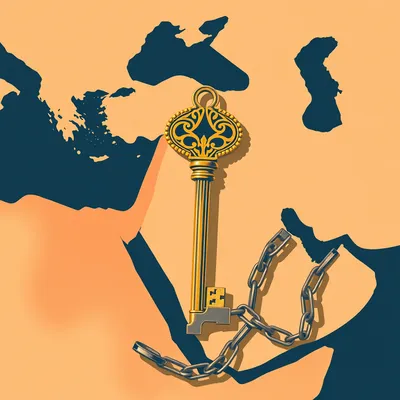
Daniel sent us this one — and it's a live geopolitical puzzle. is openly negotiating with Iran while simultaneously authorizing kinetic strikes against Iranian assets, all with the stated aim of forcing terms. Meanwhile, Israel appears to have been sidelined from the process entirely. The prompt asks whether there's any real precedent for this kind of military diplomacy — negotiations conducted under the literal threat of gunfire — and whether calling it "diplomacy" is even accurate anymore. There's a lot to unpack here.

There is, and the first thing I want to do is give this situation its proper name, because it actually has one. What we're watching is coercive diplomacy in its purest form — and I don't mean that as a euphemism. Coercive diplomacy is a defined concept in international relations. Thomas Schelling wrote about it extensively in the sixties. The idea is you use limited, calibrated force not to defeat the adversary militarily, but to demonstrate resolve and shape their cost-benefit calculus at the negotiating table.
"talk or I'll hit you again" as statecraft.
Crudely put, but yes. And the key word is calibrated. You're not trying to win a war. You're trying to make the other side believe that the cost of not agreeing to your terms will keep climbing. Schelling called it "the diplomacy of violence." The violence is the message.
Which is different from what most people think of when they hear "gunboat diplomacy.
It is, and that distinction matters. Gunboat diplomacy is usually about a one-time show of force — you park a destroyer off someone's coast, you fire a warning shot, you make a point, and you leave. Coercive diplomacy is an ongoing process where the military pressure and the diplomatic channel are running in parallel, deliberately, with each strike calibrated to influence the next round of talks.
The prompt's instinct that calling this "diplomacy" feels like a misnomer — I understand where that's coming from. But the counterpoint is that this is what diplomacy looks like when one side has decided that pure negotiation wasn't working and pure war is too costly.
And the United States has done this before, though rarely this transparently. The most direct precedent people reach for is Nixon's "madman theory" in Vietnam — the Christmas bombings of nineteen seventy-two. Nixon ordered the heaviest bombing campaign of the entire war, B-52s over Hanoi and Haiphong, while Henry Kissinger was simultaneously negotiating with Le Duc Tho in Paris. The bombing wasn't meant to win the war militarily. It was meant to bring the North Vietnamese back to the table on terms more favorable to the United States.
The prompt mentions the Strait of Hormuz and tariffs — this is the economic dimension that sits alongside the military one. Which Nixon didn't really have in his toolkit in the same way.
Right, and that's what makes the current situation genuinely novel. You have three levers being pulled simultaneously: direct military strikes, economic pressure through the strait, and open diplomatic channels. The Trump administration is essentially running a multi-domain coercive campaign, and they're not hiding it. The transparency is part of the signaling.
Let's talk about the transparency, because that's the element the prompt flags as uniquely strange. Usually states at least pretend the left hand doesn't know what the right hand is doing.
That pretense serves a purpose. It gives the adversary room to concede without appearing to capitulate to a threat. If you publicly say "we're bombing you until you sign this deal," you've backed the other side into a corner where any agreement looks like surrender. The traditional playbook says you maintain ambiguity — plausible deniability about whether the strikes are connected to the negotiations at all.
Why drop the pretense now?
I think there are two reasons. One is domestic — the administration wants to project strength and clarity to a domestic audience that's skeptical of endless Middle Eastern entanglements. "We're not drifting into war, we're executing a strategy." The second is about credibility with Iran specifically. The Iranians have spent decades perfecting the art of negotiating in bad faith while running out the clock. The Obama and Biden administrations played the ambiguity game, and from Trump's perspective, Iran exploited it every time. By making the linkage explicit — "these strikes stop when the deal is signed" — you remove their ability to pretend the military pressure isn't connected to the diplomatic track.
It's the diplomatic equivalent of reading someone their Miranda rights. You're making the terms of the interaction unmistakable.
Though I'd add — the risk is that you've also made it impossible for Iran to accept any deal without looking domestically humiliated. And that's where the Israel dimension comes in, because Israel being excluded from this process may actually be part of the solution to that problem.
If you're the Iranian regime, accepting a deal that's been negotiated directly with the United States is already politically difficult. Accepting a deal that appears to have been brokered through Israel, or shaped by Israeli demands — that's domestically impossible. The regime's entire legitimacy narrative is built on opposition to the "Zionist entity." So paradoxically, sidelining Israel may be a precondition for getting any deal done at all.
Which is cold comfort for Israel, obviously. The prompt mentions critics in Israel feeling abandoned — that Trump is essentially sacrificing the alliance on the altar of energy prices and strait access.
There's a real case to be made for that view. Twenty percent of global oil supply transits the Strait of Hormuz. The economic disruption from a prolonged closure would be catastrophic — we're talking oil prices potentially spiking to a hundred fifty, two hundred dollars a barrel. The administration is looking at that and deciding that the immediate economic threat to the global economy outweighs the longer-term strategic threat of a nuclear Iran. Whether that calculus is correct is an entirely different question.
Let's go back to historical precedent, because the prompt asks specifically about negotiations conducted under threat of gunfire. You mentioned Nixon.
The nineteen ninety-five Dayton Accords are an interesting parallel, though the dynamic was reversed. NATO bombing of Bosnian Serb positions — Operation Deliberate Force — created the conditions for the negotiations. The bombing was directly linked to the diplomatic track. Slobodan Milošević came to Dayton because the military pressure had shifted the balance on the ground. Richard Holbrooke, who led the negotiations, was explicit about this: the bombs and the talks were two sides of the same strategy.
That was a multilateral NATO operation with UN authorization. This is unilateral U.
Right, and the legitimacy questions are entirely different. But the operational logic is similar. Holbrooke's approach was essentially coercive diplomacy — use force to create a diplomatic opening, then negotiate while the threat of resumed force hangs over the table.
What about cases where it failed?
The most instructive failure might be the nineteen eighty-three U.intervention in Lebanon. The Reagan administration tried to use naval gunfire and air strikes to shape the behavior of various militias while simultaneously pursuing a diplomatic settlement. The bombing of the Marine barracks in October eighty-three demonstrated that the adversary wasn't deterred by the limited force being applied. The coercive signal didn't land. The United States withdrew entirely a few months later.
The lesson there is that coercive diplomacy works only if the adversary believes you're willing to escalate further. If they call your bluff and you're not prepared to go up the escalation ladder, the whole strategy collapses.
And that's the central gamble of the current approach. The Trump administration is betting that Iran believes the United States will keep escalating if necessary. If Iran concludes otherwise — if they think domestic political pressure or international backlash will force a U.withdrawal — then the coercive framework breaks down.
How does the Pakistan-mediated deal factor into this? There were reports of a deal being sealed within twenty-four hours.
Pakistan has been playing intermediary, which is itself notable. Pakistan has historical ties to Iran but also a complicated relationship with the United States. Their involvement suggests that the back channel is serious enough to warrant a credible third party. Whether a deal actually materializes is uncertain — we've seen "imminent" deals evaporate before. But the fact that Pakistan is publicly confirming their mediation role is itself a signal that both sides are at least at the table.
What would a deal actually look like? What are the terms the U.is trying to force?
From what's been reported, the core demands are: verifiable limits on Iran's nuclear program that go beyond the twenty-fifteen JCPOA framework, restrictions on ballistic missile development, and an end to Iran's support for proxy forces — Hezbollah, the Houthis, Shia militias in Iraq and Syria. In exchange, the U.is offering sanctions relief and, critically, a commitment not to pursue regime change.
That last piece is the part Iran has always wanted and never quite believed they'd get.
Because the United States has never been willing to offer it explicitly. Every administration since nineteen seventy-nine has maintained at least rhetorical ambiguity about regime change. If Trump is actually putting a non-regime-change guarantee on the table, that's a significant shift.
Can he credibly offer that? He's one administration. The next president could reverse it.
That's the fundamental problem with any executive agreement rather than a treaty. The JCPOA was an executive agreement, and Trump himself withdrew from it in twenty-eighteen. Iran knows that whatever Trump promises can be undone by his successor. So what they're really negotiating for is something more durable — probably a combination of congressional authorization and international guarantees that would be politically costly for a future administration to unwind.
Let's circle back to the prompt's core question about whether "diplomacy" is even the right word here. I think the answer is yes, but it's a specific subtype of diplomacy that most people find uncomfortable because it strips away the pretense of goodwill.
The pretense of goodwill is a relatively recent invention in diplomatic history, though. For most of human history, diplomacy was conducted under explicit or implicit threat. The Congress of Vienna in eighteen fifteen happened after Napoleon had been defeated militarily — the negotiations were shaped entirely by the military outcome. The Treaty of Versailles was imposed on Germany under the threat of resumed hostilities and a continued blockade that was causing mass starvation. The "diplomacy" of the nineteenth century was routinely backed by gunboats.
The innovation here isn't the combination of force and negotiation. It's the candor about it.
And the candor is strategically intentional. The administration is essentially saying: "We are not pretending this is anything other than what it is." That's consistent with Trump's broader approach to foreign policy — rejecting the norms of diplomatic language in favor of what his supporters would call clarity and his critics would call crudeness.
There's another precedent I want to throw in, though it's not a perfect fit. negotiations with Japan in the months before Pearl Harbor. The United States had imposed an oil embargo on Japan and frozen Japanese assets in the summer of nineteen forty-one. The negotiations that followed were conducted under that economic gun. position was essentially: change your behavior in China and Indochina, or the embargo stays. Japan experienced that as coercive diplomacy — and chose war instead.
That's an unsettling parallel, because it illustrates what happens when the coerced party concludes that the cost of compliance is higher than the cost of escalation. Japan's leadership decided that accepting American terms would mean the end of Japan as a great power. So they chose a desperate gamble instead. If Iran's leadership reaches a similar conclusion — that accepting a deal that curtails their nuclear program and proxy network is equivalent to strategic surrender — then the coercive framework could produce the opposite of its intended effect.
How does Israel factor into that calculus? Because the prompt suggests Israel feels abandoned, but there's another read: Israel may be the unspoken stick that makes the deal possible.
That's the "good cop, bad cop in stereo" theory, and I think there's something to it. The implicit message to Iran is: "You can negotiate with us, or you can deal with what Israel might do unilaterally." Israel has made it clear for years that they will not accept a nuclear Iran, and they've demonstrated willingness to strike Iranian nuclear facilities — they did it in Iraq in nineteen eighty-one, in Syria in two thousand seven. can present itself as the moderating force, the actor that's offering Iran a way out that doesn't involve Israeli strikes on Natanz and Fordow.
Israel being "left out" of the process might actually be the point. It preserves their option to act independently, which in turn strengthens the U.
It's a plausible reading. Whether it's intentional or just a convenient post-hoc rationalization is harder to say. The Israeli government certainly doesn't seem to be treating it that way. The public statements from Jerusalem suggest genuine alarm, not a coordinated good-cop-bad-cop routine.
Let's talk about the Strait of Hormuz specifically, because the prompt connects Trump's approach to the pressure of tariffs and energy prices. That's the economic dimension that makes this situation different from, say, the Nixon bombing campaign.
The Strait of Hormuz is the single most important chokepoint in global energy markets. About twenty-one million barrels of oil and petroleum products pass through it daily. That's roughly twenty-one percent of global consumption. Iran has repeatedly threatened to close the strait if attacked, and they've demonstrated the capability to disrupt shipping through mines, small boat swarms, and anti-ship missiles.
has responded with what — a naval buildup?
More than a buildup. There have been direct engagements. Iranian fast-attack craft have harassed commercial shipping, and the U.Navy has responded with warning shots and, in at least one confirmed incident, the destruction of an Iranian vessel that approached a U.destroyer too aggressively. The economic stakes are enormous. Every time there's an incident in the strait, insurance rates for tankers spike, and oil futures jump.
The kinetic strikes the prompt mentions — are these strikes on Iranian naval assets, or are we talking about something broader?
From what's been reported, the strikes have targeted a mix of assets: Iranian naval vessels in the Gulf, missile launch sites along the coast, and drone facilities that Iran has used to attack shipping. The goal appears to be degrading Iran's ability to disrupt strait traffic while simultaneously signaling that the United States is willing to escalate if necessary.
This is where I want to push on the strategic logic. If you're striking Iranian military assets while negotiating, you're simultaneously raising the cost of non-agreement and making it harder for the Iranian regime to sell any agreement domestically. You're creating a constituency within the Iranian military that wants revenge, not compromise.
That's the central tension in coercive diplomacy, and Schelling wrote about it extensively. The strikes have to be calibrated carefully — enough to hurt, not enough to humiliate. If you cross the line into humiliation, the adversary's domestic politics may make capitulation impossible, even if the leadership privately wants a deal. The Iranian regime has its own hardliners who will use every American strike as evidence that negotiation is futile.
Which brings us back to the Israel question. If the Iranian hardliners can point to the strikes and say "the Great Satan is attacking us while the Little Satan waits to finish the job," what does that do to the domestic politics of accepting a deal?
It makes it extremely difficult. Which is why I suspect the administration's actual strategy — as opposed to its public posture — involves some combination of back-channel assurances to Iran about Israel, and parallel pressure on Israel to stand down publicly while the negotiations proceed.
Assurance that Israel won't strike?
Or assurance that the United States won't support an Israeli strike, and might even actively oppose one. That would be a significant shift in the U.-Israel relationship, and it would explain why the Israeli government is alarmed.
The prompt mentions media reports suggesting Israel has been left out. Is this confirmed, or is it speculative?
It's been reported by multiple outlets — the Times of Israel, Haaretz, Reuters. The Netanyahu government has made statements indicating they were not briefed on the specifics of the U.Whether "left out" means excluded or simply kept at arm's length while being informed of broad strokes is harder to determine. Governments often have an interest in appearing more excluded than they actually are, because it preserves their freedom of action.
"We weren't consulted" is also a way of saying "we're not bound by whatever you agree to.
And Israel has used that language before. When the JCPOA was being negotiated, Netanyahu made very public statements about Israel not being bound by an agreement it didn't sign. It's a way of reserving the right to act independently.
How should we understand this situation, returning to the prompt's final question? What's the framework that makes sense of all this?
I think there are three lenses, and you need all three to see the full picture. The first is coercive diplomacy — the Schelling framework we've been discussing, where military force and negotiation are complementary tools in a single strategy. The second is what political scientists call "two-level games" — the idea that negotiators are simultaneously playing against the adversary at the table and against domestic constituencies at home. Trump is negotiating with Iran while also managing his domestic base, the energy market, and the U.relationship with Israel. Khamenei is negotiating with the United States while managing the IRGC, the hardline clerics, and an Iranian public that's deeply skeptical of American intentions.
The third lens?
The third is the most uncomfortable one from an Israeli perspective. It's the possibility that the United States is engaging in what strategists call "offshore balancing" — stepping back from direct regional commitments and letting regional powers manage their own security, while the U.focuses on preventing any single power from dominating the global energy architecture. In that framework, the U.goal isn't to solve Israel's Iran problem. It's to stabilize the Strait of Hormuz and prevent a disruption to global oil markets that would tank the global economy. Everything else — the nuclear program, the proxies, the missile development — is secondary.
That's a grim read for Israel, but it's internally consistent. If your primary objective is keeping oil at sixty dollars a barrel rather than two hundred, then a deal that limits Iran's nuclear breakout time to six months instead of six years might be acceptable, as long as it keeps the strait open.
That's the nightmare scenario from the Israeli perspective — a deal that looks good on paper, provides short-term economic stability, but leaves Iran with a nuclear infrastructure that can be weaponized rapidly once the agreement expires or collapses.
Let me push back on that, though. The Trump administration's own rhetoric has been maximalist on Iran for years. "Maximum pressure," withdrawal from the JCPOA, the Soleimani strike. If they're now pivoting to a deal that Israel considers inadequate, that's not just a policy shift — it's a reversal of the entire posture that defined Trump's first-term Iran policy.
It is, and that's what makes this situation so disorienting for allies. The administration that tore up the last Iran deal is now racing to negotiate the next one. The administration that ordered the strike on Qasem Soleimani is now sitting across the table from Iranian diplomats. If you're Israel, or Saudi Arabia, or the UAE, you're asking yourself: what changed?
The answer, presumably, is the Strait of Hormuz.
The strait, and the broader economic picture. The global economy in twenty twenty-six is not the global economy of twenty twenty. is in a different fiscal position. The energy market has been through multiple shocks. The political appetite for another Middle Eastern war is effectively zero in Washington. The administration is looking at the menu of options and concluding that a negotiated settlement — even an imperfect one — is preferable to a military confrontation with Iran that could spiral into a regional war and a global recession.
The prompt's suspicion — that Trump has effectively given in to Iranian demands because of the pressure of tariffs and energy prices — has some merit. But "given in" might be the wrong framing.
It's more like a reprioritization. The administration still wants to constrain Iran's nuclear program and regional influence. But the ordering of priorities has shifted. Preventing economic disruption is now priority number one. Constraining Iran's nuclear program is priority number two. And Israel's security concerns are — from the administration's perspective — a derivative of those first two priorities, not an independent objective.
Which is a coldly realist way of looking at alliances. The alliance exists to serve American interests. When the alliance conflicts with American interests, the interests win.
That's the realist tradition in a nutshell. And Trump has always been, rhetorically at least, a foreign policy realist — skeptical of alliances, focused on tangible American interests, dismissive of the idea that the United States has moral obligations to allies that transcend cost-benefit analysis.
Is there any precedent for an alliance dynamic quite like this? Where a patron power negotiates directly with its ally's primary adversary while effectively sidelining the ally?
The closest parallel might be the U.negotiations with China in the early nineteen seventies. Nixon and Kissinger's opening to China was conducted largely in secret, and Taiwan — America's formal ally — was not consulted. The Shanghai Communiqué of nineteen seventy-two effectively downgraded the U.commitment to Taiwan without Taiwan having any say in the matter. The difference, of course, is that Taiwan wasn't facing an existential threat from China in quite the same way Israel perceives an existential threat from Iran.
The other difference is that the China opening was about triangulating against the Soviet Union. It was a strategic masterstroke that reshaped the Cold War. It's not clear that the Iran negotiation has a comparable grand-strategic logic behind it.
Unless the grand strategy is simply: avoid a war that would crash the global economy while maintaining enough pressure on Iran to prevent nuclear breakout. That's not a grand strategy in the Kissingerian sense. It's crisis management dressed up as statecraft. But crisis management is most of what great powers actually do, most of the time.
There's a phrase I keep coming back to from the prompt: "negotiations while under threat of gunfire." It captures something visceral about this situation. The absurdity of diplomats talking while ordnance is in the air.
Yet that's been the reality of conflict resolution for centuries. The Korean War negotiations at Panmunjom dragged on for two years while fighting continued on the ground. The Paris Peace Talks on Vietnam went on for five years while the war escalated. The idea that negotiations and combat are separate phases — first you fight, then you talk — is a myth. They almost always overlap.
The difference here is the sequencing. Usually the fighting starts first, and the negotiations are an attempt to end it. Here, the negotiations and the strikes are simultaneous and coordinated from the outset. The violence isn't the failure of diplomacy — it is the diplomacy.
That's the most uncomfortable insight here, and I think it's correct. The strikes are not a breakdown of the diplomatic process. They are a feature of it. They're the punctuation in the sentences being exchanged across the table. Each strike says: "We are serious. The alternative to this deal is more of this, and worse.
Which raises an ethical question. If the strikes are calibrated to influence negotiations rather than to achieve military objectives, are they still legitimate uses of force under international law?
That's a difficult question. The traditional just war framework requires that military force be used for a legitimate military purpose — destroying an enemy's capacity to fight, protecting civilians, etc. Using force primarily as a bargaining tool — as a form of communicative violence — doesn't fit neatly into that framework. It's not obviously unlawful, but it's not obviously lawful either. International law hasn't really caught up to the practice of coercive diplomacy.
We're in a legal gray zone, with an ally that feels abandoned, negotiating with an adversary that's being bombed, over a deal that may or may not materialize, mediated by Pakistan, with the global economy hanging in the balance.
That's a fair summary of where things stand on June thirteenth, twenty twenty-six.
Let's talk about what happens if the deal fails. What's the next rung on the escalation ladder?
If the coercive framework doesn't produce an agreement, the administration has a choice: escalate further or back down. Further escalation would likely mean strikes on Iranian nuclear facilities — which would be a massive step up from hitting naval assets and coastal missile sites. That risks a full-scale regional war, with Hezbollah opening a northern front against Israel, Houthi attacks on Saudi oil infrastructure intensifying, and Shia militias in Iraq targeting U.
Backing down means accepting a nuclear Iran?
Or accepting that the military option has failed and pivoting to containment — which is what the Obama administration was essentially doing with the JCPOA. If the current negotiation produces a deal that looks a lot like the JCPOA, or worse, then the entire exercise will have been a costly detour back to the same destination.
Which is why the Israeli government is alarmed. From their perspective, the JCPOA was already an unacceptable deal. Anything that looks like it is worse than no deal at all.
That's the fundamental tension. The United States and Israel have different thresholds for what constitutes an acceptable risk. For the United States, an Iran that's six months from a nuclear weapon and economically constrained is a manageable problem. For Israel, an Iran that's six months from a nuclear weapon is an existential threat — because six months can become three months, can become a fait accompli before anyone has time to respond.
The prompt asks how we might better understand this strange situation. I think the answer is: stop thinking of it as diplomacy with occasional violence, and start thinking of it as a single integrated coercive campaign where the talks and the strikes are the same thing. The distinction between "diplomacy" and "military action" is the illusion we need to discard.
Once you discard it, the situation becomes more legible — even if it doesn't become more comfortable. The United States is using every tool at its disposal to achieve a specific outcome: an Iran that cannot disrupt global energy markets and cannot rapidly produce a nuclear weapon. If that outcome requires bombing Iranian assets while simultaneously negotiating with Iranian diplomats, that's what the United States will do. The fact that it looks strange to us is a reflection of our own outdated categories, not of incoherence in the strategy.
Whether the strategy works is a separate question.
Coercive diplomacy has a mixed track record at best. For every Dayton, there's a Lebanon. For every successful coercion, there's a miscalculation that spiraled into a war nobody wanted. The problem with using force as communication is that the message can be misread. Iran might interpret the strikes as a sign that the United States is not serious about a deal — that the bombing is the real policy and the negotiations are a cover. At which point the coercive signal produces the opposite of its intended effect.
We wait and see whether the Pakistan-mediated deal actually materializes.
We wait and see. And in the meantime, we recognize that what we're watching is not a breakdown of diplomacy or a failure of statecraft. It's statecraft operating according to a logic that most of us find uncomfortable because it doesn't pretend to be anything gentler than what it is.
Now: Hilbert's daily fun fact.
Hilbert: In the nineteen sixties, competitive kabaddi players in the Caspian basin discovered that a raider's sustained chant produced a resonant frequency of approximately one hundred ten hertz — a pitch that consistently destabilized defenders' breath control when maintained for more than thirty seconds.
I have so many questions about how one measures that.
I have questions about why one measures that.
Where does this leave us? I think the open question — the one worth watching in the coming weeks — is whether this transparently coercive approach actually produces a deal that holds, or whether it produces the very escalation it's designed to avoid. The historical record suggests both outcomes are possible, and the difference usually comes down to whether the adversary reads your signals correctly.
Whether you've correctly read theirs. The hardest thing in coercive diplomacy is knowing when you've applied enough pressure to produce agreement without applying so much that you produce defiance. There's no formula for that. You find out by doing it.
This has been My Weird Prompts. Thanks to our producer, Hilbert Flumingtop. If you want more episodes, we're at myweirdprompts.
If you enjoyed this, leave us a review wherever you listen.
Until next time.