Daniel sent us this one — and it's the question I think a lot of people are asking right now. What's actually happening between Iran and Israel, and out in the Strait of Hormuz, over the last few days? Because the fog is real. You've got Trump saying Iran is in a state of collapse, you've got CBS on the ground in Tehran saying no it isn't, you've got ships somehow getting through the strait while it's supposedly blockaded, and everyone from Tel Aviv to Tokyo is watching oil prices climb and wondering who blinks first. There's a lot to untangle here.

It's day sixty of this war, which is wild to say out loud. Sixty days in, and we're in this strange limbo where the active bombing has mostly paused but the economic stranglehold is just getting started. By the way — quick note, today's script is coming to us from DeepSeek V four Pro. So if anything sounds unusually coherent, that's why.
I'll take that as a compliment to our usual incoherence.
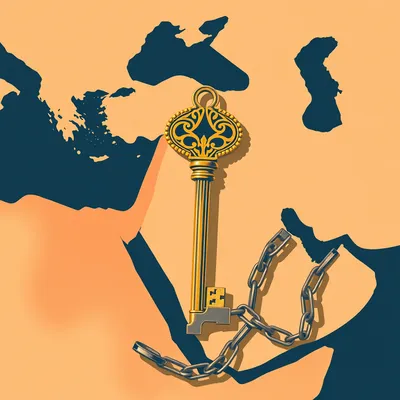
So let's start with the core standoff, because this is the thing that's actually driving everything right now. Iran has made an offer. They'll reopen the Strait of Hormuz — which they've been choking off since the war started — if the U.lifts its naval blockade of Iranian ports and ends the war. But here's the catch, and it's a big one. The proposal pushes all discussion of Iran's nuclear program to a later date. It's basically saying, let's stop the economic pain now, and we'll talk about the nukes...
Which is exactly what the U.has been saying it won't accept for, what, two decades now? The whole point of the pressure campaign was to get Iran to the table on nukes. So Iran's offer is essentially, we'll stop hurting you if you stop hurting us, and by the way we're not going to talk about the thing you actually care about.
And Secretary of State Marco Rubio was on Fox News Monday and shut this down explicitly. His quote was "we can't let them get away with it." Which is a pretty clear signal that the administration isn't biting on this framework. But then — and this is where it gets strange — Trump posts on Truth Social Tuesday that Iran has "just informed us that they are in a State of Collapse" and wants the strait opened "as soon as possible.
I saw that post. And my immediate reaction was, wait, who informed who of what? Because the Iranian foreign minister was in Russia meeting with Putin the same day, and that didn't exactly look like a government in collapse begging for mercy.
This is where the information fog becomes part of the story, not just noise around it. CBS News has a producer in Tehran, Seyed Rahim Bathaei, and he reported directly that the country does not appear to be in a "state of collapse, by any standards at all." He acknowledged the blockade is causing real economic strain — which of course it is, you cut off a country's oil exports and it hurts — but collapse?
You've got two completely contradictory narratives. Trump says Iran is collapsing and desperate. The guy on the ground in Tehran says things are strained but functional. And both of these can't be true. Someone is spinning, or maybe both are.
Both are almost certainly spinning. But let's talk about what "collapse" would actually look like, because I think this is where most coverage gets it wrong. Iran has been under sanctions of various intensities for decades. They've developed an entire parallel economy — smuggling networks, barter arrangements, cryptocurrency channels, front companies in the Gulf. The internet blackout that NetBlocks has been tracking for sixty days now — that's not just oppression, it's also a tool to prevent the population from seeing their savings evaporate in real time or coordinating protests. The regime has learned how to manage economic pain.
That's the thing. Collapse implies a loss of control, and the Iranian regime has spent forty-plus years building systems to maintain control precisely during crises like this. The internet blackout is day sixty now, according to CNN's reporting. That's not a regime losing its grip. That's a regime tightening its grip.
And NetBlocks has been documenting this — they're calling it "digital darkness." Remote workers cut off from income, businesses unable to operate normally, but also no viral videos of unrest, no coordinated opposition. It's brutal but strategically coherent.
When Trump says "state of collapse," what's he actually doing? Because he's not just describing reality incorrectly. He's creating a narrative that serves a purpose.
I think there are two purposes. One is domestic. There was a Reuters Ipsos poll that came out — only twenty-six percent of Americans say the war has been worth the cost. Twenty-six percent. That's a catastrophic number for an ongoing military engagement. Midterms are coming. Trump needs an off-ramp that looks like victory, and "we brought Iran to the point of collapse" is a much better story than "we're in a stalemate and oil is a hundred and twelve dollars a barrel.
The second purpose?
The second purpose is that it might actually be a negotiating signal. If you're Trump and you want to declare victory and get out, you need to frame whatever deal you get — or whatever unilateral pullback you do — as a concession from a defeated enemy. Saying "they're collapsing, they're begging us to open the strait" lays the groundwork for saying "we won" even if the actual terms are a mutual stand-down that doesn't address nukes at all.
Which brings us to the Reuters report that U.intelligence agencies are actually studying how Iran would react if Trump unilaterally declared victory and pulled back. That's extraordinary. The intelligence community is gaming out a scenario where the president just... says we won and leaves.
The initial assessment from the early days of the war was that Iran would view such a declaration as a win for them. Which makes sense, right? If the world's superpower attacks you, bombs your country for weeks, blockades your ports, and then leaves without having destroyed your nuclear program or your missile capability or your regime — you get to say you survived. You get to say you stood up to the Americans and they blinked.
Both sides could declare victory from the same outcome. Which is actually how a lot of these standoffs end historically. But the problem is the strait.
The strait is everything now. And this is where I want to get into the numbers, because they're staggering. Brent crude hit a hundred and twelve dollars a barrel on Tuesday. That's up about sixty percent from around seventy dollars before the war started on February twenty-eighth. average gasoline is at four dollars and eighteen cents a gallon, the highest since twenty twenty-two. The World Bank is calling this "the largest oil supply shock on record" and warning it could push oil to a hundred and fifteen dollars a barrel this year.
This isn't just an American problem. Every economy that imports oil is feeling this. Japan, India, Europe, China. The global economy is taking a hit because of a waterway that's twenty-one miles wide at its narrowest point.
The Strait of Hormuz handles about twenty percent of the world's daily petroleum liquids. That's roughly twenty-one million barrels a day in normal times. And right now, the flow is severely restricted. Iran has been using mines, drone swarms, and fast attack craft to threaten shipping, and the U.Navy has been running a counter-blockade on Iranian ports. So you have two blockades essentially operating simultaneously — Iran blocking the strait, the U.blocking Iranian exports.
Yet, here's the weird part. A Japanese supertanker carrying two million barrels of Saudi crude successfully transited the strait on Tuesday. According to Iran's Tasnim news agency, it did so "in coordination with Iran.
This is the "toll booth" question, and I find it fascinating. Iran says the strait is closed, but they're selectively allowing ships through — possibly for a fee, possibly as a political favor, possibly to signal that they're reasonable while still maintaining leverage. If this becomes a de facto toll system, it changes the nature of the standoff entirely. Iran goes from being a blockade state to being a gatekeeper extracting rents.
Which is actually more sustainable for them than a total closure. A total closure brings the whole world down on your head eventually. A selective toll system lets you keep the oil flowing enough to avoid a global depression while still extracting economic and political benefits.
It fractures the international response. If Japan can get its oil through by coordinating with Iran, does Japan still support the U.If India cuts a side deal, does India still back sanctions? It's a divide-and-conquer strategy.
Let's talk about the UAE quitting OPEC, because this connects directly to what's happening in the strait.
This is huge, and I think it's going to be one of the most consequential long-term outcomes of this war. The UAE announced on April twenty-eighth that it's withdrawing from OPEC and OPEC plus, effective May first. The energy minister told CNN the timing was chosen specifically because the Strait of Hormuz closure limits the immediate market impact. They're essentially saying, look, the strait is already messed up, so our production increase won't cause a price crash right now, but we need the flexibility to meet what they called "urgent needs of the market.
Translation: we want to pump more oil, we've wanted to pump more oil for years, and this crisis gives us the cover to break from the cartel without looking like we're just being greedy.
Analysts say the UAE could nearly double its output without OPEC quotas. That's millions of additional barrels per day that could come online. In the short term, that helps stabilize prices. In the long term, it fundamentally reshapes the global oil market and fractures the Saudi-led consensus that's held OPEC together for decades.
This is what I mean about knock-on effect. The war is between the U.and Iran, but one of the biggest institutional casualties might be OPEC. The Gulf states are hedging — against Iran, yes, but also against U.If you're the UAE and you're watching the U.get bogged down in a war with Iran while oil prices spike and the global economy wobbles, you start thinking about your own interests pretty quickly.
The UAE has been chafing under OPEC quotas for a while. They've invested heavily in production capacity and they want to use it. The war gave them the political cover and the market conditions to make the break. It's a reminder that every major geopolitical shock creates winners who reposition themselves.
Let's shift to the diplomatic track, because it's been chaotic even by the standards of this conflict. Trump canceled a planned trip by his envoys — Steve Witkoff and Jared Kushner — to Islamabad over the weekend. Said it would take "too much time" and Iran could just call.
Which is a remarkable thing to say about a diplomatic mission that your own administration scheduled. "Too much time" — for what? For a conflict that's been going on for sixty days and could reshape the Middle East for a generation? Meanwhile, Iranian Foreign Minister Abbas Araghchi didn't wait around. He shuttled to Oman and then to Russia, where he met Putin in St. Petersburg on Monday. Putin praised Iran's "brave and heroic" fight.
While the U.is canceling diplomatic trips, Iran is consolidating its relationships with Russia. That's not a collapsing regime. That's a regime doing diplomacy.
Putin's embrace isn't just symbolic. Russia has been providing Iran with satellite intelligence, electronic warfare support, and diplomatic cover at the UN. The Russia-Iran axis has deepened significantly during this war. If you're mapping the geopolitical landscape coming out of this, you have to account for a much tighter Moscow-Tehran partnership.
The UN piece is worth dwelling on for a second. Iran was selected as one of thirty-four vice presidents of the month-long Nuclear Non-Proliferation Treaty review conference. called it an "affront" and "beyond shameful." Iran accused the U.of hypocrisy as the only country to have used nuclear weapons. This is high theater, but it also shows that Iran still has diplomatic standing despite everything.
It speaks to how the rest of the world sees this conflict. and Israel are fighting Iran, but Iran isn't isolated the way North Korea is isolated. It has relationships with Russia, China, Turkey, Qatar, Oman. It has diplomatic channels. It gets elected to UN vice presidencies. The framing of "international community versus rogue state" doesn't hold here. This is a polarized international system where different blocs have different views.
Let's talk about the Lebanon front, because it hasn't gone quiet even with the ceasefire.
No, it hasn't. Despite a U.-brokered ceasefire, Israeli strikes killed at least eight people in southern Lebanon on Tuesday. Three of them were Civil Defense paramedics — they were hit by a second strike while responding to the first. That's a double-tap attack, and it's the kind of thing that generates lasting bitterness even if the strategic rationale makes sense to military planners.
Israel also destroyed what it called a Hezbollah tunnel network in Qantara. The blast was large enough to register as a seismic event. And an Israeli contractor was killed by a Hezbollah drone in southern Lebanon on Tuesday.
The Lebanon front is still hot, even if it's not making the same headlines as the strait. Hezbollah has been degraded but not destroyed. They're still capable of launching drones. They're still digging tunnels. The ceasefire is holding in the sense that there's no full-scale ground war, but it's not peace. It's a low-intensity continuation.
This connects back to the broader question of what "winning" means. Israel went into Lebanon to degrade Hezbollah's capabilities and push them back from the border. Has that been achieved? But Hezbollah is still there, still fighting, still killing Israelis. The war goals were maximalist and the outcomes are partial.
Which is true on every front. goal was to eliminate Iran's nuclear program — hasn't happened. Degrade Iran's missile capability — partially done but Iran is still firing. Regime change was never the stated goal but was clearly the hope — not happening. So you have this gap between what was promised and what's been delivered, and that gap is what's driving the "declare victory and leave" conversation.
Let's talk about the human toll, because it's easy to get lost in strategy and oil prices and forget what's actually happening on the ground. The AP has been tracking the numbers. At least three thousand three hundred seventy-five people killed in Iran. Two thousand five hundred thirty-four in Lebanon. More than forty in Israel. Six UN peacekeepers. That's since February twenty-eighth.
The ICRC president arrived in Tehran on Tuesday to assess humanitarian needs. That tells you something about the conditions on the ground. Sixty days of bombing, a naval blockade cutting off imports, internet blackout cutting off information and economic activity — this is a population under enormous strain, regardless of whether you call it "collapse" or not.
One thing I want to flag about the fatality numbers — they're almost certainly undercounts, especially on the Iranian side. The internet blackout makes independent verification nearly impossible. The Iranian government controls the information flow. We're getting numbers from the AP and other outlets doing their best, but the real toll is probably higher.
That's part of the fog too. We don't really know what's happening inside Iran. We have the regime's narrative, we have Trump's narrative, we have a few reporters on the ground, and we have satellite imagery. That's it. Everything else is inference and spin.
Let's try to cut through the fog for listeners, because I think that's what Daniel is really asking. How do you parse competing claims when both sides are spinning this hard?
The first thing I look for is independent verification. CBS has a producer in Tehran — that's valuable. NetBlocks tracks internet connectivity — that's hard data. Satellite imagery of the strait shows ship movements — that's observable. Oil prices are a market signal that incorporates information faster than any government press release. When Brent crude hits a hundred and twelve, the market is telling you the strait is not functioning normally, regardless of what anyone says.
The second thing is to look at what each side does rather than what they say. Iran says it's not collapsing, but it's also sending its foreign minister to Russia and Oman to seek support. says it's winning, but it's also gaming out a "declare victory" scenario. Actions reveal more than words.
The third thing is to watch for internal contradictions. Trump says Iran is in a state of collapse and desperate to reopen the strait. But Iran's offer conditions reopening on the U.lifting the blockade and ending the war — with nukes off the table. That's not a desperate offer. A desperate offer would be unconditional. Iran is still negotiating from a position of leverage, even if that leverage is destructive.
The strait is Iran's leverage. And they know it. They've been threatening to close it for decades. Now they've actually done it — partially, selectively — and they're seeing what it does to global markets. The lesson they're learning is that it works. Oil prices spike. The world pays attention. has to negotiate.
Which creates a terrible incentive going forward. If Iran emerges from this with its nuclear program intact and the lesson that choking the strait gives them leverage, why wouldn't they do it again in five years? Why wouldn't other countries with chokepoint leverage — and there are several — take notes?
This is the long-term strategic problem that the "declare victory" scenario doesn't solve. You can end this war, you can reopen the strait, you can bring oil prices down. But if the underlying dynamic hasn't changed — if Iran still has its nuclear ambitions and its strait leverage and its missile program and its proxy network — then you've just bought time at enormous cost.
That might be the best available outcome. I want to be careful here, because I'm not advocating for endless war. The costs are real and mounting. Twenty-six percent public support. Oil at a hundred and twelve. Allies getting nervous. The UAE leaving OPEC. There's a case that the best thing to do is stabilize the situation, reopen the strait, and manage the Iran problem through containment rather than military action.
The counterargument is that containment failed — that's why we're here. The Obama and Biden administrations tried containment and sanctions. Iran kept enriching uranium, kept developing missiles, kept building its proxy network. The war happened because the "manage the problem" approach ran out of road.
That's the genuine dilemma. Neither approach — military action or containment — has a great track record with Iran. The military action has been costly and hasn't achieved its stated goals. Containement allowed the problem to grow. So what's the third option?
There might not be a clean third option. There might just be choosing which set of problems you're willing to live with. That's not satisfying, but it's often where foreign policy actually lands.
Let me bring in one more piece of this that I think is under-discussed. The UAE leaving OPEC is not just about oil markets. It's about the Gulf states repositioning themselves in a world where U.security guarantees look less reliable. If you're Abu Dhabi or Riyadh, you're watching the U.struggle with Iran, you're watching oil prices spike, you're watching domestic political support for the war collapse. You start thinking about your own defense and your own economic interests.
The Gulf states have been quietly building ties with China and hedging against U.retrenchment for years. This war accelerates that. If the U.declares victory and pulls back without having decisively defeated Iran, the Gulf states will draw conclusions about American staying power.
China is watching all of this very carefully. China imports enormous amounts of oil through the Strait of Hormuz. They've been relatively quiet during this conflict, but they're taking notes. that gets bogged down in the Middle East is a U.that's distracted from the Pacific. that can't keep the strait open is a U.that can't guarantee freedom of navigation — which is the cornerstone of the entire global maritime order.
This is the thing about the strait standoff. It's not just about Iran and Israel and the U.It's about whether the global commons — the waterways and trade routes that everyone depends on — can be secured by the existing power structure. If the answer is no, or if the answer is "only at enormous cost," then we're entering a different era.
The "toll booth" scenario is a glimpse of that different era. If Iran can selectively allow ships through for a fee, and the world basically accepts it because the alternative is worse, then we've moved from a rules-based maritime order to something more like a protection racket. And once that precedent is set, it applies everywhere. The South China Sea. The Bab el-Mandeb. The Turkish Straits.
Where does this go in the next few days? What are you watching?
I'm watching three things. First, whether the Japanese tanker transit was a one-off or the start of a pattern. If more ships start getting through with Iranian coordination, it means a de facto toll system is emerging. Second, I'm watching the UAE production numbers. If they actually ramp up significantly in May, that changes the oil price equation and gives the U.more room to maneuver. Third, I'm watching Trump's Truth Social feed — not for policy substance, but for signals about his patience level. If he starts talking more about "winning" and less about specific demands, the "declare victory" scenario is getting closer.
I'm watching the Lebanon front, because that's where this war could reignite quickly. If Hezbollah escalates, or if Israel decides the ceasefire isn't worth maintaining, you could have a second front opening up just as the strait standoff is supposedly being resolved. And I'm watching Russia. Putin's embrace of Araghchi wasn't just ceremonial. Russia has interests in keeping the U.bogged down and oil prices high. If Russia starts providing more direct support to Iran — intelligence, air defense, anti-ship missiles — the military equation changes.
The oil price is the transmission mechanism for all of this. The World Bank warning about the "largest oil supply shock on record" — that's not hyperbole. Twenty percent of global petroleum transiting a waterway that's now contested. If the strait fully closes, we're not talking about a hundred and twelve dollars a barrel. We're talking about numbers that make two thousand eight look mild.
That's the mutual assured destruction element of this standoff. Iran can't fully close the strait without cratering its own economy and inviting a much more aggressive international response. can't maintain the blockade and the war indefinitely without cratering the global economy and losing domestic support. Both sides have an interest in finding an off-ramp.
The question is whether the off-ramps available to each side are compatible. Iran's off-ramp is: lift the blockade, end the war, we'll talk about nukes later. off-ramp is: we declare victory, the strait reopens, Iran's nuclear program is addressed — not necessarily resolved, but addressed. Those aren't the same off-ramp.
Which is why we're in a staring contest. Both sides are waiting for the other to blink. Iran is betting that oil prices and domestic U.politics will force Trump to accept something less than his stated goals. Trump is betting that the blockade and the bombing campaign have hurt Iran enough that they'll eventually concede on nukes.
The CBS reporting suggests Iran isn't there yet. The economic strain is real, but the regime is not in collapse. They've been through worse. The Iran-Iraq war in the eighties was far more devastating, and the regime survived. Sanctions under maximum pressure in twenty eighteen and twenty nineteen were severe, and the regime survived. The question is whether this time is different.
The internet blackout makes it hard to know. If there's unrest building in Iran, we can't see it. If the economy is closer to collapse than the regime is letting on, we can't verify it. The fog isn't just a media phenomenon — it's a deliberate strategy by both sides to control the information environment.
That's what makes this conflict so disorienting for people following it. You have Trump saying one thing, the Iranian regime saying another, a few reporters on the ground providing fragments, and the whole thing filtered through state media and social media and partisan outlets. It's genuinely hard to know what's true.
What's a listener supposed to do with all of this? If you're living in Israel, like Daniel and like me, you're trying to figure out whether the rockets will start again, whether the economic pressure will ease, whether the strategic situation will be better or worse when this is over. If you're anywhere else, you're watching oil prices and wondering about your heating bill or your gas tank.
Now: Hilbert's daily fun fact.
The average cumulus cloud weighs about one point one million pounds. That's roughly the weight of two hundred adult elephants floating above your head.
Let's talk about what listeners can actually do with this information, because it's easy to feel helpless in the face of a geopolitical standoff.
The first practical thing is to understand your own energy exposure. If you're in a country that imports oil through Hormuz — which is most countries — your energy costs are going to be volatile for the foreseeable future. Locking in fixed-rate energy contracts where possible, or adjusting household budgets to account for higher fuel costs, is not irrational.
The second thing is to diversify your information sources. If you're only getting news from one side of this conflict, you're getting a partial picture. Read the AP and Reuters for straight reporting. Read CBS and CNN for on-the-ground perspective. Read Al Jazeera for how the conflict is being covered in the region. Read the Times of Israel for the Israeli perspective. None of these sources are perfect, but reading across them helps you triangulate.
The third thing is to pay attention to the market signals, not just the political ones. Oil prices, shipping insurance rates, tanker tracking data — these tell you what's actually happening in the strait more reliably than government statements. If Brent crude starts dropping, something is changing. If it spikes again, something is deteriorating.
The fourth thing — and I know this sounds abstract, but it matters — is to think about the long-term implications for global stability. The UAE leaving OPEC, the strait toll system, the Russia-Iran axis, the U."declare victory" scenario — these aren't just headlines. They're signals about how the international order is changing. Understanding those changes helps you make better decisions about everything from investments to where you might want to live.
I'd add one more. If you're in a position to influence policy — even at the local level, even just as a voter — ask hard questions about what "victory" means. Every politician wants to declare victory. But if victory means leaving the underlying problems unresolved and setting precedents that make future conflicts more likely, it's not victory. It's just a pause.
That's the hardest question hanging over this whole thing. In sixty days of war, with thousands dead and oil at a hundred and twelve dollars a barrel and the global economy wobbling — what has actually been achieved? Iran's nuclear program is still there. Hezbollah is degraded but not destroyed. The strait is still contested. The diplomatic landscape is more polarized than before.
The counterargument, which I think has to be taken seriously, is that we don't know the counterfactual. Maybe without the war, Iran would be even closer to a nuclear weapon. Maybe Hezbollah would have been even more entrenched. Maybe the strait would have been closed anyway, just on a different timeline. We can't run the experiment twice.
That's fair. And I want to be clear that I'm not trying to Monday-morning-quarterback the decision to go to war. The question now is what happens next. And the "declare victory" scenario, for all its flaws, might be the least bad option if the alternative is a prolonged stalemate that bleeds the global economy for months or years.
The danger is that "declare victory" becomes a euphemism for strategic defeat that everyone else can see. If the U.pulls back without having achieved its core goals, adversaries around the world update their assessments of American power. Allies update their assessments of American reliability. The world becomes a more dangerous place not because of what happened, but because of what was revealed.
That's why this standoff matters so much. It's not just about Iran and Israel. It's about whether the post-Cold War order — the one where the U.guarantees freedom of navigation and prevents regional powers from developing nuclear weapons — is still functional. If the answer is no, or if the answer is "only at costs the American public won't sustain," then we're in a different world.
Daniel asked us to walk through the fog, and I think that's what we've done. The fog is real. The competing claims are real. The stakes are real. And the outcome is uncertain. That's not a satisfying answer, but it's an honest one.
The thing I keep coming back to is that Japanese tanker. Two million barrels of Saudi crude, transiting the strait "in coordination with Iran." Is that a crack in the blockade, or is it the shape of things to come? A world where Iran collects tolls on the world's most important oil waterway is a very different world from the one we had sixty days ago.
It's a world where chokepoints become leverage points, and leverage points become revenue streams, and the whole system of free navigation that's underpinned global trade since the nineteen forties starts to fray. That's the big story here, bigger than the day-to-day headlines.
We'll keep watching it. Thanks to Hilbert Flumingtop for producing, as always.
This has been My Weird Prompts. You can find every episode at myweirdprompts dot com or on Spotify. If you've got thoughts on this one, Daniel reads everything that comes in.
We'll be back soon.