Rural Ireland, 1905. A Jewish man walks a dirt road with a pack on his back — forty pounds of Christian religious paintings, pots, pans, whatever he could carry. He's knocking on doors where even the electricity poles gave up miles ago. No shop for twenty miles in any direction, but he's there. He's the vikleman. The original gig economy worker, a century before anyone coined the term.

Daniel sent us this one — it's personal. His late grandfather, Fred Rosehill, was the first generation of the family born in Ireland. His great-grandfather was the immigrant, one of those viklemen, peddling house to house in the Irish countryside. And Daniel's been thinking about what that history means now, because he's living his own version of it — moved from Ireland to Israel at twenty-five, now has a son, Ezra, who's the first generation in a new country. Three generations from Cork peddler to Israeli immigrant, and he's asking: what were these viklemen? What did that life actually look like? And what does it mean to inherit not just a family story, but a structural position in the world?
That's the question that sticks with me. Because the vikleman wasn't just a job — it was a role that history forced on people, and the echoes of it ripple through every immigrant generation since. The pack changes, the country changes, but something about the position — the outsider carrying goods to people who need them, absorbing risk, facing suspicion — that structure keeps reappearing. I mean, think about it. Daniel's great-grandfather is walking through County Limerick with a pack full of pictures of saints, and a hundred and ten years later Daniel's navigating Israeli bureaucracy with a smartphone. Different tools, same basic position: the stranger who has to figure it out from zero.
The thing is, this isn't just a family memoir. Daniel's story mirrors a pattern that's playing out globally right now. Millions of people are navigating exactly this cycle — displacement, reinvention, building something from zero in a place where you're the stranger. The tools are different, but the underlying logic hasn't changed much since 1905. And I think that's what grabbed me about Daniel's prompt. He wasn't just asking for family history. He was asking: what does it mean that my great-grandfather and I did the same thing, a century apart, in opposite directions?
Where do we even start with this? Who were the viklemen, and why did they end up in the Irish countryside carrying Christian paintings of all things?
The word itself — vikleman — comes from the Yiddish "viklen," which means to peddle or hawk goods. But in the Irish context, it wasn't just any kind of peddling. It was a very specific economic niche. Door-to-door sales of household goods — pots, pans, religious pictures, fabric, small tools — almost always on credit, with payment deferred to harvest time or whenever the farmer got paid.
The vikleman was essentially a walking store that also functioned as a bank.
Though calling it a bank makes it sound more stable than it was. The vikleman would buy his stock on credit from a Jewish wholesaler in Cork or Dublin, head out on a circuit of rural towns and farms, sell on installment plans, and hope to collect enough to pay the wholesaler and have something left over. The margins were razor thin. One bad harvest, one customer who didn't pay, one stretch of bad weather that kept him from making his rounds — and he was underwater.
The customer base was people who had no other options. No shops nearby, no access to credit from any formal institution. The vikleman was the last mile of commerce in pre-industrial Ireland.
And that's the thing to sit with — he was doing work nobody else would do, in places nobody else would go. But that visibility also made him vulnerable. When you're the only stranger showing up at the door asking for money, even money you're legitimately owed, you become a target. And I'm thinking about what that actually felt like on a Tuesday afternoon in February. You walk three miles in the rain to a farmhouse, the woman owes you two shillings from a pot she bought in November, and she doesn't have it. Maybe she genuinely doesn't. Maybe she's embarrassed. Maybe her husband is standing behind her, and he doesn't like seeing a Jew at his door asking his wife for money. What do you do? Do you press? Do you let it slide and hope next time is better? Every single interaction was a negotiation where you had no leverage except the relationship itself.
If you press too hard, you lose the customer and maybe get a reputation. If you let it slide every time, you starve. There's no winning move, just a constant calibration of risk against survival. So how did these men end up in that position in the first place? What pushed a Lithuanian Jew to rural Ireland with a pack on his back?
The immigration wave that brought Daniel's great-grandfather started in the 1880s. Tsar Alexander the Second was assassinated in 1881, and the pogroms that followed were brutal. We're talking about organized violence that swept through hundreds of communities. Homes burned, people killed, entire families displaced overnight. Jews fled the Pale of Settlement — mostly from what's now Lithuania, which was then part of the Russian Empire — and a small number ended up in Cork. When they arrived, they had nothing. No capital, no connections, no English in many cases. And the trades open to them were severely limited. They couldn't join guilds, they couldn't own land, they couldn't set up fixed shops without capital they didn't have. Peddling was one of the few doors that wasn't bolted shut.
No capital required, no premises, no guild membership. It was the only on-ramp available. But let's be specific about what "no capital required" actually means. It doesn't mean zero. The wholesaler extended credit, sure, but that credit was extended within the community — Jew to Jew. So the vikleman was already embedded in a network of mutual obligation before he ever left Cork. He owed the wholesaler, the wholesaler depended on him to move goods, and the whole thing rested on a foundation of trust that was partly economic and partly ethnic. You paid the wholesaler not just because you needed more stock, but because he was the only person in the country who'd stake you, and if you burned him, you burned the whole community.
That's what we're going to trace through the rest of this episode — how that on-ramp, born of necessity, became a lightning rod. The vikleman's credit system, which was just basic economic survival, got reframed as usury. And that reframing wasn't abstract — it led directly to the Limerick riot of 1904, the only major anti-Semitic riot in Irish history. Then we'll follow the thread through to Daniel's own family, and ask what this history tells us about the immigrant experience that's still relevant right now.
The arc is: economic necessity creates the vikleman, the vikleman's credit model gets weaponized against him, the community gets attacked, and yet — the children of those peddlers become shopkeepers, and their grandchildren become... well, podcast prompt-senders in Jerusalem. The question is what survives across those generations, and what the pattern tells us about immigration itself.
To understand the vikleman, you have to understand the economics of rural Ireland in 1900 — a world where cash was scarce and trust was everything. The typical vikleman would start by getting stock on credit from a Jewish wholesaler in Cork or Dublin. That wholesaler was often a slightly more established immigrant himself, someone who'd graduated from peddling to running a fixed premises. So the whole system was built on chains of credit within the community. It's almost like a ladder, where each rung is someone who made it just far enough to pull the next person up — but only just. The wholesaler isn't rich. He's one bad season away from being back on the road himself.
Which means the vikleman was carrying debt before he even knocked on his first door. He owed the wholesaler, and his customers owed him. He was a middleman in the most exposed position imaginable. And here's a fun fact that I stumbled on while reading about this: there's a Yiddish term, "luftmensch" — literally "air person" — for someone who lives on nothing, who survives on air. The vikleman wasn't quite a luftmensch, because he had goods and a route, but he was adjacent to it. One missed payment away from floating. The whole enterprise was held together by promises and ledgers and the hope that the harvest would be decent.
The circuit he'd walk — we're not talking about a few streets. These men covered enormous rural territories. We're talking about routes that might take two or three weeks to complete, looping through dozens of villages and isolated farms. They'd be gone for days or weeks, sleeping in barns or cheap lodging houses, carrying samples of everything they sold. The pack itself, as Daniel mentioned, could weigh forty pounds or more. And they'd travel routes where, as his great-grandfather described it, the electricity poles just stopped. That's not poetic license — that was the actual boundary of commercial infrastructure. Beyond that point, no shop existed. If you wanted a pot, a picture, or a piece of fabric, you waited for the vikleman.
They were indispensable. The last mile of commerce, literally. But that also meant they were the most visible Jews most rural Irish people would ever encounter. The vikleman wasn't an abstract figure from a sermon — he was the man at the door, asking for payment. And if you're an Irish farmer who's never met a Jew before, the vikleman is your entire mental model. Everything you think you know about Jews gets filtered through this one guy with a heavy pack and a ledger. That's an enormous weight to carry — not just the pots, but the representation of an entire people.
That brings us to the credit mechanism, which is where everything gets combustible. Deferred payment wasn't a choice — it was the only way the business could function. Rural customers had no cash until harvest or until they sold livestock. So the vikleman would sell goods on an installment plan: a small deposit up front, the rest due later. He'd keep a ledger, return to collect, and hope the customer had the money.
Here's where it gets tricky. The vikleman had to cover his own costs — the wholesale debt, his travel, his own family's survival. So he'd either charge explicit interest on the deferred amount or, more commonly, embed the cost of credit into the price of the goods themselves. The pot that cost him a shilling might sell for a shilling and sixpence on installment. And that sixpence difference — that's the vikleman's entire margin. Out of that comes his food, his lodging on the road, his family's rent in Cork, and the repayment of his own debt to the wholesaler. It's not profit in any meaningful sense. It's the cost of the service.
That markup — which was just the cost of providing credit in a cashless economy — got framed as usury. The anti-Semitic trope of the Jewish moneylender exploiting the honest farmer was centuries old by 1904, and the vikleman's ledger was all the evidence anyone needed to deploy it. Never mind that no bank would lend to these farmers. Never mind that the vikleman was taking on enormous risk himself — bad debts, theft, weather, illness. The narrative was already written. And here's the thing about that narrative: it was useful. It gave the farmer a villain instead of a system. The farmer isn't poor because of land tenure laws or British economic policy or the simple fact that cash is scarce in a subsistence economy. He's poor because the Jew at the door is charging him too much for pots. It's a story that redirects anger downward and outward, away from the actual structures of power.
It wasn't a fringe view. This was mainstream enough that it got amplified from the pulpit. Which brings us to Limerick.
Father John Creagh, a Redemptorist priest, delivers a series of sermons at the Redemptorist church in Limerick. He accuses the Jewish peddlers of — and I'm quoting from contemporary accounts — "bloodsucking" and "parasitic" practices. He tells his congregation that buying from Jews is a sin, that Jewish credit arrangements are usury, that the community is being drained. The sermons ran for multiple days. The Limerick Leader, the local paper, described Jewish peddlers as "a curse to the city.
That's a direct quote from the newspaper of record. This wasn't some pamphlet from a crank — this was the establishment. The priest says it from the pulpit, the paper prints it, and suddenly it's not just one man's opinion — it's the official stance of the community. It's not a metaphor about money. It's a physical image. It turns an economic transaction into a bodily violation. The Jew isn't just charging interest — he's draining the life out of the community. That's the kind of language that gets people hurt.
The result was a boycott that lasted months. Jewish homes were stoned. Families were physically attacked. The Jewish population of Limerick at the time was about a hundred and seventy people — mostly peddlers and their families. Within a year of Creagh's sermons, roughly half of them had fled. Some went to Cork, some to Dublin, some left Ireland entirely.
The thing that's crucial to understand — this wasn't theological anti-Semitism in the sense of deicide accusations or blood libel. Creagh's attack was economic. The vikleman's credit system was the weapon. The deferred payment, the markup, the ledger — that's what got reframed as exploitation. And here's the question I keep coming back to: how much of this was genuine belief, and how much was strategy? Because the sermons didn't just attack Jews in the abstract. They told people to stop buying from them. That's a boycott. That's an economic weapon. And it worked.
Which is why it's so important to look at what the vikleman was actually doing. He was providing a service that didn't exist otherwise. He was extending credit to people who had no access to it. He was absorbing risk that no formal institution would touch. The economic logic was sound — it was the same logic that underpins every installment plan and credit arrangement in history. But because a Jew was doing it, and because he was visible, and because the priest needed a target, the whole thing got weaponized.
The riot was highly effective at its actual goal, which wasn't theological purity — it was removing economic competitors. Half the Jewish population gone in a year. The boycott didn't just intimidate people; it destroyed livelihoods. These were men who'd built customer relationships over years, who'd extended credit that would never be collected, who'd carried packs through Irish mud for a generation. And they had to just... Think about that ledger. All those outstanding debts from farmers who now had no intention of paying, because the priest had just told them the debt itself was sinful. The vikleman doesn't just lose his home. He loses his entire balance sheet. Every shilling he's owed vanishes overnight.
One of the things that's easy to miss from a distance is how small and fragile these communities were. A hundred and seventy people in Limerick. The Cork community wasn't much larger. There was no safety net, no institutional support, no political power. When the priest turned the city against them, there was nowhere to appeal. The vikleman's vulnerability wasn't just economic — it was existential. And I think that's the part of the story that's hardest to sit with. This wasn't Nazi Germany. This was Ireland in 1904, a country that knew something about oppression itself. And still, a hundred and seventy people could be targeted, terrorized, and driven out, and the machinery of the state did nothing.
Yet, the vikleman kept walking. The ones who fled Limerick often started over somewhere else — Cork, Dublin, Liverpool. The pack went back on the shoulders. The ledger got opened again. That's the part of the story that Daniel's phrase "crushing and hard" captures — it wasn't heroic in any romantic sense. It was just survival, repeated daily, in the rain, at doors that sometimes got slammed in your face. You lose everything in Limerick, so you go to Cork and you start again. Not because you're resilient in some inspirational way. Because what else are you going to do? There's no backup plan. There's no family in the old country to return to — the old country tried to kill you. So you walk.
The Limerick riot was a breaking point, but it wasn't the end of the story. For the vikleman's children, the pack became a shop, and the shop became a different kind of life. Daniel's grandfather, Fred Rosehill — he was the pivot generation. His father carried the pack. He opened a photo frame business and a children's toy store in Cork.
That's the classic second-generation arc. The peddler accumulates just enough capital and customer relationships to plant a flag — a fixed premises, a sign over the door, a business that doesn't depend on walking twenty miles in the rain. The vikleman was the seed. The shop was what grew from it. But I want to be careful about how we tell that story, because it's easy to make it sound inevitable. It wasn't. Plenty of viklemen never graduated to a shop. Plenty of their children stayed poor. The ones who made it across that line had some combination of luck, timing, and sheer stubbornness that the ones who didn't lacked.
People miss how directly one led to the other. The vikleman wasn't just selling pots — he was building a customer list. He knew who paid reliably, who needed what, when the harvest money came in. That knowledge was the real asset. When his son opened a toy store, he wasn't starting from zero. He was converting a network of rural relationships, built over decades on foot, into a storefront. It's the same asset, just in a different form. The pack becomes a shop. The ledger becomes a customer database. The route becomes a reputation.
A toy store, of all things. The grandson of the man who carried religious paintings to farmers ends up selling toys to children in Cork. There's something almost pointed about that — the next generation gets to sell joy instead of necessity. The vikleman sold pots because people needed pots. Fred Rosehill sold toys because people wanted toys. That's a different relationship to commerce entirely. It's the difference between surviving and living.
Here's where Daniel's own story loops back in. He moves from Ireland to Israel at twenty-five. New language, new culture, starting from zero. His son Ezra is the first generation born there. Structurally, that's exactly what his great-grandfather did — arrived in a strange country, built something from nothing, raised a child who'd be the first native of the family in that place. The direction is reversed — Ireland to Israel instead of Lithuania to Ireland — but the pattern is identical.
The difference being that Israel is a Jewish state. The great-grandfather fled pogroms to a country where a priest could turn a city against him. Daniel moved to a country where being Jewish is the default, not the exception. That's not a small difference — it's the entire context flipped. The vikleman was a minority in a Christian country. Daniel is part of the majority in a Jewish one. The vulnerability that defined his great-grandfather's life doesn't apply to him in the same way.
But what's the same? The language barrier. The moment where you realize you don't know how anything works — not the bureaucracy, not the social codes, not which shop sells what. Every immigrant knows that moment. The vikleman knew it in 1890. Daniel knew it in 2014. The tools change, but that experience of being the outsider, of having to figure everything out from scratch — that's constant. And I wonder if Daniel felt that echo when he was standing in some government office in Jerusalem, filling out forms in a language he was still learning, and thought: my great-grandfather did this too. Not the forms, but the standing-there-not-knowing.
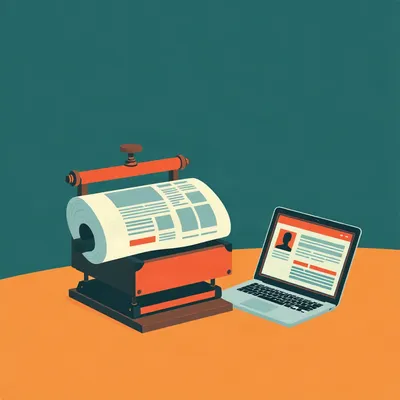
The infrastructure of survival evolves too. The vikleman's pack was a mobile store, a credit ledger, and a social network rolled into forty pounds of canvas. Today's immigrant carries a smartphone. WhatsApp groups replace the circuit of farms. Remittance apps replace the handshake and the installment plan. But the structural position — being the bridge between communities, absorbing risk, facing suspicion — that hasn't budged. The pack is lighter, but the position is the same.
Think about what a delivery driver for a platform app does today. No benefits, no safety net, all the risk on the individual. Paid per task, not per hour. Often an immigrant, often working routes nobody else wants, often the target of exactly the same accusations — taking jobs, exploiting customers, driving down wages. The vikleman was the original independent contractor. The gig economy just added an app. And the app doesn't make you less vulnerable. In some ways it makes you more vulnerable, because the company can deactivate you with a click, and you have even less recourse than the vikleman had with his wholesaler.
The credit mechanism has its own modern echo. The vikleman's deferred payment system — buy now, pay at harvest — is structurally identical to what Klarna and Afterpay do. They let you defer payment, they embed the cost of credit in the transaction, and they attract exactly the same criticism about debt traps and exploitation. The difference is scale and legitimacy. The vikleman was doing it on foot with a handshake. Klarna does it with an algorithm and a terms-of-service agreement nobody reads. But the underlying mechanism — defer payment, embed the cost, hope the customer can pay later — that's the same.
The difference is that Klarna is a billion-dollar company with lobbyists and compliance departments. The vikleman was one man with a ledger, and when the priest called him a bloodsucker, there was no PR team to call. There was no regulatory framework to appeal to. There was just the road, and the pack, and the hope that the next town would be better.
Which brings us back to Fred Rosehill's toy store. What did that generation build that enabled Daniel's mobility? They built stability. A fixed address. A known name in the community. Enough margin to educate the next generation. The vikleman's pack didn't just carry pots — it carried the possibility that his grandson wouldn't have to carry it. And that's the thing about intergenerational mobility that we don't talk about enough. It's not just about money. It's about the removal of certain kinds of vulnerability. Fred's children didn't have to worry about a priest turning a city against them. They had a store. They had neighbors who knew them. They had a place.
Daniel's son Ezra won't be selling pans in rural Israel. But he'll inherit something else. The knowledge that starting over is possible. The understanding — maybe unspoken, maybe not — that his family has done this before, in harder conditions, with fewer tools. That's what the vikleman actually passed down. Not the pack.
What does a hundred-and-twenty-year-old story about a Jewish peddler in rural Ireland have to do with anyone listening today? I think there are two frameworks worth taking from this.
First one: next time you hear someone say immigrants are taking jobs or exploiting the system, ask what economic niche they're actually filling. The vikleman was doing work nobody else would do, in places nobody else would go. That's not a coincidence — that's the structural position. The jobs immigrants get aren't the jobs people are fighting over. They're the jobs that exist because nobody else showed up. And if you look at any immigrant community anywhere in the world, at any point in history, you'll find the same thing. The jobs that natives won't do, in the places natives won't live, on terms natives won't accept. That's not a stereotype. That's a structural description.
The second one cuts against the romance. We love the immigrant entrepreneur story — the peddler who becomes a shopkeeper, the shopkeeper whose kid becomes a doctor. It's a satisfying narrative. It makes us feel good about the system. But it sanitizes something. The vikleman didn't choose entrepreneurship because he had a disruptive idea and venture capital. He chose it because every other door was locked. That's not the same thing. That's not the American Dream. That's a forced march dressed up as a bootstrap story.
Survival dressed up as hustle. The grind wasn't ambition — it was the absence of options. And when we tell those stories as if they're purely inspirational, we erase the part where the doors were locked. We make it sound like the vikleman chose the road because he had an entrepreneurial spirit, when actually he chose the road because the guild wouldn't let him in, the bank wouldn't lend to him, and the landlord wouldn't rent to him. That's not a choice. That's a funnel.
When you see a delivery driver on a moped in the rain, or a street vendor who barely speaks the language, the framework shouldn't be "look at that work ethic." It should be: what doors were closed to this person? What does the pack they're carrying actually weigh? Because the pack is always heavier than it looks. It's got the rent, the remittances, the debt, the language barrier, the immigration status, the kids who need to see a doctor, the landlord who might raise the rent, the app that might deactivate you. The pots are the lightest thing in there.
The vikleman's pack wasn't just pots and religious paintings. It was the down payment on a toy store that wouldn't open for another generation. Every door he knocked on was a brick in a foundation he'd never stand on himself. And I think that's the part of the story that gets me. He knew he wasn't going to own the toy store. He knew he was building something he'd never enter. And he walked anyway.
Which brings us back to Daniel's son, Ezra. A one-year-old in Jerusalem, first generation in a new country, great-great-grandson of a man who carried pots through Irish mud. What does he inherit? Not the pack. But maybe the thing that made carrying it possible.
The vikleman is gone. The pack is in a museum somewhere, or more likely rotted in a shed decades ago. But the pattern doesn't go away. Every generation of immigrants reinvents the same strategies — peddling, credit, community networks — because the structural challenges of displacement don't change. You arrive with nothing. You find the niche that's open. You absorb risk nobody else wants. You build something for the next generation that you might not get to enjoy yourself. That's the vikleman's legacy, and it's still being lived, right now, in every city on earth.
The question is whether the host societies ever learn to see it differently. To see the vikleman not as a threat, but as what he always was: the person who brought the pots, the pictures, and the possibility. The person who showed up where infrastructure didn't, carrying what people needed, on terms they could afford, at risk nobody else would take.
I keep thinking about Daniel's phrase — "crushing and hard." He's right. But there's something else in there too. His great-grandfather walked those roads so his grandfather could open a toy store. His grandfather ran that store so Daniel could choose his own path. And Daniel's in Jerusalem now, raising Ezra, building whatever foundation Ezra will stand on. That's not a sad story. It's just...
The weight of the pack changes. It always does. But nobody gets to put it down entirely. You just pass it forward, and hope the next generation carries it a little further, a little easier, to a place where the electricity poles don't stop.
This has been My Weird Prompts. Thanks to our producer, Hilbert Flumingtop.
If you have a weird prompt — maybe a family story that's been sitting in the back of your mind, or a question about history that nobody's answered for you — send it to us. We're at show at my weird prompts dot com.
Or visit the website at my weird prompts dot com. We'll be back soon.