Daniel sent us this one — he's been thinking about the gap between the sci-fi renderings of urban farming and what it actually feels like to do it. The core question is, what does the life of an urban farmer actually look like? Not the technology stack, not the yield-per-square-foot metrics, but the lived experience. Is it going to be some depressing dystopia of workers in lab coats monitoring sensor dashboards while robots do all the actual growing? Or can we build something that captures some of what makes traditional farming feel satisfying — the connection to land, the pace, the community — but inside a city?

This is exactly where my brain goes when I see those glossy vertical farm press releases. You know the ones — gleaming white towers, perfectly uniform lettuce, a person in a clean suit holding a tablet. The images are always aspirational, but they never show anyone who looks like they've touched soil in their life.
The architectural render always has exactly one human in it, and they're always gazing meaningfully at a basil plant like it just revealed the secrets of the universe.
The basil whisperer. But here's what's interesting — the actual data on who's doing urban farming right now tells a completely different story from those renderings. There was a big Agritecture piece in January where they surveyed global controlled environment agriculture experts about the near future, and the consensus was striking. The headline prediction wasn't about automation or AI or sensor density. It was about decentralization and community integration.
The experts are saying the renderings are wrong.
The renderings have been wrong for a decade. Look, let's separate the two worlds here, because they're barely the same activity. On one side you've got vertical farming — the indoor, stacked, LED-lit, hydroponic operations. These are venture-backed companies, massive capital expenditure, and frankly, the sector is in rough shape right now. AeroFarms filed for bankruptcy, AppHarvest went under, Infarm pulled out of multiple markets and downsized dramatically. The unit economics have been brutal.
I remember when Infarm was the poster child. Their modules were in like every Whole Foods in Berlin.
Now they've retreated to a handful of core locations. The problem is that growing leafy greens indoors with electricity is an energy equation that doesn't balance easily. You're competing against a field in California that uses the original fusion reactor — the sun — for free. But that's the venture capital story. The other world, the one that's actually thriving, looks nothing like that.
What does it look like?
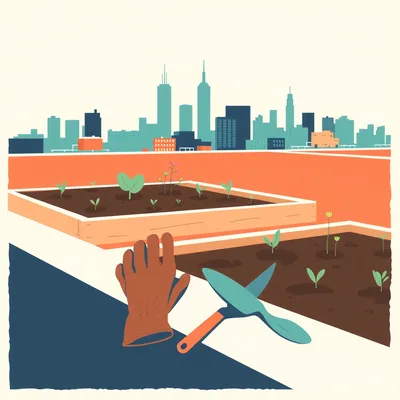
It looks like a forty-five-year-old woman named Maria who runs a half-acre market garden on a reclaimed lot in Detroit, selling produce within a two-mile radius, employing three people from the neighborhood, and making a modest living. It looks like community land trusts in Boston that lease parcels to immigrant farmers who grow culturally specific crops — callaloo, bitter melon, amaranth greens — for communities that can't find them in supermarkets. It looks like the Brooklyn Grange rooftop farms in New York, which are essentially soil farms on top of buildings, not hydroponic laboratories.
Soil on a roof. There's something almost defiant about that.
And they're growing tomatoes and peppers and herbs in actual dirt, on top of a building in Queens, and they run a CSA and host events and teach workshops. The farmers there are sunburned and calloused. They're not monitoring dashboards. They're farming.
The question almost answers itself in the asking. The life of an urban farmer, in practice, looks a lot more like farming than like urbanism.
Yes, but with a crucial twist. The urban farmer has something the rural farmer often doesn't — direct, daily contact with the people eating their food. A farmer in Iowa might never meet a single person who buys their corn. It goes into the commodity stream and disappears. An urban farmer sees their customers at the farm stand, at the market, at the restaurant where the chef is featuring their carrots tonight. That changes the psychology of the work enormously.
There's a feedback loop of meaning there that the industrial system can't replicate.
And this connects to something I think the prompt is really circling — this question of whether urban farming can feel pastoral. Pastoral isn't about being in the middle of nowhere. The pastoral tradition, going back to Virgil, is about a certain relationship to land and season and community. It's a mode of attention, not a zip code.
The pastoral as a state of mind rather than a geographic location.
And I'd argue that a well-designed community garden in Philadelphia can feel more genuinely pastoral than a thousand-acre monoculture operation in Kansas. The monoculture farm is an industrial workplace. The community garden, even if it's surrounded by row houses, is a place where people are engaging with soil biology and seasonal rhythms and each other.
There's also something here about scale. Traditional farming, if you're doing it at commodity scale, is largely about driving large machines in straight lines for hours. It's solitary in a way that can be isolating. The urban farm, by necessity, is small. You can't run a combine on a third of an acre. So the work defaults to human scale — hand tools, close observation, the kind of detailed plant-by-plant attention that industrial agriculture specifically evolved to eliminate.
That human-scale work is exactly what people find satisfying. There's good research on this from the therapeutic horticulture world. The combination of physical engagement, visible results, connection to natural cycles, and community — it hits something deep. Urban farms are increasingly being used as mental health interventions, as addiction recovery programs, as veteran reintegration spaces.
The satisfaction isn't despite the lack of industrial scale. It's because of it.
Now, let me push back on myself for a second, because I don't want to romanticize this into something it isn't. Urban farming is hard. The pay is generally low. Land access is a constant struggle — urban land is expensive, soil contamination is a real issue, and zoning can be hostile. Most urban farmers I've read about are piecing together income from multiple sources — the farm itself, maybe, plus education programs, plus grants, plus a partner's salary. It's not an easy path.
Which, honestly, sounds a lot like traditional small-scale farming. The financial precarity is the same. The difference is that in the city, you might have a spouse with a tech job instead of a spouse who also farms.
That's a brutally accurate way to put it. The urban farm household economy often involves one person earning city wages and the other farming. It's a patchwork. And that's before we even get to the vertical farming side of things, where the economics are even more punishing.
Let's talk about the vertical farming worker, because I think that's where the dystopian version of the question lives. What does that person's day actually look like?
This is where the Agritecture survey and the industry coverage get really interesting. The early vertical farming pitch was essentially "we've automated farming so completely that it's now a tech job." The worker was portrayed as a technician — monitoring sensors, managing nutrient solutions, analyzing data. And that does exist. But what's emerged in practice is more complicated.
Because the automation hasn't worked as well as promised. A lot of the tasks that were supposed to be fully automated — harvesting delicate greens, pruning, spotting disease early, transplanting seedlings — still require human hands and human judgment. So you have workers who are part farm laborer, part quality control inspector, part data entry clerk. They're doing repetitive physical work in what is essentially a warehouse, but they're also expected to be technically literate enough to log data into a tablet and spot anomalies in the system.
It's the worst of both worlds. The physical demands of farming plus the surveillance and metrics of a warehouse job.
That's the risk. And it's particularly acute because a lot of vertical farming companies, in their scramble to reduce costs, have turned to the same labor practices as the broader food system. There was a great piece in Civil Eats a couple of years ago looking at working conditions in some of the larger vertical farms, and the reality was far from the gleaming futurism of the marketing. Repetitive motion injuries, pressure to work faster, limited upward mobility.
The basil whisperer has been replaced by the basil quota.
That's if the company survives. The wave of bankruptcies in the sector means a lot of workers have been through the cycle of being sold a vision of the future of agriculture, only to be laid off when the unit economics didn't pencil out. It's been a rough few years for the industry.
If the vertical farming employment model is fragile and often not great for workers, and the community-scale soil farming model is satisfying but financially precarious, where's the synthesis? Is there a version of this that actually works at scale for the people doing it?
I think the most promising models right now are the middle layer. Not the venture-backed vertical farms, not the scrappy half-acre market garden, but something in between. Think about what's happening in cities like Detroit and Cleveland and Buffalo — places with abundant vacant land and strong community development networks. You're seeing the emergence of what people are calling "agrihoods" or agricultural neighborhoods.
That's a word that sounds like it was invented by a real estate developer having a crisis of conscience.
It absolutely was. But the concept underneath the branding is interesting. The idea is that instead of a golf course or a clubhouse as the amenity around which a development is organized, you have a working farm. Not a community garden — a farm, with a farmer whose job it is to farm it. Residents can participate if they want, but they're not responsible for production. The farm sells to the neighborhood, to local restaurants, to markets.
The farmer in that scenario is a professional with a defined role, not a volunteer coordinator or an educator who also happens to grow some vegetables.
And that's the key shift. The urban farmer in an agrihood is a farmer. Their primary identity is agricultural producer. They're not a community organizer who gardens, not a teacher who farms on the side. They're a farmer who happens to farm in a city, surrounded by the people who eat their food.
That sounds almost obvious when you say it, but it's actually a radical departure from how most urban agriculture has been framed for the last two decades. The framing has been either "community building activity" or "food justice intervention" or "educational program." The farmer as farmer — as a person doing a job and expecting to make a living at it — gets lost.
That framing has real consequences. If urban farming is always positioned as a social program, then it's always dependent on grants and volunteers and the enthusiasm of a rotating cast of interns. The moment the grant runs out or the volunteer coordinator burns out, the farm collapses. But if it's a business — a real farm business, just located in a city — then it has to function on its own economic terms.
Which brings us back to the question of what makes farming satisfying. Because one of the things that makes traditional farming satisfying, for the people who stick with it, is precisely that it's a real livelihood. It's hard, but it's yours. You're not a project. You're a producer.
That dignity piece matters enormously. There's a tendency in urban agriculture discourse to treat the farmer as a sort of noble educator, bringing the gift of kale to the food desert. It's condescending and it burns people out. The farmers I find most compelling in the reporting are the ones who talk about their work the way any skilled tradesperson talks about theirs — with pride in craft, frustration with margins, and a clear-eyed sense of the business.
The electrician doesn't have to also run an after-school program to justify their existence.
So if we're trying to answer the prompt honestly — what does the life of an urban farmer actually look like — I think we have to say it depends enormously on which model we're talking about. The community garden coordinator is essentially a nonprofit worker who gardens. The vertical farm technician is essentially a warehouse worker with specialized skills. The agrihood farmer is a small business owner who farms. The rooftop farm operator is an entrepreneur running a diversified operation — some produce sales, some events, some education. These are different lives.
Different lives, different satisfactions, different miseries. The community garden coordinator probably has the most human connection and the least financial stability. The vertical farm technician has the most regular paycheck but the least autonomy and probably the least connection to the actual biology of growing. The agrihood farmer has autonomy and connection but is carrying the full weight of small business risk.
The rooftop farmer is basically running three businesses at once and hoping the events revenue covers the soil delivery costs. It's exhausting.
Where do you see the most genuine satisfaction showing up? If you had to point to the model that actually delivers on the pastoral promise within city limits?
Honestly, I think it's the soil-based, diversified small farm model — whether it's on a rooftop, in an agrihood, or on a reclaimed vacant lot. Because that model preserves the thing that actually makes farming feel like farming, which is the relationship with a living ecosystem. Soil isn't just a medium. It's a community of organisms. When you farm in soil, you're managing a biological system that you can influence but never fully control. That partial control, that ongoing negotiation with something larger than yourself — that's the pastoral experience. That's what people find meaningful.
Versus hydroponics, where you're basically running a chemical factory with plants as the output.
I don't want to be too dismissive of hydroponics. There are hydroponic growers who are deeply skilled and who find real satisfaction in the precision and the craft. But I think it's telling that when you look at the urban farms that have become genuine community institutions — the ones where people want to spend time, where volunteers stick around for years, where the farmer seems energized rather than drained — they're almost always soil-based. Brooklyn Grange, Growing Power before it collapsed, the Detroit market gardens, the community land trust farms in Boston. The whole messy biological circus.
There's a sensory dimension here that I think gets overlooked in the tech-forward discussions. The smell of soil. The feeling of pulling a carrot out of the ground. The sound of bees in the flowering cover crop. These aren't romantic frills — they're the actual texture of the work that makes it feel like something other than a job.
They're exactly what the vertical farm eliminates. A vertical farm is a clean room. It smells like nothing, or like cleaning solution. The lighting is artificial. The temperature is constant. You could be in any industrial park in any city in the world. There's no there there.
Which is fine if what you want is a job. But the question was about a satisfying life. And I think the evidence suggests that the satisfying version of urban farming looks a lot more like a slightly chaotic, perpetually underfunded, deeply human soil farm than it does like the render.
Let me complicate this a little, though, because I think there's a generational shift happening that might change the equation. The Agritecture piece on agritourism from February pointed to something interesting — there's a growing demand for farm experiences that are explicitly about reconnecting with food production. People are paying to harvest their own dinner, to attend farm-to-table events where the table is literally in the field, to do weekend work-stays on urban farms.
Agritourism as the new brunch.
But it's not just tourism. It's also education and what the industry is calling "agri-tainment" — cooking classes on farms, farm yoga, farm weddings. This is becoming a significant revenue stream for urban farms, sometimes eclipsing the actual produce sales.
Which creates an interesting tension. The farmer becomes part producer, part event planner, part Instagram backdrop. That's a very different kind of satisfaction than just growing beautiful tomatoes.
For some farmers, it's energizing. They love the education piece, the community connection, the performance aspect of it. For others, it's a distraction from the work they actually want to do, which is farm. I've read interviews with farmers who say they got into this to grow food, not to host wedding parties, and the constant pressure to diversify into experiences is its own kind of burnout.
The farmer as content creator. There's a version of this that's deeply unappealing — the pressure to document every harvest, to maintain the social media presence, to make sure the farm stand is photogenic enough for the weekend crowd. At some point you're not farming, you're performing farming.
That performance pressure connects back to the financial precarity. If the margins on produce are thin, and the events revenue is what keeps the lights on, then the events stop being optional. The farm becomes a venue that also happens to grow food, rather than a farm that occasionally hosts events. That's a real identity shift.
We've got a spectrum. On one end, the vertical farm technician — stable paycheck, sterile environment, no autonomy, no connection to biology. On the other end, the diversified soil farmer — deep connection, high autonomy, constant financial anxiety, pressure to perform the pastoral for paying audiences. Neither is exactly the pastoral ideal.
I'd argue the soil farmer is closer to something real. Because even with the financial stress and the performance pressure, they're still engaged in the actual work of growing food in living soil. That's not nothing. That's the thing itself. The technician is growing food too, but in a system designed to make the biology irrelevant.
The answer to the prompt's central question — can we create urban growing communities that are somehow pastoral within the urban environment — is yes, but it's fragile, it's underfunded, and it requires the farmer to wear about six different hats, some of which they probably hate.
It's happening anyway. Despite all of that, people are doing it. The number of urban farms and community gardens in the U.has grown steadily for two decades. The USDA's last urban agriculture census showed something like eighteen thousand urban farms nationally, and that's almost certainly an undercount because a lot of them are too small or too informal to show up in the data.
That's a real movement, not a trend piece.
It's globally distributed. Singapore's "thirty by thirty" goal — producing thirty percent of nutritional needs domestically by twenty thirty — has spawned an entire urban farming sector there, though it's heavily tilted toward the high-tech vertical model because land is so constrained. The Netherlands has been doing urban-adjacent intensive greenhouse agriculture for decades and it's woven into the national identity. Cuba's organopónicos — urban organic gardens — emerged from necessity during the Special Period and became a permanent feature of Havana's food system.
The Cuban case is interesting because it wasn't a lifestyle choice. It was "we have no oil, no fertilizer, and no food imports, figure it out." And what they figured out was intensely local, soil-based, community-managed agriculture embedded in the urban fabric. Not because it was charming, but because it worked.
Those organopónicos are still there, decades later, because they proved resilient. The farmers who work them are municipal employees in many cases, so they have stable incomes. The produce goes directly to the surrounding neighborhood. It's not pastoral in the romantic sense — Havana is a dense city and these are working gardens, not bucolic retreats — but it's pastoral in the functional sense. A direct, ongoing relationship between people, land, and food.
That word "functional" is doing a lot of work. The pastoral doesn't have to be pretty. It has to be real.
I think that's the through-line here. What makes agricultural life satisfying isn't the scenery. It's the agency, the skill, the visible results, the connection to natural cycles, and the community of people who share in the work and the harvest. All of those things can exist in a city. They're harder to achieve in a city because land is expensive and regulations are complex and the economic pressure to monetize every square foot is intense. But they're not impossible.
The prompt also asked whether the future is a depressingly digitized version of agriculture with sensor arrays and automated systems. I think the evidence says that version exists, it's being heavily funded, and it's struggling. Not because the technology doesn't work — the technology mostly works — but because the economics don't close and the human experience of working in those facilities seems hollow in ways that affect retention and morale.
The turnover rates in some of these vertical farming operations are reportedly very high. When the work is essentially warehouse labor with plants instead of boxes, you get warehouse-level job satisfaction, which is to say, not much. The plants don't care that the lighting is purple and futuristic. It's still repetitive physical work in a windowless room.
Meanwhile, the soil farmer on the reclaimed lot is making less money but can point to a specific tomato plant they've been nurturing since March and feel something about it.
That something is what the entire agritourism industry is trying to bottle and sell. People will pay to feel connected to food production precisely because the industrial system has made that connection so rare. It's just a factory with a green paint job.
The greenwashing of industrial agriculture, literally.
I want to be fair here — there are vertical farming operations that are trying to solve real problems. Water scarcity, pesticide reduction, food miles, year-round production in climates where outdoor growing is impossible for half the year. These are legitimate goals. The question is whether the solution creates a meaningful human life for the people doing the work, or whether it just replaces one form of agricultural alienation with another.
I think that's the sharpest version of the prompt's question. Not "can we grow food in cities" — we obviously can. But "can we grow food in cities in a way that nourishes the growers as well as the eaters.
The answer seems to be: yes, but only if we prioritize the grower's experience as a design goal. If the system is designed purely for yield and efficiency, you get the vertical farm, and the worker experience is an afterthought. If the system is designed for community engagement and education, you get the volunteer-dependent garden that can't pay its staff. If the system is designed for the farmer as a skilled professional making a living, you get something closer to the agrihood model or the diversified market farm.
None of these are perfect. But the third one seems like the one worth building toward.
And I think the policy implications are interesting. Right now, most urban agriculture policy is focused either on land access — making vacant lots available — or on food access — getting fresh produce into underserved neighborhoods. But almost no policy is focused on making urban farming a viable livelihood. There's very little in the way of business development support, or affordable equipment access, or cooperative marketing infrastructure, or health insurance for small farmers.
The USDA probably isn't thinking about the urban farmer's health insurance.
They're starting to. The USDA created an Office of Urban Agriculture and Innovative Production a few years ago, and they've been running grants and cooperative agreements. But it's still tiny relative to the scale of the need. Most urban farmers are on their own when it comes to the business side.
If we're synthesizing this into a picture of the urban farmer's life, I think it's something like this. You wake up early, because farming always starts early. You're maybe a fifteen-minute bike ride from your farm, which is on a reclaimed industrial lot or a rooftop or tucked into an agrihood development. You spend the morning doing the actual farming — planting, weeding, harvesting, managing irrigation, checking for pests. You're in soil. You're sweating. You're making dozens of small decisions based on observation and experience.
Midday, you might switch to the business side — invoicing restaurants, updating the CSA list, posting to social media, coordinating with the events person about Saturday's farm dinner. Then back to the field for the afternoon harvest, because you want the greens to be as fresh as possible for tomorrow's market.
In the evening, you might host a workshop or a volunteer session or just collapse. The pay is modest but you're piecing together enough to live on. You know your customers by name. You can see the difference you're making in the neighborhood. And at the end of the season, when you pull the last of the tomatoes and plant the cover crop, there's a satisfaction that has nothing to do with the bank balance.
That's the pastoral within the urban. It's not a painting. It's a life. And it's being lived right now by thousands of people who decided that farming in a city was worth the trouble.
For every one of them, there's probably three who tried it and burned out after two seasons because the economics didn't work. We shouldn't romanticize the attrition rate.
No, we shouldn't. The attrition rate is high. Land access is the number one barrier, followed by capital access, followed by the sheer physical toll. Farming is hard on the body regardless of where you do it. Doing it in a city adds layers of regulatory complexity and land insecurity. A lot of urban farms are on short-term leases or informal arrangements. You can spend three years building up your soil and then lose the land to a development deal.
That's the part that keeps me up. The soil-building. If you've spent years amending contaminated urban soil, building organic matter, establishing beneficial fungal networks, and then a developer buys the lot — that's not just a business loss. That's a small ecological tragedy.
A personal one. I've read accounts from urban farmers who lost their sites and talked about it like a death in the family. Because you've put yourself into that soil. Literally — your compost, your labor, your thousands of hours of attention. When the bulldozers come, they're not just clearing a lot. They're erasing an ecosystem that you built with your hands.
Which is why the community land trust model is so important. If the land is held in trust, permanently designated for agricultural use, the farmer can actually invest in it long-term. Put down roots, figuratively and literally.
The Dudley Street Neighborhood Initiative in Boston has been doing this for decades — community land trusts that include urban agriculture as a designated use. The farmers on that land know it's not going to be sold out from under them. That security changes everything about how they farm and how they live.
Security is the missing ingredient in a lot of the pastoral fantasy. The traditional pastoral — the shepherd in the meadow — assumes a kind of timeless stability. The land has always been there, the grazing rights are established, the seasons turn. The urban version of that stability is a land trust or a long-term lease or an agrihood covenant. Without it, the pastoral is just precarious.
With it, something new becomes possible. A farmer who can build equity in their land, improve it over decades, pass it on to the next generation. That's the arc of traditional family farming, transplanted into the city. It's rare, but it exists.
To wrap this around to the core question — what does the life of an urban farmer actually look like — I think we've landed on something specific. It looks like a small business owner doing skilled manual and intellectual labor in a biological system, embedded in a community of eaters, financially fragile but meaning-rich, and increasingly diversified into education and experiences out of necessity. It's not the gleaming vertical farm of the render. It's not the romantic yeoman fantasy either. It's something messier and more interesting.
It's a life that more people are choosing. The USDA data shows urban farm numbers still climbing. The community garden movement is stronger than ever. The agrihood concept is spreading beyond its early adopters. The technology-first model is stumbling, but the human-first model is finding its footing.
The basil whisperer in the render never existed. But the farmer with dirt under their fingernails, selling tomatoes to their neighbors on a Saturday morning — that person exists, and they're probably happier than the render ever suggested was possible.
Definitely more tired.
The good kind of tired.
The kind that comes from building something real.
And now: Hilbert's daily fun fact.

In the year nine hundred and eighty-six, a Norse expedition led by Erik the Red narrowly missed discovering the Kangerlussuaq seamount chain off Greenland's coast, which would later be found to host seventeen species of coral and sponge found nowhere else on Earth. Erik reportedly dismissed the area as "uninteresting water" and sailed on.
The man discovered Greenland and couldn't be bothered with a seamount.
Some people have no appreciation for benthic biodiversity.
Our thanks to producer Hilbert Flumingtop. This has been My Weird Prompts. Find us at myweirdprompts.com or wherever you get your podcasts.
Until next time.