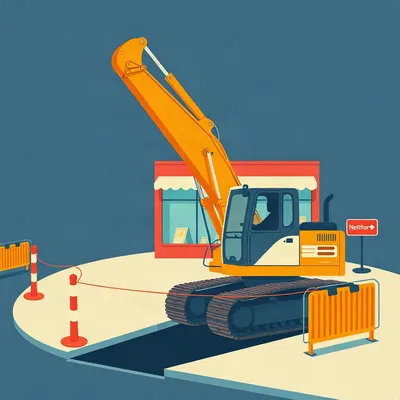
Daniel sent us this one while he's literally in the middle of moving apartments — hauling boxes on a platform trolley through the streets, and he notices something. The route he'd walked a hundred times as a pedestrian suddenly reveals itself as an obstacle course the moment you're pushing weight on wheels. Curb cuts that look fine from a distance turn out to have a two-inch lip. Ramps that technically exist lead to nowhere useful. And he's asking: how are cities and buildings actually mandated to create accessible spaces, who checks whether any of it works, and what does that picture look like globally?

What I love about this is Daniel accidentally rediscovered the single best accessibility audit method I've ever heard of. Load a platform trolley with fifty kilos and try to navigate one kilometer. You will learn more about your city's infrastructure in twenty minutes than any checklist inspection will tell you in a week.
Because the weight changes everything. Walking the same route, you don't notice that a curb ramp has a slope that's technically one-in-twelve but the transition at the bottom has settled into a sharp ridge. On foot you step over it. With a loaded trolley, you're suddenly doing an impromptu deadlift in traffic.
That ridge is exactly the kind of thing that tips a wheelchair forward or catches a stroller wheel. The trolley doesn't lie. It's a universal proxy — if you can't push a loaded trolley through a route, a wheelchair user can't navigate it independently, a parent with a stroller is going to struggle, a delivery worker with a hand truck is cursing your building's name every single day.
Daniel mentioned being able-bodied and never having had occasion to think about any of this before. Which is the entire problem in one sentence. The people designing and approving these spaces are overwhelmingly people who've never had to test them under load.
The timing on this question is sharp. The World Health Organization estimates fifteen percent of the global population lives with some form of disability — that's over a billion people. But that number only counts permanent disabilities. Add temporary injuries, pregnancy, aging, carrying children, pushing strollers, pulling luggage, making deliveries — and suddenly "accessibility" isn't a niche concern. It's describing the condition of basically everyone at some point in their lives.
Yet the gap between what's legally mandated and what's actually usable on the ground is enormous, and weirdly under-discussed. You hear about accessibility laws, you see the blue signs on parking spaces, and there's a vague assumption that someone somewhere is checking. Daniel's trolley experience suggests otherwise.
He's right. So let's trace this properly. What do the laws actually require, how is enforcement supposed to work, where does it break down, and why does a borrowed platform trolley catch failures that code inspectors miss? Because the story here is genuinely surprising — both how well some places do it, and how badly others fail while being technically compliant.
The two big frameworks to know are the UN Convention on the Rights of Persons with Disabilities — specifically Article Nine on accessibility — and the Americans with Disabilities Act Standards for Accessible Design, the 2010 version. They're very different animals.
The UN convention is a treaty. One hundred eighty-six countries have ratified it. Article Nine says states must identify and eliminate obstacles to accessibility in buildings, roads, transport, and information technology. It's sweeping language. But it has no enforcement teeth of its own — it leaves implementation to national law. So you get this enormous gap between ratification and reality. A country signs on, passes some domestic legislation, and then... well, that's where the trolley comes in.
It's a promise that may or may not be kept, and nobody's really checking at the international level.
The ADA, by contrast, is domestic US law with actual technical specifications. Ramp slope maximum one-in-twelve, width minimum thirty-six inches, handrails on both sides, landing platforms at top and bottom. Those numbers are enforceable. If a building doesn't meet them, you can sue.
Which brings us to the enforcement question Daniel was really asking. Who's out there with a clipboard and a trolley?
That's the uncomfortable answer. In the US, ADA enforcement is almost entirely complaint-driven. Someone has to experience a barrier, file a complaint with the Department of Justice, or bring a private lawsuit. There's no federal agency doing routine proactive inspections of existing buildings for accessibility. New construction gets checked during the permitting process, but the rigor varies wildly by jurisdiction. And once the certificate of occupancy is issued, nobody comes back.
A ramp gets built to spec, the inspector signs off, and five years later the drainage has settled, there's a two-inch lip at the bottom, and the only way it gets fixed is if someone in a wheelchair files a complaint.
Or a guy with a platform trolley writes an angry email. And that's the US, which has one of the stronger enforcement regimes globally. The EU adopted its European Accessibility Act in 2019, enforceable starting June 2025, but member states implement it differently. Japan's 2006 accessibility law is considered one of the best, especially for tactile paving — those yellow textured ground strips you see everywhere in Tokyo. But even Japan has gaps, like missing elevator connections in older stations.
In much of the developing world, the laws exist on paper but the enforcement capacity simply isn't there.
Which is why the trolley test is so revealing. A code inspection checks whether the ramp meets the slope spec. It doesn't check whether the ramp is blocked by a parked scooter, or whether the surface is treacherously slippery when wet, or whether the ramp leads to an entrance that's actually open to the public. Those are the failures that matter, and they're invisible to a compliance checklist.
I want to sit with that last point for a second — the checklist versus reality gap. Because Daniel's Tel Aviv experience is a perfect case study. You've got a curb ramp that technically meets the one-in-twelve slope spec. But the drainage wasn't installed properly, so over two rainy seasons the base settled and now there's a two-inch lip right where the ramp meets the street.
Two inches doesn't sound like much until you're pushing a loaded trolley and the front wheels hit it dead on. That's the moment you either strain something or the whole load shifts. And for a wheelchair user, a two-inch lip at the bottom of a ramp is a tipping hazard. The front casters catch, the chair pitches forward. It's dangerous. But a code inspector measuring slope with a digital level would never flag it — they're looking at angle, not transition.
The spec was met, the inspection was passed, and the ramp is functionally broken. That's not a design failure, it's an enforcement model failure.
And it connects to something broader about how the ADA enforcement structure actually works. The Department of Justice can investigate patterns of non-compliance, and there are certified access specialists who do plan reviews for new construction. But for existing buildings, the trigger is almost always a complaint. Someone has to encounter the barrier, know their rights, document it, and take action. That's a lot of friction.
Which means the system is effectively filtering for people who have the time, knowledge, and resources to file complaints. Not exactly the population you'd want to be your primary enforcement mechanism.
That's the US — again, one of the stronger regimes. Now look at Japan. Their 2006 accessibility law produced some of the best tactile paving standards in the world. Those yellow textured strips are everywhere, they're standardized, they actually guide people effectively. But I came across a case at a Tokyo subway station where the tactile paving was immaculate — truly world-class — but the elevator connection from the platform to the street level simply hadn't been installed. The station was built before the law, and retrofitting an elevator shaft into an existing underground structure is expensive and complicated.
You can follow the tactile path perfectly and it leads you to... Which defeats the purpose if you can't use stairs.
And that's the thing about accessibility — it's a chain. One broken link and the whole route fails. The ramp can be perfect, but if the door at the top requires fifteen pounds of force to open and there's no automatic opener, you're still stuck.
The EU approach is interesting here because it's newer and attempts to address some of these gaps. The European Accessibility Act from 2019, enforceable as of last year, covers products and services — ATMs, ticketing machines, e-commerce, banking apps — not just physical infrastructure. And member states have to report on implementation. But the devil's in the transposition. Germany does it one way, Romania another.
The act sets minimum requirements, but enforcement still depends on national authorities. So you get this patchwork where Barcelona is retrofitting medieval alleyways with ramps and lifts — impressive work — while other cities in the same legal framework are barely moving.
Which brings us back to the trolley. A compliance regime that only checks technical specifications will never catch the scooter parked across the ramp, or the ramp surface that turns into an ice rink when it rains, or the accessible entrance that's technically present but located behind the loading dock next to the dumpsters.
The dumpster entrance. I've seen that more times than I can count. Brand new building, fully compliant on paper, and the wheelchair-accessible entrance is two hundred meters from the main entrance, past the trash bins, through a service corridor. It meets every measurable spec. It's also a quiet statement about who's welcome and who's an afterthought.
You'd never know that from reviewing the plans. You only know it if you're the one making that walk — or pushing that trolley.
This is where the knock-on effect really land. Because the dumpster entrance doesn't just humiliate wheelchair users — it also means the delivery driver with a hand truck full of restaurant supplies is hauling through the same service corridor, navigating the same badly-designed ramp, cursing the same architect. The failures that block wheelchairs also block parents with strollers, travelers with luggage, anyone who's temporarily on crutches, and yes, our brother Daniel with his platform trolley.
The trolley test as universal proxy. It's almost elegant — one borrowed piece of moving equipment exposes infrastructure failures that affect a staggering cross-section of people who'd never describe themselves as having a disability.
The WHO numbers back this up in a way that should reframe how we think about accessibility entirely. Fifteen percent of the global population with a permanent disability — over a billion people. But when you layer in temporary impairments, situational limitations, aging-related mobility changes, people pushing strollers or pulling shopping carts — suddenly you're not talking about a minority accommodation. You're talking about a near-universal experience that the built environment simply refuses to acknowledge.
Which makes the surprisingly good cases worth understanding. Because they prove this isn't impossible or even especially mysterious.
Barcelona is the example I keep coming back to. Their superblocks program — superilles — reduced car traffic in entire neighborhoods, widened sidewalks, added ramps and level access points throughout the historic center. These are medieval streets we're talking about. Narrow, winding, originally built for donkeys and carts. And they retrofitted them.
Donkeys and carts. So the streets were technically accessible to our ancestors.
I walked right into that one. But the point stands — Barcelona proved that "the buildings are old" is not an excuse. Berlin did similar work after reunification, retrofitting pre-war buildings with lifts and ramps. Singapore mandated accessible entrances in all Housing and Development Board blocks — that's public housing for something like eighty percent of the population. When accessibility is built into the standard from the start, it's not an expensive retrofit. It's just how buildings work.
The success cases share something: they treated accessibility as infrastructure, not as an accommodation bolted on afterward.
And the failure cases are almost always the result of treating it as a checkbox. The shopping mall where the accessible entrance is two hundred meters from the main entrance, past the dumpsters — that's a building where someone looked at the ADA checklist, realized they needed an accessible entrance somewhere, and shoved it around the back where it wouldn't interfere with the grand staircase and the revolving doors.
The revolving door is the architectural handshake that says "we didn't think about you.
It's everywhere. Or the ramp that technically meets the one-in-twelve slope spec but is so long and winding — switchback after switchback — that by the time you reach the top you've traveled four times the distance of the stairs. It meets code. It's also exhausting and impractical. A wheelchair user with limited upper body strength simply can't use it. But the spec was met.
The building gets its certificate and everyone congratulates themselves while the actual entrance remains functionally inaccessible. This is the checklist-versus-reality gap again, but now we're seeing it in design philosophy, not just enforcement.
Daniel asked specifically about Israel, so let's go there. Israeli building code — Standard 1918 — mandates accessibility in new construction and major renovations. It covers ramps, elevators, accessible bathrooms, the works. On paper, it's comprehensive. In practice, enforcement is wildly inconsistent. Older buildings in Tel Aviv and Jerusalem often have no ramp at all, or a ramp that was clearly added later at a slope that makes the one-in-twelve spec look like a gentle suggestion.
I've seen ramps in Jerusalem that are essentially skateboard half-pipes with handrails. You'd need a running start.
The trolley test in Tel Aviv reveals exactly the patchwork Daniel was describing. Some streets are excellent — smooth, wide sidewalks, properly graded curb cuts, clear paths. Two blocks later you're navigating around construction debris, or a parked car is blocking the only curb cut, or the ramp is so steep you're braking the whole way down just to keep the load from running away from you.
The parked car problem is interesting because it's not a design failure — it's a maintenance-of-access failure. The infrastructure exists but the city doesn't protect it.
Which is exactly the kind of thing no building code can solve. It requires ongoing attention, enforcement of parking rules, a culture that treats blocking a ramp the way we treat blocking a fire hydrant. And we're not there yet, in Israel or in most places.
The global snapshot is this: the laws exist, the technical standards are mostly sound, but the gap between spec and lived experience is enormous and filled with parked scooters, settled drainage, afterthought entrances, and the quiet assumption that people who need accessible infrastructure will somehow manage. And the only reliable audit is putting weight on wheels and seeing what actually happens.
Given this global patchwork, what can someone actually do? Because Daniel's prompt wasn't just a diagnosis — he was asking for the practical takeaway.
And the first one writes itself. If you want to audit your own neighborhood, borrow a platform trolley, load it with about fifty kilos, and try to navigate a one-kilometer route. The failures will announce themselves immediately. You don't need a checklist. The trolley is the checklist.
Fifty kilos is important — that's roughly the weight of a small child in a stroller, or a loaded suitcase, or a standard delivery crate. Too light and you glide over problems. Too heavy and you can't complete the route. Fifty kilos is the sweet spot where bad design becomes physically undeniable.
Document what you find. Photos, locations, specific barriers. Because the second takeaway is for anyone involved in urban planning, local councils, or advocacy: push for proactive inspection regimes. Complaint-driven enforcement means problems only get fixed after someone suffers them. That's not a system — it's a waiting room.
The EU's Accessibility Act, enforceable since last year, is the live test case here. It requires member states to report on implementation, which at least creates a paper trail. Whether that translates into actual proactive audits is the question. If you're in Europe, that reporting mechanism is a leverage point. Ask your local authority what their compliance timeline looks like.
For everyone else — most cities now have apps or hotlines for reporting accessibility barriers. Pothole reporting, blocked sidewalks, broken signals. The ramp blocked by a parked car is a reportable obstruction. The curb cut with the two-inch lip is a maintenance request. These systems only work if people use them.
There are also organizations that do formal access audits and publish the results — disability advocacy groups, some university research centers, local nonprofits. Supporting those efforts, even just amplifying their findings, shifts the baseline. When audit results are public, the dumpster entrance stops being a quiet secret and starts being a liability.
That's the shift, really. Accessibility stops being an afterthought when the failures become visible to everyone, not just the people forced to navigate them every day. The trolley makes those failures visible in about twenty minutes.
The question that sticks with me is whether this becomes a voting issue as cities densify and populations age. Because the trolley test makes it tangible in a way that abstract "accessibility mandates" never do. You don't need to know the ADA spec to know that a ramp that nearly throws you into traffic is broken.
The demographics are pushing hard in that direction. The over-sixty-five population is growing faster than any other age group globally. These are voters who are going to notice, very directly, whether they can navigate their own neighborhoods. A curb cut that was an annoyance at thirty becomes a dealbreaker at seventy-five.
Here's the twist I've been thinking about — the next wave of accessibility challenges isn't just about static infrastructure. It's about the new stuff cluttering the sidewalks. Autonomous delivery robots, e-scooters dumped across curb cuts, dockless bike shares blocking tactile paths. These are mobility innovations that are actively making sidewalks less navigable for people with disabilities.
We're building robots to deliver groceries, and they're parking themselves on the ramp that a wheelchair user needs to get to the grocery store.
Current accessibility law has almost nothing to say about any of this. The ADA standards were written before sidewalk delivery bots existed. The EU Accessibility Act covers products and services, but a scooter abandoned on a curb ramp isn't a product design problem — it's a public space management problem that no regulation currently addresses.
The next round of accessibility advocacy has to be about protecting the paths we already built, not just building new ones. And that's a harder problem because it's not solved by a construction specification. It's solved by rules, enforcement, and a cultural shift that treats blocking a ramp the way we treat blocking a fire lane.
Which is where the trolley test becomes almost a civic ritual. If every planning commissioner, every city council member, every building inspector had to do that one-kilometer push — just once — the conversation would change overnight. You can't un-feel a two-inch lip when you're hauling fifty kilos.
That might be the real answer to Daniel's question. The mandates exist. The specs are mostly fine. What's missing is the feedback loop that makes the failures undeniable to the people with power to fix them. The trolley closes that loop in about twenty minutes.
Now: Hilbert's daily fun fact.
Hilbert: In the 1960s, Turkish oil wrestlers discovered that the olive oil coating their bodies produced a distinct acoustic signature when two competitors locked grips — a wet, percussive slap that seasoned referees could use to judge the force of engagement even when their view was obstructed.
...that's a lot of information about oiled bodies slapping together.
I have follow-up questions I'm choosing not to ask.
This has been My Weird Prompts. Our producer is Hilbert Flumingtop, and Daniel sent in the prompt. If you enjoyed this, leave us a review wherever you listen — it helps. We'll be back next week.