Daniel sent us this one — he's asking about Israel's two major urban spaces, Tel Aviv and Jerusalem, and how they can stop acting like rival islands and start cooperating. The core question is, what do strong case studies from around the world tell us about two cities with complementary functions — one an economic engine, the other a seat of government — achieving real synergy through coordinated development and transport links. There's a lot to unpack here.

The timing on this is almost too perfect. Israel's population is projected to hit ten million by twenty thirty, with sixty percent of that growth concentrating in the Tel Aviv-Jerusalem corridor. The high-speed rail line between them is already at capacity during peak hours. This isn't a thought experiment anymore.
Two cities, sixty kilometers apart, forty-five minutes by train — and yet they operate like separate planets. Tel Aviv generates forty percent of Israel's GDP with about eight percent of the population. Jerusalem has the Knesset, the Supreme Court, Hebrew University, the entire machinery of state. One runs on venture capital and exit strategies, the other on legislation and pilgrimage.
The frustrating thing is, the distance between them is basically nothing by global standards. The London commute from Zone 6 to Canary Wharf can take longer than the Tel Aviv-to-Jerusalem express. So what's actually stopping these two cities from acting like a single metro area? Let's start with the structural problem.
The structural problem is that they have completely separate transit authorities, incompatible fare systems, zero coordination on land-use planning, and — let's be honest — a deep cultural rivalry that makes every conversation about cooperation feel like a negotiation between warring city-states.
You've got Dan running buses in Tel Aviv, Egged dominating Jerusalem, Israel Railways operating the intercity service in between, and none of them talk to each other in any meaningful way. If you want to go from a tech office on Rothschild Boulevard to a government meeting in Givat Ram, you're navigating three different fare systems and a scheduling nightmare. That's not a metro area. That's a border crossing.
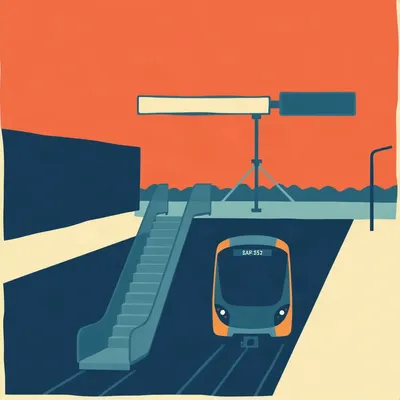
Yet the physical infrastructure for integration already exists. Thirty daily departures each direction, forty-two minutes at best. The twenty twenty-eight upgrade is supposed to bring that down to twenty-eight minutes with four trains per hour. At that point, the commute from Jerusalem to central Tel Aviv is shorter than crossing Tel Aviv in traffic during rush hour.
Which brings us to the first thing most people get wrong about this. The misconception is that high-speed rail automatically creates economic integration. You build a fast train, the cities merge, problem solved. But that's not what the evidence shows. Without coordinated land-use planning and fare integration, fast trains just enable longer commutes without changing the competitive dynamics between cities. You get sprawl, not synergy.
What does actual synergy look like? Let's look at places that have already solved this.
Two case studies that Tel Aviv and Jerusalem should be studying right now. First, the Paris-Lyon TGV effect. This is the classic example and it's still the best one. Before nineteen eighty-one, Lyon was a regional city with a nice food scene and not much else. Paris dominated everything — finance, government, media, corporate headquarters. The TGV opened in eighty-one and cut travel time from four hours to two hours flat.
Two hours turns out to be the magic number for what transportation economists call the "day-tripping executive" threshold. Below two hours, you can attend a morning meeting in Paris, have lunch, and be back at your Lyon desk by three in the afternoon. That changes the calculus for where you locate your company.
The numbers are striking. Within five years of the TGV opening, Lyon saw a twenty-two percent increase in business service jobs. Paris saw only three percent growth in the same sector over the same period. Forty percent of Lyon's business travelers reported choosing Lyon over Paris for headquarters locations specifically because the train connection let them maintain Parisian networks while living and operating in a lower-cost city.
The train didn't just move people faster. It fundamentally changed the economic geography by making Lyon a viable alternative rather than a satellite.
And here's the key mechanism that actually made it work. The French national government didn't just build a train line and walk away. They paired the infrastructure investment with a deliberate decentralization policy. Government agencies were relocated from Paris to Lyon. The regional development agency actively recruited companies by emphasizing the dual advantage — Paris access without Paris costs.
What's the equivalent for Israel? Move a few government ministries to Jerusalem and suddenly every lobbyist, lawyer, and contractor who needs face time with regulators has a reason to be on that train.
The government is already in Jerusalem. That's the whole point. But here's the missed opportunity — the government presence in Jerusalem should be the anchor that creates demand for the corridor, not just a destination in itself. In the Lyon model, the TGV didn't just connect two cities. It created a corridor where economic activity could distribute itself based on comparative advantage rather than proximity to the old center.
Let's talk about the second case study, because I think it's even more relevant. The Rhine-Ruhr region in Germany.
This is the one that should be required reading for every Israeli urban planner. You've got eight cities — Cologne, Düsseldorf, Dortmund, Essen, Duisburg, Bochum, and a couple of others — with eleven million people total, connected by the S-Bahn Rhein-Ruhr network. One point two million passengers a day. And here's the crucial part: each city has a distinct economic specialty and a distinct cultural identity, and they coordinate rather than compete.
Düsseldorf for finance and fashion, Cologne for media and insurance, Dortmund for logistics and tech. Nobody's trying to be the one city that does everything.
The institutional design that makes this possible is genuinely impressive. First, unified transit governance — a single fare system, the VDV tariff, covering eight cities and four different transit operators. You buy one ticket and you can ride anything. Second, a shared regional development agency, the Regionalverband Ruhr, that does coordinated land-use planning so cities aren't undercutting each other with competing business parks. Third, a tax revenue pooling arrangement that means cooperation is actually financially incentivized — if Düsseldorf's success creates spillover benefits for neighboring cities, those cities share in the upside.
That last part is crucial, because right now in Israel, every municipality is in a zero-sum competition for commercial property tax revenue. Jerusalem wants to build a high-tech park because tech companies pay arnona, the municipal property tax, and Jerusalem's budget needs that revenue stream. Tel Aviv doesn't want Jerusalem to build that park because it would compete with Tel Aviv's existing tech cluster. Both cities are acting rationally given the incentives they face.
That's the institutional failure in a nutshell. The arnona system — Israel's municipal property tax — is designed in a way that makes cities compete for commercial development because commercial properties pay vastly higher rates than residential ones. A city that gets a new office tower gets a windfall. A city that builds affordable housing gets a fiscal burden. The incentive structure is completely backwards for regional cooperation.
If you're a mayor, you'd rather have an empty office park than a fully occupied apartment building, because the office park generates more revenue with less demand on services.
And this is why the Rhine-Ruhr model of shared tax revenue is so important. When the cities in the Ruhr region agreed to pool a portion of commercial property tax revenue and redistribute it based on population and need rather than location, the zero-sum competition evaporated overnight. Suddenly it didn't matter whether the new logistics hub was technically in Dortmund or Essen — both cities benefited.
Which brings us to the question of what's actually feasible in Israel. Those are the blueprints. Now let's apply them to the messy reality of Israeli politics.
It is messy. There was a serious attempt in twenty eighteen to create a Greater Jerusalem metropolitan authority that would have coordinated planning between Jerusalem and its satellite communities. It collapsed almost immediately.
What killed it?
Municipal autonomy fears, mostly. Israeli mayors guard their authority like medieval barons. The idea of ceding any zoning power or tax authority to a regional body triggered immediate opposition from both the Jerusalem municipality and the surrounding towns. Everyone was afraid that a regional authority would be dominated by Jerusalem's interests and the smaller towns would get steamrolled.
Which is not an unreasonable fear. Jerusalem has about a million residents. Mevaseret Zion has twenty-five thousand. If you put them in a room together, Mevaseret's voice isn't exactly going to dominate the conversation.
That's the design challenge. Any regional coordination mechanism for the Tel Aviv-Jerusalem corridor has to be voluntary and incentivized, not imposed from above. The national government can't just decree a merger — that failed in twenty eighteen and it would fail again. The model has to be opt-in, with clear benefits for every participating municipality.
There is a proof of concept already working. The Rav-Kav smart card.
The twenty twenty-three pilot that extended Rav-Kav to cover all transit in the Tel Aviv district — buses, light rail, everything on one card — that was a genuine success. It proved that fare integration is politically feasible when you frame it as a convenience upgrade rather than a loss of municipal control. Nobody had to give up authority. They just agreed to make their systems compatible.
That's the low-hanging fruit. Extend Rav-Kav to Jerusalem and intercity trains, and suddenly the corridor feels like a single metro area for the person using it, even if the governance structure hasn't changed.
And that's actionable insight number one. Start with fare integration. It's technically straightforward — the infrastructure already exists, the smart card system is already deployed, it's just a matter of the transport ministry mandating interoperability. The political win is that nobody loses anything and every commuter gains convenience.
What's the second thing a planner could do tomorrow?
Create a voluntary Corridor Development Compact. Tel Aviv and Jerusalem agree to a ten-year moratorium on building competing business parks. Instead, new commercial development is directed to transit-adjacent zones in each city's respective specialty. Jerusalem focuses on government services, tourism, and higher education — Hebrew University, Bezalel Academy, the planned National Library expansion. Tel Aviv focuses on tech and finance. They agree not to poach each other's target industries.
The incentive for Jerusalem to agree to this? Because right now, Jerusalem's municipal leadership sees tech as the future and they're actively courting startups.
The incentive is that Jerusalem gets something Tel Aviv can't offer: exclusivity on the government and education cluster. If Tel Aviv agrees not to build a competing government services hub, then every company that needs proximity to the Knesset or the ministries has to locate in Jerusalem. That's a captive market, and it's a high-value one. Government contractors, law firms, policy consultancies, international NGOs — these aren't glamorous like startups, but they're recession-proof and they pay premium rents.
Plus, Jerusalem's actual comparative advantage in higher education is enormous. Hebrew University is a world-class research institution. Bezalel produces talent that feeds the creative industries. Trying to turn Jerusalem into a second-rate tech hub when you could be building a first-rate knowledge and government services cluster is just bad strategy.
It's the economic development equivalent of a basketball team trying to compete in soccer because soccer is popular, instead of getting better at basketball. Jerusalem should lean into what it already does well.
Fare integration is step one, the development compact is step two. What's step three?
Use the twenty twenty-eight high-speed rail upgrade as a forcing function. The travel time is dropping to twenty-eight minutes. That's game-changing. At twenty-eight minutes, the Jerusalem-Tel Aviv commute is faster than the commute from many Tel Aviv suburbs to the city center during rush hour. But here's the risk — if you don't attach conditions to the station-area development, the corridor becomes a luxury commuter belt.
When you drop travel time dramatically between two expensive cities, what happens to the intermediate towns? Modi'in, Beit Shemesh, Mevaseret Zion — these places suddenly become extremely attractive to professionals who want to work in Tel Aviv or Jerusalem but can't afford to live in either. Property values spike. Developers build high-end apartments aimed at the commuter market. The existing residents get priced out.
The train that's supposed to connect the country actually creates a string of exclusive enclaves along the corridor.
Unless you mandate otherwise. The mechanism is straightforward. Require any new station-area development to include a minimum of twenty percent affordable housing and mixed-use zoning. No single-use residential towers surrounded by parking lots. You want to build near the train station? You build apartments, offices, retail, and public space, and a fifth of the units are priced for median income.
That sounds like the kind of regulation that developers fight tooth and nail.
They do, but the trade is worth it. The developer gets to build in the most valuable location in the corridor — walking distance from a station that gets you to central Tel Aviv in under thirty minutes. The public gets housing that's actually accessible to the people who work in the city. And the municipality gets a mixed-use neighborhood that generates activity and tax revenue around the clock instead of a commuter dormitory that empties out during the day.
There's a knock-on effect here worth exploring. If coordinated development succeeds, what happens to the intermediate towns themselves? Do they become real communities or just bedroom suburbs?
That depends entirely on zoning and investment. If you allow higher density near the stations and invest in local amenities — schools, parks, commercial streets — these towns can become genuine urban nodes with their own identity and economic activity. The Rhine-Ruhr model shows this works. The smaller cities in the Ruhr aren't just suburbs of Düsseldorf. They have their own universities, cultural institutions, and local economies. They're connected but not subsumed.
The alternative is what you see in a lot of American commuter rail corridors — towns that are essentially parking lots with a train station, where everyone leaves at seven in the morning and returns at seven at night, and there's no street life, no local economy, no community.
That's the luxury commuter belt scenario, and it's the default outcome if you just build the train and let the market do whatever it wants. The market, left to its own devices, will produce housing for the highest bidder. The highest bidders are Tel Aviv tech workers who want a four-bedroom apartment with a view. They don't need local jobs or local amenities because they work in Tel Aviv and spend their money in Tel Aviv. The town becomes a dormitory.
The affordable housing mandate and the mixed-use zoning aren't just progressive nice-to-haves. They're the difference between creating actual towns and creating commuter storage facilities.
And this is where the Israeli planning system has an advantage that many countries don't. The Israel Land Authority controls a huge portion of the land supply. The state can attach conditions to land allocation in a way that a fully private land market can't. If the government decides that station-area development requires affordable housing and mixed use, it has the leverage to make that stick.
Let's zoom out for a moment. If Tel Aviv and Jerusalem can crack this code, what's the broader significance?
It becomes a template for every mid-sized country with a dual-city structure. Canada with Toronto and Ottawa — economic capital and political capital, four hundred kilometers apart, connected by a train that takes four and a half hours. If they could get that under two hours with high-speed rail and coordinate development, you'd see the same dynamics play out. Australia with Sydney and Canberra. Brazil with São Paulo and Brasília. Even the United States with the Northeast Corridor, though that's a more complex polycentric chain.
The key variable seems to be travel time. Under sixty minutes door-to-door enables daily commuting. Under ninety minutes enables weekly hub-and-spoke business travel — you go to the capital for two days of meetings, come back, repeat next week.
Twenty-eight minutes, which is what the Tel Aviv-Jerusalem line is targeting for twenty twenty-eight, is firmly in the daily commuting zone. At that speed, you could live in Jerusalem and work in Tel Aviv, or vice versa, without it being a lifestyle-destroying grind. That fundamentally changes the labor market. Jerusalem's talent pool becomes accessible to Tel Aviv employers. Tel Aviv's economic opportunities become accessible to Jerusalem residents.
That cuts both ways. If the train makes it easy for Jerusalem residents to work in Tel Aviv, it also makes it easy for Jerusalem's talent to leave Jerusalem.
Which is exactly why the development compact matters. If Jerusalem doesn't have a strategy for retaining talent and building its own economic base, the fast train becomes a talent drain. Jerusalem's best graduates hop on the train to Tel Aviv salaries and never look back. But if Jerusalem has a focused economic strategy — government services, higher education, tourism, creative industries — then the train becomes a two-way street. Tel Aviv talent can come to Jerusalem for the things Jerusalem does better.
The Rhine-Ruhr cities manage this. Someone might live in Essen and work in Düsseldorf, but someone else lives in Düsseldorf and works at the university in Bochum. The flows balance out because each city has something distinctive to offer.
That's the concept of polycentric urban synergy. The whole is greater than the sum of its parts, but only if each part is allowed to specialize. Two identical cities connected by a fast train don't create synergy. They create competition. Two complementary cities connected by a fast train create a labor market and an economic ecosystem that neither could sustain on its own.
There's a cultural dimension to this that's worth naming. The idea that Jerusalem and Tel Aviv are too culturally different to cooperate comes up constantly in Israeli discourse. Tel Aviv is secular, cosmopolitan, startup-obsessed. Jerusalem is religious, traditional, government-focused. The assumption is that these identities are incompatible.
The Rhine-Ruhr cities have distinct cultural identities too. Cologne has its carnival, its Catholicism, its specific dialect. Düsseldorf has its art scene, its fashion industry, its rivalry with Cologne that goes back centuries. They make jokes about each other constantly. And they still coordinate on transit, zoning, and economic development.
Cultural difference isn't a barrier to cooperation. It's actually the thing that makes specialization possible in the first place. If Jerusalem and Tel Aviv were culturally identical, they'd be competing for the exact same residents and businesses. The fact that they attract different kinds of people is what allows each to focus on what it does best.
The cultural rivalry is an asset if you channel it properly. Let Tel Aviv be Tel Aviv. Let Jerusalem be Jerusalem. The goal isn't to make them the same. The goal is to make them better at being what they already are, and to connect them so that the whole country benefits from both.
If you're a planner in the Tel Aviv district or the Jerusalem municipality, here are three things you could start doing tomorrow. One, push for Rav-Kav extension to cover intercity trains and Jerusalem buses. It's already proven in Tel Aviv, the technology exists, and the political resistance is minimal because nobody loses authority. Two, propose a voluntary Corridor Development Compact with a ten-year moratorium on competing business parks. Jerusalem focuses on government, education, and tourism. Tel Aviv focuses on tech and finance. Both agree not to poach. Three, get ahead of the twenty twenty-eight rail upgrade by mandating that new station-area development includes twenty percent affordable housing and mixed-use zoning. Use the Israel Land Authority's leverage to make it stick.
All three of these are incremental. None requires a grand merger of municipalities or a constitutional change. Start with the easy win on fare integration, build trust, then move to the harder conversations about zoning and tax sharing.
The tax sharing piece is the hardest one politically, but it's also the most important for long-term sustainability. If you don't fix the arnona incentive structure, cities will keep competing for commercial development regardless of what any compact says.
The pilot model is worth considering here. You don't have to overhaul the entire municipal tax system overnight. Start with a pilot program where property tax from new commercial developments within five hundred meters of a train station along the corridor is split fifty-fifty between the two cities. If it works, expand it. If it doesn't, let it sunset. The key is to create a proof of concept that shared revenue actually benefits both parties.
The intermediate towns — Modi'in, Beit Shemesh, Mevaseret — need a seat at this table. They're not just passive recipients of whatever Tel Aviv and Jerusalem decide. They're going to absorb a huge portion of the population growth over the next decade, and their zoning decisions will determine whether the corridor becomes a string of real communities or a luxury commuter belt.
The twenty twenty-five projections from the Central Bureau of Statistics are unambiguous on this. Sixty percent of Israel's population growth through twenty thirty is going to concentrate in this corridor. That's hundreds of thousands of people who need somewhere to live. If the intermediate towns zone for low-density single-family housing — which is the default in a lot of Israeli planning — you get sprawl, traffic, and housing prices that exclude anyone who isn't a tech executive.
The alternative is to zone for medium-density mixed-use development around the train stations. Four to six story apartment buildings with ground-floor retail. Frequent bus connections to the station. The kind of urban fabric that European commuter towns have been building for decades.
That's not a radical proposal. It's basically what Tel Aviv's own neighborhoods looked like before the tower boom. Four-story Bauhaus apartments with cafes on the corner. It's one of the most beloved urban environments in the world, and Israel somehow forgot how to build it.
We've been talking mostly about mechanics and policy, but there's a bigger question underneath all of this. What kind of country does Israel want to be at ten million people? Because the current trajectory is a country where Tel Aviv becomes an unaffordable global city, Jerusalem becomes a government town that can't retain its young people, and the space between them fills up with gated communities and highway interchanges.
The alternative is a country where the Tel Aviv-Jerusalem corridor functions as an integrated metropolitan region, where each city specializes in what it does best, where the train is full in both directions because people are moving between complementary economic clusters, and where the intermediate towns are actual places with street life and community rather than just commuter storage.
The twenty twenty-eight rail upgrade is going to be a test. Will it be a catalyst for integration, or just a faster way to move people between two cities that still refuse to cooperate?
I think the honest answer is that it could go either way. The infrastructure alone doesn't determine the outcome. It's the institutional choices made in the next two to three years that will decide whether this corridor becomes a Rhine-Ruhr or a missed opportunity.
If Israel gets this right, the model travels. Every country with an economic capital and a political capital that aren't the same city — and there are dozens of them — will be watching. Canada, Australia, Brazil, Kazakhstan, Nigeria, Turkey. The list is long.
The specific numbers will vary — different distances, different travel times, different governance structures — but the three mechanisms are universal. Unified transit governance with a single fare system. Complementary zoning that allows specialization instead of forcing competition. Shared tax revenue that makes cooperation financially rational.
It requires competent, incremental governance. Fare cards that work across systems. Zoning that makes sense. Tax incentives that reward cooperation instead of competition. This is the unglamorous work of making a country function, and it's been neglected for decades.
Because it's not a ribbon-cutting ceremony. Nobody shows up with a big pair of scissors when you harmonize two bus fare systems. But the cumulative effect of getting these things right is enormous. It shapes where people can afford to live, where businesses choose to locate, and whether the country's economic geography works for or against its population.
The question for the next two years is whether anyone in the transport ministry or the planning administration is willing to do the boring work. Because the twenty twenty-eight train is coming whether they plan for it or not. The only choice is whether it arrives in a corridor that's ready to use it well.
Now: Hilbert's daily fun fact.

The largest hand tool ever produced for a specific trade was a cooper's adze measuring six feet eight inches in length, crafted in nineteen-oh-two for a South Sudanese boatbuilder who needed to shape the hull of a forty-foot dhow from a single log of mahogany. The tool required two apprentices to operate and was reportedly retired after exactly one use.
...right.
The question becomes — will they actually do it? And what happens if they don't? The twenty twenty-eight rail upgrade is going to reshape this corridor one way or another. The only question is whether it reshapes it for everyone, or just for the people who can afford a luxury apartment near the station.
If you want to dig deeper into the fare integration side of this, we covered some of the American failures and successes in an earlier episode on the transit friction crisis. The Israeli context has its own complications, but the core lesson is the same — if you make people juggle multiple fare cards and schedules, they'll drive instead, no matter how fast the train is.
This has been My Weird Prompts. Thanks to our producer Hilbert Flumingtop, and thanks to everyone who sends in these questions — they keep getting better. If you enjoyed this episode, leave us a review wherever you listen, it helps. And if you have a weird prompt of your own, send it to myweirdprompts.
We'll be back next week.