Welcome to My Weird Prompts, episode two hundred and one. So Daniel sent us this one — and it's basically a dare. He wants you to crack open the vault on real-world situational awareness. Not the digital stuff we've kicked around before, but the boots-on-the-ground kind. You spent years moving through Russia and the Balkans, allegedly doing things you still won't confirm on mic, and he wants the practical tips. What do you actually check when you step into an unfamiliar city where the neighborhoods have teeth?

The noise floor. That's the first thing. Before I look at a map, before I check my phone, before I even figure out which direction I'm walking — I stop and I listen. Every city block has a normal. It's like a heartbeat. And if you don't know what the heartbeat sounds like, you can't hear the arrhythmia.
You just stand there like a tourist who's lost his group?
Exactly like that, actually. Looking confused is its own kind of camouflage. Nobody targets the guy who looks like he's already having a bad day. But yes — I stand still for maybe twenty seconds, and I'm building a mental snapshot. What's the foot traffic cadence? Are people walking with purpose or ambling? What's the ambient sound — is there construction, music, arguing, silence? How many people are loitering versus moving through? That twenty seconds gives me a baseline. After that, anything that breaks the pattern pops like a flare.
This is the thing you learned not from spy manuals but from just... being in places where getting it wrong had consequences.
Nobody handed me a field guide. I showed up in Moscow in the mid-nineties with conversational Russian and a medical degree that meant nothing there, and I learned by being uncomfortable. The baseline method came from walking home at two in the morning through neighborhoods where the streetlights had been dead since the Soviet Union collapsed. You learn to read silence the way a sailor reads clouds.
Let's define this properly before we go deeper. We're not talking about paranoia here. This isn't "always be scanning" or treating every stranger as a threat.
No, and that's the biggest misconception. Real situational awareness is low-effort. It's not hypervigilance — hypervigilance burns you out in about ninety minutes, and then you're functionally blind. What I'm describing is more like... setting a mental tripwire. You establish what normal looks and sounds like, and then you let your subconscious monitor it. Your brain is extraordinarily good at noticing anomalies if you've given it a template. The goal is to be relaxed but primed. A cat napping with one ear swiveled.
The cat analogy works. You're not a prey animal scanning for predators. You're a predator who's comfortable enough to rest but still knows where the exits are.
That's it. And the distinction matters because the "always be scanning" crowd tends to be visibly anxious. They're the person in the café whose head is on a swivel, making jerky movements, accidentally making eye contact with everyone. That's not awareness — that's advertising that you're afraid. And in any environment where threat is real, fear reads as vulnerability.
The difference between being alert and being visibly alert is the whole game.
It's the whole game. If you look like you belong, if your movements are smooth and unhurried, if you're not telegraphing wealth or fear, you're already doing eighty percent of the work. The rest is just pattern recognition.
Alright, let's get granular. You're in a new city — say, Skopje. You've done your twenty-second listen. What's next?
The three-exit scan. Every single time I enter a building — a café, a hotel lobby, a train station, a plaza — I identify three ways out before I do anything else. Primary exit is the door I came through. Secondary is usually a back entrance, a kitchen door, a service corridor. Tertiary is the creative one — a window that opens, a connecting rooftop, a construction scaffold. You don't need to plan an escape route. You just need to know they exist. It takes maybe four seconds. And then you can order your coffee.
That's less time than most people spend deciding where to sit.
I'd argue where to sit is part of the same scan. Don't put your back to the door if you can avoid it — that's not paranoia, that's just good ergonomics. Face the room. Know who's coming and going. If there's a mirror behind the bar, use it. Reflective surfaces are free intelligence.
This brings us to something you've mentioned off-mic — the shoulder check clock. Explain that one.
This is a rhythm thing. When I'm walking in an unfamiliar area, I use reflective surfaces — store windows, parked car mirrors, the glass on a bus shelter, even the black screen of my phone held at a slight angle — to check what's behind me. But the key is that I do it at irregular intervals and I never break stride. If you spin around to look, you've just told anyone following you that you're aware of them. If you glance at a shop window like you're checking the merchandise and your eyes flick to the reflection for half a second, you've gathered the same information invisibly.
It's not a surveillance technique. It's a rhythm you fold into normal pedestrian behavior.
You're window shopping. You're checking your phone. You're adjusting your bag strap. All of these are natural movements that happen to give you a rearward glance. The rhythm is important — if you check every thirty seconds like clockwork, someone watching will pattern you. But if it's organic, you're just a guy who likes looking at shoes in shop windows.
I want to circle back to something you said about Skopje. You once told me about a street musician who stopped playing, and that was your cue to cross the street. What happened there?
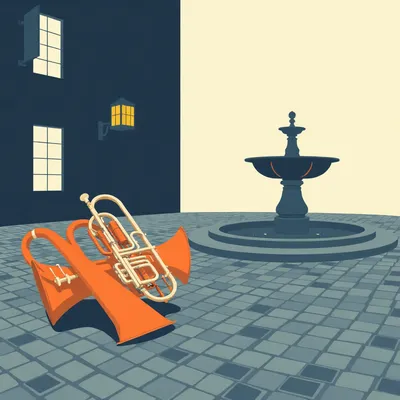
This was in the Old Bazaar, maybe two in the afternoon. Tourist-heavy area, lots of foot traffic, the usual mix of locals and visitors. There was a Roma brass band playing near the fountain — loud, cheerful, drawing a crowd. I was about forty meters away, walking toward them, and then the music just... Not a natural end to a song. Mid-phrase, abrupt. And the ambient noise of the square dropped with it — the chatter didn't fill the gap, it kind of hushed. That's the anomaly. When noise stops and conversation doesn't rush in to replace it, something has shifted. I didn't know what it was — could have been a fight, could have been police, could have been nothing. But I crossed to the far side of the street and kept walking. About twenty seconds later, a cluster of three young men moved through the crowd where I would have been, working pockets. Someone had signaled them, the music stopped, the crowd tightened up, and they went to work.
You read the silence.
I read the silence. And I didn't need to understand Macedonian to do it. Sound is a universal language. When a crowd goes quiet in a way that doesn't feel natural, you don't need to know why. You just need to not be there.
That's almost poetic. The street musician was your early warning system and he didn't even know it.
Street musicians are fantastic barometers, actually. They read crowds for a living. If they pack up suddenly, you pack up too.
Let's expand the lens. You've talked about foot traffic cadence and noise floors. What about the physical environment itself? The stuff that doesn't move?
This is what I call reading micro-geography. Cities tell you where you are if you know what to look at. Curb height is one — when sidewalks get lower or disappear entirely, you're often transitioning from a maintained commercial zone to a residential or industrial one. Lighting color temperature is another. Municipal sodium-vapor lights are that orange-amber glow — they're cheaper to run, and they tend to cluster in lower-income areas or older infrastructure. LED white light usually means recent investment, which usually means either a commercial corridor or a gentrifying block. Neither is inherently safe or dangerous, but the transition between them is where the rules are in flux. And flux is where things happen.
Broken street furniture. You've mentioned that before.
A single broken bench means nothing. Three broken benches, a bus shelter with no glass, and a public trash can that hasn't been emptied in a week — that's a pattern. It tells you the municipal services in this area are either underfunded or overwhelmed. That means slower police response, fewer cameras, less foot traffic at night. Again, not automatically dangerous. But it shifts your threat model. In a well-maintained plaza, the primary risk is opportunistic — someone sees a phone and grabs it. In a neglected block, the risk might be more organized.
You're reading neglect as a proxy for institutional presence.
And institutional presence is the invisible safety net. In Zagreb, the pedestrian plazas are well-lit, regularly patrolled, and full of families until late. Your threat model there is pickpocketing in crowds — low-sophistication, high-opportunity. In a transitional block in southern Belgrade, near the train station, you've got mixed-use zoning, lower lighting, fewer cameras, and a population that shifts dramatically after dark. Same city, same baseline technique, completely different threat profile.
This is where the misconception about "dangerous neighborhoods" falls apart. Most people think bad lighting and graffiti equal danger.
The data says otherwise. Transition zones — gentrifying blocks, festival crowds, transit hubs — are statistically riskier than visibly poor areas. Because in a visibly poor neighborhood, the social rules are established. People know each other. There's an informal order. In a transition zone, you've got old residents and new residents, different expectations, different thresholds for what counts as suspicious behavior. The rules are in flux, and that's where opportunistic crime thrives.
The broken windows theory in reverse. It's not the broken windows that predict crime — it's the windows that are half-fixed.
That's exactly the counterintuitive part. A block with new coffee shops next to old mechanics' garages is more unpredictable than a block that's been the same for twenty years.
Alright, let's shift gears. We've been urban so far. But a lot of your experience was rural — villages in the Russian Urals, back roads in the Balkans. How does the calculus change when you're two hundred kilometers from the nearest traffic light?
It flips completely. In a city, the risk is opportunistic — someone sees a target and takes a chance. In a rural area, the risk is systemic. You're not being targeted because you look wealthy. You're being targeted because you're an outsider, and outsiders don't know the rules, and not knowing the rules can be expensive or dangerous. The threat isn't a pickpocket. It's being perceived as a mark for extortion, or stumbling into a local hierarchy you didn't know existed.
Give me an example of stumbling into a hierarchy.
I was in a village in the Urals — this is late nineties, maybe a thousand people, one road in, one road out. I needed to get to the next town, about sixty kilometers away, and the only bus ran twice a day. I missed the afternoon bus by about four minutes. Now, in a city, you shrug and wait for the next one. In this village, the bus wasn't just transportation. It was the social calendar. The driver knew everyone. He knew who was visiting whom, who was going to the hospital, who was carrying packages for relatives. Missing the bus meant I was stranded for eighteen hours, and everyone in the village knew it within about ten minutes.
You're suddenly the main character in a story you didn't know you were in.
And the way I solved it taught me the local barter etiquette. I didn't wave money around — that would have marked me as a rich foreigner and probably doubled the price of any help. Instead, I found the farmer who ran the informal taxi service — an old UAZ van that smelled like diesel and hay — and I offered him something useful. In this case, it was a pack of Western cigarettes I'd been carrying for exactly this purpose. Not as a bribe. As a gesture. He offered me a ride, I offered him the cigarettes, he refused once, I insisted once, he accepted. That's the dance. If you skip the dance, you've just hired someone. If you do the dance, you've made a friend. And in a village of a thousand people, one friend is worth more than a full tank of gas.
That's the unwritten rule set you were talking about.
Every region has its own version. In the Balkans, the dance often involves rakija. If a farmer offers you homemade brandy at eleven in the morning, you drink it. You don't ask questions. You drink it, you compliment it, and you accept that you are now in a social relationship that may last twenty minutes or twenty years. Refusing is not a neutral act — it's an insult. And you do not want to insult someone whose brother might be the local police chief.
The fuel and food rule. You've mentioned this before. Never let your tank drop below half, and never eat at a place with no locals at two in the afternoon.
The fuel rule is straightforward. In rural areas, gas stations are sparse and they close early or randomly. If you're at a quarter tank and the next station is forty kilometers away and might be closed, you're not being adventurous — you're being stupid. Half a tank is your floor.
The restaurant rule?
If a restaurant is empty at two PM in a town where everything else is open, there's a reason. It could be food quality, it could be prices, it could be that the owner is unpleasant. But in some places, it's because the restaurant is a front, or because it's known to be where outsiders get overcharged, or because there was an incident and the locals quietly blacklisted it. You don't need to know the reason. You just need to eat somewhere else. A place full of locals at an odd hour is a place that has earned trust.
It's the same principle as the noise floor. You're reading the absence of something that should be present.
All of this is pattern recognition. The specific cues change — noise, foot traffic, restaurant occupancy, lighting color — but the method is identical. Establish normal, notice anomaly, adjust.
Let's talk about police encounters. You've gone through checkpoints in the Balkans. You've been stopped in rural Russia. What's the protocol?
First rule: documents in a specific pocket, always the same pocket. You don't want to be patting yourself down while a bored officer with a rifle watches. Second rule: hand them over with your non-dominant hand. It's a small thing, but it signals that you're not a threat — your dominant hand is visible and empty. Third rule, and this is the one most people get wrong: make eye contact with the junior officer, not the senior.
Why the junior?
The senior officer is the decision-maker, but he's also performing authority. If you look at him directly, you're engaging in a dominance negotiation whether you mean to or not. The junior officer is the one actually processing your documents, checking your vehicle, doing the work. If you're polite, calm, and focused on the person doing the task, you're signaling that you respect the process without challenging the hierarchy. The senior officer can observe you without feeling observed. That's the dynamic you want.
That's remarkably subtle.
It's theater. Most checkpoint encounters are theater. The officer is bored, or trying to impress a superior, or looking for something to break the monotony. Your job is to be uninteresting. Not submissive — uninteresting. Answer questions directly. Don't volunteer information. Don't make jokes. Don't complain. Be the gray man.
You had an encounter near the Bosnia-Serbia border where the officer's question revealed more about his mood than about your route.
This was maybe two in the morning, a checkpoint in the middle of nowhere. The officer asked where I was going, and I said Belgrade. But then he asked it again, slightly different phrasing — "And after Belgrade?" That second question wasn't about my destination. It was him probing to see if I'd get flustered or change my story. If I'd said "I already told you, Belgrade," I'd have escalated. If I'd started explaining my whole itinerary, I'd have looked nervous. Instead I just said, "Probably sleep for about twelve hours." It was true, it was boring, and it gave him nothing to work with. He waved me through.
You defused it with a non-answer that was technically an answer.
The art of being uninteresting. It's a skill.
The overnight train protocol. You've got strong opinions about Balkan rail travel.
I love Balkan rail travel. It's slow, it's unpredictable, and it's one of the best places to practice situational awareness because you're trapped in a metal tube with strangers for hours. Here's the protocol. First, book a couchette with three strangers, not a private sleeper. A private sleeper sounds safer but it's not — you're isolated, the door locks from the inside which means nothing if someone has a key, and there's no witness. In a shared couchette, you've got three built-in alarms. Second, sleep with your bag strap around your ankle. It doesn't prevent theft — it ensures you wake up if someone tries. Third, before the train departs, identify the conductor's car. Walk the length of the train if you have to. Know where the authority figure sleeps.
The shared couchette as safety in numbers. That's counterintuitive for most travelers.
Most travelers think privacy equals safety. In transit, the opposite is often true. A thief wants an isolated target. Three strangers in a compartment are each other's security. You don't need to be friends. You just need to be present.
Let's bring this back to something actionable. We're recording in June, peak travel season. IATA is projecting over two point three billion air passengers globally this summer. A lot of those people are going to step off planes in cities they've never visited, and most of them will have done zero preparation beyond booking a hotel. What's the one thing they should do before they even leave home?
Spend ten minutes on Google Maps Street View. Walk the route from your accommodation to the nearest transit hub. Don't just glance at it — actually move through it virtually. Note the lighting. Are there streetlights? Note the setback of buildings — are they right up against the sidewalk or set back behind fences? Note the presence of twenty-four-hour businesses. A twenty-four-hour pharmacy or convenience store is a safe haven. If something goes wrong at two in the morning, you now know exactly where to go. Ten minutes of virtual walking gives you a mental map that pays off the moment you arrive.
You're not just memorizing streets. You're pre-loading the baseline.
When you actually arrive, you're not starting from zero. You've already seen the normal. Now you just need to confirm it.
The two-second rule. Explain that one.
This is a mental reset exercise. At any random moment — walking down the street, sitting in a café, waiting for a train — ask yourself: can I describe the person behind me in two seconds of thought? Not in detail. Just basic descriptors. Gender, approximate age, clothing color, direction of movement. If you can't, you've lost situational awareness. That's not a failure — it's a reminder. Re-establish your baseline and keep going. Practice this once an hour and it becomes automatic.
It's a calibration tool, not a test you pass or fail.
It's a nudge. Your brain drifts — everyone's does. The two-second rule is a gentle way to pull it back to the present without spiraling into anxiety.
The "one thing" principle?
In any new environment, pick one environmental cue to monitor. Foot traffic density. Ambient noise level. Don't try to track everything — that's how you get overwhelmed and tune out entirely. Lock in that one baseline. Once it's solid — and this might take five minutes or an hour — you can add a second cue. But start with one. Mastery is cumulative, not instant.
That's the opposite of what most safety advice says. Most advice says "be aware of everything all the time.
That's why most safety advice fails. It's impossible to implement. The one-thing principle is actually doable. And a doable system that works at sixty percent capacity is infinitely better than a perfect system that works at zero percent because you gave up after ten minutes.
Let's talk about traveling with other people. If you're with kids, or a group, how does the calculus change?
This is where distributed awareness comes in. When I'm alone, I'm running a single-point system — all the monitoring flows through me. When I'm with a group, especially if there are children involved, I shift to a different model. One person is designated as the primary — they're watching the environment. The other adults are watching the kids, the bags, the logistics. You rotate the primary role every hour or so because it's mentally fatiguing. The key is that everyone knows who's on point at any given moment. If there's ambiguity, there's a gap. And gaps are where things happen.
It's not "everyone be alert." It's "one person is alert, everyone else is supporting.
And the primary's job is not to be a bodyguard. It's to maintain the baseline and flag anomalies. "That crowd is getting denser to our left." "The street ahead is darker than what we just walked through." "That guy has circled back twice.The group doesn't need to act on every one — they just need to know.
I want to zoom out for a moment. We're in an era now where cities are deploying facial recognition, drone patrols, AI-powered surveillance grids. Does old-school situational awareness still matter when the threat model is increasingly systemic rather than interpersonal?
It matters more, actually. Here's why. The systemic threats — mass surveillance, automated tracking, algorithmic policing — they operate on patterns. They're looking for anomalies in data. The person who blends into the human environment also blends into the data environment. If you're not drawing attention on the street, you're not generating the kind of behavioral metadata that triggers automated flags. The gray man principle applies to cameras as much as it applies to checkpoints.
The same skills that kept you safe in nineties Moscow translate to a world of ring cameras and license plate readers.
The tools change. The principles don't. Baseline and anomaly works whether the observer is a pickpocket, a police officer, or a machine learning model. Don't be the spike in the data.
That's oddly reassuring. All this analog wisdom, and it turns out to be future-proof.
Human attention is the original surveillance system. Everything else is just an extension of it.
Alright, let's land this. Three things a listener can practice in the next twenty-four hours, whether they're traveling or not.
One — the two-second rule. Right now, wherever you are, can you describe the person behind you? If not, re-establish. Practice this three times today. Two — the one-thing principle. Pick one environmental cue in your current location and monitor it for five minutes. Notice what normal feels like. Three — the three-exit scan. Next time you walk into any building — your office, a coffee shop, your own home — identify three ways out. Do it every time for a day and it'll be automatic by tomorrow.
That's genuinely doable. No gear, no training, just attention.
That's the whole point. Situational awareness isn't a skill you buy. It's a skill you practice. And the practice is free.
Before we wrap, I want to touch on one more thing. You've been doing this for decades. At what point did it stop feeling like work?
About two years in. Maybe two and a half. There's a threshold where the scanning stops being a conscious effort and becomes... I don't want to say instinct, because it's learned, but it becomes a background process. You don't think about breathing unless something's wrong with the air. You don't think about the baseline unless something breaks it.
Now: Hilbert's daily fun fact.
The term "transient lunar phenomenon" was first systematically catalogued in the nineteen twenties by a British astronomer who originally called it "lunar vulcanism" — a term that was etymologically awkward since the moon has no volcanoes, a fact he acknowledged by cross-referencing his observations with weather patterns in the Namib Desert, possibly because he was already losing his eyesight and his grip on the scientific method.
...right.
This has been My Weird Prompts. Thanks to our producer, Hilbert Flumingtop. If you've got a weird prompt you want us to tackle, send it to prompts at myweirdprompts dot com. We might make it an episode. Find us at myweirdprompts dot com for the full archive. Until next time.