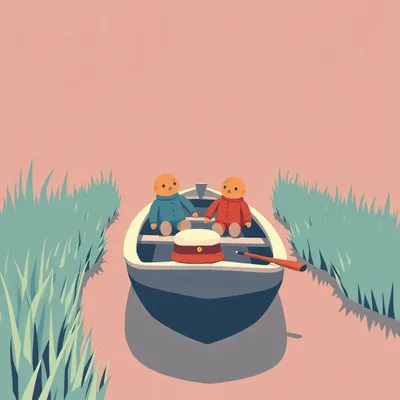
Daniel sent us this one — he's been on a bit of a children's television kick lately, and now he's asking about Rosie and Jim. Two ragdolls, a narrowboat, a man in a flat cap, drifting down the canal. Looks like the gentlest show on British television. But what if the real story here is about surveillance, class anxiety, and the death of the industrial working class?

Oh, this is a good one. And it's timely — you've got this whole cottagecore revival happening, slow living aesthetics all over TikTok, people romanticizing canal boats and sourdough and whatever else. But they're consuming the aesthetic without any of the original subtext. Rosie and Jim was never just a peaceful boat ride.
It never is, is it? The peaceful boat ride is always a front. Like adopting a feral cat — it looks like a simple act of kindness, but what you've actually done is invited a tiny predator into your home who will now judge your life choices from the top of your bookshelf.
I stand by the analogy. But go on — establish the groundwork.
Let's establish the facts first, because the show's technical DNA matters. Rosie and Jim aired from 1990 to 2000 on ITV's Children's ITV block. One hundred thirty-seven episodes. Created by John Cunliffe — same man who gave us Postman Pat. The premise is almost aggressively simple: two ragdolls live on a narrowboat called the Ragdoll, and they travel the canals with their owner, a man named Mr. Johnson in the early episodes, later just referred to as "the man.
They dropped the name? That feels significant. It's a removal of identity, a shift from person to archetype.
It is, and we'll get there. But first, the puppeteering. This was rod puppetry, with operators hidden behind the set — not hand puppets, not stop-motion. And it was unusually sophisticated for the era. The cost was approximately fifteen thousand pounds per episode in 1990, which is roughly thirty-five thousand in today's money. That's not cheap children's television. Cunliffe was deliberate about this. He wanted what he called "emotional realism" — a fluid, almost human gait that would make children connect with the dolls on a deeper level.
The movement itself was the first encoded message. Before any plot, before any dialogue — the way these things moved was telling children something about who they were.
Precisely the argument. Rosie and Jim are both ragdolls, but their physical construction encodes their personalities. Rosie has button eyes and a dress. Jim has stitched-on features and overalls. And the puppeteers — there was a crew of twelve per episode — gave Rosie a more upright, cautious posture. Shorter steps, more deliberate. Jim got a slouchier, more exploratory gait. Longer strides, more erratic movements.
Before a single word is spoken — and to be clear, the dolls never speak — children have already absorbed that the female-coded character is careful and restrained, and the male-coded character is adventurous and impulsive. It's operating at a pre-verbal level. You can't argue with it because you don't even notice you're receiving it.
This is consistent across the series. I went back and looked at specific episodes. In "The Windmill" from 1991, Rosie's steps are measured, she pauses at thresholds, she looks back at the man before moving forward. Jim barrels through. In "The Lock" from 1992, there's a ninety-second sequence of the man operating a lock gate — no dialogue, no music, just the sound of water and the creak of the mechanism — and Rosie watches from the boat while Jim is at the edge, leaning forward, physically straining toward the action.
Wait — ninety seconds of lock operation. That's radical slow television. I'm trying to think of a contemporary equivalent and I can't. Maybe the YouTube videos of trains arriving at stations, but those aren't made for children, they're made for train enthusiasts who are, let's be honest, mostly adult men with spreadsheets.
And this is the second encoded message. The show is a deliberate anti-drama. Cunliffe was reacting against what he saw as the overstimulation of American children's programming flooding UK markets in the early nineties. No conflict, no antagonist, no stakes. The quietness is not neutral — it's a political statement about what childhood should look like.
The absence of drama is the drama. It's like that John Cage piece, 4'33" — the silence is the content. Except instead of a pianist not playing, it's a man not having a plot.
And the show ran for a decade. A full ten years with essentially no plot. That tells you something about the hunger for this kind of content. Parents were actively choosing this. They were putting it on because it was the opposite of the sugar-rush programming elsewhere.
Alright, so we've got the technical craft and the anti-drama philosophy. But here's where it gets strange. The dolls never speak. The man rarely speaks to them directly — he talks to himself, to the boat, to the audience. What does that framing do?
This is what I think of as the "silent witness" framing, and it's one of the most psychologically complex things about the show. The man is the only human character with any real presence. He mutters to himself while steering, he explains things to the air, he occasionally addresses the camera. But he almost never acknowledges the dolls as conversational partners. They're there, they're watching, but they're not participants.
Which mirrors the adult-child relationship, but also something darker. It's the dynamic of the observer and the observed, and only one party gets to decide which is which.
The dolls are objects being observed, not subjects with agency. They are literally puppets, but the show never acknowledges this — there's no meta wink, no breaking of the fourth wall. The audience is constantly aware of the manipulation but the show pretends it's natural. It's almost a Brechtian alienation effect by accident.
They're being watched, they're being moved, they have no voice. And the man — the only human — treats them as furniture that happens to have faces. It's like if your IKEA bookshelf had eyes and you just... ignored that fact, every single day.
Yet children loved them. Which raises an uncomfortable question: is part of the appeal that children recognized their own position in the power structure? You're small, you're moved around by adults, you don't get to initiate the journey, you just get to watch it happen.
The dolls as a mirror of childhood powerlessness. That's cheerful morning television. "Here's your breakfast cereal, and here's an existential meditation on your lack of agency.
Wait until we get to the canal itself.
Go on then. What's the canal doing?
The canal is the most important character in the show, and it's a ghost. The UK canal system peaked in the 1840s — four thousand miles of navigable waterways. By 1900, only two thousand miles remained in use. By 1990, when Rosie and Jim launched, the canals were almost entirely recreational. They were a transportation network that had been dead for a century.
Cunliffe deliberately set the show on a transportation system that no longer transported anything. It's like setting a show in a shopping mall where no one buys anything — oh wait, that's just the modern retail economy.
The narrowboat is not going anywhere. There's no destination, no schedule, no urgency. The man has no job, no appointments, no reason to be on the canal other than being on the canal. This is a temporal ghost — a world that never existed for the children watching. It's encoded pastoral nostalgia, a longing for a pre-industrial England that was already a fantasy in 1990.
The musical equivalent of beige wallpaper, but with ideological freight.
The show never acknowledges the anachronism. There are no cars, no phones, no television sets. The occasional lock-keeper or shopkeeper appears, but they're also frozen in this timeless rural aesthetic. It's England as a theme park of itself. You could walk into any National Trust gift shop and find this exact version of the country in postcard form.
Which brings us to the man. The flat cap, the practical clothes, the manual labor. He's working-class coded — but he doesn't actually work.
This is where the class analysis gets really interesting. The man operates locks, repairs the boat, ties ropes, paints the hull. These are working-class signifiers. But he has no employer, no wages, no economic reality at all. He is a working-class figure without working-class conditions. This show aired during the tail end of Thatcherism and the beginning of John Major's "classless society" rhetoric. Rosie and Jim presents a working class that has been de-fanged, de-urbanized, and turned into a tourist attraction.
He's the working class as heritage experience. You can almost imagine the gift shop selling little flat caps and tiny painted narrowboats. "Take home your very own decontextualized proletarian.
He's content. That's the crucial part. He never complains about money, never seems cold or hungry, never expresses any dissatisfaction. The canal life is presented as idyllic. This is a sanitization of actual working-class experience — which, historically, on the canals, involved fourteen-hour days, extreme poverty, and children working from the age of six. The canal families of the nineteenth century were some of the most exploited laborers in British history, and the show turns that into a gentle retirement fantasy.
The show takes the aesthetic of working-class labor and scrubs out the labor part. It's the glockenspiel of corporate approachability — it signals something without containing it. You hear the glockenspiel in the bank advert and you think "friendly, trustworthy, local," but what you're actually getting is a multinational financial institution that will charge you thirty pounds for an overdraft.
And the dolls are positioned as tourists in their own home. They observe the lock-keeper working, they watch the shopkeeper selling, they see the windmill turning. But they never participate in any labor. They're leisure-class ragdolls. They don't even have the dignity of being workers — they're spectators to work.
Which connects to another strange absence. Where are the other children?
This is one of the most unusual things about Rosie and Jim. In one hundred thirty-seven episodes, the dolls never interact with child characters. The only recurring figures are adults. This is deeply unusual for children's television — most shows populate the world with peer characters so the child viewer can project themselves into the narrative.
Rosie and Jim doesn't want children to project themselves into it. It wants them to observe. It's not "here's a character like you having adventures." It's "here is a world you are not part of, and your job is to watch quietly.
The show is not about childhood at all. It's about the adult fantasy of childhood as a solitary, frictionless state. No tantrums, no meals, no bedtime, no other children to fight with. The dolls are the ideal children — they watch quietly, they never ask questions, they never make demands. Parenting as a hobby, not a responsibility.
There's no mother.
This is the absence that really stands out once you notice it. In one hundred thirty-seven episodes, a maternal figure appears exactly twice — both times as a background character in a shop. No mother on the boat, no grandmother visiting, no female authority figure of any kind. The Ragdoll is a fantasy of single fatherhood without any of the mess.
The man made the dolls, according to the show's lore. He created them. So you've got this oedipal setup — the father-creator, the children he made, no mother, and the children are literally objects of his making. They can't leave, they can't grow up, they can't talk back. It's the ultimate parental control fantasy. You make your children, and they stay exactly as you made them forever.
The boat is the container for all of this. It's a floating nuclear family, sealed off from the world. The canal is a liminal space — neither here nor there, always between destinations. The family is in permanent transit, never arriving. It's the fantasy of the family that never has to face the outside world. No school gates, no parent-teacher conferences, no birthday parties to navigate.
The boat is the home, the man is the father, the dolls are the children. But the dolls are also property. They're owned. That's a pretty bleak vision of family, dressed up in pastel colors and gentle accordion music. It's like if a family law textbook had a picture book adaptation.
The music is doing work too. It's diegetically ambiguous — sometimes it seems to come from the man's radio, sometimes it's just there. It creates this haze of pleasantness that coats everything. You don't notice the absences because the vibes are so gentle.
Covering the covers. The music is the acoustic wallpaper that stops you from asking why there's no mother on the boat.
That's exactly what it is.
Let's talk about the gender encoding more specifically. You mentioned the gait differences, but there's a broader pattern here.
I tracked this across the series. Rosie is almost always shown observing, waiting, or holding objects. Jim is shown exploring, touching, and initiating action. In the one hundred thirty-seven episodes, Rosie initiates a journey exactly zero times. Jim initiates twenty-three times. This is not subtle. It's a systematic reinforcement of gendered passivity versus agency.
She holds the map. He chooses the direction. It's the navigator versus the explorer — and the navigator only gets to say where they are, not where they're going.
When they encounter something new — a swan, a windmill, a lock — Jim approaches it. Rosie hangs back. She's the cautious one, the one who needs to be beckoned forward. This maps directly onto 1990s British gender roles. The girl is careful, the boy is bold. The girl observes, the boy acts.
Because the dolls never speak, this is pure physical semiotics. Children absorb it without any verbal framing. It's gender training through movement. You can't even argue with it because there's nothing to quote.
It's particularly effective because it's not didactic. There's no moment where the man says "Rosie, be careful, you're a girl." It's just encoded in the choreography. The puppeteers are performing gender, and children are learning it through osmosis. By the time a child is old enough to articulate what they've absorbed, the pattern is already set.
Which brings us to the show's educational philosophy. Or rather, its anti-educational philosophy.
This is where Cunliffe was genuinely radical. Rosie and Jim never learn anything explicitly. They encounter phenomena — a windmill, a lock, a swan — but there's no pedagogical framing. No "and that's how a windmill works." No "can you see the gears turning?" No "let's count the ducklings." The man narrates what he's doing, but he's not teaching. He's just existing.
Compare that to The Magic School Bus, which was running around the same time. Frizzle explicitly explains everything. There's a lesson, a takeaway, a "now we understand." Rosie and Jim just... It's the difference between a guided tour and just being left in a museum with no audio guide and no labels on anything.
That's the point. Cunliffe believed children learn through immersion, not instruction. He thought the didactic model was condescending — that children would absorb the rhythms of canal life, the physics of water, the mechanics of locks, simply by watching them happen. The show is an argument for osmotic learning. Childhood education as exposure, not explanation.
Which is either deeply respectful of children's intelligence or deeply negligent about their need for scaffolding. I can imagine a five-year-old watching the lock sequence and absorbing something about water displacement, and I can imagine another five-year-old just seeing a man turning a wheel for ninety seconds and learning absolutely nothing except that wheels are boring.
I think it's both. And it worked for some children and completely failed for others. But as a philosophy, it was a genuine departure. Postman Pat, Cunliffe's earlier show, had much clearer narrative arcs and moral lessons. Rosie and Jim stripped all of that away. It's almost experimental television masquerading as gentle entertainment.
The show as a Zen koan. What is the sound of one ragdoll learning?
Here's where the surveillance element comes in. The dolls are always watching. They're positioned as witnesses. But they're also being watched — by the man, by the audience, by the puppeteers. There's a constant layer of observation. The show is about looking. And the dolls, who cannot speak or act independently, are the perfect subjects of the gaze.
They're watched, but they also watch. They're the panopticon of the narrowboat. Everyone is observing everyone, but no one is doing anything about what they see.
The man is the warden who pretends not to be watching. He's always aware of where the dolls are, but he rarely looks at them directly. He's performing for them, but he acts like he's alone. It's a strange, almost unsettling dynamic if you pay attention to it. There's a kind of gaslighting quality — the man is clearly aware of the dolls, he made them, he moves them around, but he performs as though they're not really there.
Which nobody noticed, because it was on at seven in the morning and parents were making toast. The show operated in the peripheral vision of the nation.
The show operated below the level of conscious attention. That's what makes it so effective as a delivery system for ideology. Nobody argues with Rosie and Jim because nobody thinks Rosie and Jim is saying anything. You can't critique what you don't notice.
Let's pull all of this together. What are the encoded messages? What was this show actually transmitting to a generation of British children?
Message one: the working class is charming and harmless and exists for your aesthetic appreciation. The man is a heritage exhibit. Message two: gender is performed through movement, and girls should be cautious observers while boys should be bold explorers. Message three: childhood is a state of passive observation, not active participation. Message four: the nuclear family is a sealed unit, father-led, mother-optional, floating through a world without conflict or consequence.
Message five: England was better before industry, before cities, before complexity. The canal is a nostalgia delivery system for a past that never existed.
Message six, which is the most sophisticated: learning happens by watching, not by asking. Don't question, just observe. The good child is the quiet child.
That last one is particularly striking given the show's target audience. You're teaching preschoolers that the ideal state is silent observation. It's almost Victorian. "Children should be seen and not heard" — but in this case, they're not even seen as people. They're seen as dolls.
It is Victorian. And Cunliffe, whether consciously or not, was channeling a very specific British cultural tradition — children should be seen and not heard. Rosie and Jim literalizes that. The dolls are seen constantly. They are never heard. The proverb becomes the premise.
Alright, so we've done the dark reading. But let's be fair — there's genuine craft here. The puppeteering was beautiful. The show was a labor of love. We should acknowledge that before we reduce it entirely to its ideological skeleton.
And I don't want to lose that. The rod puppetry technique required twelve puppeteers per episode. The synchronization required to make two ragdolls move fluidly through a cramped narrowboat set — that's impressive. These were not Muppets with a single performer's hand inside. These were complex rigs requiring multiple operators working in tight coordination. The show was expensive, technically demanding, and artistically ambitious. It wasn't churned out. It was made with real care.
The quietness, whatever its ideological implications, was also a gift to overstimulated children. In 1990, British kids were getting hammered with American cartoons — fast cuts, loud noises, constant action. Teenage Mutant Ninja Turtles was on the air. The pace of children's media was accelerating rapidly. Rosie and Jim said: you can just watch a man paint a boat for three minutes. It's okay. The world will still be there when you're done. There's something countercultural about that slowness.
That's the paradox of the show. It was simultaneously transmitting regressive social messages and providing a genuine alternative to the attention-economy children's programming that was taking over. Both things can be true. The medium was revolutionary and the message was reactionary.
Like a lovingly crafted cage.
A lovingly crafted cage with a nice view of a canal.
What do we do with this? If you're a parent or an educator, what's the actionable takeaway? You can't just say "don't show your children Rosie and Jim" — that's both impractical and probably an overreaction.
The main one is: pay attention to what's not shown. The absences in children's media are often more revealing than the presences. Rosie and Jim's lack of conflict, lack of other children, lack of explicit learning, lack of mothers — these are all choices that shape a child's worldview, and they're choices that are easy to miss because we're trained to notice what's on screen, not what's been left out. When you're selecting media for children, ask: who's missing? What never happens? Who never speaks?
It's the negative space analysis. What's been edited out of the frame. The same way you'd look at a photograph and ask what's just outside the shot — who's holding the camera, whose perspective is being centered.
And this applies to contemporary content too. The cottagecore TikTok videos that romanticize rural life — who's doing the actual farm work? Where's the economic reality? The absences are doing ideological work even when the content seems apolitical. The girl in the linen dress making bread in a sunlit kitchen — who built that kitchen? Who grew the wheat? Who's paying the mortgage?
The framework travels. It's not just about a 1990s puppet show. It's a portable analytical tool. You can apply it to YouTube, to TikTok, to whatever AI-generated content is about to flood the children's media landscape.
For media analysts, Rosie and Jim is a case study in how technical craft encodes ideology. The puppeteering, the pacing, the sound design — these aren't neutral production choices. The quietness of the show is a political statement about what childhood should look like. The gait of the dolls is a gender curriculum. The canal setting is a class argument. None of this is in the dialogue, because there essentially is no dialogue. It's all in the craft.
For creators, there's a market signal here. The show ran for ten years. One hundred thirty-seven episodes. Children watched it. They didn't switch off because it was slow. The high-stimulus model is not the only path to engagement. There is an audience for anti-stimulus children's content, and that audience is probably underserved right now.
The lo-fi girl of 1990s British television.
That's exactly what she is. The lo-fi girl is the Rosie of the twenty-first century — a quiet figure, perpetually studying, never speaking, ambient and unchanging. The format works because the quietness is the product. Millions of people stream lo-fi channels while they work, and the appeal is precisely the absence of demands on your attention. Rosie and Jim was doing that for preschoolers thirty years before the YouTube algorithm figured it out.
With AI-generated children's content becoming ubiquitous now, these questions about encoded messages become even more urgent. A human creator like John Cunliffe had intentions — some of them problematic, but at least they were intentions. He chose the canal, he chose the silent dolls, he chose the absent mother. AI will encode its own biases, but without any intentionality at all. The absences in AI-generated content won't be choices. They'll be statistical artifacts of the training data.
Which is somehow worse. At least Cunliffe knew he was making a show about a man and his dolls on a boat. The AI won't know what it's leaving out. It won't know that its training data overrepresents certain family structures and underrepresents others. It won't know that its version of "gentle" is culturally specific. It'll just generate whatever the math says is most probable, and the absences will accumulate without anyone ever making a decision.
We won't know either, unless we're doing this kind of analysis. The absences will just feel natural. They'll just feel like how children's content is supposed to be. That's how ideology works — it disappears into the background. It becomes the water the fish doesn't see.
The real lesson of Rosie and Jim is: the most effective propaganda is the kind that doesn't look like anything at all. It's just a nice man on a boat with two ragdolls. What could possibly be political about that?
Everything is political about that. The boat, the man, the dolls, the canal, the silence, the music, the gait, the lock, the windmill, the absent mother, the missing children, the erased labor. Every single element is a choice, and every choice carries a worldview.
Alright, so let's end with a question. If Rosie and Jim were made today, what changes? Do the dolls get agency? Does the canal stay a pastoral fantasy, or does it become a climate change allegory — rising water levels, flooding, the narrowboat as an ark?
I think a modern version would almost certainly give the dolls voices and agency. The silent witness framing would feel too passive for contemporary sensibilities. We're now in an era where children's media is expected to empower, to give children a sense of control and voice. But I'm not sure that's an improvement. The quietness was the show's most distinctive feature. A version where Rosie and Jim talk and make decisions and go on adventures — that's just every other children's show. You've lost the one thing that made it unusual.
In 2026, the canal system is purely recreational. The industrial history is even more distant than it was in 1990. Would a modern version even acknowledge that, or would it double down on the fantasy?
I suspect it would become explicitly environmental. The canal as an ecosystem, the boat as a model of sustainable living, the man as an eco-conscious off-gridder rather than a heritage boatman. Which would be a different set of encoded messages — still ideological, just a different ideology. The green pastoral instead of the heritage pastoral. You'd swap the flat cap for a solar panel and the accordion for an acoustic guitar.
The ideology updates, but the mechanism stays the same. The absences shift — maybe the mother appears this time, but the economic reality of canal life remains invisible. Maybe the dolls get voices, but the gender encoding just moves from movement to dialogue. The form evolves, but the function persists.
That's the thing about ideology — it's not a fixed set of beliefs, it's a delivery system. The content changes, but the mechanism of encoding values into apparently neutral entertainment remains the same. The question isn't whether children's media is ideological. It always is. The question is whether we're paying attention to what ideology is being delivered.
Now: Hilbert's daily fun fact.

In 2004, French Guiana's spaceport was used to launch the largest solid rocket booster ever built for the Ariane 5, which stood at 31 meters tall and weighed 270 tons — but the record for the oldest preserved rocket component actually goes to an ancient Greek steam-powered device from 400 BCE found in Alexandria, not French Guiana at all.
That fact contained several sharp turns. We began in a South American spaceport and ended up in ancient Alexandria via a steam engine. I feel like I've been on a journey.
I feel like Hilbert just took us on a journey and we didn't quite reach the destination. We got the launch pad, the rocket, the ancient Greek device — and then we just stopped. It's like a canal boat ride with no final lock.
This has been My Weird Prompts. Produced by Hilbert Flumingtop. You can find us at myweirdprompts dot com.
Next time, we're leaving the canal and heading to the island. We're going to look at the 1990s Australian children's show The Ferals and ask: what were those puppets really saying about masculinity and the environment?
Until then, watch what isn't there.