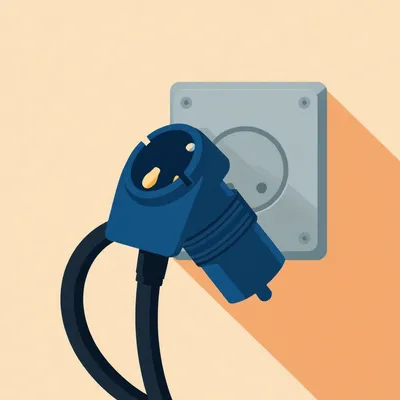
You know, Herman, I was looking through that big plastic bin under the stairs this morning, the one we call the graveyard of forgotten electronics, and I realized something. I have at least twelve different power cables that look almost identical, but if I actually tried to use them interchangeably, I might literally set the house on fire. It is a strange kind of anxiety, looking at a drawer full of black plastic and copper and knowing that one wrong choice results in the dreaded magic smoke.

Herman Poppleberry here, and Corn, you are not even exaggerating. That is the terrifying reality of the modern power supply unit, or P-S-U. We live in an era where high-end computing power is more accessible than ever, yet we are hamstrung by a lack of basic electrical standardization where it matters most. You have these cables that look like they should fit, they might even click into place with that satisfying little plastic snap, but the internal wiring, the pinout, is completely different from one brand to the next, or even between two different models from the same company. It is like having a key that fits into a lock, but instead of opening the door, it triggers a security system that floods the room with concrete.
It is a mess, and it is exactly what Daniel was getting at in his prompt for us today. He wanted us to dive into the long tail of tech components and why we have this massive lack of standardization for niche parts. It is a fascinating problem because it sits right at the intersection of engineering necessity, corporate greed, and environmental disaster. We are sitting here in February of twenty-twenty-six, and despite all our talk about the circular economy and the right to repair, we are still drowning in proprietary plastic.
It really does come down to that long tail. For those who might not be familiar with the term, popularized by Chris Anderson back in the early two-thousands, we are talking about that huge number of niche products that sell in small quantities compared to the big hits. In the context of tech parts, it is that one specific ribbon cable for a twenty-twelve MacBook Pro, or that unique six-pin to eight-pin adapter for a ten-year-old Seasonic power supply. Individually, these parts are insignificant. Collectively, they represent a massive logistical and environmental burden.
Right, and Ali-Express has basically become the global warehouse for this long tail. If you need a very specific component that hasn't been manufactured in a decade, they have it. But as Daniel pointed out, that model is incredibly inefficient from a sustainability standpoint. Shipping a single three-dollar cable halfway across the world in a diesel-burning freighter and then a local delivery van is a logistical and environmental nightmare. We are essentially outsourcing our lack of standardization to the global shipping industry.
It is. But the reason that long tail is so long and so complicated is because of this lack of standardization. Let’s take the power supply unit as the prime example. On the component side, things are actually very standardized. A twenty-four pin motherboard connector is a twenty-four pin motherboard connector. An eight pin G-P-U power connector is standard. That is why you can buy a graphics card from any brand and it works with any power supply. The industry agreed on the interface between the cable and the component decades ago.
But that is only on one end of the cable, right? That is the part that always confuses people.
Exactly. The end that plugs into your motherboard or your graphics card is a standard set by the A-T-X specification, which Intel originally introduced way back in nineteen-ninety-five. But the end that plugs into the power supply itself? That is the Wild West. There is no industry standard for the pinout on the P-S-U side of a modular cable. One manufacturer might put the twelve-volt rail on the top left pin, while another puts the ground there. If you swap those cables, you are sending twelve volts of electricity directly into a ground pin on your expensive graphics card. The result is an instant short circuit and, quite often, a dead component.
That seems almost criminal. I mean, why isn't there a standard? We have standards for almost everything else in computing. We have U-S-B, we have P-C-I Express, we have H-D-M-I. Why did the power supply manufacturers decide that the connection between the box and the cable should be proprietary? It feels like we solved the hard part, which is the communication between devices, but we failed at the easy part, which is just moving electricity from point A to point B.
Part of it is actually a genuine engineering need, or at least it started that way. Different power supply architectures require different internal layouts. Some use multiple twelve-volt rails to distribute the load, others use a single massive rail. As these units became more efficient and more powerful, reaching into the sixteen-hundred-watt and even two-thousand-watt range for A-I workstations, manufacturers wanted the flexibility to design the internal circuitry without being boxed in by a rigid connector standard. They argue that a fixed pinout would limit their ability to innovate on ripple suppression or thermal management.
Okay, I can see that for the early days of modularity. But we have been building modular power supplies for decades now. Surely by episode six hundred ninety-seven of this podcast, the industry could have agreed on a safe, universal plug for a twelve-volt rail. We are in twenty-twenty-six. We have self-driving cars and generative A-I that can write poetry, but we can't agree on which hole the yellow wire goes into?
You would think so. But this is where we get into the second part of Daniel’s question, distinguishing between genuine need and unnecessary proprietary connectors. In many cases, it is about brand lock-in. If you buy a high-end Corsair power supply and you spend eighty dollars on a nice set of individually sleeved, braided cables, you are much more likely to buy another Corsair power supply when you upgrade because you already have the cables. It is a subtle form of ecosystem capture.
It is the same logic as the old cell phone chargers before U-S-B-C became the law of the land in the European Union. Every company wanted you to buy their specific dongle or their specific cable. But with P-S-U cables, it is even more insidious because the cables look the same. At least a Nokia charger didn’t fit into a Motorola phone. With these power cables, they often use the same physical Molex connectors, so they physically fit, but the electrical mapping is different. It is like a booby trap for enthusiasts.
And that is the real danger. It creates a massive amount of e-waste because when a power supply fails, people often throw away the cables too, even if the cables are perfectly fine, because they know they can’t use them with a different brand. Or worse, they keep the cables, try to use them with a new unit, and fry their entire system. I’ve seen it happen on tech forums more times than I can count. People lose thousands of dollars of hardware because of a ten-cent plastic connector.
It feels like a massive failure of the industry to self-regulate. But let’s look at the supply chain side of this. If I’m a local computer shop here in Jerusalem, I can’t possibly stock every variation of these cables. I can stock a few standard power cords, but I can’t stock the long tail.
No, it is mathematically impossible. Think about the permutations. You have at least five or six major P-S-U manufacturers, each with several different platforms. Some platforms stay consistent for years, others change with every revision. You might have three hundred different cable variations just for the most popular power supplies of the last five years. No local shop is going to dedicate shelf space to that. It is dead capital.
Which brings us back to Ali-Express. They can afford to stock them because they are serving the entire world. They are the only ones who can make the long tail profitable because they have the scale. But is that the only way? Could we tackle this through better design or better legislation? We saw the E-U force Apple's hand with U-S-B-C. Could we see a similar mandate for internal power?
Well, we are finally seeing some movement. The move to A-T-X three point zero and the more recent A-T-X three point one standards was a step in the right direction. They introduced the twelve-V-H-P-W-R connector, which was then revised to the twelve-V-two-by-six connector to fix the melting issues we saw back in twenty-twenty-three and twenty-twenty-four. While those standards had their own growing pains, they represent an attempt to create a unified standard for high-wattage delivery directly from the P-S-U to the G-P-U.
But even with A-T-X three point one, is the P-S-U side of the cable standardized?
Generally, no. Most manufacturers are still using their own proprietary layouts on the unit itself. However, some companies are starting to move toward more universal internal standards. For example, Corsair has their Type four and Type five cable systems. While it is still brand-specific, at least it is consistent across their entire product line. But we are still a long way from a world where I can take a cable from a Seasonic unit and plug it into an E-V-G-A unit without a second thought.
So how do we distinguish between the genuine need and the proprietary nonsense? If I’m a consumer or a regulator, what are the red flags?
One big red flag is when a connector changes for no apparent electrical reason. If the voltage and current requirements haven't changed, but the plastic shape of the plug has, that is usually a sign of artificial segmentation. Another sign is when a company refuses to publish their pinout diagrams. A company that cares about repairability and standards will make it very clear which pin does what. In twenty-twenty-five, we saw several Right to Repair laws pass in the United States that actually started to touch on this, requiring manufacturers to provide technical documentation for power interfaces.
It’s also about the complexity of the connector. Look at something like H-D-M-I versus V-G-A, which Daniel mentioned in his notes. V-G-A was an analog standard that lasted for decades because it was simple and it worked. H-D-M-I has had many versions, but the physical connector stayed the same for a long time. That is a genuine need for more bandwidth leading to new versions of a standard, rather than just changing the plug for the sake of it. When the physical shape changes without a massive jump in capability, you should be suspicious.
Exactly. And look at what the European Union did with U-S-B-C. They basically said, the era of proprietary charging ports is over. It didn't matter if Apple argued that their Lightning connector was better for their specific ecosystem. The environmental cost of that long tail of cables was simply too high. I think we might eventually see similar pressure on internal computer components. The E-U's Ecodesign Directive is already looking at power supply efficiency and repairability. Standardizing the modular interface is the logical next step.
Do you think we could ever get to a point where all internal power cables are just U-S-B-C? I mean, U-S-B-C can deliver up to two hundred forty watts now with the latest Power Delivery standards. That is enough for a lot of mid-range components.
It is a nice dream, but we are talking about massive amounts of current. A high-end graphics card in twenty-twenty-six can pull five hundred or six hundred watts on its own during peak loads. U-S-B-C is great for laptops, but for a high-performance desktop, we need thicker wires and more robust connectors to handle that kind of heat and current without melting. However, that doesn't mean the connectors can't be standardized. We just need a high-power standard that everyone agrees on, perhaps a more robust version of the current twelve-volt standards.
What about the idea of moving the power conversion out of the P-S-U and onto the motherboard? I remember reading about a standard called A-T-X twelve-V-O, which stands for twelve volts only.
Yes! That is a great example of trying to simplify the long tail. In a traditional system, the power supply takes the wall voltage and converts it into twelve volts, five volts, and three point three volts. That requires a lot of different wires and a very complex, bulky cable. A-T-X twelve-V-O says, let's just send twelve volts to the motherboard and let the motherboard handle the conversion for the smaller voltages.
That would mean the cable between the power supply and the motherboard would be much smaller and simpler, right?
Much simpler. It goes from a massive twenty-four pin connector down to a ten pin connector. It is more efficient, it reduces the amount of copper needed, and it makes it much easier to standardize across the industry. But the problem is, it requires both power supply makers and motherboard makers to change their designs simultaneously. It’s a classic chicken-and-egg problem. Motherboard makers don't want to add the cost of voltage conversion to their boards, and P-S-U makers don't want to lose the market for their complex units.
And in the meantime, we are stuck with the graveyard of cables. I think about the supply chain inefficiency Daniel mentioned. Think about the millions of man-hours spent by people like us, or Daniel, searching Ali-Express for a specific six pin to eight pin adapter that shouldn't have to exist in the first place. It is a hidden tax on being a tech enthusiast.
It’s a massive hidden cost of the tech industry. It’s not just the e-waste of the physical cable, it’s the cognitive load and the time lost to these proprietary silos. And when you multiply that by millions of enthusiasts and professionals, the economic impact is staggering. We are wasting human potential on solving problems that were created by marketing departments.
So, if we were to design a solution, what would it look like? Is it just a matter of a government saying, thou shalt use this specific Molex connector with this specific pinout? Or is there a more elegant engineering solution?
That’s one way, but I think a better way would be an industry-led consortium that focuses on modularity. Imagine a world where the back of every power supply had a row of identical, high-current universal ports. You could plug any cable into any port, and the power supply and the component would communicate via a small data pin to negotiate the power needs.
Like a handshake?
Exactly. Just like U-S-B-C does. The cable tells the device how much power it can handle, and the device tells the power supply how much it needs. If we had a smart handshake for internal power, the pinout wouldn't even matter as much because the system could reconfigure itself or simply refuse to send power if the connection was unsafe. This would eliminate the risk of frying components and allow for a truly universal cable system.
That sounds like it would add cost, though. You’d need a small chip in every cable and a controller in the power supply.
It would add maybe fifty cents to the cost of a cable. But compared to the cost of a fried five-hundred-dollar motherboard or a fifteen-hundred-dollar graphics card, that is a bargain. And the savings in supply chain efficiency and e-waste would be massive. We already have the technology; we just lack the collective will to implement it because it breaks the brand lock-in model.
I love that idea. It takes the intelligence we already have in our peripherals and brings it inside the box. It makes the "dumb" part of the computer "smart." But until that happens, what can people actually do? If someone is building a P-C today and they want to avoid this long tail trap, what’s the move?
The first thing is to buy a high-quality, name-brand power supply that has a long warranty and a history of consistent cable types. Companies like Seasonic or Corsair are generally better about this than some of the budget brands that change their O-E-M suppliers every six months. Second, if you do get custom cables, make sure they are specifically labeled for your exact model. Never, ever assume that a cable from one unit will work with another, even if they are from the same brand.
And keep your original cables! Don't throw them in a random bin without labeling them. I’ve started using a silver sharpie to write the model of the power supply directly on the plastic connector of each cable. It takes five seconds, but it saves so much headache three years later when you're trying to add a new hard drive or a second G-P-U.
That is a pro tip, Corn. Seriously. Labeling is the only defense we have against the chaos of the long tail. And for the stuff you don't need anymore, don't just toss it in the trash. Look for specialized e-waste recyclers. Some of them actually strip the cables for the copper, which is becoming increasingly valuable. It is better than it ending up in a landfill where the plastic insulation will take five hundred years to break down.
It’s also worth mentioning that there are some third-party companies, like CableMod, that have done a lot of work to map out these proprietary pinouts. They are almost like the librarians of the long tail. They have documented the pinouts for hundreds of different power supplies so they can sell you safe, custom cables. They are providing a service that the manufacturers should be providing for free.
They really are. In a way, they are doing the work that the industry should have done itself. They are creating a layer of compatibility on top of a fragmented landscape. But again, it’s a solution to a problem that shouldn't exist. We shouldn't need a third-party company to tell us how to safely plug a cable into a power supply.
You know, this conversation makes me think about the wider world of tech, beyond just P-C parts. We see this in the automotive industry too, especially with electric vehicles. For a while, every E-V maker had their own charging plug. Then Tesla opened up their N-A-C-S standard, and now almost everyone in North America has moved toward it. It took a decade, but the industry realized that a single standard is better for the consumer and for the growth of the entire market.
It’s the same pattern. Early innovation leads to fragmentation, fragmentation leads to consumer frustration and inefficiency, and eventually, the market or the regulators force a consolidation. We are just in that messy middle phase for a lot of internal tech components. The question is how much e-waste we are going to generate before we reach the consolidation phase.
It’s also interesting to think about the role of the consumer here. If we all started demanding better standardization and refusing to buy products with unnecessary proprietary connectors, the companies would listen. But the problem is that when you’re buying a power supply, you’re usually thinking about wattage and efficiency ratings, not the pinout of the modular cables. It is a low-visibility problem until it becomes a high-impact disaster.
Right, it’s a secondary or even tertiary concern for most buyers. It only becomes a primary concern when you’re trying to upgrade or repair your system three years later. And by then, the sale is already done. That is why I think regulation or industry-wide standards like A-T-X are so important. They protect the consumer from problems they don't even know they have yet. It is about building a foundation of reliability.
I think about the supply chain side again. If we had these standards, local shops could actually stock replacement parts. Imagine being able to walk into a store in downtown Jerusalem or London or New York and buy a replacement cable for your power supply just as easily as you can buy an H-D-M-I cable. That would be a huge win for repairability and for local businesses. It would take the power away from the giant global warehouses and put it back into the hands of local technicians.
It would change the game. It would mean that a power supply failure wouldn't necessarily mean the end of your cable management work. You could just swap the box and keep the cables. It’s more sustainable, more convenient, and more economical. We are talking about a future where hardware is modular in the way it was always promised to be.
But instead, we have the Ali-Express model. Which, to be fair, is amazing in its own way. The fact that a factory in Shenzhen can produce a niche cable and get it to my door in two weeks is a miracle of modern logistics. But as Daniel said, it’s a miracle we shouldn't have to rely on for such basic things. We are using a high-tech global solution to solve a low-tech local problem.
It’s a bandage on a broken system. We are using a global, high-carbon logistics network to solve a problem caused by a lack of common sense in engineering. It’s like using a jet engine to blow out a candle. It works, but it is incredibly wasteful and unnecessary.
That’s a great analogy. So, where do we go from here? Do you see a future where the long tail of tech parts finally gets shorter? Or are we destined to keep adding more and more niche connectors to the pile?
I think we are seeing a slow move toward what I call the U-S-B-C-fication of everything. More and more devices are using standard power delivery protocols. We are seeing motherboards that require fewer different voltages. We are seeing the rise of open standards in other areas of hardware, like the O-C-P, or Open Compute Project, in the server space. It’s a slow process, but I think the pressure from both consumers and environmental regulators is only going to increase. By twenty-thirty, I suspect the idea of a proprietary P-S-U cable will seem as archaic as a proprietary cell phone charger seems today.
I hope so. I’d love to be able to clear out that bin under the stairs and know that I only need three or four types of cables for everything in the house. Imagine the peace of mind, knowing that if a cable breaks, you can just grab another one from the drawer without checking a spreadsheet first.
We can dream, Corn. We can dream. But until then, keep that silver sharpie handy. It is your best friend in the fight against the long tail.
I will. And I think that’s a good place to wrap up this look at the long tail. It’s one of those topics that seems small until you’re the one stuck with a dead P-C and a cable that almost, but doesn't quite, fit. It is a reminder that the "guts" of our technology matter just as much as the flashy screens and the fast processors.
Exactly. It’s the little things that keep the world running, or in this case, the little things that keep the electricity flowing where it’s supposed to go. Without standardization, we are just building houses of cards.
Well, thank you Daniel for that prompt. It’s something we’ve all dealt with, but rarely stop to think about the systemic causes behind it. It’s a classic My Weird Prompts topic because it connects a frustrating personal experience to a global economic and environmental issue.
It really does. And hey, if you’ve been listening to us for a while, or if this is your first episode and you’re enjoying the deep dive into the technical niches of our world, we’d really appreciate it if you could leave us a review.
Yeah, whether you’re on Apple Podcasts or Spotify, a quick rating or a review really helps the show reach more people who are curious about these kinds of weird, technical topics. It genuinely makes a difference for us and helps us keep the lights on—using standard power cables, of course.
It does. And remember, you can find our entire archive of six hundred ninety-seven episodes at my-weird-prompts-dot-com. We have a search bar there, so if you want to see if we’ve covered other parts of the supply chain, or more e-waste topics, or even the history of the Molex connector, you can find them all there.
You can also reach out to us at show-at-my-weird-prompts-dot-com if you have your own thoughts on the long tail or if you’ve had your own P-S-U cable disasters. We love hearing your stories of technical triumph and tragedy.
We really do. This has been My Weird Prompts. I’m Herman Poppleberry.
And I’m Corn. Thanks for listening, and we’ll talk to you in the next one.
Goodbye!