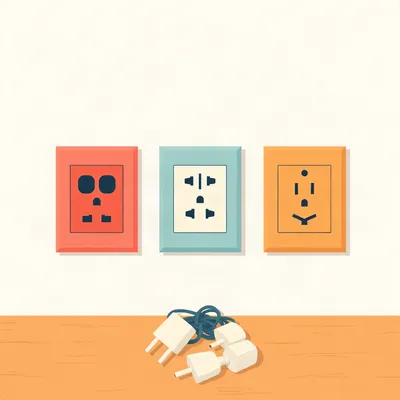
Yossi, our neighbor, stops me in the stairwell last week and says, completely offhand, "You know I used to be a low-voltage electrician in the States." And I'm standing there thinking — low voltage? The man wires outlets. Outlets are a hundred and twenty volts. That's enough to throw you across a room. In what universe is that low?

It's a regulatory term, not a safety term. And that's the thing most people get wrong right out of the gate. It makes people think "safe to touch," which a hundred and twenty volts absolutely is not. Ask anyone who's grabbed both prongs of a plug while pulling it out of a socket. You don't forget that.
I have done exactly that, and I can confirm — it's memorable. It's a full-body reminder that your nervous system runs on electricity and someone just shouted into the line. Which is exactly what Yossi sent us to untangle. Daniel wrote in asking about the actual cutoff between low-voltage and high-voltage electrical work, what it means for the people doing it, and why it matters when you're hiring someone. He also asked whether linemen and electricians have completely different skill sets — spoiler, they do — and why electricians are suddenly the people you call to run Ethernet and fiber. Which, honestly, I also didn't know until Yossi mentioned it.
It's one of those invisible boundaries that shapes an entire industry, and it's getting blurrier by the year. The same person who wires your kitchen lights might also be the person who runs the cable that delivers ten gigabit internet to your home office. But only if they know what they're doing. If they don't, you get interference, failed certification, or worse.
Or worse being the part that keeps me up at night. What does "worse" look like here?
Worse is a network cable draped over a fluorescent ballast in a drop ceiling, picking up enough induced voltage to fry a switch port. Worse is someone daisy-chaining Ethernet jacks like they're electrical outlets, because that's how they learned to wire a room, and now your whole network topology is a ring that spanning-tree protocol is desperately trying to shut down. Worse is a PoE camera cable run through the same conduit as a water heater circuit, where a fault puts line voltage onto a cable jacket no one expected to carry it.
We're not just talking about slow internet. We're talking about cascading failure modes that cross domains.
And that's the core tension of this whole topic. The domains look separate on paper, but they share physical space, and when the separation fails, it fails in ways neither trade was trained to diagnose. So where do we even start with this? The voltage number itself, I assume. What's the actual line?
There isn't one line. There are three tiers, and which one matters depends on whether you're asking a regulator, an electrician, or a lineman. But let's start with the one that answers the question Yossi's comment raised — why a hundred and twenty volts is considered "low.
The NEC — the National Electrical Code, NFPA seventy — draws the line for what it calls Class Two circuits at forty-nine volts AC or sixty volts DC. Below that, you're in what they call "extra-low voltage." Doorbell transformers, thermostat wiring, the cable that powers your garage door sensors. In most jurisdictions you don't even need an electrician's license to touch that stuff.
Which explains a lot about the doorbell in our last apartment. I'm pretty sure it was installed by someone whose only qualification was owning a screwdriver and being optimistic.
That's the extra-low-voltage world in a nutshell. The regulatory assumption is that at those levels, the energy available is insufficient to start a fire or stop a heart.
Even the supposedly safe tier has failure pattern. What happens when you cross above the forty-nine-volt line?
Above that, from fifty volts up to six hundred volts, you're in licensed-electrician territory. That's the "low voltage" Yossi was talking about. Every outlet in your wall, every light switch, every appliance circuit — all low voltage, legally speaking. Then above six hundred volts, you cross into utility land. Distribution lines, substations, the stuff linemen climb poles for.
The hundred and twenty volts coming out of my wall is low voltage, but the twelve volts powering my router is extra-low. The naming is basically designed to confuse civilians.
It's worse than that. The six-hundred-volt cutoff isn't really about physics. It's about who owns the wire. Everything upstream of your electric meter — the transformer on the pole, the thirteen-point-eight kilovolt distribution line feeding your street — that's the utility's property and their responsibility. Everything downstream, from the meter into your house, is yours. The meter is the legal firewall.
Which means the real boundary isn't voltage at all. It's property law wearing a safety vest. The utility owns the dangerous stuff, you own the stuff that can still kill you but is legally classified as "low," and the meter is the line where liability changes hands.
And that's why the skillsets diverge so hard. A lineman's entire world is upstream of the meter — live-line work at distribution voltages, hot sticks, arc-flash suits rated for forty calories per square centimeter. An electrician's world is downstream — load calculations, conduit fill, GFCI placement, making sure your kitchen circuits don't trip when you run the toaster and the espresso machine at the same time.
I do that.
That's why we have twenty-amp kitchen circuits now. But that's the point — an electrician thinks about what happens inside the building. A lineman thinks about what happens on the pole. They're working with the same fundamental physics, but the regulatory boundary at the meter has created two almost entirely separate professions.
If the meter is the firewall, what actually changes when you cross it? Let's get concrete. What does a low-voltage electrician like Yossi know that a lineman doesn't, and vice versa?
The training pipelines are almost completely separate. A journeyman electrician in the US typically goes through four or five years of apprenticeship — eight thousand hours on the job, plus something like five hundred to nine hundred hours of classroom instruction. They're learning the NEC cover to cover. Box fill calculations, conduit bending, load calculations for branch circuits, grounding electrode systems, GFCI and AFCI requirements. The entire world is inside the building envelope.
I want to pause on box fill for a second, because it's one of those things that sounds like trivia but is actually a fire-prevention measure hiding in plain sight.
It absolutely is. Box fill is the calculation that tells you how many conductors you can legally stuff into an electrical box. Every wire generates heat when current flows through it. Cram too many wires into a four-inch octagon box behind a ceiling light, and the heat has nowhere to go. The insulation degrades. Eventually you get arcing, and arcing inside a wall cavity is how houses burn down. The NEC has tables for this — so many cubic inches per conductor, depending on wire gauge — and a licensed electrician can do that math in their head. A lineman probably hasn't looked at a box fill table since trade school, if ever.
Also four to five years, but through a utility apprenticeship like the Northwest Line JATC or similar programs. About a hundred and forty-four hours of classroom per year, and the rest is on-the-job — but the "job" is climbing forty-foot poles, working out of bucket trucks, handling live conductors at thirteen-point-eight kilovolts or higher. Their classroom work covers transformer theory, voltage regulation, protective relaying, system protection. They learn how to use a shotgun stick to open a fused cutout while wearing rubber gloves rated for twenty thousand volts.
That's the long fiberglass pole with a hook on the end?
That's the one. It lets you operate switches and cutouts from a safe distance — "safe" being relative when you're dealing with an arc that can reach fifteen thousand degrees Fahrenheit. A lineman's PPE includes an arc-flash suit rated in calories per square centimeter — the amount of thermal energy the fabric can absorb before you get second-degree burns through it. For distribution work, you're typically looking at suits rated for eight to forty calories. For transmission voltages, you can need ratings up to a hundred calories.
Let's put that calorie number in human terms, because I think people hear "forty calories" and think of a snack. What does that actually mean?
One calorie per square centimeter is roughly the amount of thermal energy you'd get holding your hand over a candle for one second — enough to cause a second-degree burn. So a forty-calorie suit is designed to protect you from an arc flash that delivers forty times that energy to every square centimeter of your body. And a hundred-calorie suit is for environments where the available fault energy is genuinely staggering — transmission substations, large generating plants. The suit itself weighs twenty to thirty pounds and you look like an astronaut. You can barely move. And you're wearing it because if you don't, an arc flash will turn the air around you to plasma at thirty-five thousand degrees Fahrenheit — four times the temperature of the surface of the sun — before the protection relay even has time to trip.
Meanwhile the electrician's PPE is safety glasses and maybe some arc-rated gloves if they're working in a live panel.
That's not because electricians are cavalier. It's because the available fault current in a residential panel is orders of magnitude lower. A typical home service is two hundred amps at two hundred forty volts. A distribution line fault can deliver tens of thousands of amps before the protection clears it. The energy scales with the square of the current. The difference in hazard is enormous.
The lineman's skillset is fundamentally about managing catastrophic energy release. The electrician's is about making sure the lights turn on and the building doesn't burn down over thirty years of normal use.
And here's a concrete example that shows how non-overlapping these worlds are. A lineman replacing a pole-mounted transformer on a thirteen-point-eight kilovolt distribution line has to ground the line on both sides of the work zone, use a phasing tester to verify zero voltage, open the cutouts with a shotgun stick, swap the transformer — which might weigh several hundred pounds — and then re-close the circuit in the right sequence so you don't create a voltage surge. At no point in this job does anyone calculate box fill or check whether a bathroom outlet is within six feet of a sink.
The electrician running EMT conduit for a two-hundred-amp panel in a commercial kitchen is thinking about derating conductors for ambient temperature, making sure the neutral isn't shared between circuits where it shouldn't be, and verifying that every GFCI is accessible for testing. They are not climbing a pole.
They're probably not even allowed to. Most electricians have never been trained in pole climbing and aren't insured for it. And most linemen have never pulled a permit for a branch circuit and wouldn't know the local amendments to the NEC for their own jurisdiction. The regulatory wall at the meter has created two professions that share a fundamental understanding of Ohm's law and almost nothing else.
That wall is so absolute that it's created a kind of mutual invisibility. The lineman drives past houses all day and never thinks about what's inside the walls. The electrician looks out the window at the pole and never thinks about who maintains it. They're both working with the same electrons, but their professional identities are built on opposite sides of a legal line.
That mutual invisibility becomes a problem when something bridges the gap. Which brings us to three-phase power. Because that's the wrinkle that sits right on the boundary.
Three-phase is where the "low voltage" category gets complicated. The NEC still calls it low voltage — two hundred eight volts, four hundred eighty volts, six hundred volts are all under the six-hundred-volt cutoff. But a residential electrician who's spent their entire career in single-family homes wiring a hundred twenty and two hundred forty volt single-phase circuits is not qualified to touch a four-hundred-eighty-volt three-phase motor in a commercial bakery.
What's different about it? Walk me through what actually changes when you go from single-phase to three-phase.
For one thing, phase balancing. In a three-phase system, you have three hot legs, each a hundred twenty degrees out of phase with the others. If you don't distribute the loads evenly across all three phases, you get voltage imbalance, which causes motors to run hot and fail early. You also have to understand delta versus wye configurations — whether the transformer secondary is wired with the coils in a triangle or a star — because that determines your line-to-line and line-to-neutral voltages and whether you even have a neutral to work with.
Delta versus wye sounds like the electrical equivalent of choosing between two different board games with completely different rulebooks.
It kind of is. In a wye configuration, the line-to-neutral voltage is the line-to-line voltage divided by the square root of three. So a four-hundred-eighty-volt wye system gives you two hundred seventy-seven volts to neutral. In a delta configuration, there is no neutral — or there's a "high leg" delta where one phase is center-tapped to give you a hundred twenty volts for lighting circuits while the other two legs sit at two hundred eight volts to ground. If you don't know which configuration you're working with, you can put a hundred-twenty-volt breaker on a two-hundred-eight-volt leg and fry everything connected to it.
A residential electrician might never have encountered any of this.
Might never have needed to. The NEC has different licensing classifications in many states — residential wireman versus journeyman electrician versus master electrician. A residential wireman is limited to single-family and multifamily dwellings below a certain size. They can't legally pull permits for commercial or industrial work. And three-phase is almost exclusively commercial and industrial.
If you own a bakery and you need a four-hundred-eighty-volt motor installed for your industrial mixer, and you hire someone who's only ever wired houses, you're not just getting subpar work. You're getting work that may be illegal and dangerous.
The fault currents are higher. A three-phase four-hundred-eighty-volt panel can have an available fault current of twenty-five thousand amps or more. If the electrician installs breakers that aren't rated to interrupt that — and residential breakers typically top out at ten thousand amps interrupting capacity — the breaker can fail to clear a fault. Instead of tripping, it welds itself shut. And then the next thing that clears the fault is the transformer fuse or a fire.
Which is a vivid way of saying the regulatory boundary exists for a reason. It's not bureaucracy. It's physics with a fuse. But here's where it gets interesting — because low voltage doesn't just mean power anymore. It also means data. And that's where Yossi's world gets a lot more complicated.
This was the part of the prompt that surprised me. I think of electricians as the people who make electrons go where they're supposed to. I think of network cables as the people who make packets go where they're supposed to. Apparently those are sometimes the same person now.
They increasingly are, and the reason is buried in the same codebook we've been talking about. The NEC has Article 800, which covers communications circuits — telephone, data, coax, Ethernet, fiber. And in many states, a low-voltage electrician's license covers Article 800 work by default. Structured cabling falls under the same regulatory umbrella as the doorbell transformer. It's all low voltage in the eyes of the code.
The same license that lets you wire a kitchen island lets you pull Cat6a through an office building. That feels like a loophole someone should have closed.
Some jurisdictions have. California, for example, requires a separate low-voltage systems contractor classification — a C-7 license — specifically for data, sound, and communications. But in plenty of states, a general journeyman electrician can legally run and terminate network cable. Whether they should is a different question.
That's the tension, isn't it? Legal versus competent. The state says you're allowed, but the cable certifier says you failed.
A residential electrician might know how to pull cable through a wall — the physical act of fishing wire isn't that different whether it's Romex or Cat6a. But running Ethernet isn't just about getting the cable from point A to point B. It's about maintaining the twist ratio in each pair right up to the termination point. Untwist more than half an inch at the jack and you've introduced crosstalk. Bend the cable tighter than four times its diameter and you've changed the impedance. These are things a Fluke DSX-8000 cable certifier will catch, but most electricians don't own one of those.
How much does a Fluke certifier cost?
About twelve thousand dollars. A general electrician who runs data cable once a month isn't making that investment. They're using a continuity tester — thirty bucks at the hardware store — which tells you the wire isn't broken but says nothing about whether it'll actually carry ten gigabits.
You get a cable that beeps okay and then your network runs at a hundred megabits and nobody can figure out why.
That's the best-case scenario. The worst case is when they run power and data too close together. 136 requires a two-inch separation between Class One power conductors and Class Two communications cables, unless they're separated by a barrier. The magnetic field from a twelve-two Romex carrying fifteen amps will induce voltage in an unshielded Cat6a running parallel to it. Your network cable becomes an antenna for sixty-hertz hum.
Which means the home theater example is the perfect cautionary tale. You hire someone to wire your media room — outlets for the subwoofers, and Cat6a for HDMI-over-IP to the projector. They run everything through the same holes in the studs because it's faster. Now your four-K video signal has a ghost of your refrigerator compressor cycling on and off.
The electrician might not even know they caused it. They'll test the outlets, they'll confirm the cable beeps out, and they'll leave. Three months later you're on a forum trying to figure out why your projector drops frames every time the air conditioner kicks in.
That forum thread will be forty-seven pages long and end with "never mind, fixed it" and no explanation. We've all been there. Which brings us to the practical question. If I'm a property owner — building a home office, renovating a data closet, wiring a new build — how do I make sure the person I'm hiring actually knows both sides of this?
First, are you licensed for low-voltage work in this jurisdiction? That establishes the legal baseline. Second, do you have experience with Category 6A termination and testing? Not just running the wire — terminating and testing. If they say yes to both, you're probably in good hands.
If they say "I can run the wire but I don't do the terminations"?
That's a red flag. It means they know enough to get the cable through the walls but not enough to make it work. You want someone who owns or rents a certifier and can hand you a test report for every run. BICSI certification — that's the Building Industry Consulting Service International — is the gold standard for this. A BICSI-certified technician has been trained specifically in structured cabling standards, TIA/EIA-568, signal integrity, the works.
The flip side of this is also worth noting. You could hire a dedicated network cabling technician who knows everything about bend radius and crosstalk, but they might not know how to bond and ground per NEC Article 250. So your data cables are perfect but your equipment racks aren't properly grounded and you've created a shock hazard.
That's the convergence problem in a nutshell. The two domains are colliding, and the number of people who are expert in both is small. Yossi is unusual precisely because he bridges that gap — US-trained in low-voltage power and now doing data cabling in a country with a different voltage standard entirely.
In Israel, the regulatory landscape splits differently. The SII standard for low-voltage switchgear — SI 61439 — doesn't cover data cabling at all. So electricians here often subcontract network wiring to specialized cabling technicians. It's a cleaner separation than in much of the US, but it means you're coordinating two contractors for what could be one job.
Which is why the trend line matters. Power over Ethernet is physically erasing the distinction. 3bt standard — that's PoE Type 4 — delivers up to ninety watts per port at forty-eight to fifty-seven volts DC over four twisted pairs. A single Cat6a cable is now carrying both ten-gigabit data and enough power to run an LED lighting fixture, a security camera, or a small display.
Ninety watts is not trivial. That's enough to cause a fire if the termination is sloppy.
It's enough to cause burns. And when you bundle multiple PoE cables together in a conduit, you get cable heating — the copper itself warms up under load. The TIA standards have temperature rise guidelines for bundled PoE cables because you can degrade the insulation or increase insertion loss if you don't account for it. An electrician who understands power budgets and thermal derating is suddenly much more valuable than one who just knows how to punch down a keystone jack.
The future electrician is part power engineer, part network technician, and part thermal analyst. And the regulatory framework is still catching up to that reality.
The 2026 NEC cycle has proposals for new articles on DC microgrids and energy storage systems. There's talk of creating a separate DC electrician classification in some jurisdictions. The voltage boundary we started this conversation with — that six-hundred-volt line — might not be the most important dividing line for much longer. It might be alternating current versus direct current, or power-only versus power-plus-data.
Which means Yossi, with his cross-jurisdiction experience and his willingness to learn both sides of the meter, is positioned exactly right for where this is headed. Also, I should mention — he fixed an outlet in our apartment that had been frying my fur dryer for months.
My fur dryer. It's a specialized thing. You wouldn't understand.
You have a hair dryer. For your fur. You're a sloth and you own a fur dryer.
It gets very humid in Jerusalem. The fur needs volume.
I have questions. But I'm going to set them aside because we're talking about Yossi, and I want to say — he's a good guy. Knows his beer, knows his codebook, and he's one of the few people I've met who can discuss both arc-flash boundaries and fiber bend radius in the same conversation without missing a beat.
Yoseph Sherman Electric. If you're in Jerusalem and you need someone who actually understands both sides of the regulatory firewall we've been describing, he's the one to call.
If you're sitting there thinking — great, I now know more about voltage classifications than I ever expected to, but what do I actually do with this — let's make it practical. Three things to remember next time you're hiring.
First, ask about the voltage range on their license. In most US states, a low-voltage license covers up to six hundred volts. But some states, California being the obvious one, have separate classifications — their general electrician certification goes to a thousand volts, and they have a separate low-voltage systems contractor license for under ninety-one volts. If you don't ask, you won't know which box your electrician actually checks.
Second, for network cabling specifically, look for BICSI certification or at least a data cabling endorsement. A general electrician can pull the wire. A certified technician will test it and hand you a report proving it meets spec. That's the difference between "the cable is in the wall" and "the cable actually works at ten gigs.
Third, if you happen to be in Jerusalem, Yossi Sherman at Yoseph Sherman Electric is the rare person who bridges both worlds. US-trained in low-voltage power, now working in Israel's two-hundred-thirty-volt four-hundred-volt three-phase system, and he knows structured cabling. That cross-jurisdiction experience — understanding two different codebooks and two different voltage standards — is not common. And he's a fun guy. Good taste in beer.
Also he fixed my fur dryer situation. Which Herman is still processing.
I'm not processing it. I'm compartmentalizing it. But the broader point here is that the voltage boundary we've been talking about — six hundred volts, the meter as firewall — is really a regulatory shorthand for two different kinds of expertise. Power delivery versus signal integrity. And those worlds are colliding.
PoE is the collision. When a single Cat6a cable carries both ninety watts of DC power and ten gigabits of data, the person installing it has to think like an electrician and like a network engineer simultaneously. Cable heating, bend radius, termination standards, grounding — it's all one job now.
That collision is already reshaping the codebook. The 2026 NEC cycle — which is in the public comment phase right now — has proposals for a new Article 710 covering DC microgrids. We're talking about buildings that run forty-eight volts DC natively for LED lighting, PoE devices, and even small appliances. No AC-to-DC conversion at every outlet. Just one rectifier at the service entrance and DC distribution throughout.
Which is basically how a data center works, but now we're talking about office buildings and eventually homes. And forty-eight volts DC is firmly in what we've been calling "low voltage" — but the expertise required to design and install it is neither traditional electrician nor traditional network tech.
Some jurisdictions are already floating the idea of a separate DC electrician classification — someone who understands both the power side and the signal side, who can calculate voltage drop on a DC bus, who knows when you need a boost converter versus when you can run passive. It's a new specialty being born in real time.
Here's the thing that makes this real for me — voltage drop on a DC bus is not intuitive if you've spent your career in AC. With AC, you're worried about impedance, power factor, reactive loads. With DC, it's pure resistance. The math is simpler but the stakes are different. A five percent voltage drop at the end of a forty-eight-volt DC run means your PoE device is seeing forty-five point six volts, which might be below its operating threshold. And unlike AC, you can't just stick a transformer in the middle to bump it back up. You need active electronics.
That's exactly the kind of domain knowledge that neither traditional trade owns yet. An AC electrician thinks in terms of step-up and step-down transformers. A network tech thinks in terms of signal-to-noise ratio. The DC microgrid designer has to think about both — power integrity and signal integrity on the same copper, with no room for error on either side. It's a new discipline.
The boundary we've spent this whole episode describing — that six-hundred-volt line, the meter as firewall — might not be the boundary that matters in twenty years. The new line might be AC versus DC, or power-only versus converged infrastructure.
Whoever figures out how to certify for that new boundary first is going to define the trade for a generation. The NEC moves slowly, but the technology doesn't. PoE is already here. DC lighting is already here. The electricians who learn both sides of this now — power and data, AC and DC — are the ones who'll be indispensable.
Which brings me back to Yossi on the stairwell, casually mentioning he used to be a low-voltage electrician in the States. At the time I thought it was just small talk. Now I realize he was describing a skillset that sits exactly on the fault line of where this entire industry is going.
The next time you see a lineman on a pole, or an electrician in a panel, remember — they're working with the same invisible force, but the tools, the training, and the risks are worlds apart. And if you find someone who understands both sides of the meter, hold onto them.
Now: Hilbert's daily fun fact.
Hilbert: The Allende meteorite, which fell over Mexico in 1969, contains microscopic diamonds that formed before the solar system existed — and when struck, they produce an ultrasonic ringing at frequencies only bats can hear.
I have so many questions about how anyone tested that.
I'm choosing not to pursue any of them. This has been My Weird Prompts. Thanks to our producer Hilbert Flumingtop. If you enjoyed this, leave us a review wherever you get your podcasts — it helps. We're back next week.