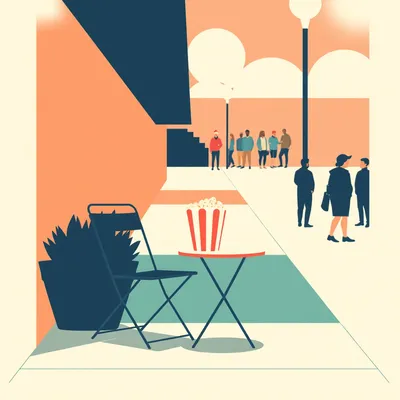
Daniel sent us this one — he's been watching the weekly Shabbat cafe protests here in Jerusalem, the Haredi groups showing up to harass a cafe that opens on Saturday, the secular and religious counter-protesters pushing back. And his instinct isn't to grab a megaphone and join the secular side, which is where you'd expect him to land. Instead, he wants to show up with a folding table, a chair, and a bucket of popcorn, sit somewhere between the two groups, and just... Like the Michael Jackson popcorn meme made flesh. His question is: how do you pull this off as actual social trolling, what's it really saying, and what happens when people react?

I love this plan. I genuinely love it. And I need to say that up front because what I'm about to do is pick it apart like a pediatrician examining a rash, and I don't want Daniel to think I'm against it. I am for it the way a coach is for the athlete who's about to attempt something that could be brilliant or could snap a hamstring.
That's a vivid image. Also, you're already diagnosing it as a rash.
A fascinating rash. The kind you write up for a journal. Here's what grabs me — Daniel isn't proposing to join the counter-protest. He's not proposing to argue with the Haredi protesters. He's proposing to create a third position that didn't exist in this fight until he showed up. That's not passive. That's architectural.
He's building a new room in a two-room building. So let's set the scene first, because not everyone listening is walking past this every week. What's actually happening on the ground?
There's a cafe in Jerusalem — and we're not naming it because the specifics don't matter for the analysis — that began opening on Shabbat. This is a thing that happens in Jerusalem. It's a city where the official character of public space is perpetually contested. Some neighborhoods observe Shabbat strictly, some don't. But when a business opens on Shabbat in a border zone, it becomes a flashpoint. Haredi groups have been showing up weekly to protest, and by protest I mean harass — shouting, blocking entrances, making the space unusable. In response, secular and some religious Jerusalemites started organizing counter-demonstrations to defend the cafe. This has been going on for weeks, and it's become one of those microcosm fights where the whole city's tensions play out on one sidewalk.
Daniel's read is: I'm on the secular side philosophically, but I don't want to be another person with a sign. I want to do something that makes both sides stop and think. Or at least makes one side stop and the other side confused. Hence the popcorn.
Hence the popcorn. Now, let's break down the mechanics. Because the popcorn meme is doing very specific rhetorical work, and most of it doesn't translate automatically from the internet to physical space.
Okay, walk me through it. What does the popcorn GIF actually say when someone posts it?
It says three things simultaneously. One: I am aware of this conflict. Two: I am not participating in it. Three: I am deriving entertainment from watching you participate in it. That third part is the edge. It's not just neutrality — it's a claim of superiority. The popcorn eater is above the fray, literally consuming the conflict as a product. Online, this works because the poster is outside the frame. The people fighting may never even see the GIF.
Daniel won't be outside the frame. He'll be in the frame. Physically present, visible, unavoidably part of the scene.
And that changes everything. When you post the GIF, you're invisible to the participants. When you set up a chair and eat popcorn twenty feet from an actual protest, you are a new participant. You've entered the ecosystem. The Haredi protesters will see him. The secular counter-protesters will see him. The police will see him. The journalists covering it will see him. And each of those audiences will read the act completely differently.
The same physical action broadcasts four different messages to four different receivers. That's either a masterpiece of layered communication or a recipe for everyone to misunderstand you in four different ways.
That's the tension. Let's take them one at a time. Audience one: the Haredi protesters. They see a non-Haredi person — Daniel's manner of dress makes that clear — who has chosen not to join the counter-protest. Some might read him as a sympathetic observer, someone who sees the secular counter-protesters as equally ridiculous. That's a dangerous misreading if Daniel's actual position is that the harassment is the problem. Others might just be confused and ignore him. The risk is that his presence gets cited as "even secular people think this is a circus.
Which is the exact opposite of what he wants. Audience two: the secular counter-protesters. These are his natural allies, and they're going to look at him and think — what? "Why isn't he with us?" "Is he mocking us?
That's the real danger. The secular group is showing up to defend a principle — freedom of commerce, freedom from religious coercion. They're putting themselves out there. And Daniel shows up and essentially says, "You're all very entertaining." That can read as betrayal. It can read as the guy who benefits from the fight without contributing to it. The free-rider problem, but make it performance art.
If someone from that group confronts him — "What are you doing, why aren't you with us?" — he needs an answer that doesn't collapse the whole thing.
We'll get to scripting. But first, audience three: the wider public and the media. This is actually the most important audience, because the act only works as protest if it's seen and understood beyond the immediate scene. A journalist covering the weekly protest sees two groups yelling at each other — that's the same story every week. Then they see a guy in a chair eating popcorn. That's the photo. That's the lede. "Amid weekly clashes over Shabbat commerce, one Jerusalem resident has found a new way to protest — by refusing to protest at all.
That's where the message lands or doesn't. The risk is that it becomes a quirky human-interest story that defangs the whole thing. "Look at this funny guy with his popcorn" instead of "look at this serious issue of religious coercion.
The Yes Men problem. The Yes Men did brilliant satirical interventions — impersonating corporate executives, making absurd announcements — and sometimes the coverage was just "ha ha, look at these pranksters" rather than "the policies they're mocking are harmful." Satire is a delivery mechanism, but the payload doesn't always arrive.
We've got three audiences, three different potential misreadings. What's the mechanism that's supposed to make this work despite all that?
The mechanism is what I'd call meta-protest. Daniel isn't protesting the cafe opening or the Shabbat observance. He's protesting the form of the protest itself. He's saying: the way this conflict is being conducted has become a ritualized theater that no longer serves any purpose except entrenchment. Both sides show up, both sides yell, nothing changes, everyone goes home until next week. The popcorn says: I see the script, and I'm not reading my lines.
Which is a powerful statement. "I reject the binary you've constructed." But it's also a statement that requires the audience to do interpretive work. You're not handing them a conclusion, you're handing them a puzzle. And people are lazy.
People are very lazy. Which is why documentation is not optional here — it's the whole point. If Daniel sits there eating popcorn and nobody films it, he's just a guy having a snack near a protest. The act only becomes a protest when it's mediated. Someone needs to capture it, ideally from an angle that shows both groups and Daniel in the middle, and that image needs to circulate. The photograph is the protest. The physical act is just the raw material.
He needs a friend with a camera, or he needs to set up his own. And that introduces another layer — now he's not just a spectator, he's a director. He's staging a scene.
Which is completely legitimate. All protest is staged to some degree. The question is whether the staging undermines the authenticity of the message. If it looks too produced, it reads as a stunt. If it looks too casual, nobody notices. The sweet spot is: it looks spontaneous to the casual observer, but every element is intentional.
Let's talk about those elements. Where does he sit?
This is critical. He cannot sit with the secular group. That would make him just another counter-protester with an unusual prop. He cannot sit with the Haredi group — that would be read as support. He needs to establish a third position, physically separate from both. Ideally, he finds a spot that forms a triangle — the two groups at two points, him at the third.
Folding chair, folding table, popcorn.
The props are perfect because they're legible. Everyone knows the popcorn meme. A folding table and chair say "I prepared for this, I didn't just wander by." The preparation is part of the message — this is deliberate. But I'd add one thing: a drink. Something visibly non-alcoholic, because you don't want "drunk guy mocks protesters" as the frame. Something with a straw. It completes the cinema aesthetic.
Daniel said his manner of dress would mark him as not Haredi, which is true, but he should think about this more carefully. If he dresses too casually, he's just a guy. If he dresses too formally, he looks like he's attending an event. What's the right register?
I'd say: dress like you're going to a movie. Not a premiere, not a gala — just a regular evening at the cinema. Jeans or casual pants, a clean shirt, nothing with text or logos that could be read as a message. You want your presence to be the message, not your clothing. Avoid anything that could be mistaken for affiliation with either group.
If someone approaches him? Let's script this, because the moment of confrontation is where the whole thing holds together or falls apart.
So there are a few scenarios. Scenario one: a secular counter-protester comes over and says, "What are you doing? Why aren't you with us?" Daniel's answer needs to be true, on-brand, and disarming. Something like: "I'm here to watch the show. It's the best entertainment in town." Said with a smile, not with aggression. The point is to signal that he's not hostile, he's just operating on a different frequency.
If they push — "This isn't a joke, this is serious" — then what?
Then he can drop the irony for one sentence. "I know it's serious. That's why I'm here. I just think the way we're having this fight is part of the problem." One moment of sincerity, then back to the bit. The sincerity is the release valve — it shows he's thought about this, he's not just a troll. But you don't stay in sincerity mode, because then the art project collapses into just another argument.
Scenario two: a Haredi protester approaches. What's the play?
The Haredi protester is likely to see him as an ally or a curiosity. If they ask what he's doing, same basic answer works: "Just watching." But he should be prepared for them to try to recruit him — "You see how they desecrate Shabbat?" His response should be neutral and non-committal. "I see a lot of things." Don't engage the argument. The whole point is that he's not in the argument.
Scenario three: a journalist. This is actually the most important one, because the journalist is the vector to the wider audience.
This is where he gets to deliver the thesis. If a reporter asks what he's doing, he should have a polished answer ready. Something like: "Every week, the same two groups show up and yell the same things at each other. I'm here to point out that this has become theater, and I'm the audience." That's quotable. That's the soundbite that makes it into the piece. And it frames the act as commentary, not just weirdness.
What about the police? Jerusalem protests often have a police presence, especially ones with religious tensions.
He should check the legality of setting up a chair and table on that particular stretch of sidewalk. If it's public property and he's not obstructing, he's probably fine, but Jerusalem has complicated rules about public gatherings. He should know them before he goes. If the police ask him to move, he moves. Getting arrested for this is not the point — it would make the story about the arrest, not about the protest. Don't let the state become the main character.
That's a good principle for a lot of things. So we've covered the mechanics. Let's zoom out. What is this act actually trying to achieve? What's the theory of change?
This is the question Daniel needs to answer for himself before he does it. Is the goal to change minds? To get media coverage that reframes the conflict? To amuse himself and his friends? To create a template that others can replicate? All of those are valid, but they require different execution.
If the goal is personal satisfaction, the bar is low. Show up, eat popcorn, enjoy the absurdity. If the goal is to shift the conversation, that's harder.
And I think Daniel's instinct — knowing him — is somewhere in the middle. He wants to make a point, but he also thinks this would be funny. And I want to defend that combination, because "this is both serious and funny" is not a contradiction. Some of the most effective political art is funny. The Billionaires for Bush protests during the two thousand four election — people dressed in tuxedos and evening gowns, holding signs that said "Leave No Billionaire Behind." It was hilarious. And it worked, because the humor was the delivery mechanism for a sharp critique.
The humor lowers defenses. If you're yelling at someone, they're braced for a fight. If you're sitting in a chair eating popcorn, they don't know what to do with you. You've exited the script they're prepared for.
And that confusion is productive. It creates a moment where someone might actually think, "Wait, what is happening here?" instead of just reflexively reciting their position. That moment of cognitive friction is where minds can change.
Let's push on the downside. There's a real risk that this reads as apathy, not critique. "I'm above this" can easily become "I don't care enough to engage." And in a situation where one side is clearly the aggressor — showing up to harass a business — is there a moral problem with refusing to take a side?
That's the big question, and I don't think there's a clean answer. If the Haredi protesters are actively harassing people, and Daniel is sitting there eating popcorn, is he witnessing or is he abdicating? There's a difference between "I refuse to join your binary" and "I refuse to help when help is needed." The popcorn protest works best when the conflict is symmetrical in its absurdity. If it's asymmetrical — if one side is clearly in the wrong and the other side is defending basic freedoms — then the refusal to take sides can look like cowardice.
Daniel said himself he sympathizes with the secular side. So he's not actually neutral. He has a position. He's just expressing it through refusal rather than through joining.
Which is a legitimate expressive choice, but it comes with a cost. The secular counter-protesters might not forgive him for making their serious effort into a punchline. And if the protest movement needs bodies — needs numbers to show that the community cares — Daniel is withholding his body. That's a real choice with real consequences.
How does he mitigate that? How does he signal to the secular group, "I'm on your side, I'm just doing it differently"?
He could do a couple of things. One: he could talk to some of the counter-protesters beforehand, not to ask permission, but to explain what he's doing. "I'm going to do this weird thing. It's not against you. I support the cafe. I just think a different tactic might get different attention." If they know in advance, they're less likely to feel mocked in the moment. Two: he could, after the popcorn bit has run its course, put down the popcorn and actually join the counter-protest. The act becomes a prelude rather than a substitute. "I've made my point about the theater of this. Now I'm here to actually help.
The popcorn as an opening act, not the whole show.
It also solves the repetition problem. If he does this every week, it stops being surprising and starts being just another part of the ritual. Week one: "Who's that guy with the popcorn?" Week three: "Oh, it's the popcorn guy again." Week five: nobody notices. The act has a shelf life. Using it once or twice, then transitioning to a different mode of engagement, keeps it fresh.
What if he doesn't transition? What if he escalates? Week one, one guy with popcorn. Week three, five people with popcorn. Week five, twenty people with popcorn, all sitting in a row, like an actual audience.
Now we're talking. That's how you build a symbol. The "popcorn party" becomes a recognizable third faction. It's not just one eccentric — it's a movement of people who are saying, "We care about this issue, but we refuse to perform the ritual of outrage." That's harder to dismiss. And it creates a community around the act, which is its own form of organizing.
It's inherently media-friendly. One guy with popcorn is a photo. Twenty people with popcorn is a story. "Popcorn Protest Movement Grows in Jerusalem." That gets picked up.
The flash mob comparison is useful here. Flash mobs were powerful because they were ephemeral and surprising. But they also got co-opted by brands almost immediately. The challenge for Daniel, if he scales this, is to keep it from becoming a gimmick. The way to do that is to maintain the connection to the actual issue. Don't let the popcorn become the story. The story is: "Jerusalem residents are so fed up with the ritualized conflict over Shabbat that they've invented a new form of protest — showing up as an audience to watch the fight nobody wins.
The framing matters enormously. The popcorn is the hook. The analysis is the payload.
That's true of all good trolling. The best social trolling exposes the gap between what something claims to be and what it actually is. This protest claims to be about Shabbat observance. But what it actually is, week after week, is a piece of street theater with a fixed script. Daniel's act says: I see the theater. I'm naming it. And I'm refusing to be a character in your play.
Which brings us back to something you've talked about before — the gap between what something claims to be and what it actually is. That's your whole framework for this stuff.
It's the only framework that consistently works. You don't attack the stated position. You don't argue with the theology of Shabbat observance. You point at the gap between "we are piously observing our faith" and "we are showing up every week to yell at a cafe." The gap is where the absurdity lives. The popcorn just illuminates it.
Let's pull this into something listeners can actually use. Daniel's specific situation is Jerusalem-specific, but the tactic is portable. Anywhere there's a polarized standoff, the popcorn move is available.
And the framework is the same. Step one: identify the binary that everyone is trapped in. Step two: refuse to enter it. Step three: create a third position that is physically and symbolically separate. Step four: make that position legible through props, placement, and framing. Step five: document it, because the documentation is the act's real existence. Step six: prepare your answers for the inevitable confrontations.
Step seven: know your theory of change. What are you actually trying to accomplish? If you can't answer that, you're just performing for yourself.
Which is fine, by the way. Performing for yourself is a valid reason to do things. But don't confuse it with political action. If you're doing this to amuse yourself, own that. Don't tell yourself you're changing the world when you're really just having a good time.
There's something almost spiritual about this, actually. The act of sitting still while a conflict rages around you. It's like a Zen thing. The immovable popcorn eater.
The Bodhisattva of snacks. But here's the thing — the Zen master sits still to demonstrate detachment from worldly concerns. Daniel would be sitting still to demonstrate engagement with worldly concerns through a different mode. It's not detachment. It's re-attachment through a side door.
That's a distinction worth keeping. This isn't apathy. It's a different kind of caring.
And that's the answer to the person who says, "If you care, why aren't you with us?" The answer is: "I am with you. I'm just not with your method. I think your method has become part of the problem.
Whether you say that out loud or just let the popcorn say it for you is a tactical choice.
I'd say let the popcorn do the initial work, and have the words ready for when someone asks. The act opens the conversation. The words close it.
One more thing before we wrap the analysis. Daniel mentioned this is "artistic social protest.It's claiming a category. It's saying: judge this by the standards of art, not by the standards of activism.
Which is a smart move, because it gives him a defensible frame. "It's art" is a harder argument to attack than "it's effective activism." Art is allowed to be ambiguous. Art is allowed to be unproductive. Art is allowed to just exist and provoke. By framing it as art, he buys himself a lot of room to experiment without having to prove outcomes.
The danger is that "it's art" also lets people dismiss it. "Oh, it's just some art project." The frame that protects also diminishes.
Everything about this plan is a double-edged sword. That's what makes it interesting. If it were straightforward, we wouldn't be talking about it for twenty minutes.
Let's land the practical takeaways. For Daniel, and for anyone else who wants to try something like this.
First: define success before you start. Is it a photo in the paper? Is it a conversation with one person from the other side? Is it just the feeling of having done something true to yourself? Know what you're aiming at. Second: prepare your lines. The one-sentence explanation, the one-sentence sincerity release valve, the one-sentence response to hostility. You don't want to be improvising when someone's in your face. Third: bring a friend with a camera. The act is the seed. The documentation is the tree. Fourth: don't overstay the bit. Do it once, maybe twice, then either escalate or retire it. The popcorn guy who's still there in week twelve is just part of the furniture.
Fifth, I'd add: be ready for it to not work. Be ready for everyone to misunderstand you. Be ready for your allies to be annoyed and your opponents to ignore you. The best-laid trolling plans often just fizzle. If you're okay with that outcome, then you're doing it for the right reasons.
The right reasons being: it's true to who you are, and it's funny, and it might, possibly, in some small way, shift how one person sees the conflict. That's enough. You don't need to win.
Before we close, there's a question we've been circling that I want to name directly. Is there a moral obligation to take a side when one side is clearly the aggressor? Daniel said the Haredi groups are harassing the cafe. That's not symmetrical. Does the popcorn protest, by treating both sides as equivalent performers in a theater piece, create a false equivalence?
And that's the risk Daniel has to sit with. If the harassment is serious — if people are being intimidated, threatened, made to feel unsafe — then treating it as entertainment could be harmful. The popcorn move works when the conflict is mostly symbolic. It stops working when there are real victims. So the question Daniel needs to answer honestly is: what's actually happening on that sidewalk? Is it a shouting match between two entrenched groups, or is it a group of people being victimized while others watch? If it's the latter, put down the popcorn and stand with the victims.
That's the line. And I think it's the right place to leave the analysis. The tactic is clever, the mechanics are sound, but the ethics depend on the facts on the ground. Know what you're witnessing before you decide how to witness it.
If you do decide to go ahead — send us the photo. I want to see it.
Now: Hilbert's daily fun fact.

In nineteen seventy-three, Hansa Nord, a shipping consortium attempting to revive Hanseatic League trade protocols, nearly established a duty-free port in the Seychelles that would have operated under medieval Lübeck law. The deal collapsed when a Seychellois minister realized the contract required all disputes to be adjudicated by a panel of German maritime historians.
...I have so many questions about the panel of maritime historians.
The Seychelles almost became a Hanseatic colony in the nineteen seventies. That's a sentence I just heard.
This has been My Weird Prompts. Thanks to our producer Hilbert Flumingtop. If you enjoyed this, do us a favor and leave a review wherever you listen — it helps people find the show. For Daniel, for Corn, I'm Herman Poppleberry. Go make some trouble.