Daniel sent us this one — he's asking whether modern militaries still use railroads for logistics. Like, actual military trains, military-developed railroads, the whole thing. And if they do, who's using them? Because honestly, you picture a troop train and your brain goes straight to black-and-white footage of guys in tin hats heading to the Western Front. Is any of this still happening, or is it all cargo planes and trucks now?

It is absolutely still happening, and at a scale that would genuinely surprise most people. I went down quite a rabbit hole on this one. The short answer is yes, modern militaries use railroads extensively — and I mean extensively — for logistics. The longer answer involves entire military railway units, purpose-built military rail lines, and some wild engineering that most defense coverage completely ignores.
The romantic image of the troop train isn't dead, it's just...
Containerized, digitized, and in some cases still armored and armed. Let me start with the United States, because the scale is staggering. The Department of Defense owns and operates the Fort Eustis Military Railroad in Virginia. This is an actual, functioning military railroad — thirty-one miles of track, its own locomotives, its own rail yard, and it connects directly to the CSX main line. It's run by the U.Army Transportation Corps, and its whole purpose is training railway operations personnel and moving military equipment.
Thirty-one miles. That's not a museum piece, that's a working rail line.
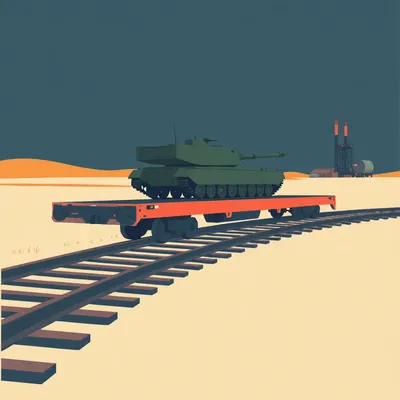
A working rail line that handles real deployments. When the Army needs to move an armored brigade's worth of Abrams tanks from Fort Stewart to a port for deployment, those tanks don't drive to the port. Each Abrams weighs about seventy tons. Putting seventy-ton vehicles on public roads for hundreds of miles destroys the roads and takes forever. So they go on railcars. Flatcars specifically designed for military loads. The Army has entire units whose sole job is railway operations — the 757th Expeditionary Rail Center, for example, which deploys overseas to manage military rail logistics in theater.
Wait, expeditionary rail center. That implies they're setting up rail operations in places where there might not be functioning rail infrastructure.
And that's where it gets interesting. The Army's railway units don't just operate on existing tracks — they can repair damaged rail lines, build new spurs, and operate in conditions where the local rail network has been bombed, neglected, or was never built to handle military loads in the first place. During the Iraq War, the U.military used rail lines to move supplies from Kuwait into Iraq. In Afghanistan, they assessed and partially rehabilitated rail connections through Uzbekistan and other Central Asian routes.
The Army has, effectively, its own miniature railroad company that it can deploy anywhere.
Complete with locomotive engineers, conductors, track maintenance crews, and the equipment to do it. And this isn't some Cold War relic that's been forgotten about — these units have been actively deployed and used in every major conflict since World War Two. Korea, Vietnam, the Gulf War, Iraq, Afghanistan. Every single one.
I'm trying to picture the recruiting poster. "Join the Army, drive trains.
You joke, but it's a critical skill set. And the U.isn't even the most rail-dependent military by a long shot. If you want to understand modern military rail logistics, you have to look at Russia.
Right, because Russia is enormous and their road network is... let's say uneven.
Uneven is generous. Russia has always been profoundly dependent on railways for military logistics, and that hasn't changed at all. The Russian military maintains dedicated Railway Troops — Zheleznodorozhnye Voiska — that are a separate branch of their armed forces. These aren't part of the army. They're a completely independent service, like their navy or their aerospace forces, specifically dedicated to railway construction, maintenance, and military rail operations.
An entire branch of the armed forces just for trains. That's either incredibly forward-thinking or a sign that your country is too big for its own good.
The Russian Railway Troops trace their lineage back to 1851, and they've been continuously operating ever since. During the Cold War, they maintained massive rail-based strategic missile systems — the RT-23 Molodets, a nuclear missile that launched from a train that looked almost identical to a civilian refrigerated railcar. The idea was that it could be hidden anywhere in the vast Russian rail network, making it essentially impossible for an adversary to target preemptively.
The nuclear ghost train. I remember reading about that. It was decommissioned in the nineties, wasn't it?
The original version was, but here's where it gets current. Russia has been developing a new rail-based missile system called Barguzin. It's been delayed and the program's exact status is murky, but the concept hasn't gone away. And even without nuclear missiles on trains, the Railway Troops have been extraordinarily active in the war in Ukraine.
Okay, let's go there. Because that's the obvious modern case study. What role have railroads actually played in that conflict?
A central one. Rail logistics have been absolutely critical for both sides, but especially for Russia. When Russia launched the full-scale invasion in February 2022, their logistical plan was built almost entirely around railheads. The Russian military doctrine for decades has been to move heavy equipment and supplies by rail as close to the front as possible, then transfer to trucks for the last mile. That's how they staged the initial invasion — massive rail movements bringing equipment and supplies to railheads in Belarus and along the Ukrainian border.
Then when those railheads got hit?
That's where things got complicated. Ukraine, with HIMARS and other precision strike capabilities, started targeting rail junctions and logistics hubs deep behind Russian lines. The Russian rail network in occupied Ukraine became a constant game of repair, reroute, and disperse. The Railway Troops were repairing tracks, building bypasses, and keeping the supply lines functioning under active bombardment. It's one of those invisible battles that never makes headlines but probably determines outcomes more than any individual tactical engagement.
The unglamorous reality of modern war — it's not just about the tanks, it's about whether the train bringing ammunition to the tanks can get through.
Whether you can repair the track faster than the other side can blow it up. The Russian Railway Troops have been building entirely new rail lines in occupied territory. One of the most significant projects has been a new railway connecting Rostov-on-Don through Mariupol and Berdiansk to Crimea, creating a direct rail link from mainland Russia to the peninsula that doesn't pass through the Kerch Strait bridge, which has been repeatedly attacked.
They're building new military railroads in the middle of an active war. That's a nineteenth-century solution to a twenty-first-century problem.
That's the thing. Rail remains the most efficient way to move heavy military equipment over land, period. A single train can carry the equivalent of dozens of trucks, with a fraction of the fuel consumption per ton. When you're moving thousands of tons of artillery shells, fuel, and armored vehicles, rail isn't just an option — it's often the only practical option.
What about the other side? Ukraine's rail network?
Ukraine's rail network has been one of the unsung heroes of their war effort. Ukrzaliznytsia, the state railway company, has kept functioning throughout the war despite constant attacks on infrastructure. They've evacuated millions of civilians, moved military supplies, and maintained connectivity even as bridges, stations, and rail yards were being hit. There was a remarkable moment early in the war where they built a temporary rail connection to Romania in just a few weeks to open a new supply route from NATO countries. The railway workers have become something of a national symbol.
We've got the U.with its expeditionary rail units, Russia with an entire branch of their military dedicated to trains, and Ukraine keeping a civilian railway running as a lifeline during an invasion. What about other countries? This can't just be an American and Russian thing.
Far from it. China is probably the most interesting case right now. The People's Liberation Army has its own railway units, and China has been building strategic railways at an absolutely staggering pace. The Qinghai-Tibet railway, which connects to the border with India, was built with explicit military purposes in mind — moving troops and equipment to disputed border regions. China's high-speed rail network, which is the largest in the world, has dual-use considerations baked into its design. The stations are built with platforms that can handle military loading, and the network is designed to be able to move entire divisions rapidly across the country.
Dual-use infrastructure. Build it for civilian passengers, design it to move tanks.
It's a model that goes back to the Roman roads, honestly. Build infrastructure that serves commerce in peacetime and logistics in wartime. Germany did the same thing with the Autobahn in the nineteen thirties. China has just applied it to high-speed rail. And they're not subtle about it — state media has shown footage of PLA troops boarding high-speed trains with their equipment.
The notion that railroads are some quaint relic of industrial-age warfare is completely backwards.
And India is another major player. The Indian military relies heavily on rail for moving troops to the borders with Pakistan and China. They have dedicated military rail lines in border regions — the Bilaspur-Manali-Leh line being constructed in the Himalayas is explicitly a strategic railway. It's being built at altitudes above three thousand meters, through some of the most challenging terrain on earth, specifically to move military supplies to the Line of Actual Control with China.
Building railways at altitude in the Himalayas for military logistics. That's a sentence that makes every civil engineer I've ever met start sweating.
The engineering challenges are extraordinary. Permafrost, avalanche zones, seismic activity. And they're doing it because the alternative — relying entirely on trucks on mountain roads — is slower, more expensive, and less reliable. When the border standoff with China flared up in 2020, one of India's biggest constraints was how quickly they could move heavy equipment and supplies to the region.
Let me ask about something that sounds like it should be in a steampunk novel but apparently isn't — armored trains. Are those still a thing?
They absolutely are. Russia has used armored trains in Ukraine — the Yenisei and Baikal are two that have been documented. These are trains with armored locomotives and cars, mounting anti-aircraft guns and machine guns, used for reconnaissance, escorting supply trains, and patrolling rail lines. They were deployed early in the war, particularly for securing rail routes in occupied territories.
I'm sorry, Russia has an armored train called the Baikal, like the lake, and it's being used in a war in 2026?
It's been in use since the war started in 2022. And Russia isn't alone. North Korea maintains armored trains — Kim Jong-un famously uses one for international travel, but the military also has them. China still has armored train units. They're not front-line combat vehicles in the sense of rolling into battle, but they're used for protecting rail infrastructure, mine clearance on tracks, and providing mobile fire support along rail corridors.
The image of a armored train with anti-aircraft guns rolling through occupied territory, escorting supply trains... it sounds like something from an alternate history novel where the First World War never really ended.
Yet it's happening right now. The reason is actually quite practical. Rail lines are predictable corridors — the enemy knows where your trains are going to be. That makes them vulnerable to ambushes and sabotage. An armored train provides mobile protection that can respond to threats along the entire route. It's not about charging into battle. It's about making sure the supply train behind it doesn't get hit by a sabotage team with a rocket launcher.
We've covered the U., Russia, Ukraine, China, India, North Korea. Is there anyone who has deliberately moved away from military rail?
Most NATO countries have significantly reduced their military rail capabilities since the Cold War, but they haven't eliminated them. The British Army still has rail movement capabilities, though they're much reduced. France maintains military rail units. Germany's Bundeswehr uses rail extensively for moving heavy equipment — Leopard tanks don't exactly pop down the autobahn for a quick trip. But the overall trend in Western Europe has been to let civilian rail networks handle military movements on an as-needed basis, rather than maintaining dedicated military rail units.
Which works fine until the civilian network is degraded or the civilian operator doesn't want their trains commandeered.
That's the vulnerability. And it's one that NATO has been increasingly concerned about. The ability to move heavy armored forces across Europe quickly — what they call military mobility — has been identified as a major gap. There's been a push to improve rail corridors between NATO countries, to ensure bridges and tunnels can handle military loads, and to streamline the bureaucratic process for moving military equipment across borders by rail.
The bureaucracy point is interesting. It's not just about having the tracks — it's about whether you can actually use them when you need to.
During the Cold War, NATO had detailed plans for rail mobilization that had been exercised repeatedly. Every bridge on every route had been surveyed for load capacity. Every tunnel had been measured for clearance. The railway authorities knew exactly what to do if the order came to move an armored division from Germany to the Inner German Border. A lot of that institutional knowledge has atrophied.
Rebuilding it is slow, unglamorous work that doesn't make for good defense contractor press releases.
Nobody's going to hold a ribbon-cutting ceremony for a railway loading ramp that can handle a seventy-ton tank. But that loading ramp might matter more in a crisis than the latest fighter jet. This is the fundamental tension in defense planning — the boring stuff is often the most important.
Speaking of boring stuff that matters — what about the actual railcars? Are we talking about modified civilian equipment, or are there purpose-built military railcars still being produced?
military maintains a fleet of specialized railcars for different purposes. Heavy flatcars for tanks, of course — the DODX railcar fleet, which is the reporting mark for Department of Defense rail assets, includes cars rated for loads over a hundred tons. But there are also specialized cars for transporting ammunition, refrigerated cars for food supplies, and cars designed to carry hazardous materials like rocket fuel. And then there are the really specialized ones — railcars designed to carry nuclear weapons components, which have security features and shock absorption systems far beyond anything civilian.
So if you're at a rail crossing and you see a train go by with DODX reporting marks, you're watching military logistics in motion.
It happens more often than people realize. military moves equipment by rail constantly, not just during deployments. Tanks going to and from training exercises, ammunition shipments, vehicles being rotated to maintenance depots. It's integrated into the civilian rail network — those trains are running on the same tracks as Amtrak and freight trains.
Which raises a question about vulnerability. If you're relying on the civilian rail network, doesn't that make your military logistics dependent on infrastructure that's not hardened and not defended?
And that's a recognized concern. rail network is vast and resilient — it's hard to disable the entire thing — but specific choke points like major bridges, tunnels, and classification yards are potential targets. The Fort Eustis military railroad I mentioned earlier? Part of its purpose is to train personnel in repairing rail infrastructure that's been damaged. They practice things like rapid bridge replacement, track repair after explosions, and restoring service to damaged yards.
They're training for the scenario where the rail network gets hit.
And other countries do this more intensively. The Russian Railway Troops train extensively on repairing bombed rail lines — they have bridging trains, which are essentially mobile bridge sections that can be deployed by rail to replace destroyed bridges. China's railway units practice rapid repair under simulated combat conditions. North Korea's entire rail system is designed with redundancy and hardening in mind.
Let me pull on a thread you mentioned earlier. The rail-based nuclear missile system. Russia had the RT-23, they're working on Barguzin. Was Russia the only country to do this?
The United States actually explored the concept extensively. In the nineteen sixties, the Air Force proposed something called the Mobile Minuteman — putting Minuteman ICBMs on trains that would roam the national rail network. The idea was the same as the Soviet concept: make the missiles impossible to locate and target. The program was cancelled, partly because of cost and partly because the Navy's submarine-launched ballistic missiles provided a survivable second-strike capability that made land-mobile basing less urgent.
The Soviets stuck with it because their submarine force wasn't as capable?
That's part of it. The other part was that the Soviet Union had a vast, state-controlled rail network that could be adapted for the purpose without the political complications the U.would have faced. Can you imagine the public reaction in the U.to nuclear missiles rolling through suburban rail crossings?
The neighborhood watch meetings would have been interesting.
"Agenda item three: the ICBM that passed through last Tuesday.
Where does rail logistics go from here? Is this a capability that's going to grow, or is it going to gradually fade as air transport gets cheaper and autonomous trucks become viable?
I don't think it fades at all. The physics of rail transport are just too favorable for heavy military equipment. Steel wheel on steel rail has incredibly low rolling resistance — a train uses roughly one-third the energy per ton-mile that a truck does. For moving the sheer mass of modern armored forces, there's no substitute. What I think we'll see is modernization — automated rail operations, better integration with other transport modes, and probably more dual-use infrastructure built from the start with military requirements in mind.
The Chinese model.
The Chinese model, but also what NATO is now trying to do in Europe. There's a program called the Permanent Structured Cooperation military mobility project, which is a very typically European name for "make sure tanks can get where they need to go by train." They're surveying bridges, standardizing procedures, and investing in rail infrastructure specifically for military mobility.
What you're saying is, if you want to know where the next war might happen, look at where they're building railways.
That's actually a pretty good heuristic. Strategic railways — lines built primarily for military purposes — have historically been one of the best indicators of where a country thinks it might need to fight. The railways China is building toward the Indian border. The rail lines Russia is constructing in occupied Ukraine. The Indian railways pushing into the Himalayas. These are statements of intent.
Nobody talks about them because a railway isn't as photogenic as a fighter jet.
A railway takes years to build, costs billions, and when it's finished, it just looks like... It doesn't do a flyover at an air show. But that railway might move an armored division to the border in forty-eight hours. The fighter jet can't do that.
I'm thinking about the contrast between how we imagine modern warfare — drones, cyber attacks, space-based sensors — and the reality that the decisive factor might be whether you can get a train full of artillery shells to the right railhead on time.
That's the thing about logistics. It's never glamorous, but it's always decisive. Every general since Alexander the Great has known this, and yet every generation of defense commentary forgets it in favor of the shiny new weapon system. Rail logistics in particular suffers from being simultaneously essential and invisible. Nobody writes think-pieces about railway loading gauges, but if your tanks don't fit through the tunnels on the route to the front, you have a problem that no amount of stealth technology can solve.
Loading gauge — that's the maximum dimensions that can fit through tunnels and under bridges, right?
And it varies by country. The British loading gauge is famously restrictive — their rail infrastructure was built early, with tight clearances. That's one reason British tanks have historically been designed with width constraints that other countries don't face. The German loading gauge is more generous. The Russian gauge is wider still, and their tracks are a different width entirely — Russian gauge versus standard gauge — which is a deliberate strategic choice that dates back to the tsarist era.
Different track width so invading armies can't just roll their trains in.
It's one of the oldest strategic defense measures in the book. When Germany invaded the Soviet Union in nineteen forty-one, one of the first things they had to do was convert captured rail lines to standard gauge or operate captured Soviet rolling stock. It was a massive logistical headache that slowed the advance considerably. Ukraine has been using the same principle — they've destroyed rail connections at the border and maintained their Soviet-gauge network to complicate Russian logistics.
The track width is itself a weapon.
A passive one, but yes. And it's not just Russia. Spain and Portugal use Iberian gauge, which is wider than standard gauge. Finland uses Russian gauge, a legacy of when it was part of the Russian Empire, which now means it connects seamlessly to Russia but requires gauge-changing equipment at the Swedish border. India uses broad gauge. These aren't just historical curiosities — they're strategic realities that shape military planning.
What about the actual workers? We've talked about the equipment and the units, but who's driving these trains in a war zone?
A mix of military personnel and civilian railway workers. In the U., the Army's railway units are staffed by soldiers trained as locomotive engineers, conductors, and track maintenance specialists. In Russia, the Railway Troops are conscripts and professionals who serve specifically in that branch. In Ukraine, it's been largely civilian railway workers — employees of Ukrzaliznytsia — who have kept the trains running under bombardment. Some of them have been killed doing it. There's a memorial now at Kyiv's main railway station.
Civilians operating what is essentially military logistics infrastructure in a war zone. That's a legal gray area, isn't it?
Under international humanitarian law, civilian railway workers engaged in military logistics could be considered to be taking a direct part in hostilities, which removes their protection from attack. But in practice, the distinction between civilian and military rail operations in wartime is almost impossible to maintain. The same worker who evacuated civilians in the morning might be moving military supplies in the afternoon.
We've established that military railroads are very much alive, they're strategically critical, and they're probably underappreciated. Let me ask a different question — what's the most interesting military railway you found that nobody's heard of?
There's a strong candidate. Have you ever heard of the White Pass and Yukon Route?
I have not.
It's a narrow-gauge railway built during the Klondike Gold Rush, running from Skagway, Alaska, into Canada. During World War Two, the U.Army took it over and used it to supply the construction of the Alaska Highway. The Army operated it as a military railway, moving troops and construction materials through some of the most brutal terrain in North America. After the war, it reverted to civilian use, but for that period, it was a genuine U.Army railroad running through the Yukon.
A narrow-gauge gold rush railway pressed into military service to build a highway. That's exactly the kind of historical footnote that sounds made up but isn't.
The Alaska Highway was built in eight months, which is insane when you look at the terrain it crosses, and the railway was essential to that timeline.
What about more recent examples? Any military railway operations that surprised you?
There's one that combines several of the themes we've been discussing. During the NATO intervention in Kosovo in nineteen ninety-nine, the U.Army deployed a railway operations unit to manage the rail line from Thessaloniki in Greece up through Macedonia into Kosovo. They were running supply trains through an active conflict zone, on rail infrastructure that was in terrible condition, with mines and sabotage as constant threats. It was the first deployment of a U.Army rail unit to Europe since World War Two.
Nineteen ninety-nine, and it was the first since World War Two. That tells you something about how conflicts changed and then changed back.
The post-Cold War assumption was that future conflicts would be expeditionary — we'd go somewhere, fight, and come home. Rail logistics seemed like a Cold War relic because the scenario was armored divisions racing through the Fulda Gap. But what we've seen in Ukraine is exactly that kind of heavy, sustained, industrial-scale warfare where rail logistics become central again. The assumptions changed faster than the infrastructure.
Which brings us back to where we started. The prompt asked whether military trains and military-developed railroads still exist. The answer seems to be not just yes, but that they're more relevant now than they've been in decades.
That relevance is growing. As great-power competition returns, as NATO and Russia face off across a long land border, as China and India square off in the Himalayas, rail logistics are back at the center of military planning. Army's newest doctrine emphasizes large-scale combat operations against near-peer adversaries, and rail mobility is a core part of that. The Army has been investing in upgrading its rail capabilities — new locomotives, upgraded railcars, expanded training.
Army is buying new locomotives in the twenty-twenties.
They took delivery of new locomotives at Fort Eustis within the last few years. These are modern, efficient machines built for military use. It's not a huge fleet — we're talking dozens, not hundreds — but it's an active procurement program for a capability that the Army clearly intends to maintain and use.
I have to ask — do these locomotives have any military-specific features, or are they basically off-the-shelf freight locomotives painted green?
They're modified commercial designs. The key modifications are things like hardened electronics to resist electromagnetic interference, improved filtration for operating in contaminated environments, and the ability to run on different fuel types. Nothing as dramatic as armor plating or gun mounts, but practical military adaptations.
Hardened against electromagnetic interference. So they're thinking about operations in an environment where someone might be trying to fry electronics.
That's the modern battlefield. GPS jamming, communications interference, cyber attacks on control systems. A locomotive that can't run because its computer systems got fried by an electromagnetic pulse is just a very heavy paperweight.
The paperweight of the future weighs two hundred tons and blocks the main line.
That's the kind of problem that keeps logistics planners up at night. A single disabled train can block a critical rail line for hours or days. During the Cold War, NATO's plans assumed that key rail junctions would be hit early and often. The entire logistics system was designed around the assumption that you'd have to constantly reroute and repair.
We've come full circle. The military railroad is not just alive — it's a critical capability that's being modernized and expanded. The technologies change, but the fundamental logic doesn't. Heavy things need to move long distances efficiently, and steel wheels on steel rails still does that better than anything else.
The countries that understand this are investing accordingly. The ones that don't are creating a vulnerability they may not realize they have. There's a reason China is building railways to every disputed border, Russia is building new lines in occupied territory, and India is pushing rail into the Himalayas. They understand something that a lot of Western defense commentary misses entirely.
The most important weapon system is the one that brings the ammunition.
That's been true since armies carried their own supplies on their backs, and it's still true when the supplies move by rail. The vehicle changes. The principle doesn't.
Now: Hilbert's daily fun fact.

In the nineteen seventies, a team of marine biologists working off the coast of Guyana proposed that cuttlefish camouflage was controlled by a specialized organ that detected ambient light directly through the animal's skin, bypassing the eyes entirely. The theory gained enough traction to make it into textbooks for nearly a decade before researchers realized the organ in question was just a mucus gland.
A mucus gland.
Textbook-worthy mucus gland.
Here's what I'm left with from all of this. The next time you see a freight train rumbling past and you're stuck at a crossing waiting for it to clear, there's a decent chance you're watching something that has a direct military counterpart — same tracks, same logic, same physics. And if things ever go badly wrong somewhere in the world, those trains are going to be the first things moving.
The people who know how to run them, repair them, and protect them are going to be some of the most important people in the fight. Even if nobody's making action movies about them.
The logistics officer is the hero the audience doesn't notice and the general can't live without. This has been My Weird Prompts. Thanks to our producer Hilbert Flumingtop for keeping the trains running, metaphorically speaking. If you enjoyed this episode, leave us a review wherever you get your podcasts — it helps other people find the show.
We'll be back next week with another one.