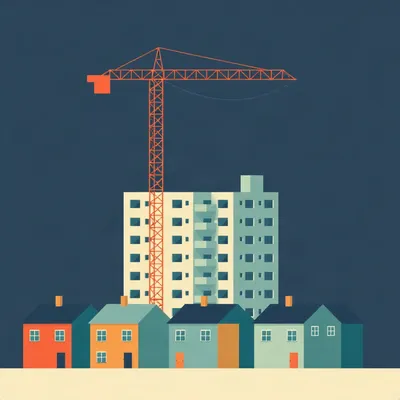
Daniel sent us this one — and it's less a question and more a call to arms disguised as a question. He's watching Jerusalem fill up with glass towers that sit dark at night while families who actually live here can't afford a two-bedroom apartment. He sees the anger bubbling up in comment sections and Facebook groups, he feels it himself, but he's asking the thing nobody seems to have an answer for: how do you take that diffuse frustration and turn it into actual political power at the municipal level? Not national politics, not running for office — grassroots organizing where the decisions actually get made. And he's right that organized opposition to Jerusalem's overall development strategy basically doesn't exist yet. So the question is, how do movements like this start from zero?

This is the right question at the right moment. The May municipal budget cycle just closed, and the city council approved another twelve hundred luxury housing units in the Baka and Talpiot zones with what I can only describe as performative debate. A few council members made speeches, the votes were tallied, and that was that. The disconnect between what people are saying and what's actually happening in those planning rooms has never been more stark. And it's not for lack of noise. The Jerusalem for All Facebook group has about twelve thousand members. There was a petition against the Gateway project with eight thousand signatures. Op-eds in Haaretz, in the Jerusalem Post. But noise is not leverage.
That's the puzzle. You've got nearly half the city living in poverty — the Jerusalem Institute for Policy Research put the rate at about forty-six percent in their twenty twenty-four report — and yet the skyline is being reshaped for people who don't vote here, don't live here, and in many cases don't even turn the lights on. Ir Amim, the NGO, published something they called the Vertical Vacancy report in March of this year documenting exactly this. Towers marketed in Miami and Paris and Moscow, sold to investors who treat the units like parking spots for capital, and the windows stay dark.
The image that sticks with me is a forty-story tower in the Gateway complex with maybe twelve occupied units visible at night. You can stand on the promenade in Talpiot and count them. It's not subtle. And yet the pipeline keeps moving.
Let's unpack why this paradox exists — and why the usual tools of protest haven't worked. Because if you're Daniel, or anyone who cares about this, the first thing you need to understand is why the outrage hasn't translated into outcomes. Otherwise you're just adding more noise to a system that's very good at ignoring noise.
And I think there are three structural barriers that are specific to Jerusalem, and they interact in ways that make organizing unusually difficult. The first is political fragmentation. Jerusalem's city council has thirty-one municipal factions. Many of them represent ultra-Orthodox and nationalist-religious blocs whose primary interest in housing policy is settlement expansion, not affordability within the city's existing neighborhoods. So when a luxury tower gets approved in Baka, it's not that these factions oppose it — they're not paying attention to it. Their political energy is directed elsewhere. The second barrier is the weak mayor system. Mayor Moshe Lion, who's been in office since twenty eighteen, has limited authority relative to the national ministries, especially the Israel Land Authority, which controls ninety-three percent of the land in Jerusalem. So even if the mayor wanted to mandate affordable housing, the city doesn't control the land it's built on. And the third barrier is the investor-driven market itself. Foreign buyers don't vote in municipal elections. Their interests are invisible to the electorate but highly visible in planning committees, where developers make the case that luxury units bring tax revenue.
You've got a city council that's structurally distracted, a mayor who can't unilaterally change zoning policy even if he wanted to, and a developer lobby that can point to tax receipts while residents point to dark windows. It's a machine designed to produce exactly the outcome we're seeing.
Here's the thing about machines — you don't stop them by yelling at them. You stop them by understanding which lever actually controls the mechanism.
Which brings us to the first real question: what organizing models actually work in fragmented, multi-ethnic cities where the people most affected by bad policy are the least likely to vote in local elections?
Let me give you two case studies that I think map onto Jerusalem's situation in useful ways. The first is the Lewisham Community Land Trust in London. Lewisham is a borough with deep economic inequality, a mix of ethnic communities, and a wave of luxury development that was pushing out long-term residents. In twenty fourteen, a group of about thirty residents — not politicians, not professional activists, just people — formed a legal entity that could bid on development sites. A community land trust is essentially a nonprofit that owns land and leases the housing on it at permanently affordable rates. The trust model gives residents legal standing. They're not protesters outside the planning meeting — they're a developer with a competing proposal.
That's a fundamentally different posture. You're not asking permission. You're making an offer.
And by twenty twenty-five, the Lewisham trust had secured two hundred units at sixty percent of market rent. That's not a symbolic victory. That's two hundred families who are still in the borough who would have been pushed out. The key strategic insight is that they didn't try to stop all development. They focused on a single, concrete demand: no more luxury towers without a forty percent affordable component. And they had the legal entity to back it up.
How did they actually recruit people? Because "form a legal entity" is a big step from "I'm angry on Facebook.
They started with house meetings. Literally, someone would invite ten neighbors to their living room, explain the trust model, and ask each person to invite ten more. Within six months they had a steering committee of twenty-five people who represented different neighborhoods and demographics. They raised initial funding through community shares — residents could buy into the trust for as little as a hundred pounds. That gave people skin in the game and created a constituency that would show up to planning meetings because they literally owned part of the organization.
The recruitment mechanism was itself the organizing mechanism. You're not just signing a petition, you're becoming a member-owner of something.
And that changes the psychology completely. A petition signer can get discouraged and disengage. A member-owner has a stake and keeps showing up.
What's the second case study?
The fifteen-minute city campaign in Paris, from twenty twenty to twenty twenty-four. This started as a non-partisan coalition of urbanists, parents, and small business owners who were frustrated with car-centric planning. They didn't have a trust model, but they used participatory budgeting — a mechanism where the city sets aside a portion of its budget for projects that residents directly vote on. Over four years, they redirected about fifty million euros from road expansion to local housing co-ops. The key move was framing their demand around something concrete and positive — not "stop building roads" but "redirect this specific budget line to housing co-ops." And they built a coalition that crossed ideological lines because everyone could agree on "my kid should be able to walk to school" and "local shops shouldn't be replaced by chain stores.
The phrase "fifteen-minute city" is doing a lot of work there. It's a vision, not just a complaint. And it's hard to organize people around a complaint for more than a few months. You need a vision.
That's exactly the mistake most Jerusalem activism makes right now. It's all complaint. "Stop the towers." "The towers are bad." "Foreign investors are ruining the city." All true, but none of it tells people what you're for. What's the Jerusalem equivalent of the fifteen-minute city? What's the positive vision that a Haredi mother in Sanhedria and a secular student in Baka can both get behind?
Affordable housing for all Jerusalemites. That's the frame. Not "stop the luxury towers" but "every new development must include housing that actual Jerusalemites can afford." The luxury towers become the wedge issue, but the platform is universal.
This is where the Gateway project becomes strategically important. It's a forty-story tower complex approved in twenty twenty-four. It's visible from half the city. It's controversial. And critically, the next planning committee vote is scheduled for September of this year. That's a concrete decision point. It's not some abstract future threat — it's a meeting on a specific date where specific people will vote on specific permits. If you're trying to build a movement from zero, you need a focal point that has a deadline.
Deadlines create urgency. Urgency creates attendance. Attendance creates leverage.
The leverage is real. Under the Public Participation in Planning law, amended in twenty twenty-three, developers are required to hold public hearings for any project over ten units. These hearings are public. They're held at Safra Square. And they are almost always empty.
Of course they are. Nobody knows they're happening, and the people who do know assume showing up won't matter.
Which is a self-fulfilling prophecy. The Tel Aviv Stop the Towers campaign, which ran from twenty twenty-two to twenty twenty-four, figured out how to break that cycle. They built a simple website where residents could enter their address and see if they were within five hundred meters of a proposed tower. If they were, the site auto-generated a letter to the planning committee with their name and address. Within six months, they had three thousand unique letters submitted. And then they took it further — they used WhatsApp groups organized by neighborhood to coordinate attendance at planning meetings. Five hundred people showing up to a committee that's used to seeing five.
Five hundred people changes the political calculus. A planning committee member who was going to vote yes without thinking now has to explain that vote to five hundred voters who are watching.
In Tel Aviv, it led to the rejection of three major projects. Not because the planning rules changed, but because the political cost of approval became visible. That's the mechanism. The rules don't need to change for the outcome to change.
Let's apply this to Jerusalem. What would it actually look like for someone sitting in their apartment in Baka or Katamon right now, frustrated and wanting to do something, to start building this?
I think there are three phases, and they map onto three different time horizons. Phase one is the next ninety days, leading up to that September planning committee vote on the Gateway project. The goal here is simple: pack the room. Find the date, publicize it, coordinate attendance. This doesn't require a formal organization. It requires a WhatsApp group and a clear call to action. The Jerusalem for All Facebook group already has twelve thousand members — that's the distribution channel. But Facebook is good for awareness, not for coordination. The move is to create a dedicated WhatsApp broadcast or Signal group specifically for planning committee actions. One message a week: here's the meeting, here's the time, here's where to stand, here's what to say if you get called to speak.
What do you say if you get called to speak?
You don't give a speech about the soul of Jerusalem. You say: "I am a resident of this neighborhood. I have lived here for X years. Under the Public Participation in Planning law, I am requesting that the committee require a community impact assessment before approving this permit. I want to know how many affordable units are included, what percentage of the building will be sold to foreign investors, and what the projected occupancy rate is based on comparable projects in the area." That's it. Specific, legal, on the record. The goal is not to win the argument in the room. The goal is to create a record that can be used later.
Because if the committee ignores the request and approves the permit anyway, and then eighteen months later the building is seventy percent dark, you've got a documented trail of being ignored. That's fuel for the next phase.
Phase two is the twelve-to-eighteen-month horizon, which is about building an organization with legal standing. This is where the community land trust model or something like it becomes relevant. You need a legal entity that can do three things: hold money, submit alternative planning assessments, and endorse candidates. The community impact assessment tool, which was created under the twenty twenty-three Planning Reform, is particularly powerful here. It allows residents to submit their own analysis of a project's impact on local housing affordability, and the city is required to respond in writing within sixty days. Most residents don't know this exists. Most planning committees hope they never find out.
You weaponize a bureaucratic tool that's already on the books. You don't need to pass a new law. You just need to use the one that's already there.
The Berlin thirty percent solution referendum in twenty twenty-one is instructive here. The campaign was led by a coalition of renters' unions, artists, and church groups — explicitly not traditional political parties. Their demand was simple: thirty percent affordable housing in all new developments. They collected signatures, got it on the ballot, and won. But the organizing that made that possible took three years. They started with exactly the kind of house meetings and local assemblies we're talking about. The referendum was the culmination, not the beginning.
This connects to the third phase, which is the twenty twenty-eight municipal elections. That's two and a half years away. If you start now, you can build something that shapes who runs and what they run on.
This is where the candidate recruitment angle comes in. The prompt says explicitly, I don't intend to run for office, but I'd love to find others who might. That's the right instinct. A drafting committee — three to five credible candidates from diverse backgrounds, recruited specifically to run on a housing-first platform. A young professional who's been priced out of the neighborhood they grew up in. A Haredi mother who's watching her children struggle to find housing near their community. A Palestinian resident of East Jerusalem who can speak to the neglect of building permits and infrastructure in their neighborhoods. The platform is universal: all new developments must include at least thirty percent affordable units, and foreign ownership of new builds is capped at ten percent.
The coalition potential here is genuinely interesting. The Haredi community faces one of the most acute housing crises in the city — large families, limited income, and political leadership that prioritizes settlement expansion in the territories over affordable housing within Jerusalem. A platform that says "housing for Jerusalemites first" doesn't ask them to abandon their political commitments. It just asks them to add housing affordability to the list.
That's the strategic insight. You don't need people to agree on everything. You need them to agree on one thing. The housing crisis affects secular Jerusalemites, religious Zionists, Haredim, and Palestinians. They experience it differently, but they all experience it. That's a potential cross-identity coalition that literally no one has tried to build.
Which brings us to the misconception that needs to be named directly. The idea that grassroots organizing can't work in Jerusalem because the city is too divided. The reality is that the divisions are real but the housing crisis cuts across all of them. The question is whether anyone can articulate a vision that's compelling enough to make people show up for something that isn't their usual political tribe.
The second misconception is that the municipal government has no power because the Israel Land Authority controls the land. It's true that the ILA controls ninety-three percent of the land, which limits what the city can do unilaterally. But the city controls zoning, density bonuses, and planning approvals. Those are powerful levers. A density bonus is when a developer gets permission to build taller than zoning allows in exchange for providing a public benefit — usually affordable units. Jerusalem could mandate that any density bonus comes with a forty percent affordability requirement. That's entirely within the city's authority. They just haven't done it.
The lever exists. It's just not being pulled.
The third misconception is the one that probably frustrates me most: the idea that online petitions and Facebook comments are enough to create change. They're not. They're useful for awareness and for demonstrating that a constituency exists. But digital mobilization has to be paired with in-person organizing at the actual decision points. A thousand likes on a post about the Gateway project means nothing to a planning committee member who sees an empty room at the hearing. A hundred people in that room means everything.
Let's get concrete. If you're sitting in Jerusalem right now, frustrated and wondering what to do next Monday morning, here are three steps that don't require an organization, don't require funding, and don't require anyone's permission.
Step one: start a planning committee watch. The municipal planning committee meets monthly at Safra Square. The meetings are public. The agendas are published in advance on the city website — they're in Hebrew, but Google Translate works. Get three or four people to commit to attending every meeting, rotating who goes. The output is a one-page summary in Hebrew, Arabic, and English, posted to the Jerusalem for All group within forty-eight hours. That's it. You're not protesting. You're not organizing. You're just making the process visible. Transparency is itself a form of pressure.
Because right now, these decisions are being made in a room that functionally doesn't exist to most residents. You shine a light on it and suddenly the calculus changes.
Step two: use the community impact assessment tool. Pick one project — the Gateway tower is the obvious choice — and submit a formal assessment. You don't need to be a lawyer or an urban planner. You need to document what's already visible: occupancy rates of comparable luxury buildings in the area, the gap between market prices and what median-income Jerusalem families can afford, the projected impact on neighborhood infrastructure. The city has to respond within sixty days. If they dismiss it, you have a record. If they engage with it, you have a seat at the table.
Step three: build the candidate pledge. Draft a simple, one-page commitment that any municipal candidate can sign. It says: I will support a thirty percent affordability mandate in all new developments, I will oppose zoning changes that don't include community benefit agreements, and I will attend at least one planning committee meeting per quarter. It's not a comprehensive platform. It's a floor. And you start circulating it now, two and a half years before the twenty twenty-eight election, so that by the time campaigns start, the pledge is already part of the conversation.
The candidate pledge is deceptively powerful. It gives you something to ask every incumbent and every challenger: have you signed the housing pledge? If they have, great — now they're on the record. If they haven't, you get to ask why not. And it creates a permission structure for people who might want to run but don't think they have a base. If five hundred people have already signed on as pledge supporters, that's a ready-made constituency for a candidate who commits to the platform.
The pledge doesn't require you to be a political operator. You're just a person with a clipboard and a clear ask. That's how movements start.
Let me add a fourth step that's more about sustainability. Between election cycles, movements die if they don't have a regular rhythm. The planning committee watch provides a monthly cadence. But you also need something social — a quarterly assembly, maybe in a park or a community center, where people can actually see each other. Digital organizing is efficient but it's thin. You need the thickness of shared space, shared food, shared presence. The Lewisham group did an annual community feast. The Paris group did neighborhood walks. It sounds soft, but it's what keeps people connected when there isn't an urgent crisis.
Like adopting a feral cat.
You feed it, you show up regularly, you don't make sudden movements, and eventually it trusts you.
not the analogy I would have chosen, but I can't say you're wrong.
Let's talk about what happens if this actually works. Not the full victory scenario — nobody's passing a comprehensive housing reform in the next two years — but the intermediate scenario. The planning committee starts seeing packed rooms. The community impact assessments start getting filed. A couple of council members realize there's a constituency they've been ignoring and start making noise about affordability. What does the developer response look like?
The developer playbook in these situations is predictable. First, they'll argue that luxury units generate tax revenue that funds city services, so blocking luxury development hurts everyone. The counterargument is that the tax revenue from a half-empty tower is less than the revenue from a fully-occupied mixed-income building, and that the infrastructure costs — water, sewage, roads, schools — are the same either way. Second, they'll argue that the free market should determine housing prices and that mandates distort the market. The counterargument is that the market is already distorted by foreign investment that treats housing as an asset class rather than shelter, and that affordability mandates are correcting a market failure, not creating one.
Third, they'll argue that Jerusalem needs to be a "world-class city" and that luxury towers are part of that vision. This is the one that's hardest to counter because it's purely aesthetic. It's not an economic argument, it's a status argument.
The counter to that is that a world-class city is one where the people who work in it can afford to live in it. A city of dark towers and displaced families is not world-class. It's a Potemkin village with better architecture.
That's the message discipline piece. Every argument the developers make has to be met with the same reframe: we're not against development, we're for development that serves the people who actually live here. The goal isn't to stop building. The goal is to change what gets built and who it's for.
There's a broader point here about how movements sustain themselves between visible victories. The Tel Aviv campaign had a clever metric: they counted not just policy wins but "process wins." Getting the planning committee to extend the public comment period by two weeks was a win. Getting a developer to publish their occupancy projections was a win. Getting a council member to ask a specific question about affordability during a hearing was a win. These small victories kept people engaged during the long stretches where nothing dramatic was happening.
Because if the only thing that counts as victory is a policy reversal, you're going to be disappointed for years. But if you're building power incrementally — more people in the room, more questions on the record, more council members on notice — you can see the trajectory even when the outcomes haven't flipped yet.
That's the mindset shift that grassroots organizing requires. It's not a campaign with an end date. It's a permanent infrastructure for accountability. The planning committee watch doesn't stop when the Gateway project gets approved or rejected. It becomes a permanent feature of how the city is governed. The candidate pledge doesn't expire after the twenty twenty-eight election. It becomes the baseline expectation for anyone who wants to hold office.
If you're listening to this and you're in Jerusalem and you want to be part of making this happen — specifically the planning committee watch or the community impact assessment work — we've set up an email address. Jerusalem at myweirdprompts dot com. Send us a note. We'll connect you with others who've reached out. This isn't us organizing it. This is us being a switchboard.
If you're not in Jerusalem but you're in a city facing the same dynamics — Vancouver, Lisbon, Dubai, take your pick — the framework transfers. Find the decision point. Pack the room. Use the bureaucratic tools that already exist. Build something that outlasts the current crisis.
The open question is whether Jerusalem, of all places, can pull this off. It's a city that's holy to three religions, politically fragmented in ways that seem designed to prevent collective action, and economically stratified to a degree that makes the luxury towers almost allegorical — glass monuments to capital towering over neighborhoods where families can't afford rent. If a grassroots movement can succeed here, it can succeed anywhere.
The counterpoint is that Jerusalem has always been a city of intense local identity. People care about their neighborhoods here in a way that's unusual. The attachment isn't abstract. It's specific — this street, this bakery, this view of the valley. That's the raw material of organizing. You don't have to convince people to care. You just have to give them something to do with the caring.
These are small steps, but they add up. The question is whether enough people will take them.
Now: Hilbert's daily fun fact.

The largest cuttlefish species, Sepia apama, can change its skin color and texture in under one second, and during the interwar period, a specimen was recorded off the coast of what was then British Somaliland measuring over one meter in mantle length and weighing nearly twenty-three pounds — making it the heaviest cuttlefish ever documented in the Indian Ocean.
Twenty-three pounds of camouflage.
a lot of cuttlefish.
This has been My Weird Prompts. If you want to support the show, the single most helpful thing you can do is leave a review wherever you're listening — it helps other people find us. We're at myweirdprompts dot com for everything else, including show notes and that Jerusalem email address we mentioned. I'm Herman Poppleberry.
I'm Corn. See you next time.