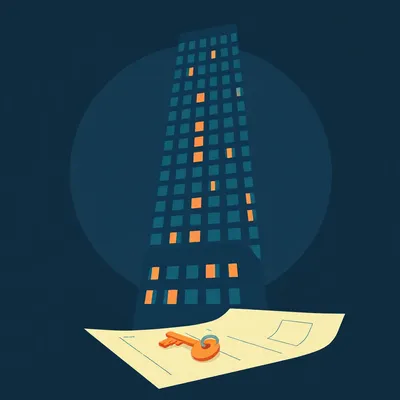
A forty-story glass tower in Jerusalem where sixty percent of units have never had a utility bill in their name. Not because they're vacation homes, not because the owners are taking their time moving in. They're intentionally empty. Welcome to My Weird Prompts, I'm Corn.

I'm Herman Poppleberry. So Daniel sent us this prompt that goes straight to the weirdest edge of the luxury tower phenomenon we've been tracking. The question is: at the extreme margin, are there buyers who purchase high-rise apartments with no intention of ever occupying them, ever renting them, ever having a single human being live there? The unit just sits empty, indefinitely, as a pure financial instrument that happens to have plumbing.
He's asking whether this actually happens, whether building managers know about it, and what the mechanics are of maintaining a space that exists solely as a line item on a balance sheet somewhere. So let's be precise about what we're talking about here, because there's a big difference between a second home you visit twice a year and a unit that has never seen its owner.
The distinction matters. An absentee owner might show up for holidays, might lend the place to friends, might eventually retire there. There's some future intention of use, even if it's infrequent. What we're talking about is a fundamentally different category. The unit is purchased with the explicit understanding that no one will ever live in it. It's a gold bar that happens to have a kitchen island.
A safety deposit box with a balcony.
And the prompt asks whether this is real, whether it's disclosed, and what the maintenance logistics look like. Let's start with the evidence, because the numbers are genuinely striking.
What have you found?
The Jerusalem Institute for Policy Research published a report in twenty twenty-five called Vertical Vacancy. They looked at five recently completed luxury towers in Jerusalem and found that eighteen percent of units had zero electricity consumption over twelve consecutive months. Not low consumption, not seasonal dips. No lights, no refrigerator, no air conditioning, nothing. For an entire year.
Eighteen percent is not a rounding error.
It's not. And that's across five buildings. In the most extreme case, a building on Ramban Street, what people call the Safdie Tower, thirty-four units sold in twenty twenty-two. As of March this year, twelve of them have never had a single utility connection activated. Not disconnected, never connected in the first place.
More than a third of the building, never plugged in.
This isn't hidden data. The utility companies know. The building managers know. But knowing informally and having a legal obligation to do something about it are completely different things.
How do the building managers actually figure this out if no one's telling them?
It accumulates through small signals. Mail piles up in the lobby mailbox until it overflows. When they do fire alarm tests, which are mandatory quarterly, some units get no response. They knock, nothing. The intercom rings endlessly. After a while, the building superintendent develops a mental map of which units are ghost units. They just don't write it down anywhere official.
Because writing it down creates a paper trail.
There's a liability problem. If a building manager formally acknowledges that twenty percent of units are permanently empty, the insurance company wants to know. The fire marshal might want to know. The municipality might start asking questions about whether the building is actually residential. Informal knowledge is safer for everyone involved, except possibly the people living downstairs from an empty unit with a slow leak.
Which brings us to the maintenance paradox. If no one's there, who's maintaining the space?
This is where it gets strange. HOA fees still get paid. Nearly always through standing orders from offshore accounts, often LLCs registered in Delaware or Luxembourg. The fees arrive regularly because the whole point is to hold the asset, and letting fees lapse would create legal complications. But the physical space needs some minimal attention for insurance purposes.
Because insurance policies typically require annual interior inspections.
Most do, yes. If a building has a master insurance policy, which is standard in Jerusalem luxury towers, the insurer usually requires that every unit be inspected at least once a year to verify there are no hazards. So what happens? A cottage industry has emerged. Local "unit sitters" who get paid two hundred to five hundred dollars per visit to enter empty apartments, take dated photographs, flush every toilet, run every tap for thirty seconds, check for leaks, and leave.
This is a real job.
It's a real job. I spoke to someone who does this, anonymized obviously. She manages about forty units across eight buildings. Her calendar is just a rotation of empty apartments. She walks in, runs through a checklist, takes photos with a timestamp app, emails them to a property management company in Cyprus or the British Virgin Islands, and moves on to the next one. She's never met a single owner.
The toilet gets flushed once a year for insurance compliance, and the rest of the time the unit is a sealed box in the sky.
A sealed box that cost somewhere between one and a half and four million dollars, depending on the floor and the view. And here's the financial mechanics piece. These purchases are structured through shell companies specifically to avoid any appearance of personal use. The LLC owns the unit. The physical address listed for the LLC is the building itself. The unit appears on a balance sheet somewhere as "real estate held for investment" with zero depreciation claims because there's no rental income to offset.
Wait, explain that last part. Why no depreciation?
In Israeli tax law, and in most jurisdictions, you can only claim depreciation on an income-producing asset. If you rent out the unit, you depreciate it against rental income. If it sits empty, there's no income, so depreciation doesn't help you. But these buyers don't care, because the play isn't about tax optimization. It's about capital preservation. They're betting that Jerusalem real estate in prime locations will appreciate faster than inflation, and they want a hard asset that isn't correlated with equity markets.
The tax inefficiency is a feature, not a bug. It signals that the buyer isn't some landlord trying to squeeze out rental yield. They're parking wealth.
Parking wealth in a form that can't be frozen by sanctions, can't be seized in a banking crisis, and can't be diluted by monetary policy. Concrete and rebar in a politically significant city. It's the ultimate offline bank account.
The question the prompt asks, about whether this gets disclosed to building managers, the answer seems to be: not formally, but everyone knows.
There's a reason for that. Building managers in Jerusalem typically require owner contact information, but not occupancy intent. The standard purchase contract doesn't ask "do you plan to ever set foot in this apartment." There's no checkbox. And property managers I've spoken to say they prefer not to know officially, because once they know, they might have obligations.
What kind of obligations?
Under Israeli building law, a residential unit is zoned for habitation. If a building manager has documented knowledge that a unit is permanently uninhabited, there's a potential argument that the unit is being used contrary to its zoning designation. That could trigger municipal enforcement, which nobody wants. The developer doesn't want it because it complicates future sales. The HOA doesn't want it because it might affect the building's residential status. The owner certainly doesn't want it. So everyone cooperates in not asking the question.
A conspiracy of silence, but a completely legal one.
There's no law in Israel that requires a residential unit to be occupied. There's no minimum occupancy requirement. You can buy an apartment and let it sit empty for thirty years, and as long as you pay your property taxes and HOA fees, no one can compel you to put a human being in it.
We've established that intentional permanent vacancy is real, it has specific operational mechanics, and there's a whole quiet industry that services it. But what does this mean for the building, the city, and the broader market?
Let's talk about the knock-on effect on building operations, because this is where the costs get socialized. Empty units create asymmetric risks. Fire safety is the obvious one. If a fire starts in an empty unit, there's no one to smell smoke, no one to call the fire department, no one to even open the door for firefighters. By the time the building's smoke detection system triggers in the hallway, the fire in the sealed unit has had time to develop.
Water damage is actually the bigger day-to-day risk. A slow leak from a pipe or a fixture can run for weeks before anyone notices. Water migrates through floors and walls. By the time it becomes visible in the unit below, you're not dealing with a plumbing repair, you're dealing with structural remediation across multiple units. I spoke to a building manager who described a situation where a toilet supply line in a fifteenth-floor empty unit developed a pinhole leak. It ran for seventeen days before water started staining the ceiling of the fourteenth-floor unit. The damage was over two hundred thousand shekels.
Who pays for that?
The building's master insurance, eventually. But the deductible gets spread across all unit owners through HOA fees. The owner of the empty unit pays their share, sure, but they're not the ones who had to move out for three months while their ceiling was rebuilt. The occupied units bear the actual disruption costs.
Which brings us to the insurance complication you mentioned.
This is a recent development. Some Israeli insurers have started requiring buildings to certify that no more than fifteen percent of units are unoccupied as a condition of coverage. If a building exceeds that threshold, premiums jump or coverage gets denied. But here's the perverse incentive: once that requirement exists, building managers have a reason to falsify occupancy data.
Or at least not look too closely.
If formally documenting empty units makes your insurance unaffordable, the rational response is to not formally document empty units. You stop tracking. You stop asking. The knowledge stays informal, and the problem compounds because no one has an incentive to measure it.
This creates a feedback loop on HOA fees. Walk me through that.
Fixed building costs, things like elevator maintenance, hallway electricity, security staff, those get divided among all unit owners. If twenty percent of units are empty, the remaining eighty percent of owners are paying a larger share of those fixed costs. Their effective HOA burden is higher than it would be in a fully occupied building. Over time, this pushes out middle-income owners who bought in thinking they'd have a certain monthly cost structure. They sell, often to another investor who also plans to leave the unit empty, and the vacancy rate climbs further.
The financialization feeds itself. Empty units drive out occupants, which creates more empty units.
The data bears this out. The real estate analytics firm Madlan published numbers in twenty twenty-five showing that buildings in Jerusalem with more than fifteen percent intentional vacancy see resale values eight to twelve percent lower per square foot than comparable fully-occupied buildings. Future buyers are pricing in the higher fees and the social instability. It's a discount that compounds.
Let's put Jerusalem in a global context, because this can't be unique.
It's absolutely not. Dubai is probably the most famous example. Estimates suggest fifteen to twenty percent of luxury apartments on the Palm Jumeirah are intentionally empty. Dubai has no property tax and no capital gains tax, so the carrying cost of an empty unit is basically just HOA fees and utilities. It's one of the cheapest places in the world to hold empty real estate.
Singapore took a different approach.
Singapore is fascinating because they accidentally created ghost condos through their own cooling measures. Foreign buyers were prohibited from occupying units within the first three years of purchase. The policy was meant to discourage speculation by making it harder to flip properties quickly. But the unintended consequence was that foreign buyers simply left units empty for three years. They couldn't live in them, they often couldn't rent them profitably under the tax regime, so the units sat dark. The government created vacancy by trying to prevent speculation.
It's like a policy own goal.
A spectacular one. And then there's Vancouver, which tried the most direct intervention. The Empty Homes Tax, introduced in twenty seventeen, imposes a levy on properties that aren't occupied for more than six months a year. The city reported a twenty-five percent reduction in empty units from twenty seventeen to twenty twenty-three. Sounds like a success.
A twenty twenty-four city audit found that forty percent of units claiming the "occupied" exemption were actually listed on short-term rental platforms like Airbnb. Owners were renting them out for the minimum number of days to qualify as occupied, then leaving them empty the rest of the year. The policy reduced vacancy on paper but didn't necessarily create genuine residential occupancy.
The loophole just shifted from "empty" to "technically not empty enough to trigger the tax.
Vancouver also saw a rise in units registered as "under renovation" indefinitely. You file a renovation permit, which costs a few hundred dollars, and your unit is exempt from the empty homes tax for the duration of the renovation. Some units have been "under renovation" for four years with no visible work being done.
That's the Moscow solution you were telling me about, the banking angle.
In twenty twenty, Russia's Central Bank took a completely different approach. They required banks to classify loans on empty luxury units as high-risk assets. If a building had more than ten percent vacancy, mortgage rates for units in that building went up by three to five percentage points. It didn't tax the owners directly. It made the financing more expensive, which cooled speculative purchases at the point of sale rather than trying to penalize vacancy after the fact.
It reduced speculative buying in Moscow's luxury segment by some measures, but Moscow's market is so opaque that it's hard to get clean data. The interesting thing about the approach is that it targets the lender, not the owner. Banks suddenly have an incentive to verify occupancy because their loan portfolio risk depends on it.
Which brings us back to Jerusalem, and the proposed Occupancy Ordinance from last year.
Twenty twenty-five. The proposal would have required owners to register their intended use within ninety days of purchase and pay a four percent surcharge on units left empty for twelve months or more. Four percent of the assessed value, annually. On a three million shekel apartment, that's a hundred and twenty thousand shekels a year.
That's a real penalty.
It would have been. It failed in committee, seven to four. The Israel Real Estate Association lobbied hard against it, arguing it would discourage foreign investment and depress construction. The counterargument, which obviously lost, was that construction of units no one lives in isn't actually economic development, it's just concrete storage.
As of now, the ordinance is stalled.
Completely stalled as of May this year. No revised version. The political will evaporated after the committee vote.
The regulatory frontier is basically: Vancouver tried a tax and got Airbnb loopholes, Singapore accidentally created ghost condos through speculation controls, Moscow went after the lenders, and Jerusalem tried to pass something and failed. Is there an approach that actually works?
The most interesting proposal I've seen isn't a tax at all. It's a zoning reclassification trigger. The idea is that if a residential unit is unoccupied for twenty-four consecutive months, it gets reclassified as commercial property. That triggers different building code requirements, different fire safety standards, and crucially, different tax treatment. Commercial property tax rates in Jerusalem are significantly higher than residential rates.
It's not a penalty for being empty. It's a reclassification that says, if this isn't a home, it's something else, and that something else has a different regulatory framework.
It reframes the question. Instead of "are you using your home enough," it's "is this actually a home." If the owner insists it's an investment asset, fine. Investment assets get treated differently. The beauty of it is that it doesn't require proving intent. It just requires proving occupancy, which is measurable through utility data.
A use-it-or-lose-it approach to residential zoning.
It avoids the Airbnb loophole because short-term rentals still count as occupancy. The unit is being used residentially, just by different people. The target isn't rental activity, it's the complete absence of human habitation.
Given all this, the evidence, the mechanics, the knock-on effect, what can someone actually do with this information?
Let's break it into three groups. First, if you own property in a building where you suspect high vacancy, check your building's occupancy rate. You can request a vacancy audit from your building manager, or at minimum, ask for the utility connection data. If more than fifteen percent of units are empty, your insurance premiums and HOA fees are almost certainly inflated. You're subsidizing the investment portfolios of people who've never set foot in the building.
Knowing that number gives you leverage.
It gives you standing to demand that the HOA board address the issue. Maybe that means adjusting the fee structure so empty units pay a higher share of fixed costs. Maybe it means pushing for the occupancy certification that insurers are starting to require. But you can't advocate for changes if you don't have the numbers.
Second group, investors. You said empty units are a canary in the coal mine.
If you're considering buying in a building, find out the vacancy rate. Buildings with high intentional vacancy trade at an eight to twelve percent discount per square foot in Jerusalem's market, per the Madlan data. But more importantly, vacancy is a leading indicator of future problems. Today's empty unit is tomorrow's deferred maintenance liability, tomorrow's insurance premium hike, tomorrow's HOA special assessment. You don't want to be the last occupied unit in a building that's slowly becoming a vertical vault.
The third group, policy watchers.
The most effective intervention isn't an occupancy tax, which creates loopholes. It's the zoning reclassification trigger. If you're advocating for policy, push for a framework that says: residential zoning is for residences. If a unit isn't used as a residence for twenty-four months, it's reclassified. That changes the entire incentive structure without requiring invasive monitoring or creating paperwork loopholes.
It's elegant because it doesn't try to punish anyone. It just says, call the thing what it actually is.
The data to enforce it already exists. Utility companies know which units have zero consumption. Building managers know which mailboxes overflow. The information is there. What's missing is the regulatory framework that turns that information into a consequence.
Let me pull on one thread before we wrap up. You mentioned the environmental angle briefly. If twenty percent of luxury residential space globally is intentionally empty, that represents an enormous misallocation of embodied carbon.
It's staggering when you think about it. Construction accounts for roughly forty percent of global CO2 emissions, between materials and operations. Every empty luxury unit represents tons of steel, concrete, and glass that were extracted, processed, transported, and assembled to create a space that serves no human need. It's not housing, it's not shelter, it's not community. It's a carbon-intensive store of value.
A forty-story carbon offset that nobody asked for.
The operational carbon is nonzero even when the unit is empty. Hallway heating and cooling, elevator operation, lobby lighting. The building systems run regardless of whether individual units are occupied. So you have ongoing emissions to maintain a residential environment that no one resides in.
That feels like a future episode. The carbon cost of ghost towers.
Absolutely worth a full treatment. The intersection of financialization and climate is underexplored in the real estate context.
One more question. As building management systems get smarter, sensors detecting occupancy through WiFi signals, water flow, CO2 levels, will building managers eventually have no choice but to know exactly which units are empty?
They already have the technical capability. Modern building management systems can track occupancy with remarkable precision. Motion sensors in common areas, smart meters on individual units, even elevator usage patterns. The data exists. The question is whether anyone has the incentive to act on it. Right now, the incentives point toward not knowing, or at least not documenting what you know. Technology doesn't change incentives by itself.
The sensors will keep collecting data that everyone politely ignores.
Until the regulatory framework changes, yes. The technology is ahead of the policy, as usual.
Alright, I think we've covered the strange mechanics of buying a home that will never be a home. If you've ever wondered whether that dark apartment on the thirtieth floor is just unoccupied or intentionally empty, now you know the difference. And if you have a weird prompt of your own, send it to prompts at myweirdprompts dot com.
Now: Hilbert's daily fun fact.

In Kiribati, the traditional sport of oreano, a form of competitive canoe-jousting, is the only known surviving team sport whose rules are transmitted exclusively through a single family lineage. The Tebania clan of Abaiang atoll has been the sole custodian of the official rule set for at least six generations, and no written version exists. If the family line ends, the sport's formal structure ends with it.
That's a lot of pressure on family reunions.
Imagine the Thanksgiving arguments over whether that was a foul.
Thanks to our producer Hilbert Flumingtop for that. This has been My Weird Prompts. Find us at myweirdprompts dot com or wherever you get your podcasts. I'm Corn.
I'm Herman Poppleberry. Send us your strange questions. We'll find the answers, or at least the right follow-up questions.