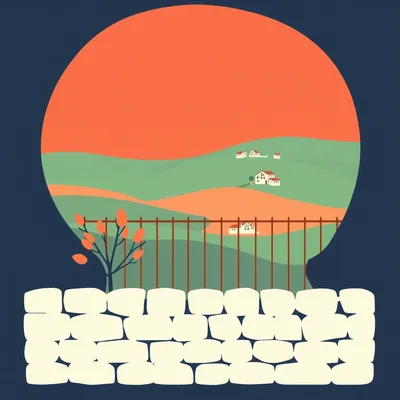
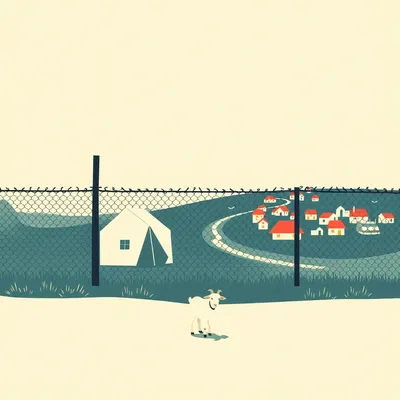
Daniel sent us this one — he's asking about the north of Israel, specifically what life is actually like up there in places like Metula and Kiryat Shmoneh. Is it still the periphery in that old sense, underdeveloped and dependent on agriculture and tourism? And with the government now trying to incentivize development in the Golan Heights, what might significant development in the north actually look like? It's a good question, because the north occupies this strange space in the Israeli imagination — everyone has an opinion, most people have driven through it, but very few people outside the north actually know what it's like to live there.

The numbers tell you why. Israel's north — the Galilee panhandle, the finger that pokes up toward Lebanon — has about one point six million people across the whole northern district, but the density falls off a cliff once you get north of the Kinneret. Kiryat Shmoneh, the largest town in that far-north corridor, has about twenty-three thousand people. Metula, the northernmost community in the country, is under two thousand.
Metula is basically a village with a main street and a really excellent view of Lebanon.
That's not even a joke. You can stand at the northern edge of Metula and look directly into southern Lebanon. The border fence is right there. And this shapes everything about life in the north — geography isn't backdrop, it's destiny. Metula was founded in eighteen ninety-six as a Jewish agricultural settlement, and for most of its history it's been a farming town surrounded by orchards. But the defining feature is that it's a border town, and being a border town in northern Israel means living with a very specific kind of uncertainty.
The kind that involves rockets.
And it's not just rockets — it's the entire security architecture. Kiryat Shmoneh was named for eight Zionist pioneers killed defending the area, and the town was founded in nineteen forty-nine as a transit camp for Jewish immigrants, mostly from North Africa and the Middle East. It was literally built as a development town, one of those places the early state created to populate the periphery, and it's carried that identity for seventy-five years. The town's economy was built on textile factories and agriculture, and when those industries declined dramatically starting in the eighties and nineties, the place didn't have an obvious next act.
This is the periphery story in a nutshell. The state says we need people here for strategic reasons, we'll build housing and offer incentives, industry will follow, and then it doesn't quite work out. And the north has this extra layer — you're not just economically peripheral, you're physically exposed in a way that makes investment decisions harder.
That exposure isn't theoretical. Kiryat Shmoneh has absorbed Katyusha rockets going back to the seventies. During the Second Lebanon War in two thousand six, something like a thousand rockets landed in and around the town. Residents spent weeks in bomb shelters. You can't price that psychological toll into a real estate listing, but it absolutely shapes who chooses to stay and who leaves.
I remember visiting Kiryat Shmoneh years ago and being struck by how quiet it was. Not peaceful quiet — more like a place where the energy had drained out. The main commercial street had half-empty storefronts, and the bus station felt like a waiting room for people who weren't sure where they were going.
That tracks with the data. Kiryat Shmoneh has consistently ranked near the bottom of Israeli socioeconomic indices — cluster two or three out of ten. Median income is well below the national average. The municipality has run deficits. And yet the north has assets that the center of the country simply doesn't have.
Land and water.
The Golan Heights alone is about one thousand eight hundred square kilometers of volcanic plateau with abundant freshwater sources. The Banyas, Dan, and Hasbani springs feed into the Jordan River and ultimately the Kinneret, which supplies about a third of Israel's drinking water. The agricultural land is rich, the climate is cooler than the coastal plain, and there's room to build in a country that's running out of room. The question is whether you can overcome the security discount.
Let's talk about the Golan specifically, because this is where the development push is focused. The government announced a plan a few years back to invest heavily — new housing, infrastructure, jobs — with the goal of doubling the population. And when a government says "we're going to double the population of a contested territory," that's not just an economic statement.
No, it's a political statement with a bulldozer attached. The Golan Heights was captured from Syria in nineteen sixty-seven and formally annexed in nineteen eighty-one, a move most of the international community doesn't recognize. About twenty-three thousand Druze live there, mostly in four villages in the north of the plateau, alongside roughly thirty thousand Jewish Israelis spread across thirty-some settlements and the town of Katzrin. Katzrin is the only urban center, with about eight thousand people. So doubling the population means going from around fifty thousand to a hundred thousand — still tiny by national standards, but a major shift for the region.
The Druze population has a complicated relationship with this. Many still identify as Syrian, even after decades of Israeli rule. You've got families split across the border, people who refused Israeli citizenship — a whole layer of identity politics that makes any development push feel like an assertion of sovereignty rather than just an infrastructure project.
That's exactly the tension. You can't separate the development incentives from the geopolitical framing. The government is offering tax breaks, subsidized land, grants for businesses — all the standard tools for attracting people to the periphery. But when you apply those tools to the Golan, you're also making a statement about permanence. And that statement has diplomatic consequences.
Right, but let's pull back to the broader north, because the prompt is asking about the development pattern across the whole region. Is the north actually still the periphery in the way people imagine it, or has that become outdated shorthand?
It depends on which north you're talking about. The Western Galilee — places like Nahariya and the coastal communities — have done reasonably well. Nahariya is a functioning small city with a train line to Tel Aviv and Haifa, a solid tourism sector, decent services. The Jezreel Valley — Afula, Migdal HaEmek, the kibbutzim — has seen real economic diversification. High-tech has crept northward, partly because companies are looking for cheaper real estate and partly because the government has thrown incentives at them.
The periphery isn't one thing. It's a patchwork.
The real challenge is the Upper Galilee panhandle and the Golan — the places farthest from the center and closest to the borders. Within that zone, you've got different tiers of struggle. Kiryat Shmoneh is a city with urban infrastructure but a shrinking economic base. Metula is a picturesque border town held together by agriculture, tourism, and a certain type of resident who's made peace with the trade-offs. And the smaller moshavim and kibbutzim have shifted from purely agricultural to mixed economies — some tourism, some light industry, some residents commuting to jobs in the center.
The commuting thing is interesting, because one of the big infrastructure stories of the last decade has been the improvement of Route Ninety and Route Six — you can now get from Kiryat Shmoneh to Tel Aviv in about two and a half hours, which is long but doable for someone who only needs to be in the office twice a week. That changes the calculus.
It does, but two and a half hours each way is still a serious commute, especially with Israeli traffic. And the train line hasn't reached Kiryat Shmoneh yet — there's been talk for years, but the geography is challenging and the security situation complicates everything. So you're still car-dependent in a way that residents of Gush Dan aren't.
Let's talk about tourism, because that's often held up as the north's economic engine. You've got the Banias nature reserve, the Hula Valley bird migration, the Hermon ski resort, the Golan wineries, the Jordan River rafting, the bed and breakfasts. It's a genuine destination. But tourism is seasonal and fragile.
The Hermon ski site is the only ski resort in the country, and it's a major draw in winter, but it's also a military zone that closes whenever the security situation heats up. The bed and breakfast economy is substantial but dominated by small operators — a family that converted a room, a couple running a zimmer. That's not the kind of employer that anchors a regional economy. It's supplementary income, not primary income for most people.
When tourism collapses — during a war, during COVID — there's no backstop. The north doesn't have the diversified service economy that Tel Aviv or even Haifa has. You lose a tourism season and suddenly a lot of households are in trouble.
This is the structural vulnerability. The north is dependent on three sectors — agriculture, tourism, and government employment — and all three have limits. Agriculture is productive but not labor-intensive enough to support a large population. Tourism is seasonal and security-sensitive. Government jobs provide stability but not growth. There's no engine for expansion unless you create one.
Which brings us back to the development question. What would significant development actually look like? Because there's a version of this conversation that just says "build more housing and hope people come," and that version has failed repeatedly.
It's failed because housing without jobs is just a dormitory. You need an economic reason for people to relocate and stay. The model that's worked elsewhere is anchor institutions — a university, a hospital, a major government facility. Something that creates a base of skilled employment that then supports services and attracts families.
The north has Tel Hai College and the Ziv Medical Center in Safed, but those are relatively small. They're not the gravitational pull that Ben Gurion University creates in Be'er Sheva or the Technion in Haifa.
And this is where the government's thinking seems to be evolving. There's been serious discussion about moving entire government offices to the north — not just branch offices, but headquarters. If you relocate, say, the Agriculture Ministry or parts of the Defense Ministry to the Golan or Upper Galilee, you create an instant employment base of a few thousand skilled workers who then need housing, schools, restaurants, services. That's a real economic ecosystem.
There's also the military angle. The IDF has a massive presence in the north already, but a lot of it is conscript soldiers who aren't permanent residents. If you shift more career personnel and their families northward — through base consolidation, through housing incentives — that's another lever. Career military families tend to be stable, civically engaged, the kind of people who build communities.
The flip side is that you're deepening the entanglement between civilian life and military infrastructure, which in a border region means civilian communities become part of the strategic landscape. That's already true — Metula and Kiryat Shmoneh have always been on the front line — but if you're trying to attract families who aren't ideologically committed, you have to offer a quality of life that compensates for the risk. And that's hard to do when the risk is periodic rocket fire.
Let me push on the stigma question, because the prompt asked whether the periphery still carries that underdeveloped, poor reputation. I think the answer is yes, but it's complicated. There's a cultural dimension here. The north — and the south, for that matter — has historically been associated with Mizrahi immigrants, with development towns, with a certain distance from the centers of power. That's not just an economic reality, it's a social hierarchy baked into Israeli society for decades.
It's not entirely fair anymore, but it's not entirely wrong either. The socioeconomic data shows persistent gaps. Educational outcomes in the north are below the national average. The brain drain is real — young people who can leave often do, heading to Tel Aviv or the center for university and not coming back.
The ones who stay are either tied to family businesses, ideologically committed to the region, or didn't have the same options. That creates a self-reinforcing cycle where the talent pool shrinks, which makes it harder to attract employers, which gives more reasons for young people to leave.
Here's the counter-narrative. There's been a quiet shift in the last decade, driven partly by the cost of living in the center. A young couple that can't afford a two-million-shekel apartment in Tel Aviv starts looking at the north, where the same money buys a house with a garden. If they can work remotely or find local employment, the quality-of-life trade-off starts to look attractive. You're seeing this in the Golan, where a new generation of small-scale farmers, winemakers, and telecommuting tech workers are settling.
The Golan wineries are a good example. The volcanic soil and altitude produce genuinely excellent wine, and the industry has grown from a handful of experimental vineyards in the eighties to something like thirty wineries now. That's a niche, but it's a real one, and it's created a brand identity for the region that didn't exist before.
The Golan Heights Winery alone produces about six million bottles a year. It's one of Israel's largest and an export success. Wine tourism feeds into the broader tourism economy — people come for tastings, they stay at the bed and breakfasts, they eat at the restaurants. It's a virtuous cycle, but still small relative to the overall economy.
What's the ceiling? Can you build a real city in the Golan — a place with a hospital, a university, a tech park, a cultural scene — not just a collection of settlements and one small town?
Katzrin is already the administrative center, and the current master plan envisions it growing to twenty-five or thirty thousand people, with new neighborhoods, commercial zones, and public facilities. But hitting that target requires solving the transportation problem — getting from Katzrin to the center means driving down the Golan escarpment and across the Jordan Valley, which is not a quick trip.
The security question doesn't go away. You can build a beautiful new neighborhood with mountain views, but if the family down the street spent last summer in a bomb shelter, that's going to affect demand.
This is the fundamental tension. The government can subsidize housing, offer tax breaks, build infrastructure — but it can't guarantee quiet. For a lot of Israelis, the memory of two thousand six is still fresh. The north emptied out during that war — hundreds of thousands fled south, and some never came back. That's the shadow hanging over every development plan.
People do live there. Kiryat Shmoneh still has twenty-three thousand residents. Metula still exists. The Golan communities are growing, slowly. So clearly there's a constituency for this life, even with the risks. Who are these people?
It's a mix. You've got the old-timers — families who've been there for three or four generations, who built the place and aren't leaving. You've got ideological settlers, especially in the Golan, who see living there as a national mission. You've got people who moved for the lifestyle — the quiet, the views, the connection to nature. And increasingly, you've got people who were priced out of the center and decided to take a chance. It's not one story.
The lifestyle argument is real. I've spent time in the Golan, and there's something about the landscape — the basalt boulders, the open spaces, the way the light hits the plateau — that's completely different from the coastal plain. It feels like a different country. For a certain kind of person, that's worth a lot.
The Golan is geologically unique — a volcanic plateau that rises from about two hundred meters below sea level at the Kinneret to over a thousand meters in the north. The soil is basaltic, which is why the agriculture is so productive. And it's sparsely populated in a way that's almost unimaginable in central Israel. You can drive for twenty minutes and see more cows than people.
That's the pitch — space, quiet, natural beauty, affordable housing. The question is whether the pitch is strong enough to overcome the counterarguments. For some people, yes. For most, probably not, unless the counterarguments get weaker or the pitch gets stronger.
Which is exactly what the government is trying to do — strengthen the pitch. The current development plan includes major infrastructure investments: a new hospital in the north, improved roads, possibly a rail extension. There's also talk of a new university or major research institute. These are the kinds of investments that change the calculus for families deciding where to put down roots.
The hospital is significant. Right now, a serious medical emergency in the Golan means a helicopter evacuation or a long ambulance ride to Safed or Haifa. A full-service hospital changes the quality-of-life equation substantially and creates hundreds of skilled jobs.
A hospital attracts other services — medical device companies, research facilities, specialized clinics. It's the anchor institution model. The challenge is that building a hospital is a decade-long project with enormous upfront costs, and you need to recruit top medical talent to a region still perceived as remote and risky.
Let's talk about agriculture, because that's been the backbone of the northern economy for a century. But agriculture is changing. The old model of labor-intensive farming has been replaced by high-tech agriculture — precision irrigation, drone monitoring, automated harvesting. The number of people employed in agriculture has been declining for decades even as output has increased.
Israel is a world leader in agritech, and a lot of that innovation comes out of the north. Netafim, the drip irrigation company, started on a kibbutz. There's a whole ecosystem of companies working on precision agriculture and water management. But these are high-skill, low-employment industries. They don't create thousands of jobs for the local population.
Agriculture is part of the economic base, but it's not the growth engine. Tourism is part of the base, but it's seasonal and fragile. What else is there?
This is the million-shekel question. The answer that's emerging is that the north needs to become a hub for industries that benefit from space, lower costs, and quality of life, rather than industries that require density and proximity to the center. Renewable energy is one possibility — the Golan gets a lot of sun and has plenty of open land for solar farms. Data centers are another — they need cheap land and reliable power.
Data centers are interesting because they're the opposite of what people usually imagine for regional development. They don't create many jobs — a massive server farm might employ fifty people — but they generate tax revenue and signal that the region is connected, powered, and secure enough for major infrastructure investment.
And once you have the power and connectivity infrastructure for data centers, you can attract other tech employers. It's a stepping stone. The real prize would be a major tech company opening an R and D center in the north — actual engineering work. That's what transformed Be'er Sheva, with the cyber campus and the IDF's move south.
Be'er Sheva is the comparison that keeps coming up. It was also a peripheral development town with a stigma problem, and it's undergone a genuine transformation. The cyber campus, the university, the train line — it's not Tel Aviv, but it's a real city with a real economy. Can the north replicate that?
The Be'er Sheva model worked because of a confluence of factors — the IDF moving its technology units south, Ben Gurion University's strength in computer science, massive government investment in the cyber campus, and a concerted effort to build housing and amenities. The north has some of those ingredients — Tel Hai College, the military presence, the government's stated commitment — but it doesn't have the same density of tech talent or proximity to the center.
Proximity matters less than it used to, though. Remote work has changed the calculus. If you're a software engineer who only needs to be in the office once a week, living in the Golan and commuting to Tel Aviv occasionally is completely viable. The question is whether the north can offer enough community — good schools, cultural amenities, social life — to make that attractive for families.
That's the chicken-and-egg problem. The amenities don't come until the people come. The people don't come until the amenities exist. Breaking that cycle requires either a massive one-time push or a gradual accretion of small wins that eventually reach critical mass.
I think the gradual accretion is actually happening, just slowly. You see it in the restaurant scene in the Golan, which has gotten good in the last decade. You see it in the boutique wineries and the cheese makers and the artists who've set up studios. These are small things, but they add up to a sense that the region has a culture, not just a location.
The Golan has developed a kind of brand as Israel's Tuscany — rolling hills, vineyards, good food, rustic charm. That's a powerful marketing tool, and it attracts a certain demographic. But the question is whether that brand can support a population of a hundred thousand or more, or whether it's inherently limited to a small-scale, boutique economy.
There's a tension between the boutique vision and the development vision. The people who moved to the Golan for the quiet and the views and the small-scale charm — they're not necessarily enthusiastic about a massive housing development going up next door. The NIMBY dynamic exists in the periphery too.
And it's especially acute in the Golan because the population density is so low that any significant development represents a dramatic change. Going from a few thousand people to tens of thousands transforms the entire character of the region. Some residents welcome it, some resist it.
Let's talk about Metula specifically, because it's the northernmost point in the country and a fascinating case study. Founded in the late Ottoman period, survived the early Zionist period, was cut off and shelled during the War of Independence, rebuilt, and has been a quiet agricultural town ever since — interrupted periodically by rockets from Lebanon.
Metula is interesting because it's one of the few places in Israel established as a Jewish settlement before the major waves of Zionist immigration. It was purchased by Baron Edmond de Rothschild in eighteen ninety-six, and the early settlers were farmers from nearby Jewish communities. It's got an old-world character that's rare in Israel — stone houses, narrow streets, a very European feel.
It's also got the Canada Centre, this massive sports and recreation complex that seems completely out of scale for a town of two thousand people. Ice skating, swimming pools, basketball courts — it's a regional attraction that draws people from across the north.
The Canada Centre was built with donations from Canadian Jewish communities, a perfect example of how external funding can create amenities the local population could never support on its own. It's also a reminder that the north has benefited from diaspora philanthropy in ways that don't always show up in government budgets.
A recreation center doesn't change the fundamental economic equation. Metula is still a farming town that's too far from everywhere and too close to a hostile border. And yet people love it. There's a fierce local pride. You don't live in Metula by accident — you choose it.
That's true of a lot of the north. The people who stay are self-selected for resilience and attachment to place. But that's also the limitation — you can't build a regional economy on the backs of people willing to endure hardship. You need to make it attractive to people who aren't ideologically committed, who are just looking for a good place to raise a family.
What does the government actually need to do? What's the checklist for making the north — and specifically the Golan — a place where a hundred thousand people want to live?
I'd say four or five things. One, a hospital. Two, a university or major research institute — something that creates a permanent base of skilled workers and young people. Three, reliable transportation — a train line, or at minimum a serious road network upgrade. Four, jobs that aren't dependent on tourism or agriculture — tech, government, industry. And five, security — not just military security, but a sense that the government is committed to protecting these communities and that the risk is being managed.
The security piece is partly out of the government's control, but the other four are policy choices. They're expensive, they take time, and they require political will. The question is whether the political will is there for the long haul, or whether this is another announcement cycle that fades when the next crisis hits.
The current government has made northern development a priority, at least rhetorically. The Golan plan was approved with significant fanfare. But the track record on these things is mixed. Israel has a habit of announcing ambitious development plans for the periphery and then underfunding them or getting distracted. Be'er Sheva worked because there was a sustained push over multiple governments and multiple decades.
Be'er Sheva had the IDF move as a forcing function. Once the military decided to relocate its technology units to the Negev, everything else followed — the cyber campus, the private sector investment, the housing. The north doesn't have an equivalent forcing function, unless the government creates one.
There's been talk of moving additional IDF units to the Golan, but the terrain limits how much you can expand the bases up there. And the Golan is already heavily militarized — it's a buffer zone with Syria. The question is whether you can convert military presence into civilian economic development, which requires a different set of investments.
Let's pull on the Syria thread for a moment. The Golan's status as occupied territory — or annexed territory, depending on your perspective — creates a layer of legal and diplomatic complexity that doesn't exist in the Galilee. International companies are sometimes reluctant to invest in settlements in occupied territory. The EU labels products from the Golan differently. There's a reputational risk.
That's real, but it's also manageable. The Israeli tech sector has thrived despite boycott movements. The wine industry exports successfully. The practical barriers are lower than the rhetorical ones. The bigger issue is that the Golan's legal status makes it a bargaining chip in any future negotiation with Syria — and while that negotiation isn't happening now, the possibility creates uncertainty. Nobody wants to build a house that might be bargained away.
Yet the government's position — consistent across multiple governments — is that the Golan is part of Israel and will remain so. The Trump administration recognized Israeli sovereignty over the Golan in twenty nineteen, a major diplomatic shift. The Biden administration didn't reverse it. From a practical standpoint, the annexation is as settled as it's ever been.
That recognition has given the development push more momentum. When the United States says the Golan is part of Israel, it changes the calculus for investors and potential residents. It doesn't resolve the international law question, but it reduces the practical risk.
Where does this leave us? The north is a patchwork — some areas thriving, some struggling. The stigma of the periphery is still real but gradually eroding. The government wants to double the Golan's population, which is ambitious but not impossible if the investments are real and sustained. And the fundamental tension between security risk and quality of life remains unresolved.
I think that's right. And I'd add one more thing — the north's future depends heavily on what happens in Lebanon and Syria. If the northern border quiets down for an extended period, the development case gets much stronger. If there's another war, it sets everything back. In a sense, the most important development policy for the north is foreign policy.
Which is a sobering thought, because it means a lot of this is out of Israel's direct control. You can build the hospital and the university and the train line, but you can't guarantee that Hezbollah doesn't start a war. And everyone in the north knows this. It's the background radiation of daily life.
And yet life goes on. Kids go to school, businesses open, people fall in love, gardens grow. The north isn't a war zone — it's a region where people live full, complex lives, just with an added layer of uncertainty that people in the center don't experience. That resilience is part of what makes the place compelling, even if it's not for everyone.
There's a phrase I've heard from people up north — "the silence is different here." It's not just the absence of noise, it's a different quality of attention, a different relationship to the landscape. For the people who choose it, that's worth more than the convenience of the center.
The development challenge is to preserve that — the silence, the space, the character — while also building an economy that gives people a reason to stay. That's the balancing act. And it's not clear yet whether the government can pull it off.
If I had to bet, I'd say the Golan grows, but slowly. Katzrin becomes a real small city. A few more tech workers move up. The wineries keep getting better. The population hits maybe seventy thousand in a decade. But the transformational leap — the Be'er Sheva model — that's harder to see without a major forcing event.
I'm slightly more optimistic, partly because I think remote work is a bigger deal than we're accounting for. If even five percent of Tel Aviv's tech workforce decides they'd rather have a house with a view and a commute that involves sheep rather than traffic, that's thousands of families. Those families bring demand for schools and services and restaurants, which creates jobs for people who aren't remote workers. It's a cascade.
The sheep commute is a compelling pitch, I'll give you that.
It's not nothing. The Golan has a quality of life that's hard to find elsewhere in Israel. The question is whether the amenities catch up to the views.
To answer the prompt directly — yes, the north is still dependent on agriculture and tourism, but that's changing, slowly. The stigma of the periphery is still real but eroding, especially among younger people priced out of the center. Significant development would look like a combination of anchor institutions, transportation infrastructure, and remote-work-driven migration, all underwritten by government investment and — crucially — a quiet border.
That's a good summary. And I'd add that the north's story is really multiple stories. Metula and Kiryat Shmoneh and the Golan and the Western Galilee are different places with different trajectories. The policy challenge is to address them as a region while respecting those differences.
One final thought — there's something about the north that resists the Israeli impulse to fill every space, to build and develop and maximize. That resistance is part of its value. Not every place needs to be Tel Aviv. Some places can just be quiet and beautiful and a little bit difficult. The question is whether that's a viable economic model or just a romantic notion.
I suspect it's a bit of both. And the people who live there have been figuring out that balance for a long time.
Now: Hilbert's daily fun fact.

In the coastal waters off Guyana, cuttlefish have been observed forming temporary hunting alliances with groupers, a behavior documented by local fishermen since at least the fourth century, when Roman naturalists first recorded the unusual cooperation between cephalopod and fish in the waters of what was then called the Guianas.
A Roman naturalist watched a cuttlefish and a grouper team up off the coast of South America and thought, I should write this down.
That's a very specific Roman.
This has been My Weird Prompts, produced by Hilbert Flumingtop. If you enjoyed the episode, leave us a review wherever you get your podcasts — it helps more than you'd think. I'm Corn.
I'm Herman Poppleberry. We'll be back next week.