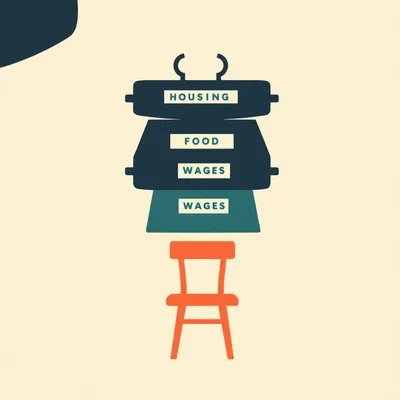
Daniel sent us this one. He says he's got this uncomfortable nagging feeling we're walking into an era of mass impoverishment — not literal starvation, but the structural elimination of the middle class. He's looking at three pressure points: housing that's become a wealth-transfer mechanism locking young families out permanently, food prices rising as a regressive tax, and wages that haven't kept up with productivity for decades. And layered on top of all that, the political feedback loop — economic precarity driving voters toward strongmen who then implement policies that deepen the precarity. He's asking whether we're headed for planetary social collapse, what levers might still exist to reverse the trajectory, and whether capitalism itself is the root cause. So let's treat this as a systems analysis. Not a rant — a diagnostic.

It's a diagnostic that needs precision, because the word "impoverishment" does a lot of work here. We're not talking about the kind of deprivation where someone can't access clean water or basic calories. What's being described is the elimination of the buffer that defines middle-class life — savings, home equity, career mobility, the ability to absorb a medical emergency or a job loss without falling off a cliff. That buffer is what separates being working class from being middle class, and it's exactly what's being hollowed out.
The middle class isn't just an income bracket. It's a set of stabilizers. You own a home, you build equity, you have a pension or retirement account, your kids have a reasonable shot at doing better than you did. When those stabilizers disappear, you're not middle class anymore — you're precarious, even if your income number looks okay on paper.
That's the thing the prompt is really getting at. The traditional markers — homeownership, single-income stability, defined-benefit pensions — those are unavailable to a majority of people under forty in most high-income countries. In Canada, the UK, Australia, increasingly the US. A thirty-year-old today, earning median income, doing everything right, cannot replicate their parents' trajectory. Not because they're lazy, not because of avocado toast. The math simply doesn't close.
The question is whether this is a cyclical downturn or a structural reconfiguration of how value is distributed. And I think the prompt's intuition is right — it's structural. These aren't temporary shocks. They're the downstream effects of specific policy choices made over forty years.
Let's start with the math. I want to walk through the three pressure points, because the numbers tell a story that's more precise than the feeling. In nineteen seventy-five, the median home price in Toronto was three and a half times median household income. By twenty twenty-five, that ratio had hit twelve point four times. A couple earning a hundred and twenty thousand dollars combined cannot afford a starter home without family wealth. The twenty percent down payment on a median Toronto home is two hundred and ten thousand dollars — more than two and a half years of a median earner's entire pre-tax income. You don't save that. You inherit it.
Toronto's not an outlier. It's the canary. Vancouver's at something like fourteen times. Sydney, Auckland, London, San Francisco — same story. The price of entry into the property market has decoupled entirely from what people actually earn.
That's before we talk about what happened during the pandemic. Between twenty twenty and twenty twenty-four, you saw institutional investors moving into single-family homes at a scale we've never seen before. Blackstone bought something like eight thousand single-family homes in the US Sun Belt in twenty twenty-four alone. They're not flipping them — they're holding them as rental assets in perpetuity. So you've got a shrinking supply of owner-occupied units, rising rents, and a renter class that cannot accumulate a down payment because their rent is consuming the very income they'd need to save.
This is the rentier spiral. Housing becomes an investment asset class rather than a place to live. Capital flows in, prices rise, more capital flows in because prices are rising, and the people who actually need shelter are competing with institutional balance sheets. They lose every time.
The UN Habitat report from just a few weeks ago — May twenty twenty-six — pegged the global affordable housing gap at something like three billion people by twenty thirty. That's not a typo. And they're not just talking about the developing world. The report specifically calls out housing cost burdens in high-income countries as a driver of political instability.
That's pressure point one. Housing has become a wealth-stripping mechanism rather than a wealth-building one. Now let's talk about food, because this is the one that hits people every single day.
The FAO Food Price Index shows global food prices have risen thirty-five percent cumulatively since twenty twenty. And that's an aggregate — specific categories are worse. Grains, dairy, oils. But here's the thing about food inflation that doesn't get enough attention: it's the most regressive tax imaginable. The bottom quintile of earners in the US spends about thirty percent of their income on food. The top quintile spends about eight percent. So when food prices rise thirty-five percent, the bottom group gets hammered and the top group barely notices.
The UK numbers are even starker. Between twenty twenty-two and twenty twenty-four, cumulative food inflation hit twenty-five percent. The Food Foundation tracked what that did to actual diets, and the poorest households cut protein consumption by eighteen percent. Not because they wanted to — because they couldn't afford meat, fish, eggs. That's not a cost of living crisis. That's a nutritional crisis driven by distribution.
It connects directly to global supply chains that are increasingly fragile. There was a really good piece from the Council on Foreign Relations recently about fertilizer dependence. The global food system runs on synthetic nitrogen fertilizer, which runs on natural gas. When energy prices spike — whether from war, sanctions, or market manipulation — food prices follow with a lag. And we've built a system with no buffer. No strategic grain reserves in most countries, no redundancy. Just efficiency and fragility.
"Efficiency and fragility" — that's basically the motto of the last forty years of economic policy.
I mean, yes. That's exactly what we've optimized for. And then we're shocked when a shock breaks things. So we've got housing stripping wealth from the bottom and middle, food prices acting as a regressive tax. Now the third piece: wages.
This is the one that should make people furious. Since nineteen seventy-three, US productivity has grown about eighty percent. Real median hourly compensation? The worker is producing nearly twice as much value and getting to keep almost none of the increase.
The Economic Policy Institute has been tracking this for decades. The gap isn't a mystery — it's a policy choice. Union density in the US private sector went from about thirty percent in the nineteen fifties to six percent in twenty twenty-four. Minimum wage hasn't kept pace with inflation. Corporate governance shifted to shareholder primacy — maximize quarterly returns, buy back stock, suppress labor costs. None of this was inevitable. It was legislated.
This is where the prompt's framing is so useful, because housing, food, and wages aren't three separate problems. They're three expressions of the same underlying shift — the transfer of economic surplus from labor to capital, and the financialization of things that used to be treated as social goods.
Housing got financialized in exactly the moment wages stopped growing. That's not a coincidence. When wages stagnate, the only way for households to maintain living standards is through credit and asset appreciation. So housing becomes the primary vehicle for wealth accumulation, which means everyone with capital piles into housing, which drives prices beyond what wages can support, which means you need family wealth to get in, which means the intergenerational transfer becomes the only path to security.
Then people look around and say, why does everything feel broken? Because the deal changed. The post-war compact — work hard, buy a house, retire with dignity — was dismantled piece by piece, and nobody held a vote on it.
We've got this triple squeeze — housing, food, wages — all compressing the middle class from different directions. But here's where it gets really interesting: the political response to that squeeze is making it worse. Let's trace that feedback loop.
The prompt nailed this. The poorer and more frustrated people get, the more receptive they become to strongman narratives that identify scapegoats. Immigrants, foreign powers, cultural elites, whatever. Perceived scarcity activates threat-based voting. This isn't speculation — it's a well-documented causal mechanism.
Look at the twenty twenty-four European Parliament elections. Far-right parties gained in every single country with above-average housing cost-to-income ratios. Not correlation — it's a causal chain. When you can't afford a home, when your grocery bill keeps climbing, when your paycheck doesn't stretch, you don't vote for technocratic incrementalism. You vote for someone who says they'll burn it all down.
Then the paradox. These parties, once in power, implement exactly the policies that created the precarity in the first place. Tax cuts for capital. Deregulation of housing markets. Austerity for social programs. The diagnosis was wrong, so the treatment makes the patient sicker.
Hungary is the textbook case. Orbán came in on nationalist rhetoric about protecting Hungarian families. Fifteen years later, homeownership rates among Hungarians under thirty-five have dropped from forty-five percent to twenty-eight percent. The policies didn't protect families — they enriched connected oligarchs and let housing become a speculative asset. The rhetoric was a decoy.
Covering the covers.
And it's happening everywhere in different flavors. The strongman playbook is consistent: identify a threat, consolidate power, redirect resources upward, blame the next threat. The economic base keeps eroding, but the political narrative keeps the base mobilized against the wrong targets.
Now we've got a self-reinforcing cycle. Economic precarity drives voters to authoritarians. Authoritarians implement policies that deepen economic precarity. The precarity deepens, which makes voters even more receptive to authoritarian appeals. At what point does this become a death spiral?
That's the question the prompt is really asking. Are we headed for planetary social collapse? And I think the answer depends on whether we're dealing with a slow, linear decline or a phase transition — a sudden reorganization of the system into something fundamentally different.
Let's talk about the intergenerational wealth transfer, because I think the prompt's intuition about a "natural expiration date" is correct, and it's one of the most under-discussed dynamics in this whole picture.
Here's the math. The Baby Boomer generation holds an enormous amount of housing wealth — trillions of dollars in the US alone, concentrated in coastal cities where prices have appreciated the most. As they age and die, that wealth transfers to their children. This is already happening. It's why you see thirty-five-year-olds buying million-dollar homes — they're not doing it on salary. They're doing it with inheritance, or with down payment gifts from parents who've unlocked home equity.
This is a one-time stock transfer, not a renewable flow. Once the last Boomer dies — roughly twenty forty-five to twenty fifty-five — there's no second wave of inherited housing wealth coming. And here's the kicker: the transfer is wildly unequal within generations. The people inheriting are the ones whose parents owned homes in expensive cities. The people whose parents rented, or owned in declining regions, get nothing. So the intergenerational transfer doesn't just preserve inequality — it deepens it. The children of homeowners become homeowners. The children of renters stay renters.
When the Boomer wealth is fully distributed, the system hits a wall. There's no more inheritance-driven demand to prop up prices at current multiples. Either prices correct — which would wipe out the wealth of everyone who bought in at the top — or the market bifurcates into a tiny ownership class and a permanent renter majority. Either way, the middle-class homeownership model is finished.
The prompt asks whether capitalism is the root cause. And I think this is where we need to be precise, because "capitalism" as a word has become almost useless — it describes everything from a Somali market stall to BlackRock. The question isn't capitalism versus something else. The question is which variant of capitalism we're running.
This is the distinction that gets lost in ninety percent of these conversations. The post-war period — roughly nineteen forty-five to nineteen seventy-five — was capitalist, but it was what economic historians call embedded liberalism. Capital was constrained by strong labor unions, progressive taxation, financial regulation, public investment in housing and infrastructure, and a political consensus that some things — shelter, food, health — shouldn't be left entirely to markets.
Broadly shared prosperity. Rising living standards across quintiles. Wages tracked productivity. It wasn't perfect — it excluded a lot of people, particularly along racial lines — but as a model for distributing gains, it functioned.
Then came the shift. Starting in the late seventies and accelerating through the eighties, you got deregulation of finance, erosion of antitrust enforcement, the assault on unions, the shareholder primacy doctrine in corporate governance, tax cuts tilted toward capital, and the retreat of the state from housing and food systems. This wasn't capitalism in its natural state asserting itself. This was a deliberate re-engineering of the rules.
Financialized, shareholder-primacy capitalism. The variant where everything is a commodity, where the only obligation of a corporation is to maximize shareholder value, where housing is an asset class and food is a trading instrument and labor is a cost to be minimized. That's the variant that produces the triple squeeze we just described.
Here's the thing: it's not more efficient. It's not producing more growth. US GDP growth in the embedded liberalism period averaged about three point eight percent. In the financialized period it's averaged about two point seven percent. We traded stability and broad prosperity for higher returns to capital and slower overall growth. It was a bad deal for almost everyone except the top decile.
The prompt asks, what can we do to bring ourselves back from the edge? And this is where we need to move from diagnosis to treatment. Because if the problem is specific policy choices, then different choices are possible. The trap is believing this is all inevitable. It's not.
Let's talk about what actually works. Housing first, because it's the biggest lever. Vienna is the model everyone cites, and for good reason. Sixty percent of Vienna's residents live in social or subsidized housing. Rents are capped at twenty-five percent of income. The city treats housing as infrastructure, not investment, and it's been doing this for a century. It's not a theoretical experiment — it's a functioning system in a major European capital.
People say, well, Vienna's unique, you can't replicate that. But Montgomery County, Maryland, has been running inclusionary zoning since nineteen seventy-four. Any new development has to include twenty percent permanently affordable units. The program has produced fifteen thousand affordable units, and they're not government-run projects — they're mixed into market-rate developments. It's a policy that works within a market system. It just sets different rules.
Land value capture is another one. When a city builds a transit line, adjacent property values skyrocket. That value was created by public investment, not by the landowner. Cities can capture a portion of that uplift and funnel it into affordable housing. Hong Kong's entire metro system was funded this way. Singapore does it. It's not exotic — it's just political will.
Singapore's worth dwelling on for a second. Eighty percent of the population lives in government-built flats. Ninety percent of those are owner-occupied. The state treats housing as a right and an infrastructure investment, and it's produced one of the highest homeownership rates in the world in one of the densest city-states on earth. It's not a left-wing fantasy. It's a pragmatic, market-adjacent system that just happens to treat shelter differently than we do.
Housing de-financialization is possible. It requires cities to use zoning power, public development corporations, land value capture, and inclusionary requirements. These are municipal-level tools. They don't require a revolution. They require showing up to zoning board meetings.
This is the second lever, and it's actually simpler than housing. Sectoral bargaining — where unions negotiate wages across an entire industry rather than firm by firm — is the mechanism that built the post-war middle class in most of Europe. It prevents a race to the bottom. When every firm in a sector has to pay the same negotiated rate, labor costs stop being a competitive differentiator.
We're seeing movement on this in the US at the state level. Michigan repealed its right-to-work law in twenty twenty-three. In the two years since, unionization rates have risen and wage growth in newly unionized sectors has outpaced non-union sectors by about eleven percent. That's not a theoretical projection — it's measured. State-level labor law reform is a concrete, winnable fight.
The other piece of wage recovery is antitrust. When a handful of employers dominate a local labor market, they don't have to compete for workers. Wages stay flat because there's nowhere else to go. The Federal Trade Commission under Lina Khan started taking labor monopsony seriously, and that's a framework that doesn't depend on who's in the White House — it's an analytical shift that's already happened.
Third lever: food price stabilization. The EU's Common Agricultural Policy spends about fifty-five billion euros a year, but most of it subsidizes large agribusiness. Redirecting even ten percent toward regional food hubs, urban agriculture, and strategic reserves could buffer price shocks for the bottom quintile. Strategic grain reserves used to be standard policy in most countries — the US had them, the EU had them. They were dismantled in the name of efficiency. Rebuilding them is straightforward.
The CFR piece on fertilizer nailed this. The global food system has no slack. A single shock — a natural gas price spike, a fertilizer plant shutdown, a trade disruption — propagates instantly into food prices because there's no buffer stock. Building reserves is boring, unglamorous policy work. It's also the difference between a price spike being an inconvenience and being a crisis.
We've got three levers: housing de-financialization at the municipal level, wage recovery through labor law and antitrust at the state and federal level, food stabilization through reserves and local system investment. None of these require overthrowing capitalism. They require changing the rules within capitalism — shifting from the financialized variant back toward something closer to the embedded model.
Here's the thing the prompt's political analysis gets exactly right: the biggest obstacle to all of this is the political feedback loop we described. The people who benefit from the current arrangement have captured the regulatory apparatus. The people who are being squeezed are voting for strongmen who promise to fight for them but deliver policies that squeeze them harder. Breaking that loop is the actual challenge.
What does an individual actually do? Because "change the system" is not actionable advice.
The uncomfortable answer is that the most effective personal action is not lifestyle optimization. Buying in bulk, cutting subscriptions, finding a cheaper phone plan — those are fine, but they're rearranging deck chairs. The decisions that actually determine whether housing is affordable, whether wages rise, whether food prices are stabilized — those are made at zoning board meetings, in state legislatures, in city council chambers. Local political engagement is the highest-leverage activity available to an ordinary person who wants to change these dynamics.
I want to be specific about this, because "get involved in politics" sounds exhausting and vague. Zoning board meetings in most American municipalities are sparsely attended, often by the same ten retirees every month. Showing up and saying "I support the inclusionary zoning proposal" or "I want the city to use land value capture for affordable housing" actually moves the needle. These decisions are made by people who hear from almost nobody.
School board elections, too. In a lot of districts, school board races are decided by a few hundred votes. The people who win those seats control billions in capital budgets and set policy that affects every family in the district. The barrier to entry is shockingly low.
State legislature races are the next tier up. State governments control labor law, housing policy, tax structure, minimum wage. A state house race in a mid-sized district might be decided by two thousand votes. The amount of policy leverage per unit of political effort is enormous compared to national races.
None of this is glamorous. It's not going to trend on social media. But it's where the rules are actually written. The people who understand this are already showing up. The question is whether everyone else will.
Let's go back to the big question the prompt ends on. Are we headed for planetary social collapse?
I think the honest answer is that we're on a trajectory that ends badly if nothing changes. The feedback loop between economic precarity and political extremism is self-reinforcing. The intergenerational wealth transfer is finite. The climate challenge adds another layer of pressure on food systems and migration patterns. These aren't separate crises — they're interconnected stress points on the same system.
— and this is a big but — societies have reversed structural inequality before without revolution. Post-war Sweden went from nineteen thirties poverty to nineteen seventies equality through a deliberate social democratic compact that included housing cooperatives, wage solidarity bargaining, and active labor market policy. It took forty years. It was dismantled in twenty. But it happened. It's proof of concept.
The US in the progressive era — trust-busting, the income tax, labor law, food safety regulation — was a response to Gilded Age inequality that looked a lot like what we're seeing now. It wasn't perfect, it took decades, and it required massive social movement pressure. But it worked. The tools are known.
The difference now is speed. The feedback loops are faster. Social media accelerates political polarization. Financial markets transmit shocks instantly. Climate change compresses the timeline. So the question isn't whether these reversals are possible in principle — they are. The question is whether we can rebuild the political will before the feedback loop of impoverishment and extremism becomes self-sustaining beyond repair.
That's where the prompt's discomfort is actually useful. That nagging feeling isn't irrational — it's an accurate reading of the data. The middle class is being structurally eliminated by specific, identifiable policy choices. The political response is making it worse. The intergenerational patch is temporary. The climate clock is ticking. Feeling uneasy about all this is the appropriate response.
The data also shows that the tools to reverse the trajectory exist and have been used before. Housing de-financialization has worked in Vienna and Singapore and Montgomery County. Wage recovery through sectoral bargaining built the European middle class. Food price stabilization through reserves was standard policy for most of the twentieth century. None of this is speculative. It's all been done.
The question the prompt is really asking — and the question we should all be sitting with — is whether we've still got the capacity for collective action, or whether the political system has been captured too thoroughly for reform to work. I don't think anyone knows the answer to that yet. But I think the only way to find out is to act as if reform is still possible and see what breaks.
Because the alternative is to watch the feedback loop tighten and hope it doesn't strangle us. Which is not a strategy — it's a gamble. And the stakes are a lot higher than most people realize.
The prompt mentions that the climate challenge presents its own set of existential risks, but that the socio-economic challenge is almost more concerning because it's entirely man-made. I think that's exactly right. We didn't choose the physics of carbon dioxide. We did choose the rules that determine who gets housing and food and income. Those rules can be changed by the same mechanism that created them — human decisions, organized politically.
That's the note I want to end on. Not despair, not false optimism, but agency. The current trajectory is bad. The data is clear. But the trajectory is the result of choices, and choices can be reversed. The question is whether enough people will recognize that before the window closes.
Now: Hilbert's daily fun fact.

In the late Victorian period, the pigment known as Scheele's Green — a copper arsenite compound used in wallpaper, clothing, and artificial flowers — was so toxic that simply breathing the air in a room decorated with it could cause chronic arsenic poisoning. Despite this, it remained popular for decades because its vivid emerald hue was unmatched by any safe alternative, and manufacturers in Britain alone produced over seven hundred tons of it annually at the industry's peak. The island of Bioko in Equatorial Guinea, then a Spanish colonial possession, became an unlikely node in the global arsenic trade, with cacao plantations there using arsenical pesticides that created soil contamination still detectable today.
...right.
So arsenic wallpaper and Equatorial Guinea's soil. That's going to sit with me.
The aesthetic price of Victorian interior design was apparently paid in neurological damage. This has been My Weird Prompts. If you found this episode valuable, share it with someone who's been feeling that same nagging discomfort — it might help to know the data backs up the feeling, and that there are actually things to do about it. Find us at myweirdprompts dot com. I'm Corn.
I'm Herman Poppleberry. Until next time.