Our home server died last week. Not a graceful decline either — just a sudden, silent refusal to POST. No warning beeps, no diagnostic LEDs, nothing. Just fans spinning and a black screen. I spent half a day diagnosing, swapping components, eventually narrowing it down to the NVMe drive that had somehow worked itself loose and the CPU fan that needed reseating. And there's this one screw. It lives between two aluminum heat sinks, spaced so tight you can barely see it, let alone reach it with a normal screwdriver. I'm talking maybe eight millimeters of clearance on either side, and the screw head is recessed about four centimeters down.

The screw that manufacturers place specifically to test your sanity. I'm convinced there's an engineer somewhere whose entire job is designing heat sink geometries that are just barely serviceable.
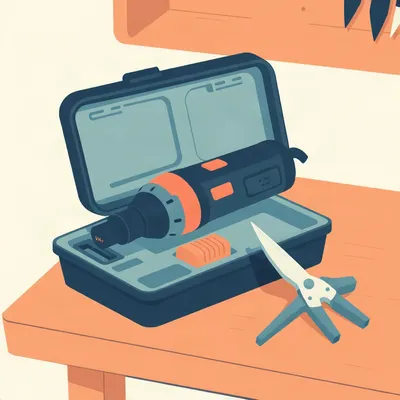
They're very good at their job. So I'm digging through this precision screwdriver kit I'd picked up for phone repairs a couple years ago — one of those thirty-bit sets that comes in a little zippered case — and I find this thing that looks like a miniature drain snake. About ten, maybe fifteen centimeters long. It had a hexagonal socket on one end and a magnetic bit holder on the other. I'd ignored it when I bought the kit — honestly didn't know what it was for, assumed it was some kind of cleaning tool or maybe a weird adapter I'd never need. But staring at that inaccessible screw, I suddenly realized it might be some kind of extension. I attached the magnetic bit, fed it between the heat sinks, and it worked. I genuinely felt like I was witnessing magic.
That moment when a tool you didn't understand suddenly reveals its purpose and solves the exact problem you're having — that's a special kind of satisfaction. It's like the universe briefly aligning in your favor.
It was the highlight of my week. Which says something about my week, but also about this tool. The bit was a little hard to clamp onto the screw at first — the magnet didn't want to grab, and I had to sort of wiggle it into position — but once it did, it transferred my torque beautifully. I seated that CPU fan more precisely than I ever could have by probing with my hands. And I sat there afterward thinking: how does this even work? Something that's flexible, that bends around obstacles, but can transmit rotational force along its entire body length without twisting itself into a knot. And how long can these things go before they stop being reliable?
That's the question Daniel sent us, actually. He had almost the exact same experience — broken server, inaccessible CPU fan screw, flexible shaft from a precision kit — and he wants to know the physics behind it, and whether you can get a thirty-centimeter one for deeply recessed cabinet screws and the like. He's apparently been assembling some flat-pack furniture and ran into a screw buried behind a drawer slide.
Daniel and I apparently had parallel repair crises this week. That's either comforting or concerning.
I'd say it's a sign of the times. More people are doing their own repairs now — phones, laptops, servers, furniture. The right-to-repair movement has been pushing manufacturers to make devices more serviceable, and there's a growing culture of just... fixing things yourself instead of throwing them away. Which means understanding the tools that make those repairs possible isn't just curiosity anymore. It's practical knowledge. It's the difference between a successful repair and a pile of stripped screws and regret.
This tool in particular — the flexible screwdriver extension — it's one of those inventions that feels like it shouldn't work. You look at it and think, that's just a bendy piece of wire. There's no way it can transmit torque. And then it does, and you feel like you've discovered a secret.
Which is exactly why we should dig into this. What's actually happening inside that cable when you turn it? What makes it different from just a solid rod that someone made thinner? And what are the real limits — at what length does the magic start to break down?
Because I'm already eyeing longer ones for furniture assembly, and I want to know if I'm about to make a mistake. I've got a bookshelf waiting in a flat box that's been giving me the side-eye for two weeks.
Let's define what we're actually talking about. A flexible screwdriver extension isn't just a bendy stick. It's a cable-like shaft — typically made of multiple layers of high-tensile steel wire wound in opposite directions. If you've ever looked inside a speedometer cable, or a drain snake for that matter, you've seen the same basic architecture.
Layers of wire, wound against each other. So it's not one solid piece of metal that's been machined to be flexible — it's a composite structure.
You've got an inner core wound in one direction, then an outer layer wound the other way. When you twist the shaft, those opposing layers tighten against each other. The wires are put into tension and compression, and the friction between strands is what transfers the rotational load from your hand to the bit. It bends easily because the individual wires can slide past each other slightly — but it resists twisting because that same movement locks them together under torque.
The thing that makes it flexible is also what makes it torsionally stiff. That's the clever bit. It's not two separate properties fighting each other — it's the same mechanism doing both jobs depending on which direction you're applying force.
That's the entire trick. And it's one of those elegant engineering solutions that's almost invisible because it's so simple. A solid rod can transmit torque too, obviously, but if you bend it past a certain point it kinks permanently — the metal yields and you've got a permanent deformation. A stranded cable can snake around obstacles and keep turning. The trade-off is that it's not perfectly rigid in torsion — there's some wind-up, some spring-like twisting of the shaft itself before the bit starts moving. And that wind-up grows with length.
Which gets to Daniel's question — and mine. The one in my kit is maybe ten to fifteen centimeters. It felt almost telepathic. Like there was no intermediary between my hand and the screw. But how far can you push that before the lag becomes a problem? At what point do you start feeling like you're turning a spring instead of a screw?
For precision work with small screws — the kind you'd find in a laptop or a CPU fan — commercial extensions typically top out around thirty to forty centimeters. Beyond that, the wind-up starts to eat your tactile feedback. You turn the handle and the bit doesn't move immediately. You lose the sense of whether the screw is seated or stripping. And at that scale, with M2 or M3 screws, you're dealing with maybe a quarter-turn between snug and stripped. If your feedback is delayed by even a tenth of a second, you're operating blind.
I imagine there's a buckling problem too. If you're pushing a flexible cable into a recessed screw, at some length it just bows out instead of staying straight. It's like trying to push a rope.
That's the compression failure mode. And it's actually the more immediately limiting factor for most users. A ten-centimeter shaft is short enough that it stays roughly in line — the column is short enough that Euler buckling isn't a concern. A sixty-centimeter shaft — which you can get for automotive work — usually needs a braided outer sheath or a rigid guide tube to keep it from folding under axial load. But that's a different class of tool. For what Daniel was doing, and what you were doing, the short shaft is basically ideal. It's long enough to reach around heat sinks and cable bundles, short enough that it feels like a direct connection.
That's why it felt like magic. The tool disappeared. My hand turned, the screw turned. Everything in between was invisible. It's like the tool became an extension of my proprioception — I could feel the screw through it as if it were directly under my fingertips.
The speedometer cable comparison is actually a perfect illustration of the design trade-off here. A speedometer cable in an older car can be one to two meters long, and it's designed for low-torque, high-speed rotation — spinning a lightweight magnet inside a gauge housing. Very different job from turning a screw. The cable in a car is spinning constantly at whatever speed the transmission output is doing, and it needs to do that for years without binding or breaking.
It's optimized for speed, not force. It's basically the opposite end of the design space.
And that's why the construction is fundamentally the same even though the applications are completely different. Both use counter-wound steel wire layers. But a speedometer cable prioritizes flexibility and minimal wind-up at the expense of torque capacity — the layers are wound at a shallower angle, the wires are thinner, there might be more layers but each one is doing less work. A screwdriver extension prioritizes torque transfer at the expense of length — steeper winding angles, thicker wires, fewer layers but each one is bearing more load. Same physics, opposite ends of the spectrum.
Which means Daniel's ten-centimeter shaft sits in a sweet spot. Long enough to be useful, short enough that wind-up is negligible. It's the Goldilocks zone for this particular tool.
And that sweet spot is partly about the wire diameter and layer count, but also about the application. For precision screwdriving, you're typically dealing with screws that require maybe half a Newton-meter of torque at most. The shaft doesn't need to be massively overbuilt. If you were trying to break loose a rusted bolt on an engine block, you'd need a completely different tool — something with a much thicker shaft and probably a different winding geometry entirely.
There's a ceiling on the physics. At some length, you hit a point where adding more wire layers or increasing the diameter stops helping. You can't cheat the fundamentals.
That's the real limitation. You can only pack so much torsional stiffness into a flexible cable before the wind-up becomes the dominant experience. And for hand tools — which is what we're talking about here, not powered drivers — the whip effect you mentioned is mostly a non-issue.
Because nobody's spinning a hand screwdriver at hundreds of RPM. We're not dealing with rotational dynamics here, just statics and maybe some very slow quasi-statics.
If you're using a drill, sure, the cable can oscillate — you can get harmonic resonances that make the shaft whip around, and that's a real problem in industrial flexible shaft applications. But for manual screwdriving, the shaft isn't rotating fast enough for whip to matter. The failure pattern for hand tools isn't vibration — it's buckling.
Which brings us back to Daniel's question about the thirty-centimeter range. For furniture assembly or cabinet work, where you're reaching into a recessed screw, you've got a different set of constraints. The shaft is longer, so wind-up is definitely present. And you're probably also dealing with some axial load if you're pushing on the driver. You're asking the shaft to do two things at once — transmit torque and resist compression.
That's where the rigid guide tube or braided sheath becomes relevant. Once you're past about forty centimeters, you almost certainly need external support to prevent the shaft from bowing out under compression. The cable itself can handle the torque, but it can't stabilize against the pushing force without help. It's like the difference between a rope and a pushrod — a rope is great in tension, useless in compression. The flexible shaft is the same way; it's designed for torsion, and compression is just not its job.
For Daniel's specific scenario — recessed cabinet screws at thirty centimeters — he'd need either a support sleeve or a willingness to accept some wind-up. And he'd want a magnetic bit with strong retention, because as he noticed, the axial flexibility means the bit can walk off the screw if the magnet isn't solidly backed. The shaft can't provide that rigid backing you get from a solid screwdriver shank.
That's the practical takeaway. At ten to fifteen centimeters, you don't need to overthink it. The shaft is short, the wind-up is negligible, the buckling risk is low, and the magnetic retention issue is manageable with a decent bit. At thirty centimeters, you need to be intentional about wind-up and have a strategy for the magnet. At sixty centimeters, you're in a different category entirely — and you probably need a guide tube.
The answer to "how long can these go" is basically: ten to fifteen centimeters is ideal for precision work, thirty is workable if you accommodate the wind-up, and sixty requires a support structure. Beyond that, you're fighting physics. And physics always wins.
The physics is worth fighting, because when the tool disappears and your intent transmits perfectly, it does feel like magic.
Until you understand it. Then it feels like genius.
That feeling — the tool disappearing — it's not just psychological. There's a real mechanical reason the short shaft feels telepathic. At ten to fifteen centimeters, the torsional wind-up is so small you can't perceive it. Your hand turns, the screw turns. What you feel through the handle is almost exactly what's happening at the bit. The shaft's natural frequency in torsion is high enough that for human-speed inputs, it might as well be rigid.
The tactile feedback loop stays intact. You can feel the screw seat, feel the resistance change, feel when it's snug versus when it's about to strip. All that subtle information that your fingers are trained to interpret — it's all still there, unmolested by the tool.
That's what makes it satisfying. You're not guessing. With a long extension or a wobbly adapter, you lose that direct connection — there's a mushy zone where you're turning the handle but not sure what the screw is doing. The short flexible shaft eliminates the mush without eliminating the reach. It's the best of both worlds: access and feedback.
Which is why I'd argue it's not just a convenience tool. It's a feedback tool. It preserves information that you'd otherwise lose. And in precision work, information is everything — it's the difference between a repair that holds and a repair that fails six months later because you undertorqued a critical fastener.
That's the thing Daniel noticed without necessarily articulating it. He said he seated the CPU fan more precisely than he could have by hand. That precision comes from the feedback. When you're probing with your fingers, you're working blind in terms of torque. You're going by feel in a completely different sense — you can tell if the screw is turning, but you can't tell how much torque you're applying. With the shaft, you're getting real-time mechanical information transmitted directly to your hand.
For anyone listening who's about to do a repair — if you've got a ten to fifteen centimeter flexible extension, you're in the ideal zone for precision work. Don't upgrade. Don't think longer is better. You've already got the right tool. Longer would actually be worse for what you're doing.
Now, if you do need to go longer — say Daniel's thirty-centimeter cabinet scenario — there are two things you have to manage. First, the magnet. The axial flexibility of the shaft means there's no rigid backing behind the bit. If the magnet is weak, the bit will walk off the screw head the moment you apply any lateral force. And in a recessed cabinet screw situation, lateral force is almost unavoidable because you're working at an awkward angle.
That's exactly what I ran into. The bit didn't want to clamp at first. I had to sort of coax it onto the screw, and even then it felt precarious — like the bit was just waiting for an excuse to pop off and disappear into the bowels of my server.
That's a known limitation. The hex or square drive on these shafts accepts standard bits, but the magnetic retention depends on the bit's own magnet strength, because the shaft itself provides zero axial support. The fix is straightforward: use a bit with a stronger rare-earth magnet, or switch to a collet-style holder that mechanically grips the bit shank.
A collet holder. So instead of relying on magnetism to keep the bit in place, you're physically clamping it. Like a drill chuck but at the bit scale.
And that solves the retention problem at both ends — the bit stays in the holder, and the holder gives you a more solid backing to push the bit onto the screw. It's a small upgrade that makes a disproportionate difference at longer lengths. We're talking about a part that costs maybe five dollars and completely changes the experience.
The second thing to manage is buckling. If you're pushing a thirty-centimeter flexible shaft into a recessed screw, the shaft wants to bow out sideways instead of transmitting that push straight through. It's the same reason you can't push a cooked spaghetti noodle through a straw — it just folds.
The fix there is pre-loading. You push slightly on the shaft to keep it in compression against the screw head before you start turning. That keeps it straight. It's a technique thing — you're essentially using the screw itself as the end support for the column. For deeper recesses — furniture assembly, automotive work — some shafts come with a rigid outer sleeve or guide tube that does the pre-loading for you. The sleeve takes the compression load so the cable only has to handle torsion.
There's a technique to it. It's not just "attach bit, turn handle." There's a little bit of craft involved, and that craft is what separates a frustrating experience from a satisfying one.
Which is true of most tools worth using. The difference between a frustrating experience and a magical one is often just knowing the two or three things the tool needs from you. The tool doesn't come with a manual explaining pre-loading or magnet selection — you either figure it out through trial and error, or someone tells you.
Now we've told people. So hopefully fewer stripped screws and lost bits in the world.
Now, how does this compare to the other tool people reach for in tight spaces — the ball-end hex key?
Oh, good question. I've got a set of those too, and I've definitely used them in situations where a straight hex key wouldn't fit.
A ball-end hex key can drive at an angle up to about twenty-five degrees off-axis. That's enough for a lot of situations — getting around a protruding component, accessing a screw that's slightly recessed behind an overhang. And they're dead simple — no moving parts, no wind-up, no buckling. Just a hex key with a spherical end that maintains contact with the socket even when you're not perfectly aligned. But twenty-five degrees is the hard limit. A flexible shaft can bend ninety degrees or more and keep turning.
The ball-end is simpler and more rigid, but you sacrifice angle. The flexible shaft gives you extreme angles but introduces wind-up and requires more care. It's a classic engineering trade-off — you're trading simplicity for capability.
That's the trade-off in a nutshell. For a screw that's just slightly off-axis behind a component, the ball-end hex key is probably the better choice — faster, fewer variables, no wind-up to manage. For a screw that's buried between two heat sinks at an impossible angle, the flexible shaft is the only thing that works. Neither tool is universally better; they're optimized for different parts of the problem space.
Which makes this tool a perfect example of what some engineers call appropriate technology. It's not the most sophisticated solution. It's not electronic, not smart, not powered. It's wound steel wire. And it solves a specific, maddening problem with elegance. No microcontroller is going to make a flexible shaft work better — the physics is the physics.
In an age of smart tools and Bluetooth-connected everything, there's something deeply satisfying about a piece of wound steel wire that just works. No firmware updates. No battery to charge. You pick it up, you use it, you put it away, and it's ready for you again ten years later.
Just counter-wound layers and friction. The same physics that made speedometer cables work in 1950s cars is still doing the job today in a ten-dollar precision screwdriver kit. That's a good run for any technology.
I think there's something almost philosophical there. We're surrounded by tools that become obsolete in eighteen months — phones, laptops, smart home gadgets. But the flexible shaft is essentially unchanged from its original design because it's already as good as it needs to be. The physics doesn't change. Steel wire wound in opposite directions will always behave the same way.
If I'm distilling all of this down for someone who just wants to fix their stuff without reading a physics textbook — and Daniel, I know you're listening — here's what I'd say. For PC and phone repair, the ten to fifteen centimeter flexible extension you already have is exactly what you want. Don't let anyone sell you a longer one for precision work. You'll gain reach and lose feel, and feel is the whole point.
That feel is what kept you from stripping a tiny screw buried between two heat sinks. At that scale, the difference between snug and stripped is maybe a quarter turn. You need the feedback. Without it, you're just guessing, and guessing with a screwdriver is how you end up with a much bigger repair than you started with.
Second thing: always test your magnetic retention before you feed the shaft into a tight space. Wiggle the bit, make sure it's not going to pop off. Because if that screw drops inside your device, you're now doing a completely different repair than the one you planned. And that repair involves a lot of shaking and tilting and hoping.
The voice of experience there.
The voice of a man who has learned things the hard way and would prefer you didn't. I've spent more time fishing screws out of laptop chassis than I care to admit. It's not a transferable skill. It doesn't look good on a resume.
The third piece — for Daniel's cabinet scenario, or anything deeper than about thirty centimeters — look for a flexible shaft that comes with a rigid outer sleeve or guide tube. These are common in automotive kits. The sleeve handles the buckling problem so the cable only has to handle the torque. You get the reach without sacrificing stability.
The rule of thumb: short for precision, sleeved for depth, and always a strong magnet. That's the whole playbook. Three rules, and they cover basically every situation you're going to encounter.
The broader point is: next time you're frustrated by an inaccessible screw, don't automatically reach for a longer screwdriver. Try a flexible extension. It might be the exact tool you didn't know you needed — sitting in your kit, waiting for its moment.
Which raises the question — could we improve on this? Steel wire has been the standard for decades, but we've got carbon fiber composites now, braided Kevlar, materials with wildly better stiffness-to-weight ratios than the high-tensile steel these shafts use. Is there a next generation of flexible shaft waiting to happen?
Carbon fiber doesn't like torsion though, does it? It's stiff in bending but I've seen what happens when you twist it. It delaminates and turns into a very expensive broom.
That's the challenge. Carbon fiber is anisotropic — strong along the fiber axis, much weaker in shear between layers. A flexible shaft lives in torsion, so you'd need a weave geometry that handles twist without delaminating. You'd essentially have to design a composite layup where the fibers are oriented at forty-five degrees to the shaft axis, which is the optimal angle for torsion. It's possible, but it's expensive and the manufacturing is complex. Kevlar's a bit better in that regard — it's tougher in shear — and it's already used in some industrial flexible shafts for aerospace applications where weight matters. But the counter-wound steel design is hard to beat for cost, durability, and simplicity.
The steel wire design might already be near-optimal for what it costs to produce. Sometimes the mature technology is mature for a reason. Not everything needs to be disrupted.
That's worth sitting with. The humble flexible extension isn't waiting for a materials breakthrough to become useful. It's already solved the problem. What's changing isn't the tool — it's who's using it and how often.
As right-to-repair laws keep pushing manufacturers toward serviceable designs, more people are going to find themselves staring at an inaccessible screw and reaching for exactly this tool. The flexible extension might be one of those quiet heroes of the repair revolution — unglamorous, unchanged for decades, and suddenly essential. It's not going to be on the cover of Wired magazine, but it'll be in the toolkit of everyone who fixes their own stuff.
The best tools are like that. They feel like magic until you understand the physics. Then they feel like genius.
Which is a better feeling, honestly. Magic is something that happens to you. Genius is something you can reach for when you need it. One is passive wonder, the other is active understanding. And I'd rather have the understanding.
Now: Hilbert's daily fun fact.
Hilbert: In the nineteen fifties, researchers exploring lava tubes in Greenland discovered that certain tunnel geometries could sustain acoustic standing waves at frequencies below twenty hertz — effectively turning the cave into a natural infrasonic organ that played itself whenever wind moved through it. The frequencies were below the threshold of human hearing, but the pressure variations were strong enough to cause nausea and disorientation in the research team. They described it as "a sound you feel in your bones rather than your ears.
...right. An infrasonic organ in a Greenlandic lava tube that makes you sick. Thanks, Hilbert. That's exactly the note I wanted to end on.
I'm going to be thinking about that for the rest of the day. A cave that plays itself at frequencies you can't hear but your body reacts to anyway. That's unsettling.
This has been My Weird Prompts. Thanks to our producer Hilbert Flumingtop for keeping the ship pointed in roughly the right direction, even when that direction is toward nauseating geological formations. If you enjoyed this, leave us a review wherever you get your podcasts — it helps. Find us at my weird prompts dot com. We'll be back soon.