

This episode dives into the art of garage storage using VDA-standard Euroboxes—originally designed for German automotive assembly lines—to create a maintenance cabinet for a Seat Ibiza. The system starts with a boltless rivet shelf unit (1800mm high, 900mm wide, 600mm deep) rated for 250-350 kg per shelf, shimmed level on sloped garage floors. Boxes are chosen in three heights: KLT 64-15 (147mm) for consumables like oil filters and spark plugs, KLT 64-28 (280mm) for brake pads and suspension parts, and KLT 64-42 (420mm) for control arms. Weight distribution puts heavy components on bottom shelves, light consumables on top, with front-to-back positioning encoding access frequency—oil filters at the front, air filters behind. Real part numbers include the cartridge oil filter (03C115561A), front brake pads (1J0698151), and rear drum shoes (1J609525). The hinged lids seal against garage dust, and the rack bolts to concrete walls for stability. This isn't just car storage—it's a logistics system that transfers to any vehicle.
#3984: Eurobox Garage: Stocking a Seat Ibiza Cabinet
Build a VDA-standard Eurobox cabinet for your Seat Ibiza, with real part numbers and shelf logic.
Episode Details
- Episode ID
- MWP-4163
- Published
- Duration
- 26:34
- Audio
- Direct link
- Pipeline
- V5
- TTS Engine
-
 chatterbox-regular
 - Script Writing Agent
- DeepSeek v4 Pro
- Topics
- logisticsdiyautomation
AI-Generated Content: This podcast is created using AI personas. Please verify any important information independently.
Downloads
Transcript (TXT)
Plain text transcript file
Transcript (PDF)
Formatted PDF with styling
You Might Also Like



Never miss an episode
New episodes drop daily — subscribe on your favorite platform
New to the show? Start here#3984: Eurobox Garage: Stocking a Seat Ibiza Cabinet

Daniel sent us this one — and I love the specificity of it. He and Hannah are renting a parking spot, and the garage allows storage as long as it's relevant to car upkeep. So his question is: if you were building a small Eurobox-based maintenance cabinet for a Seat Ibiza, what would that actually look like? Not just which boxes and which shelves, but what specific parts would you stock, how would you organize them, and how do you make the whole thing work as a system. He wants part numbers, shelf capacities, the real thing.

This is exactly where Euroboxes belong. They were literally born in the German automotive industry — the VDA designed them in the nineteen eighties so that suppliers and assembly lines could move the same containers between each other without repacking. Brake calipers, engine blocks, transmission components — these are dense, heavy parts that would crack a normal plastic tote. And now Daniel's taking that industrial standard and shrinking it down to a single parking-space cabinet for a Seat Ibiza. It's the same logic, just at human scale.
The timing makes sense. He's already standardized on Euroboxes for apartment moves — he's got the boxes, he understands the interlocking system. The next logical step is extending that into the domain where the standard was born. And the garage rule gives him the perfect excuse to do it properly.
Let's be honest — most people's garage storage for car stuff is a disaster. A cardboard box of mystery fluids, a plastic bag of old spark plugs they're not sure are the right ones, and a shelf bowing under the weight of a single brake rotor. Daniel's asking: what does it look like when you apply actual logistics thinking to this?
I think the "mystery fluids" part deserves more attention than we usually give it. I've been in garages where there's a half-empty bottle of something and the label has dissolved because it sat in a puddle of its own contents for six months. You're squinting at it going, is this brake fluid or is this the coolant I drained last year? And if you guess wrong, you're putting brake fluid in your coolant reservoir, which is a fantastic way to turn all your rubber hoses into goo.
That's a nightmare scenario, but you're right — it happens because there's no system. The bottle goes on whatever shelf has space, it leaks a little, the cardboard box underneath absorbs it, and six months later you've got a toxic archaeological site. The Eurobox contains that. If a bottle leaks inside a KLT, the fluid stays in the box. You pull the box out, rinse it, replace the bottle, and nothing else in the cabinet is affected.
He picked the right car for it. The Seat Ibiza six-L, the two thousand eight to twenty seventeen model, is one of the most common cars in Europe. Parts are cheap, they're well-documented, and the maintenance schedule is straightforward. If you're going to build a reference cabinet, that's the car to build it for.
Here's what we're going to do. We'll start with the physical system — the exact shelving unit, the box sizes, the load calculations. Then we'll open the Ibiza parts catalog and stock it shelf by shelf, with real part numbers, organized by service interval and failure probability. By the end, you'll have a shopping list and a parts list you could hand to someone and say: build this.
The thing to keep in mind throughout — this isn't just about one car or one garage. The shelving and the boxes will outlast the Ibiza. When you sell the car, the system stays. That's the whole point of a standard.
Let's start with the rack. What are we actually bolting together?
The standard rack for Euroboxes is boltless rivet shelving — the kind that assembles with a rubber mallet in about twenty minutes. The magic dimension is six hundred millimeter depth, because that's the exact short side of a Eurobox. A nine hundred millimeter wide unit lets you place two six hundred by four hundred boxes side by side, with their four hundred millimeter dimension running front to back.
The boxes don't overhang, and the weight transfers straight down through the frame. That's the thing with generic shelving — you end up with boxes sticking out, load concentrated on the wrong points. I've seen a shelf collapse because someone put a heavy tote on it sideways and the entire weight was bearing on two thin cross-beams instead of the corner posts. The rivet shelving avoids that entirely because the beams run the full width and depth, and the boxes sit inside the frame.
And for Daniel's parking spot, we want a unit that's eighteen hundred millimeters high, nine hundred wide, six hundred deep, with five shelves. That gives you ten box positions per shelf level — fifty slots total. Each shelf on a decent boltless rack is rated for two hundred fifty to three hundred fifty kilos evenly distributed.
Which sounds like plenty until you start loading car parts. A single Eurobox full of brake calipers or suspension arms can hit twenty-five, thirty kilos easily. Ten of those on one shelf and you're at the limit. So you have to think about weight distribution not just across the shelf, but across the whole rack.
That's why you don't load every shelf with brake components. Bottom three shelves take the heavy stuff — calipers, discs, control arms, suspension bushings. Top two shelves are for consumables: filters, bulbs, fluids, spark plugs. Those boxes weigh five kilos max. The rack stays happy, and you're not bending down to grab an oil filter. There's an ergonomic logic that lines up perfectly with the structural logic.
Let's talk about the floor under the rack for a second, because parking garages have sloped floors for drainage. If your rack is sitting on a two-degree slope, all that weight is leaning slightly toward the front. You want to shim the front feet so the rack is plumb, otherwise every box wants to slide forward when you open it. A couple of rubber shims from the hardware store, five minutes of work, and the whole system is level.
And while we're on installation details — bolt the rack to the wall if you can. Most parking garages have concrete walls, and a couple of expansion bolts will keep eighteen hundred millimeters of loaded shelving from becoming a domino if someone bumps it with a car door. If you can't drill into the wall, at least strap it to a pillar with a ratchet strap. It's cheap insurance.
The boxes themselves — this is where the VDA standard earns its keep. The interlocking rim isn't just for stacking. It's designed so a robot arm can grab a box from a conveyor, lift it, and place it without the box flexing or the lid popping off. The tolerance on that rim is under a millimeter.
Compare that to a generic storage tote from a hardware store. Stack three of them with twenty kilos each, and the bottom one's lid will crack, the sides will bow, and the whole stack starts leaning. Euroboxes are rated for up to four hundred kilos stacking load per box. That's an engine block sitting on top of your spark plug box — and the spark plug box is fine.
There's a great case study here that most people don't know about. Back in the early two thousands, a major German logistics company tried to save money by switching from VDA-standard Euroboxes to a cheaper injection-molded alternative for their internal warehouse. Within six months, they'd lost something like fifteen percent of their containers to cracking, and the automated picking system kept jamming because the rims didn't interlock cleanly. They switched back. The standard exists because the failure mode of "cheaper" is incredibly expensive.
That's the thing — you're not paying for plastic. You're paying for the engineering that went into the rim geometry, the draft angles on the sides, the reinforcement ribs in the base. A real KLT box from a VDA-licensed manufacturer has a design life measured in decades of daily industrial use. In a parking garage where you open it six times a year, it'll outlast you.
For Daniel's Ibiza cabinet, we want boxes from three specific heights. The six hundred by four hundred by one forty seven — that's the VDA KLT sixty-four fifteen. Perfect for oil filters, spark plugs, bulbs, small consumables. Then the two eighty millimeter height, the KLT sixty-four twenty-eight, for brake pads, calipers, suspension bushings. And the big four twenty millimeter, KLT sixty-four forty-two, for control arms or a spare driveshaft.
One more thing on box choice — get the type B with hinged lids. They let you stack boxes and still open any one of them without unstacking everything above it. In a tight parking garage, where you might need to grab a coolant sensor while wedged between the car and the wall, that matters. The lids also seal against dust, which is a real thing in a parking garage environment. Concrete dust from the structure, tire dust from the cars, brake dust — it gets into everything. A sealed lid means your spark plugs aren't sitting in a fine abrasive powder.
The hinged lid is the detail that separates "I stored this part" from "I protected this part." If you've ever opened a cardboard box of car parts that's been sitting in a garage for two years, you know what I mean. Everything has a fine coating of grime. You're cleaning a brake caliper before you can even inspect it.
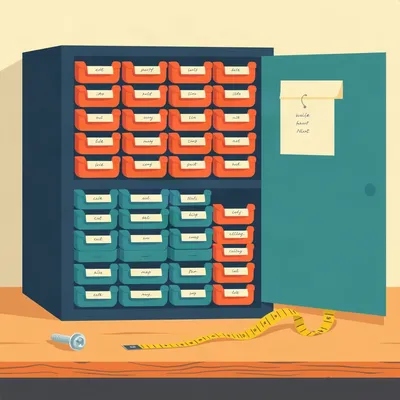
The physical system is: one boltless rivet rack, eighteen hundred by nine hundred by six hundred, five shelves. Ten Euroboxes split across three heights, all type B with hinged lids. Heavy on the bottom, light on top. Now the question is what actually goes in them.
The Ibiza six-L came with a few different engines, but the one point four liter sixteen-valve petrol — engine code BXW or BPY — is the one you see everywhere. And its maintenance schedule is refreshingly simple. Oil and filter every fifteen thousand kilometers or twelve months. Cabin filter every thirty thousand. Air filter and spark plugs every sixty thousand.
Right away, you know the oil filter is the most frequently touched item in the cabinet. That's going to live at waist height, not buried at the back. But this raises a question — how does the maintenance schedule actually drive the shelf layout? Because you could organize the whole cabinet around service intervals instead of part weight.
That's the tension, and I think the weight constraint wins for the shelf assignment, but the interval logic wins for which box goes where within a shelf. The oil filter box sits at the front of its shelf position, not at the back, because you're grabbing it twice as often as the air filter. Even though they're in the same box type on the same shelf, the front-to-back position encodes the frequency of access.
That's the kind of detail that costs nothing to implement but saves you thirty seconds of rummaging every single time. Over the life of the car, that's probably hours of your life you're not spending staring at identical boxes.
That filter is part number oh-three-C-one-one-five-five-six-one-A. It's a cartridge-style filter, not a spin-on canister, so it's small — maybe fifteen centimeters tall. Fits perfectly in the one forty seven millimeter high box, the KLT sixty-four fifteen, alongside the cabin filter and the air filter.
Let's walk the shelves from bottom to top. Bottom shelf, heaviest stuff. I'm putting a KLT sixty-four twenty-eight on the left with brake components — front pads, part number one-J-zero-six-nine-eight-one-five-one, and rear drum shoes if it's the base model, one-J-six-zero-nine-five-two-five. That box is going to weigh maybe twenty-two kilos. Next to it, another sixty-four twenty-eight for suspension parts — top mounts, six-L-zero-four-one-two-three-three-one, and drop links, six-L-zero-four-one-one-three-one-five. Another twenty kilos.
If you've got a spare brake disc, that goes in the big KLT sixty-four forty-two on the right side. A single front disc for the Ibiza weighs about seven kilos. You're not filling that box to capacity — it's more about the diameter. The disc needs the four hundred twenty millimeter height to sit flat. And here's a thing people get wrong: store brake discs flat, not on edge. If you stand them on edge for a year, they can develop a slight warp from their own weight, especially if there are temperature cycles in the garage. Flat in the box, no problem.
That's the kind of tribal knowledge that doesn't appear in any manual. Someone learns it the hard way, replaces a disc, and the new one has a pulse in the pedal because it sat on its edge in a cold garage for eight months.
This is the service-interval shelf. One sixty-four fifteen holds all the filters — oil, air, cabin — plus a set of four spark plugs, NGK PFR six-Q, part number one-zero-one-zero-zero-zero-zero-six-three-double-A. Another sixty-four fifteen next to it for bulbs: H seven low beam, W five W sidelight, P Y twenty-one W indicator. Those boxes weigh almost nothing.
The bulbs box is the one you'll open in the dark with your phone flashlight, so label the lid clearly. Which brings us to the label system — every Eurobox has a standard slot on the front face for a paper label. VDA designed that in from the start. Print a label with the part number, quantity, and the date you last checked stock. Slide it in.
I'd add one field to that label: the service interval. If the spark plugs are every sixty thousand kilometers, put "60k km" on the label. When you're doing a quick visual inventory, you can see at a glance whether you're stocked for the upcoming service or whether you need to order.
Top shelf is fluids and tools. A sixty-four fifteen with one-liter bottles of coolant G twelve plus-plus, brake fluid DOT four, and a five-liter jug of five-W-thirty oil. The oil jug is tall, so it might need to lie on its side — the box handles that fine. Next to it, a second sixty-four fifteen for tools specific to the Ibiza: a sixteen millimeter spark plug socket, a set of Torx bits, an oil filter wrench, and a drain plug key.
Then there's the box I think is the most important one in the whole cabinet — the "Sunday failure" box. A single sixty-four fifteen with parts that are small, cheap, and will absolutely strand you if they fail when the parts shops are closed. Coolant temperature sensor, part oh-four-C-nine-one-nine-five-oh-one-A. Ignition coil pack, oh-three-six-nine-oh-five-seven-one-five-A. Alternator belt, six-L-oh-two-six-oh-eight-four-nine. Total cost for all three is maybe sixty euros. Total misery avoided is incalculable.
That's the box that justifies the entire cabinet. You're not going to rebuild an engine in a parking garage. But swapping a coil pack or a coolant sensor with basic hand tools? That's a twenty-minute job that saves you a tow truck and a garage bill. Can we talk about the coil pack specifically, because that's the one that catches people out?
The one point four BXW engine uses individual coil-on-plug packs, one per cylinder. When one fails, you get a misfire that feels like the engine is shaking itself apart. The car is technically drivable, but you're dumping unburned fuel into the catalytic converter, which will destroy it if you drive more than a few kilometers. So you're stranded. But the fix is literally: unplug the electrical connector, remove one bolt, pull the old coil pack out, push the new one in, bolt it down, reconnect. Five minutes per cylinder. If you have the part.
The Eurobox system makes it possible because the parts aren't scattered across a shelf getting dusty. They're sealed in a hinged-lid box, labeled, exactly where you left them six months ago. When the temperature gauge spikes on a Sunday afternoon, you know exactly which box to open. You're not digging through a cardboard box going, "I know I bought one of these, where did I put it?
The inventory side of this doesn't need to be complicated. Daniel's not running a parts warehouse — he's maintaining one car in a parking spot. A simple spreadsheet on his phone with three columns: part number, quantity on hand, and date last checked. Open it twice a year when he does the oil change, update the counts, reorder anything that got used.
The label holder on each box makes the physical side trivial. You don't have to open five boxes to find the coolant sensor — you read the labels at a glance. That's the thing that separates this from the cardboard-box-of-mystery approach. The system tells you what's where.
There's one organizational tension worth naming here. You can organize by service interval — everything for the sixty-thousand-kilometer service in one box — or by part type — all filters together, all brake parts together. For a single-car cabinet, part type wins. When you're doing an oil change, you want the oil filter and the drain plug key in the same reach, not scattered across three boxes because they happen to have different replacement intervals.
The service interval logic is already baked into the shelf arrangement. The filters and plugs live on the middle shelf at waist height because you touch them most often. The brake and suspension boxes are on the bottom because they're heavy and you replace them less frequently. The shelf position is the interval cue — you don't need to encode it again in the box labels. It's a beautiful example of using physical space as information architecture.
One thing we haven't mentioned — the one point four liter BXW engine has a timing chain, not a belt. So you're not stocking a timing belt kit. But the alternator belt we listed in the Sunday failure box, that's a separate serpentine belt that drives the alternator, power steering, and air conditioning. It's a wear item that can snap without warning, and when it goes, your battery stops charging. Fifteen minutes to swap if you have the spare.
That's a repair that looks intimidating because the belt snakes around multiple pulleys, but the Ibiza's belt routing diagram is usually printed on a sticker right in the engine bay. You release the tensioner with a wrench, slip the old belt off, match it against the new one to confirm it's the right length, and route it around the pulleys following the diagram. The hardest part is usually just getting your hand down to the tensioner.
Which is exactly the kind of repair this cabinet is designed for. Not engine-out rebuilds. The stuff that strands you, that a shop would charge you an hour of labor for, that you can do yourself with a socket set and a YouTube video — as long as you have the part.
The part is right there, in a labeled box, not rusting on a damp garage floor. That's the Eurobox advantage in a nutshell.
If we're handing Daniel a complete parts manifest, here's what it looks like. Four KLT sixty-four fifteens, four sixty-four twenty-eights, two sixty-four forty-twos. One rack, five shelves. Total cost for the storage system, maybe three to four hundred dollars depending on where you source the boxes. The parts themselves — stocking every item we've listed — runs about two hundred fifty to three hundred euros. For under seven hundred total, you've got a maintenance cabinet that covers eighty percent of the common failures on a ten-plus-year-old Ibiza.
The parts that don't make sense to stock — oil, for instance. You keep one five-liter jug on the top shelf for top-ups, but you buy the four point two liters for an oil change fresh each time. No point storing multiple oil changes' worth of oil in a parking garage. Same with coolant — one liter of concentrate is enough for emergency top-ups. If you're losing enough coolant that you need more than that, you've got a leak that needs fixing, not a bigger storage box.
The Sunday failure box is the one you restock immediately after using. If you pull the coil pack out on a Sunday, order the replacement on Monday. That box should never sit empty. Think of it like a fire extinguisher — the moment you use it, you replace it. You don't wait until the next fire.
Here's the shopping list, distilled. One boltless rivet rack, eighteen hundred by nine hundred by six hundred, five shelves. Ten Euroboxes: four of the one forty seven millimeter height, four of the two eighty, two of the four twenty. All type B with hinged lids. Total for the storage system, roughly three to four hundred dollars. It'll sit in the corner of a standard parking space and leave plenty of room for the car.
The parts manifest. Filters, plugs, bulbs, brake pads, suspension bushings, fluids, the Sunday failure box with the coolant sensor, coil pack, and alternator belt. Stocked once, that's around two hundred fifty to three hundred euros. After that, you're just replenishing what you use.
Prioritize by how often you touch them and how badly you need them when things go wrong. Oil filter and cabin filter are annual — keep those at waist height and never run out. The Sunday failure items — coolant sensor, coil pack, alternator belt — those are the ones you restock the moment you use them. An empty Sunday failure box defeats the whole point.
Label every box using the VDA slot on the front face. Part number, quantity, date last checked. Print it, slide it in. Takes thirty seconds per box. And the inventory review — tie it to the oil change. Every six months, when you're under the car anyway, open each box, update the spreadsheet on your phone, reorder anything that's low. It's five minutes of admin that keeps the system honest.
What I like about this is that the shelf arrangement itself enforces the logic. Heavy stuff lives low because physics demands it. Frequently touched consumables live at waist height because your back demands it. The Sunday failure box lives at eye level because urgency demands it. You don't need a complicated organizational scheme — the shelf positions do the work.
Here's the thing that's easy to miss. Daniel started using Euroboxes for apartment moves — stackable, standardized, they fit in vans and shipping containers. That's the consumer use case. But what he's building now is the original industrial use case, shrunk to a single parking spot. The same boxes that move brake calipers between a supplier and a Volkswagen assembly line are now holding brake pads for one Seat Ibiza in a rented garage.
That's the scalability of the standard. A KLT sixty-four fifteen doesn't care whether it's in a warehouse with ten thousand identical boxes or sitting on a shelf next to a concrete pillar. The interlocking rim works the same. The label holder works the same. The load rating works the same. You're buying into a system that was designed to outlast individual products, individual cars, individual companies even.
When the Ibiza eventually gets sold or scrapped, the rack and the boxes stay. They'll hold parts for the next car, or they'll become general garage storage, or they'll stack flat in a corner until you need them again. The system is the asset, not the parts inside it.
That's the thing about standards done right. They don't become obsolete when the technology changes — they just get applied to the new thing. Look at what's happening in EV factories right now. The same VDA forty-five hundred Euroboxes that moved pistons and camshafts for decades are now moving battery modules and power electronics. The box doesn't care what's inside it.
No oil filters, no spark plugs, no serpentine belts. An electric Ibiza — or whatever Seat's calling the electric equivalent by then — needs completely different parts. But the six hundred by four hundred footprint doesn't change. The interlocking rim doesn't change. The label holder doesn't change. You might be stocking a cabin air filter and a charge port actuator instead of spark plugs and an alternator belt, but the Sunday failure box logic still applies — small, cheap parts that strand you when they fail.
The system was designed for an industry that reinvents its products every five to seven years. That's the whole point. The container outlasts the contents.
Daniel's cabinet isn't really for the Ibiza. The Ibiza is just the first tenant. The rack and the boxes are the long-term investment.
Now — Hilbert's daily fun fact.
Hilbert: In the late sixteen hundreds, a Jesuit missionary in Korea attempted to document the country's complex speech-level honorifics but mistakenly attributed the entire seven-tier system to a single dialect spoken on the island of Kiribati, an error that persisted in European linguistics texts for nearly a century before a Dutch scholar noticed that Kiribati is about five thousand kilometers from Korea and has never spoken Korean.
Hilbert: In the late sixteen hundreds, a Jesuit missionary in Korea attempted to document the country's complex speech-level honorifics but mistakenly attributed the entire seven-tier system to a single dialect spoken on the island of Kiribati, an error that persisted in European linguistics texts for nearly a century before a Dutch scholar noticed that Kiribati is about five thousand kilometers from Korea and has never spoken Korean.
a pretty significant geographical oversight. I'm trying to imagine the moment of realization. The Dutch scholar is reading this text, probably at a desk in Leiden, and just slowly puts down his coffee.
Five thousand kilometers. That's roughly the distance from London to New York. It would be like someone documenting the Cockney dialect and attributing it to a fishing village in Newfoundland.
This has been My Weird Prompts. Thanks to Hilbert Flumingtop for producing, and to Daniel for the prompt that finally gave us an excuse to open a Seat Ibiza parts catalog on air.
If you want to send us your own weird prompt, email the show at show at my weird prompts dot com.
We'll be back soon. Until then, label your boxes.
This episode was generated with AI assistance. Hosts Herman and Corn are AI personalities.