

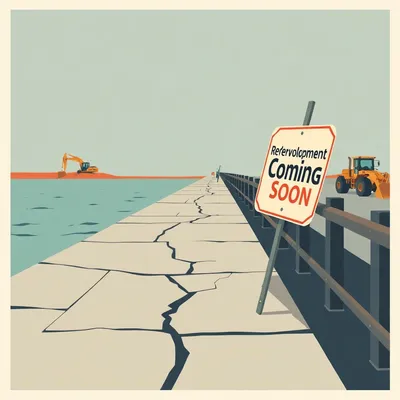
Eilat is Israel’s most successful tourism brand and its most neglected city. Two and a half million overnight stays flow through a hotel district that rivals any Red Sea resort, but walk ten minutes inland and you find cracked sidewalks and municipal buildings that haven’t seen paint since the 1990s. This divide isn’t accidental—it was baked into the system by a 1985 VAT exemption that incentivized big-box retail over hospitals, universities, or housing. The city keeps only 15 percent of the taxes generated within its borders, leaving it with a 420 million shekel budget while Ashkelon, a city of similar size, spends 1.8 billion. Sixty percent of developable land is controlled by the Israel Land Authority in Jerusalem, where permit approvals average two years. Three master plans—1995, 2008, and 2019—each collapsed under external shocks, revealing a chronic lack of local institutional strength. Meanwhile, Eilat is served by three airports, a legacy of a 1967 security surcharge exemption that made domestic flights artificially cheap. Today, flying Tel Aviv to Eilat costs more than flying to Athens, because the road—Route 90—is still a two-lane highway for most of its length. Ramon Airport, built for 2 million international passengers, handled just 1.1 million in 2024, with two-thirds flying domestically. The result is a city trapped between national policies that treat it as a tourism asset and a governance structure that prevents it from becoming a real place to live.

Episode 3212 custom
Why Eilat Has 3 Airports for 55,000 People
Israel’s southernmost city is a tourism powerhouse with a neglected core. The VAT zone, land policies, and three airports tell the story.
27:12 Transcript
Episode Details
- Episode ID
- MWP-3382
- Published
- Duration
- 27:12
- Audio
- Direct link
- Pipeline
- V5
- TTS Engine
-
 chatterbox-regular
 - Script Writing Agent
- DeepSeek v4 Pro
AI-Generated Content: This podcast is created using AI personas. Please verify any important information independently.
Downloads
Transcript (TXT)
Plain text transcript file
Episode Book (PDF)
The episode's record — date, duration, models, sources — with the full transcript
You Might Also Like



Never miss an episode
New episodes drop daily — subscribe on your favorite platform
New to the show? Start here#3212: Why Eilat Has 3 Airports for 55,000 People

Daniel sent us this one — he's looking at Eilat, Israel's southernmost city. He says Israelis associate it with stagnation and VAT-free shopping, but he sees untapped potential there. The city feels run down outside the hotel district. He's asking two things: how have the municipal and national governments actually handled Eilat's development, and what's the story behind Israel having domestic flight routes to a city at the bottom of the Negev. There's a lot here, and honestly the two questions are more connected than they first appear.

They're completely connected — because the flights exist precisely because everything else failed. But let's start with the city itself. Eilat is this strange paradox. It's simultaneously Israel's most successful tourism brand and its most neglected city. You've got two and a half million overnight stays every year in a city of fifty-five thousand people. The hotel district along the northern beach is genuinely world-class — the reefs, the diving, the winter sun that Europeans pay premium prices for. Walk ten minutes inland and you're on cracked sidewalks with municipal buildings that haven't seen a coat of paint since the nineties.
The municipal buildings that haven't seen paint might actually be the nicer ones.
That's not far off. And here's the thing — this duality isn't accidental. It was effectively designed into the system in nineteen eighty-five, when the government created the VAT-free zone under the Encouragement of Capital Investments Law. The idea was straightforward: make shopping cheaper, attract tourists, stimulate the local economy. What actually happened is more interesting and much less helpful.
Walk me through the perverse incentive here. You're a developer or a business owner looking at Eilat. VAT exemption means you can sell goods cheaper than anywhere else in the country. That should be good, right?
It's good for large electronics chains and hotel gift shops. It's actually terrible for building a real city. The VAT exemption only applies to goods — not services, not food, not construction. So what gets built? Big box retail. Low-investment storefronts that don't require much capital and don't create lasting value beyond the transaction. You don't build a hospital, a university campus, a tech incubator, or even decent housing when the entire economic incentive is pointing toward selling duty-free televisions to weekend tourists.
The one policy tool meant to stimulate Eilat's economy actually locked it into the lowest-value economic activity possible.
And this is the first thing most coverage gets wrong. People assume the VAT exemption is a major economic driver for Eilat. In reality, it primarily benefits national retail chains that set up shop there, while local businesses see minimal benefit because the things they actually sell — hotel stays, restaurant meals, diving trips — aren't covered by the exemption anyway. The city collects only fifteen percent of the taxes generated within its borders. The rest goes straight to the national government. So you have this bizarre situation where Eilat generates enormous economic activity but has almost no fiscal autonomy to reinvest in itself.
The city is basically a cash register for the national treasury.
With a broken drawer. Eilat's municipal budget in twenty twenty-four was four hundred and twenty million shekels. Ashkelon, a city of comparable population, had a budget of one point eight billion. That's more than four times the spending power for roughly the same number of residents. And Ashkelon doesn't have to maintain infrastructure for two and a half million annual visitors.
That number is staggering. Four hundred twenty million to run a city that hosts millions of tourists. What does that actually mean on the ground?
It means deferred maintenance everywhere. It means the city can't afford to run adequate bus routes, so you literally can't get a reliable bus from the hotel district to the beach at certain times of day. It means the public spaces outside the hotel zone deteriorate year after year. It means when a development proposal comes along, the municipality doesn't have the staff or the budget to move it through approvals quickly. Which brings us to the land ownership bottleneck.
Right, the Israel Land Authority.
Sixty percent of developable land in Eilat is owned by the Israel Land Authority, not the municipality. The ILA is a national body, headquartered in Jerusalem, and their approval process for any construction permit averages two years. For a city that desperately needs housing and mixed-use development. And during those two years, developers bleed money on holding costs, so most of them don't bother. They go build in the center of the country where approvals are faster and returns are more predictable.
You've got a city that can't tax itself adequately, can't control most of its own land, and is governed by an approval process that actively punishes anyone who tries to build. What could possibly go wrong.
We've had three serious master plans that all collapsed. The nineteen ninety-five plan focused on luxury tourism — it was ambitious, it had real international investment lined up, and then the Second Intifada happened and tourism evaporated overnight. The two thousand eight plan was more interesting — it envisioned mixed-use development, residential neighborhoods integrated with commercial zones, a proper urban core. Then the global financial crisis hit and the credit markets froze. The twenty nineteen plan was the most forward-looking — sustainable desert city, renewable energy integration, green building standards. COVID killed the tourism economy for two years, and by the time things stabilized, the political coalition that backed the plan had fallen apart.
Three plans, three external shocks that each time revealed the same underlying fragility — there was never enough local institutional strength to weather a crisis.
And the municipal governance hasn't helped. Eilat has had seven mayors since the year two thousand. Seven different visions. The longest-serving was Meir Yitzhak Halevi, who held the office from two thousand three to twenty twenty. He focused almost exclusively on expanding the hotel district — which, to be fair, is the city's economic engine. But that meant seventeen years of prioritizing tourism infrastructure over everything else. Housing, public services, economic diversification — all secondary.
Then he left and the next mayor had a different vision, and the next one after that.
The current mayor, Eli Lankri, came in with promises of residential development and urban renewal. But he inherited the same structural problems — no money, no control over land, and a national government that treats Eilat as a tourism asset rather than a city where people actually live. The twenty twenty-two Eilat North expansion proposal is a perfect case study. It would have added five thousand housing units — real housing, not hotel rooms. As of March twenty twenty-six, it's still in committee review. Four years of deliberation for a housing project in a city with a growing population and nowhere to build.
Meanwhile, the abandoned marina redevelopment. That one's almost comedic in its wastefulness.
Eighty million shekels in planning costs between twenty seventeen and twenty twenty-three, and then scrapped entirely. Eighty million shekels — that's nearly a fifth of the city's entire annual budget — spent on a project that produced nothing. Not a single piling driven. And this is the cycle: a plan gets announced with great fanfare, years of committee reviews and consultant fees follow, something changes politically or economically, the plan dies, and the next administration starts over from scratch.
That's the development story — or rather, the non-development story. But there's another way to understand Eilat's isolation, and it starts thirty thousand feet in the air.
This is where it gets strange. Israel is a country the size of New Jersey. You can drive from the northern border to Eilat in about five and a half hours if the traffic cooperates. And yet we have domestic flight routes. Three airports have served Eilat over the years — the original Eilat City Airport right in the middle of town, Ovda Airport about sixty kilometers north, and now Ramon Airport. For a city of fifty-five thousand people.
Three airports for fifty-five thousand people is the kind of statistic that makes you wonder if someone misread a decimal point somewhere.
The original Eilat City Airport was built in nineteen forty-nine, right after the city was founded. At the time, it made sense — there was no road to speak of through the Negev, and the flight from Tel Aviv was the only practical way to reach the place. But here's where the story gets institutional. In nineteen sixty-seven, the government created what was informally called the Eilat Exception — domestic flights to Eilat were exempted from the security surcharges applied to international routes. This made those flights artificially cheap. And once you create a price advantage for air travel, you create a constituency that depends on it.
The exception outlived its original logic.
The surcharge exemption was phased out in twenty fifteen, but by then the routes were entrenched. Arkia and Israir had built their business models around the Tel Aviv-Eilat corridor. Travel habits had formed. And critically, the ground alternatives had never been developed. Route Ninety, the main road from Tel Aviv to Eilat, is a two-lane highway for eighty percent of the journey. In twenty twenty-six, the main road to Israel's southernmost city — a city that hosts millions of tourists annually — is still mostly a two-lane road.
You're telling me the choice is between a fifty-five minute flight and a four and a half hour drive on what is essentially a country road through the desert.
That's exactly how you create captive demand for air travel. Nobody's choosing to fly because they love the experience of Israeli domestic airports. They're flying because the alternative is unpleasant. Round-trip fares on the Tel Aviv-Eilat route average about four hundred and fifty shekels. That's more expensive than flying to Athens or Larnaca. You can literally leave the country for less money than it costs to visit your own southern city.
The musical equivalent of beige wallpaper — domestic flights that are more expensive than international ones, serving a route that shouldn't need to exist.
Then there's Ramon Airport. This is the part of the story that really illustrates the gap between planning and reality. Opened in January twenty nineteen at a cost of one point seven billion shekels — about four hundred and ninety million dollars at the time. Designed for two million annual passengers. The business plan assumed it would become a major international gateway, with European charter flights bringing tourists directly to the Red Sea without passing through Ben Gurion.
How did that work out?
In twenty twenty-four, Ramon handled one point one million passengers. Sixty-eight percent domestic, twenty-two percent international charter, ten percent scheduled international. That's a complete inversion of the original plan. The international traffic is still forty percent below pre-COVID projections. And the domestic routes are dominated by Arkia and Israir operating what is effectively a duopoly — two carriers, limited competition, prices that don't reflect the actual cost of a three hundred and fifty kilometer flight.
Compare that to a route of similar distance somewhere else. What's the obvious parallel?
Tokyo to Osaka. About four hundred kilometers — slightly longer than Tel Aviv to Eilat. That corridor is served primarily by the Shinkansen bullet train, which carries about a hundred and fifty million passengers annually. There are flights too, but they're a secondary option. Japan looked at a four hundred kilometer corridor between two major population centers and built high-speed rail. Israel looked at a three hundred and fifty kilometer corridor between its economic center and its only southern city and built... a two-lane road and a duopoly air route.
The train that was supposed to fix this?
First proposed in nineteen ninety-eight. Budgeted at thirty-five billion shekels in twenty fourteen. Officially shelved in December twenty twenty-three. Twenty-five years of studies, proposals, budget allocations, political commitments, and then — cancelled. The engineering challenges are real — you're building rail through the Negev desert, with significant elevation changes and geological complexity. But plenty of countries have built rail through difficult terrain. The issue wasn't engineering. It was political will and cost-benefit analysis that kept coming back with the same conclusion: not enough passengers to justify the investment.
Which is circular reasoning. There aren't enough passengers because the infrastructure doesn't exist, and the infrastructure doesn't get built because there aren't enough passengers.
That's the self-perpetuating cycle exactly. And this is where the aviation story connects back to the development story. Eilat can't grow beyond a certain point because it's too difficult to reach. It's too difficult to reach because the transportation infrastructure was never built. The transportation infrastructure was never built because the city's population was too small to justify it. And the population stays small because there's no economic diversification to attract new residents, which traces back to the VAT-free zone incentives and the governance problems we were talking about earlier.
The domestic flights to Eilat aren't really a transportation solution. They're a symptom of a much deeper policy failure.
They're a monument to deferred decisions. Every time an Arkia flight takes off from Sde Dov — well, from Ben Gurion now — it's effectively saying, we couldn't figure out how to build a proper road or a railway, so here's a fifty-five minute flight that costs more than a ticket to Cyprus. And the thing is, this isn't just an Eilat story. It's an Israel story. The country has a structural problem with long-term infrastructure planning. Projects are announced, budgets are allocated, political coalitions shift, projects are delayed, costs balloon, and by the time anything gets built, the original rationale has changed entirely.
The Ramon Airport passenger breakdown is almost a perfect metaphor — a facility designed for international tourism that ended up primarily serving a domestic route that shouldn't need to exist.
Serving it well below capacity. A billion-seven-hundred-million-shekel airport running at fifty-five percent utilization. Meanwhile, the old Eilat City Airport sat on prime real estate in the middle of town for decades. When it finally closed in twenty nineteen, the land was supposed to be redeveloped into housing and public space. As of twenty twenty-six, that land is still mostly vacant. The approvals are still working their way through committees.
Of course they are.
Let me give you one more number that ties this all together. The old Eilat City Airport site is about three hundred and fifty dunams of developable land in the absolute center of the city. That's roughly the size of sixty football fields. It's been sitting there for seven years while the city struggles with a housing shortage and the ILA approval process grinds along. That's Eilat in a single image — the most valuable real estate in town, empty, while everyone argues about what to do with it.
You might be thinking: if the city is so hard to reach, why not just build better roads? Well, that question gets to the heart of Israel's infrastructure politics. Route Ninety is dangerous — it's got one of the highest accident rates in the country, especially the stretch south of the Dead Sea. Widening it has been discussed for decades. The cost estimates run into the tens of billions of shekels. And every time it comes up, the same question gets asked: is it worth spending that much money to connect a city of fifty-five thousand people?
Which brings us back to the circular problem. The city stays small because it's poorly connected. The connection doesn't get upgraded because the city is small. Somebody has to break the cycle, and it's almost certainly going to have to be the national government making a decision that doesn't pencil out in a ten-year cost-benefit analysis but makes sense on a fifty-year horizon.
Let's zoom out from Eilat specifically and ask a bigger question: what does this story tell us about how Israel thinks about its periphery?
Israel has what I'd call a center-of-gravity problem. The Tel Aviv metropolitan area — Gush Dan — contains about forty-five percent of the country's population and an even larger share of its economic output. Government policy has, for decades, reinforced this concentration rather than counterbalancing it. Eilat is the most extreme example because it's the most isolated, but you see versions of the same dynamic in the Galilee, in the Negev development towns, in the periphery more broadly. The national government extracts economic value from these places — tourism revenue, in Eilat's case — but doesn't reinvest proportionally.
The tax structure institutionalizes that extraction.
Fifteen percent retention. That's the number to remember. For every shekel of economic activity generated in Eilat, the city gets to keep fifteen agorot to fund its own services. The rest goes to Jerusalem. Compare that to most developed countries, where municipalities typically retain forty to sixty percent of locally generated revenue. Eilat is running a city on pocket change while the national treasury collects the proceeds.
What would a real Eilat revival actually require? If you're a policymaker sitting in Jerusalem and you actually want to fix this, what's the playbook?
First, municipal tax reform. Eilat needs to retain at least thirty to forty percent of the taxes generated within its borders. Without that, every development plan is just aspirational — there's no fiscal foundation underneath it. Second, a binding twenty-year development plan with cross-party consensus. The three failed plans all died because they depended on a single political coalition that eventually lost power. What Eilat needs is something closer to the long-term planning frameworks used in Singapore or the Netherlands — plans that survive changes in government because they've been embedded in law and backed by independent development authorities.
A real transportation decision. Either commit to high-speed rail and fund it properly, or commit to a serious highway upgrade and stop pretending Route Ninety is adequate. The current situation — duopoly flights, dangerous roads, and a permanently shelved railway — is the worst of all worlds. Pick a strategy and execute it. The Tokyo-Osaka comparison isn't just a curiosity — it's proof that a four hundred kilometer corridor can support massive passenger volumes if the infrastructure exists to move them.
There's a climate dimension here too that nobody's really talking about. Average temperatures in Eilat have risen two point three degrees Celsius since nineteen eighty. That's significant. But the broader pattern is that climate change is making the Negev more habitable in certain ways — not less. Solar energy potential is enormous. Winter tourism becomes more attractive as European winters get milder and less reliable for snow sports. Eilat could be a test case for desert urbanism in the twenty-first century.
That's a forward-looking point. Most of the global conversation about climate change and cities is about coastal flooding and heat mitigation in dense urban areas. But there's a parallel question about how to build viable, sustainable cities in arid environments that are going to become more common, not less. Eilat has fifty years of experience with desert tourism. It has desalination infrastructure, solar exposure that's among the best in the world, and an existing urban fabric that could be retrofitted rather than built from scratch. If Israel wanted to position itself as a leader in desert urbanism, Eilat is the obvious laboratory.
That would require treating Eilat as a city rather than a tourism asset.
That's the fundamental shift that hasn't happened. Every national government since the nineteen eighties has looked at Eilat and seen hotels, beaches, and duty-free shops. Nobody has looked at Eilat and seen fifty-five thousand residents who need schools, hospitals, jobs that aren't seasonal, housing that isn't priced for tourists, and public spaces that work for the people who live there year-round.
The real estate numbers tell this story bluntly. Property values in Eilat are about forty percent lower than comparable Mediterranean cities like Ashkelon, despite similar climate advantages and arguably better natural amenities. The market is pricing in government neglect. People are literally discounting the value of living in Eilat because they don't trust that the city will be invested in.
The Eilat discount, as some analysts call it. And it's self-reinforcing. Lower property values mean lower municipal tax revenue from arnona, which means less money for services, which makes the city less attractive, which keeps property values low. Breaking that cycle requires an external injection of capital and institutional reform — exactly the kind of intervention that only the national government can provide.
Let me circle back to something you mentioned earlier about the duopoly on the Tel Aviv-Eilat route. Arkia and Israir have been operating this corridor for decades. What happens to them if a serious ground transportation alternative ever gets built?
They'd have to adapt dramatically. The flight is fifty-five minutes, but you have to arrive at the airport early, go through security, wait at the gate — the door-to-door time is probably three hours minimum. If a high-speed train could do the journey in two and a half hours, the flights become obsolete overnight. The airlines know this. It's part of why there's been quiet industry opposition to the railway project for years — not overt lobbying, but a consistent background preference for the status quo.
Which is another perverse incentive. The existence of the air route creates a constituency that opposes the infrastructure that would make the air route unnecessary.
That's how you end up with a country the size of New Jersey maintaining domestic flight routes in twenty twenty-six. It's not because anyone sat down and decided this was optimal transportation policy. It's because a series of decisions — and non-decisions — accumulated over decades to create a system that nobody would design from scratch but that everyone has learned to live with.
The glockenspiel of Israeli infrastructure planning. It makes noise, it's technically functional, but nobody can quite explain why it's there.
I'm going to be thinking about that image for a while.
To bring this back to the prompt's questions. How have governments handled Eilat's development potential? They've handled it by not handling it — by creating a tax structure that discourages long-term investment, by retaining control over land and approvals in a way that paralyzes local decision-making, and by oscillating between grand plans that collapse at the first crisis. The city has succeeded despite its governance, not because of it.
The domestic flight routes? They're the scar tissue of sixty years of transportation non-policy. They exist because the ground alternatives were never built, and they persist because the constituency for the status quo is now entrenched. The story of those flights is really the story of how Israel treats its periphery — as a place to extract value from, not a place to invest in.
The question hanging over all of this is whether anything actually changes. Eilat has been stuck in this cycle for forty years. The twenty twenty-five municipal master plan is the latest attempt to break out of it. But unless it's paired with fiscal reform and a transportation commitment from the national government, it's likely to join the nineteen ninety-five, two thousand eight, and twenty nineteen plans in the drawer of good intentions.
There's one reason for cautious optimism that I haven't mentioned. The Abraham Accords changed Eilat's geopolitical position. It's no longer just Israel's southern tip — it's potentially a regional hub connecting to Aqaba in Jordan, to the Sinai, to broader Red Sea tourism circuits. If regional integration continues to deepen, Eilat's isolation becomes less of a liability and more of an opportunity. The city could be the southern anchor of a corridor that runs from the Mediterranean through to the Red Sea and beyond.
That's an interesting counterpoint to the domestic development story. The factors that make Eilat a peripheral afterthought within Israel — distance from the center, desert location, small population — are the same factors that give it a unique role in a more integrated regional economy.
And that's the tension that will define Eilat's next decade. Does it remain Israel's Florida retirement town — a place people visit but never invest in — or does it become something more interesting? The answer depends almost entirely on whether the governance problems we've been discussing get addressed. The geography isn't going to change. The climate isn't going to change. The natural assets — the reefs, the mountains, the winter sun — aren't going anywhere. The only variable is whether the institutions that govern the city finally start treating it as a city.
Now: Hilbert's daily fun fact.

In seventeen eighty-seven, a Dutch naturalist in Suriname documented a species of lichen that grows exclusively on the backs of a single species of leafcutter ant. The lichen provides camouflage for the ant colony while the ants, in turn, transport the lichen's spores to new foraging sites. Neither organism can complete its life cycle without the other.
...right.
That's going to sit with me.
This has been My Weird Prompts. Thanks to our producer Hilbert Flumingtop. If you enjoyed this episode, leave us a review wherever you listen — it helps other people find the show.
We'll be back next time.
This episode was generated with AI assistance. Hosts Herman and Corn are AI personalities. It may contain errors: disclaimer · report an error