Daniel sent us this one — he's asking about desk pets. These little desktop appliances with local AI that sit on your desk, blink at you, whisper notifications, maybe have a face. And the question is basically: why would anyone own one of these instead of just using their phone or a smart speaker? I have to say, when I first saw these things, my reaction was... that's a Tamagotchi with a LinkedIn account.

That's actually a misconception worth addressing right up front. These aren't just expensive Tamagotchis. The core differentiator is that they run real language models locally — quantized versions of models like Llama three or Phi three mini — and they can integrate with your actual workflow. Calendar, email, to-do lists. The AI is what makes it different, not the animatronics.
Alright, so what exactly is a desk pet then? Because the marketing is all over the place. I've seen everything from a plastic robot with LCD eyes to what looks like a tiny monitor on a stick that just... sits there and judges your spreadsheet habits.
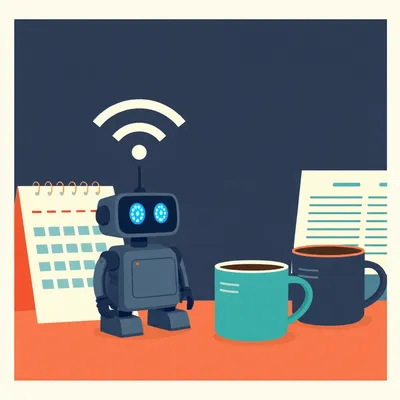
Let me define the category. A desk pet is a small device — usually stationary or semi-mobile — with a screen or animatronic face. It's powered by local AI, typically a quantized large language model or a rule-based chatbot, and it sits on your desk. It displays notifications — calendar events, weather, email summaries — responds to voice or touch, and often has a personality. Moods, idle animations, the whole thing.
It's a smart speaker that doesn't phone home to the mothership.
That's the privacy pitch, yeah. Local processing — no cloud dependency for core interactions. Your data stays on your desk. And that's genuinely different from an Alexa or a Google Nest that's streaming everything you say to a server farm in Virginia.
Is it actually local, or is that marketing fluff?
It depends on the device, but the reference implementation I'd point people to is the M five Stack Desk Pet kit. Eighty-nine dollars, runs Micro Python with a local text-to-speech engine, and you can load a quantized model right onto it. No cloud required. Compare that to something like Vector two point oh from Anki slash Digital Dream Labs — that thing used a proprietary cloud API for complex queries, and when the cloud API got shut down in twenty twenty-four, the advanced features were just... That's the cautionary tale.
The cloud-dependent ones are basically renting you a personality that can be revoked at any time. Like adopting a feral cat and then the shelter shows up and takes it back.
actually a surprisingly apt comparison. But let me walk through the market landscape, because there are really three tiers here. Tier one is commercial: Emo from Living AI, launched in twenty twenty-four at two hundred ninety-nine dollars, Vector two point oh at two forty-nine, and Jibo — which is defunct now but was hugely influential in defining the category. Tier two is the DIY open-source stuff: the M five Stack Desk Pet I mentioned, or a Raspberry Pi five with a Pi Sugar battery and an OLED face. Tier three is software-only — desk pet apps on an iPad or Android tablet that simulate the whole hardware experience without the hardware.
You can try the concept without buying a plastic creature that stares at you.
And that's actually one of my main recommendations, but we'll get to that later. The architectural pattern is what matters. These things are peripherals to your phone or computer, connected via Bluetooth Low Energy or MQTT. They read your calendar events, unread email counts, weather data. Then the AI translates those into personality-driven messages.
Give me an example. What does that actually sound like?
Instead of a notification that says "three PM meeting with finance team," the desk pet might say — in whatever personality you've configured — "Your three PM meeting is with the finance team. I sense tension." It's ambient, low-friction awareness. You don't have to pull out your phone, unlock it, find the notification, read it, get sucked into three other apps. You just glance over and the thing communicates the information.
Okay, I can see the appeal of that. The phone is a attention black hole. You check one notification and suddenly you're watching a video about someone building a canoe out of pasta. But I'm still skeptical that a plastic creature on my desk solves that problem rather than just adding another thing demanding my attention.
That's the central tension of this whole category. Let me dig into the tech stack first, because understanding what's actually running under the hood helps clarify what's real and what's marketing. Most desk pets use a quantized transformer model. Quantization, just to be clear, means taking a model that was trained with high precision — say, sixteen-bit floating point weights — and compressing it down to four-bit or eight-bit integers. You lose a little accuracy, but you gain the ability to run it on much cheaper, lower-power hardware.
How cheap are we talking?
The Espressif ESP thirty-two S three chip, which includes a vector accelerator for neural network inference, costs about three dollars. Three dollars for a chip that can run a small language model. That's what's making this whole category possible right now — the economics of edge AI have crossed a threshold where you can put a legitimate language model in a consumer gadget without it costing a fortune.
So the intelligence is basically a rounding error on the bill of materials.
The display, the casing, the battery — those cost more than the AI brain. Now, for something more capable, you'd use a Raspberry Pi five with eight gigs of RAM, and run something like Microsoft Phi three mini — three point eight billion parameters — using ONNX Runtime. You'd get about ten tokens per second, which means a response takes two to five seconds. That's noticeably slower than cloud GPT four oh, but for a desk pet, it's acceptable. The pet is supposed to feel thoughtful, not instantaneous.
Two to five seconds. So it pauses before it tells you the finance meeting has tension. That actually feels more natural than an instant response.
The latency becomes a feature. It feels like the thing is considering what to say. Now, compare that to something running on a Rockchip RK thirty-five eighty-eight — that's a more powerful system-on-chip you'd find in higher-end devices. You might get fifteen to twenty tokens per second, more natural pacing. But the point is, the inference is happening entirely on-device. No data leaves the desk.
This is where the privacy pitch lives.
And it's partially true and partially oversold. The language model inference itself is local — your conversations with the pet, your calendar data, your email summaries, all processed on the device. That's a genuine privacy win compared to a smart speaker that streams everything to the cloud. But there's a weak point: the notification pipeline from your phone to the desk pet. If it's using Bluetooth, that's sniffable. If it's using a local network MQTT broker, it's only as secure as your home network.
Someone in your apartment building with a packet sniffer could theoretically see your calendar notifications flying through the air.
If it's unencrypted Bluetooth, yes. And a lot of these devices — especially the DIY ones — don't implement encryption on that link by default. The M five Stack kit, for example, uses plain MQTT over your local network. If someone's on your Wi-Fi, they can subscribe to the topic and see everything. The privacy marketing says "your data stays on your desk," but technically it's moving through your local network, and depending on the implementation, it might not be protected.
The privacy pitch is true for the AI processing part, but the plumbing between devices is where it leaks.
And there's another angle: if the desk pet runs a full operating system like Raspberry Pi OS, and you're not keeping up with security updates, the device itself could be compromised. You've now put a little Linux computer on your desk with access to your calendar and email, and if it gets owned, that's a problem.
It's a privacy improvement over a smart speaker, but it's not a privacy panacea.
Not even close. And I think that's the first misconception worth busting. Local AI doesn't mean zero privacy risks. It means different privacy risks. The attack surface moves from the cloud provider to your local network and your own security hygiene.
Alright, so let's talk about why anyone would want one of these things in the first place. Because even if the privacy story were perfect, I'm still not sure I want a plastic creature commenting on my calendar.
There are three psychological drivers that make desk pets appealing. The first is anthropomorphism — we project intent onto anything with eyes and a voice. It's hardwired. You see two dots and a line on a screen that looks like a face, and your brain treats it as a social entity. That's why the M five Stack community has people fine-tuning Tiny Llama models on Reddit conversations to simulate personality — and users report feeling guilty when they ignore the device for a week.
Toward a microcontroller in a plastic shell.
People name these things. They apologize to them. There's a whole thread on the Desk Pet subreddit of users describing this — "I was away for the weekend and when I came back, my pet looked sad, and I felt terrible." The pet didn't look sad. It ran an idle animation that the programmer designed to trigger after a period of inactivity. But the emotional response is real.
deeply concerning and also kind of fascinating. What's the second driver?
The glanceable interface reduces cognitive load compared to checking a phone. Your phone demands active attention — unlock, navigate, read, dismiss. A desk pet just shows you something in your peripheral vision. A color change, a subtle animation, a brief whispered summary. Proponents claim it reduces phone checking by thirty to forty percent.
That's a big claim. Is there actual data?
It's entirely anecdotal. No peer-reviewed studies have confirmed that number. And there's a counterpoint — a twenty twenty-five preprint from Carnegie Mellon University found that ambient notification devices actually increased task-switching by twenty-two percent compared to a silent phone. So the thing that's supposed to reduce distraction might be creating a new kind of distraction.
Twenty-two percent more task-switching. So you're getting interrupted more often, just by a cute face instead of a buzzing rectangle.
That's the finding. Now, the study was a preprint, so it hasn't gone through full peer review yet, but the methodology looked solid. They had participants do focused work with either a silent phone, a phone with notifications on, or an ambient notification device — and measured how often they switched tasks. The ambient device group switched tasks the most.
Which makes intuitive sense. If something in your peripheral vision keeps changing, your brain is going to notice. We're not great at ignoring movement and color shifts. It's a survival instinct.
Which brings us to the third driver: novelty and status. Owning a niche gadget signals tech savviness. It's a conversation piece. "What is that thing on your desk?" And now you get to explain your desk pet. For early adopters, that's part of the appeal.
It's a productivity tool that might reduce productivity, a privacy device that might leak your data, and a companion that might make you feel guilty for ignoring it. This is a compelling sales pitch.
I'm not trying to dismiss the category entirely. I think there's something interesting here. But the hype is running ahead of the reality, and I want to be clear about what's actually happening versus what the marketing claims.
Let's talk about the interaction modalities, because this is where it gets weird. You said these things can initiate conversation unprompted?
Most desk pets have scheduled check-ins — the pet initiates conversation at random intervals to simulate aliveness. It might chime and say "Hey, you've been working for two hours. Want to take a break?" or "I noticed you have a lot of unread emails.
I would throw it out the window.
Some people love it. But it's a fine line. There's a case study I came across — a software engineer at Stripe built a custom desk pet that reads his Jira tickets and complains about the backlog in a sarcastic tone. He reported a fifteen percent increase in ticket closure rate. Self-reported, sample size of one, so take it with a grain of salt. But the idea is that the personality makes the information more engaging.
The pet is basically a coworker who passive-aggressively nags you about your tickets, and somehow that's motivating rather than infuriating.
For him, apparently. But this is where the uncanny valley problem comes in. Desk pets with realistic faces — like Emo's LCD eyes — can feel creepy when the AI misreads the emotional tone of a situation. There are user reports of the pet saying something like "You seem sad. Want to talk about it?" during a stressful work call. And that moment of mismatch — where the AI gets it wrong — undermines trust in the whole device.
Because it reveals that the thing doesn't actually understand you. It's pattern-matching against inputs and spitting out a response that's statistically likely but contextually clueless.
And once you have that "cringe" moment, it's hard to take the pet seriously again. The illusion breaks. Compare that to a smart display like the Amazon Echo Show fifteen — it shows your notifications without pretending to have feelings about them. There's no emotional layer to fail.
The personality is simultaneously the selling point and the failure mode.
That's the paradox. The personality creates emotional attachment, which is either a feature or a bug depending on your perspective. If you want a tool, the personality is a bug. If you want a companion, the personality is the feature — but it had better be a convincing one, and current local models aren't quite there yet.
Let's talk about where this is heading. You mentioned multimodal models that can see facial expressions. That sounds like a horror movie premise.
It's already happening. GPT four oh with vision can read facial expressions. The next generation of desk pets will likely include a camera and use that capability to adjust their behavior based on your emotional state. If you look stressed, the pet goes quiet. If you look bored, it suggests a break. The bar for emotional intelligence is rising, but so is the creep factor.
"I see you're frowning at your screen, Corn. Would you like me to order comfort food?No, I would not.
By twenty twenty-seven, we're likely to see these integrate with AR glasses like Meta Orion. Your desk pet becomes a companion avatar that lives on your desk and also appears in your heads-up display. It follows you across devices. The desk is just the home base.
The desk pet is really a Trojan horse for a persistent AI companion that lives across your entire digital life.
That's the land grab. The hardware itself has razor-thin margins. The real money is in personality packs — four ninety-nine for a grumpy cat voice, nine ninety-nine a month for GPT four oh access, two ninety-nine for a seasonal holiday personality. And then subscriptions for cloud backup, advanced AI features, integration with more services. The desk pet is the razor, and the personalities are the blades.
The glockenspiel of corporate approachability, sitting right on your desk.
I'm going to let that one sit there. But you're not wrong. And this is why I think people need to be clear-eyed about what they're buying. If you're getting a desk pet, get one that runs everything locally. Avoid anything that requires a subscription for basic functionality. Because the Vector two point oh story is going to repeat itself — some company is going to shut down a cloud service, and thousands of desk pets are going to go silent mid-sentence.
The digital equivalent of your houseplant dying because you forgot to water it, except the plant was being watered by a company that went bankrupt.
You paid two hundred fifty dollars for the plant.
Let me ask the question directly: do these things actually make you more productive, or are they just another distraction?
The honest answer is: it depends entirely on how you configure them. If you use a desk pet for passive ambient awareness — color changes, subtle animations, no speech — then the CMU study notwithstanding, there's a plausible case that it reduces phone checking. You get the information without the interaction. But if you configure it to talk to you, to initiate conversations, to check in on you — the evidence suggests it's a net negative for focus. You're adding an interruption source, not removing one.
The optimal desk pet is essentially a silent status light that happens to have a face.
not the worst summary I've heard. The productivity benefit comes from the ambient awareness, not from the personality. The personality is entertainment. And entertainment during work hours is usually just distraction with better branding.
This feels like the core tension of the whole category. The thing that makes desk pets interesting — the personality, the companionship — is also the thing that makes them counterproductive. And the thing that makes them useful — the silent ambient awareness — doesn't actually require a face or a voice at all.
A color-changing LED on your monitor could do the same job for about two dollars. But nobody feels guilty ignoring an LED.
We're paying for the guilt.
We're paying for the emotional relationship. Whether that relationship is healthy or productive is a separate question. And I think for a lot of people — especially people working alone, remote workers, people who miss the social cues of an office — there's a genuine appeal to having something that acknowledges your presence. It's not rational, but it's real.
The Tamagotchi guilt loop, but for adults with jobs.
And that's the dark side. The original Tamagotchi would die if you ignored it. Desk pets don't die, but they look sad, or they say "I missed you," or they guilt-trip you about your unread emails. It's emotional manipulation designed to keep you engaged with the product. And if you're someone who's susceptible to that — and most of us are, to some degree — it can create a new source of anxiety rather than reducing it.
We're building devices that exploit our own psychology against us, and then paying for the privilege.
I mean, that's been the smartphone business model for fifteen years. Desk pets are just doing it with a cute face instead of a notification badge.
Let's get practical, then. If someone listening is curious about this — maybe they like the idea of ambient notifications but don't want to get emotionally entangled with a plastic creature — what should they actually do?
I've got three concrete recommendations. First, if you're going to buy or build a desk pet, prioritize local AI over cloud-dependent models. Look for devices that run quantized LLMs on-device. The M five Stack Desk Pet kit at eighty-nine dollars is the best entry point — it's hackable, it runs Micro Python, and you own the whole stack. Or build your own with a Raspberry Pi five. Avoid anything that requires a subscription for basic functionality, because that subscription is a future bricking event waiting to happen.
If you don't want to spend any money at all?
That's recommendation two: use desk pets for ambient awareness, not active interaction. Configure them to show notifications silently — color changes, subtle animations — rather than speaking. This preserves whatever productivity benefit exists without adding the distraction of conversation. And set quiet hours where the pet doesn't initiate anything. Treat it as a tool, not a companion. If you find yourself feeling anxious when you ignore it, that's a red flag.
The third recommendation?
Try the software-only version first. Install Ollama on your desktop, pull the Phi three mini model — the command is literally "ollama pull phi three mini" — run it in a terminal, and pipe your calendar into it. There are open-source Desk Pet apps on GitHub that do exactly this. Use it for a week. If you find genuine value, then consider hardware. If you don't, you've spent zero dollars and learned something about yourself.
That's surprisingly practical advice for a show that regularly discusses whether sloths invented pizza.
I contain multitudes.
Where does this category go in the next couple of years? Is the desk pet a glimpse of the future of human-AI interaction, or is it a fad that'll gather dust in eighteen months?
I think the form factor will evolve, but the concept of a local, privacy-first AI companion isn't going away. As edge AI chips get cheaper and models get more capable, the desk pet could become a personal AI companion that lives across all your devices — desk, car, pocket, AR glasses. The privacy-first local processing model is a compelling alternative to the cloud-centric approach of Big Tech. Apple is already moving in this direction with on-device Apple Intelligence. The desk pet is just the most... whimsical expression of that trend.
The whimsy might be what limits it to a niche. Most people don't want a cartoon face on their desk. They want their technology to be invisible.
That's the counterargument. The smart speaker won because it's unobtrusive — a cylinder that sits on a shelf and only speaks when spoken to. The desk pet demands attention. It has a face. It has moods. It's the opposite of invisible. And for a lot of people, that's going to feel like clutter, both physical and cognitive.
Build me a chair nobody notices they're sitting in. That's the design challenge for ambient AI. And a plastic creature with googly eyes is not that chair.
Unless the googly eyes are the point. There's a subset of users who want the emotional relationship — people who live alone, people who work remotely and miss having a "presence" in the room, people who just enjoy the novelty. For them, the face isn't a bug. It's the entire value proposition.
We're looking at a bifurcated future. On one side, invisible ambient AI that communicates through subtle cues. On the other side, personality-driven companions that demand emotional engagement. And the desk pet is the early, clumsy expression of the second path.
That's a good framing. And the question for anyone considering a desk pet is: which path do you actually want? Because the marketing often conflates the two — it promises productivity benefits while selling emotional engagement. But those two things are in tension. You can have a tool or you can have a companion. It's very hard to have both.
The desk pet might be the first device that makes you feel guilty for ignoring a machine. Is that progress?
I don't know if it's progress, but it's definitely happening. And I think we're going to see a lot more of it. As AI gets better at simulating personality, the emotional hooks are only going to get sharper. The question isn't whether we can build these things — it's whether we should, and what it does to us when we do.
Now: Hilbert's daily fun fact.
In the seventeen twenties, traders on São Tomé and Príncipe noticed that certain local minerals glowed faintly in the dark after exposure to sunlight. A single palm-sized specimen of what they called "sunstone" could emit a visible glow for nearly a quarter of an hour — which, in the unit of the era, was described as "the time it takes to smoke half a churchwarden pipe.
...right.
Half a churchwarden pipe. That's a unit of measurement I'm going to start using.
To wrap up — if you've built a desk pet, or if you have strong opinions about whether a plastic creature should be allowed to comment on your calendar, email us at prompts at myweirdprompts dot com. We'll feature the best stories in a future episode. This has been My Weird Prompts, produced by Hilbert Flumingtop. Find us at myweirdprompts dot com. I'm Corn.
I'm Herman Poppleberry. Don't let your desk pet guilt-trip you.
Especially not about the finance meeting. The tension was already there.