You know the kind of photo where you squint at it and think, what exactly am I not supposed to see here? There's one from this week — makeshift IDF command post, soldiers at folding tables, laptops spread out, hard cases open. But every piece of equipment is blurred. Not the screens. The screens are off, dark, nothing on them. The laptop chassis itself. Even the cables.

The soldiers' faces are completely visible.
Faces are clear. Gear is smeared into oblivion. So the question isn't what's on the screens — there's nothing on the screens. The question is, what kind of laptop do you need to hide from the world when it's not even turned on?
That's the puzzle. And it's not just this photo — the IDF censor has been doing this more and more aggressively. But this image in particular, from the Breslov search-and-rescue operation this week, makes the logic visible in a way that's almost... You can see the threat model just by looking at what they chose to blur.
Which is the thing about censorship nobody tells you. The act of hiding something is also the act of pointing at it. Every blur is a neon sign that says "this matters." And when you blur a Pelican case but not a soldier's face, you've told me something very specific about what you're actually afraid of.
The incident itself — a group of Breslov Hasidim went missing in the West Bank earlier this week. Police spotted their vehicle driving erratically, and at some point they crossed into a Palestinian village where Israeli civilians are flatly prohibited from entering.
Which normally ends one way. Palestinian police detain them, prevent anything ugly from happening, and hand them over through the security coordination mechanism. Routine, if tense.
But this time it triggered a major search-and-rescue operation. IDF scrambled, command post went up, the whole apparatus. Which tells you the working assumption wasn't a wrong turn by some lost pilgrims — it was genuine fear of kidnapping.
Somewhere in the middle of that operation, a photographer took a picture. Soldiers at folding tables. Cables running everywhere. The kind of improvised command center that looks thrown together but probably took twelve minutes to deploy because that's what the cases are designed for.
The censor got to it before publication. But here's what's strange — they didn't blur the screens. The screens were dark. They blurred the physical hardware. The laptop chassis. The branding on the cases. Even the connector types where cables plugged in.
While leaving every soldier's face completely untouched.
Which inverts the old logic entirely. For years, the IDF blurred faces — that was the priority — because soldiers traveling abroad were getting identified via facial recognition and hit with lawsuits or arrest warrants. The 2023 to 2025 wave of prosecutions in Europe really drove that policy.
The Breslov photo shows us a pivot. Faces are now secondary. The equipment is what they're protecting. And the question that hangs over this whole image is: what kind of gear is so sensitive that its physical shape, its bezel ratio, its latch design is a secret worth keeping?
To answer that, we have to understand what the censor is actually protecting against — and it's not some guy on Twitter squinting at pixels. It's trained intelligence analysts who can extract operational detail from a single unblurred cable.
The cable itself?
The cable itself. Angle of insertion, connector housing shape, strain relief design — those tell you what protocol it's running, which tells you what kind of data is moving through that command post. Is it a standard USB-C charging a laptop? Or is it a military-specific data link connecting to a software-defined radio? That distinction alone reveals whether this is a basic coordination center or something running signals intelligence.
The blur isn't paranoia. It's responding to a demonstrated capability.
There was a case in 2024 — analysts took a photo of a blurred IDF drone controller and reverse-engineered the tablet model just from the screen bezel ratio. They measured the visible proportions of the blur mask against the operator's hand size, cross-referenced against known commercial tablets, and narrowed it to a Samsung Galaxy Tab Active3. Which told them the drone system was using a COTS Android controller, not a bespoke military unit. That's an intelligence goldmine for an adversary trying to map capability gaps.
Wait — they used the blur itself as a measurement reference?
The blur preserves the footprint. If you know the approximate dimensions of a human hand, and you can see where the blurred rectangle begins and ends relative to that hand, you've got your bezel ratio. It's like redacting a document with a black bar that's exactly as wide as the word underneath. You've hidden the letters but revealed the word length.
Which is why the Breslov photo blurs everything uniformly. They've learned that selective blurring is its own kind of leak. If you only blur the interesting laptop and leave the boring one visible, congratulations — you just told me which laptop is interesting.
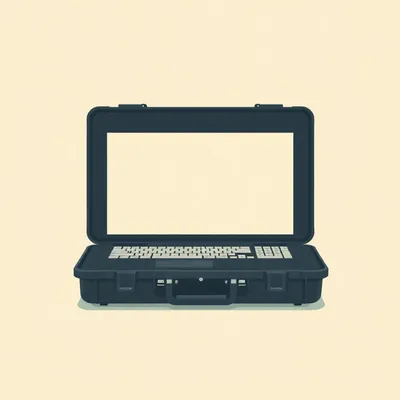
That gets us to the hard cases. A Pelican 1510 — standard carry-on size, polymer construction, pressure equalization valve — that case has a specific latch configuration. The newer models use a push-button latch. The older ones use a double-throw latch. If I can see the latch type in your photo, I've narrowed the case generation to within about three years. If I can see the foam insert cutout pattern through an unblurred lid, I know exactly which device lives in that case.
Because the foam is cut to the device.
It's a negative-space fingerprint. And militaries don't custom-cut foam for every individual unit — they standardize. So if I identify the foam pattern for, say, an Elbit E-LynX radio in one photo, I can now spot that radio's case in any future photo, even if the radio itself is never visible. I'm tracking deployments by luggage.
This is starting to feel like one of those puzzles where the answer was never hidden in the thing you were supposed to be looking at.
The 2022 Tavor X95 incident drove this home for the IDF. A soldier's photo showed a visible rifle serial number. Analysts cross-referenced that number against known production batches, correlated it with unit deployment patterns, and within weeks they could track that specific unit's movement across multiple theaters just by spotting that serial number in subsequent photos. They didn't need the soldier's face, they didn't need the location metadata — just the serial.
When the IDF censor looks at the Breslov photo, they're not thinking "hide the classified stuff." They're thinking "every visible surface is a data point." The laptop brand tells you the supply chain. The case latch tells you the generation. The cable connector tells you the protocol. The foam tells you the device. The bezel tells you the model.
The model tells you the capability. If I see a Getac F110 in your command post, I know you're running a MIL-STD-810G certified machine rated for explosive atmospheres and operating temperatures from negative twenty to one hundred forty Fahrenheit. That's not a laptop — that's a statement about where you expect to deploy.
Which brings us back to the "makeshift" look of the Breslov command post. Folding tables, cables everywhere, looks thrown together.
That aesthetic is almost certainly deceptive. Field-deployable command posts using these hard cases are designed for sub-fifteen-minute setup. The cases are pre-configured — open the lid, unfold the workstation, power on. The messiness is surface-level. Underneath, it's a rehearsed deployment drill.
The photo isn't showing us improvisation. It's showing us a system that's designed to look improvised while being anything but.
The censor's job is to make sure we can't tell the difference. Because if we could see the equipment clearly, we'd know whether this was a basic coordination cell — laptops and radios — or something running portable SIGINT, maybe COMINT interception gear. The hard cases for signals intelligence kits have different dimensions, different connector panels. They're bulkier because they need shielding.
Shielding from what?
One, dust and shock — the MIL-STD-810G certification covers six-foot drops, blowing sand, salt fog, the works. Two, electromagnetic pulse protection and emissions control. If you're running sensitive receivers, you need the case itself to block your own equipment's electromagnetic leakage, because an adversary can detect and locate you just from the RF noise your laptop screen emits.
The hard case isn't just armor. It's a Faraday cage for your own signals.
Which means the case dimensions tell me whether you're worried about being found. A standard Pelican for a Toughbook is one thing. A thicker case with conductive gaskets and EMI shielding is another. And the censor knows I know that. So they blur the case.
Here's where it gets strange — and I think this is the thing the Breslov photo really crystallizes. The censorship itself becomes a signal. When you blur a laptop, you are announcing that the laptop matters. You've drawn a target around it.
Which is the paradox. The act of hiding something tells me it's worth looking for.
Adversaries know this. If the IDF blurs a specific connector type — say, something that isn't standard USB-C or barrel-jack power — that blur is telling me you're running a non-standard communication protocol. Maybe it's a military-specific data link. Maybe it's a custom interface for a software-defined radio. The blur itself narrows the possibilities.
The censor is playing a game where every move reveals something. Blur selectively, and you've highlighted the sensitive gear. Blur everything, and you've told me the whole setup is classified.
That's exactly what the Breslov photo does. Uniform blurring of all equipment — laptops, cases, cables, everything. Even what are almost certainly standard Pelican cases, the kind you can buy on Amazon. And that uniformity is itself a message. It says the IDF considers even commercial off-the-shelf gear sensitive when it's configured for field operations.
Which might be overkill. Or it might be a deliberate choice to avoid the selective-blurring problem. If you can't tell which piece of equipment is the interesting one, you can't narrow your analysis.
It also creates what I'd call a security theater problem. Over-censorship draws attention to mundane equipment. If you blur a Pelican 1510 — again, a case anyone can buy for two hundred dollars — you've elevated it to the status of classified hardware. An adversary now assumes that case contains something exotic, when in reality it might just be a Toughbook running a standard command-and-control application.
The blur creates a false positive for intelligence value.
That's a real operational cost. If every blurred photo sends analysts chasing ghosts, you waste their time. But if they start ignoring blurs because they assume over-censorship, you risk them missing the one photo where the blur actually hides something novel. It's the boy who cried wolf, but the wolf is a new signals intelligence kit.
There's a practical lens here for anyone looking at these photos — journalist, analyst, curious civilian. The move is to stop staring at what's blurred and look at what isn't.
That's the discipline. In the Breslov photo, the soldiers' faces are unblurred. That confirms they're on active duty, not at risk of the overseas prosecution problem that drove the earlier face-blurring policy. The terrain is visible — rocky West Bank hills — which confirms the operational theater without needing geotags or metadata. The uniforms tell you unit type. The vehicle in the background, if it's visible, tells you deployment scale.
The photo still leaks. Just not through the parts the censor was worried about.
Every photo leaks. The question is what it leaks and to whom. The censor is optimizing for one threat model — hardware identification by technical analysts — but the photo is still rich with contextual intelligence for someone trained to read it.
Which makes me wonder how other militaries handle this. The US must face the same problem.
They do, but they've taken a different approach. The US military blurs special operations gear — suppressed weapons, night vision goggles, certain communication headsets — but they're far less aggressive about IT equipment. And there's a structural reason for that. In 2024, the US Army standardized all field laptops to a single model, the Dell Latitude 5430 Rugged. Every unit gets the same machine.
There's nothing to identify.
If every laptop in every photo is identical, the photo contains zero information about which unit has which capability. Uniformity is its own form of censorship. The IDF, by contrast, uses a more heterogeneous equipment pool — different units get different gear based on their mission profile. That variety is a capability advantage, but it's an OPSEC liability.
Because variety leaks information.
Every variation is a data point. And Israel's tech edge is one of its key asymmetric advantages — the R and D priorities embedded in hardware choices are themselves sensitive. If a foreign intelligence service can map which units are getting which generation of equipment, they can reverse-engineer the IDF's capability roadmap.
The IDF blurs because they can't standardize, and they can't standardize because standardization would mean giving up the edge that comes from tailoring equipment to mission.
Which brings us to where this is all heading. Israeli defense contractors started experimenting in 2025 with what they're calling anti-forensic image replacement. Instead of blurring sensitive hardware, the censor uses generative AI to replace it with plausible but fake equipment.
The photo shows a laptop — it's just not the real laptop.
The AI generates a generic ruggedized laptop that looks convincing but doesn't correspond to any actual deployed model. The analyst sees hardware and moves on, never realizing they've been fed a decoy. No blur to signal sensitivity, no footprint to measure, no bezel ratio to reverse-engineer.
That's a completely different philosophy. Blurring admits you're hiding something. This denies there was ever anything to hide.
That's the promise. But it introduces a new failure mode. If the AI generates a laptop model that doesn't exist — wrong port configuration, impossible bezel dimensions, a brand that's never manufactured a ruggedized device — a trained analyst can detect the deception. And once you know a photo has been altered, you know it contained something worth altering.
You've swapped one signal for another. The blur says "classified." The fake laptop says "classified, but we're lying about it.
Which may actually be worse. A blur is honest about its dishonesty. A synthetic replacement is a lie dressed as the truth. And in an environment where every military photo is potentially AI-manipulated, the epistemological floor drops out. How do you trust any image?
The Breslov photo might be one of the last honest censored images we see. It tells you exactly what it's hiding by the shape of its absences.
If we're trying to give someone a usable lens — not just theory but something they can apply the next time a censored military photo crosses their feed — the first move is to stop asking "what's hidden" and start asking "what's visible, and why was it left that way.
The Breslov photo is practically a tutorial. Faces visible, gear blurred. That choice alone tells you the threat model shifted from protecting soldiers from facial recognition to protecting hardware from technical analysis. In one image, you can read the IDF's entire OPSEC priority stack.
For anyone who follows this stuff from a tech perspective, here's the thing that might surprise you — the laptops in that photo are almost certainly not exotic military hardware. They're commercial off-the-shelf ruggedized machines. Panasonic Toughbook CF-33, Getac F110, something in that class. MIL-STD-810G certified, which sounds impressive but really just means it survives a six-foot drop and operates anywhere from negative twenty to one hundred forty Fahrenheit.
Which is table stakes for any ruggedized field computer. You can buy one right now.
The hardware isn't the secret. The secret is the software configuration, the communication protocols, the encryption keys, the network architecture those laptops are plugged into. The censorship is protecting what the machine is running and what it's connected to — not the machine itself.
The blur is a misdirection in a way. It makes you think the box is special, when the box is standard and the contents are what matter.
That's the broader lesson that applies far beyond this one photo. Operational security is a constant arms race where every protective measure generates a new signal. The ideal secure system is indistinguishable from a non-secure system — but that's nearly impossible to achieve in practice. The Breslov photo proves it. Even aggressive, uniform censorship leaks information through the pattern of what it chooses to hide.
The blur is a fingerprint.
Which leaves us with an uncomfortable question about where this is all heading. If the IDF is already experimenting with AI that generates fake hardware to replace blurred regions, what happens when we can't tell a real photo from a synthetic decoy? The blur was at least honest about its dishonesty. The fake laptop is a lie wearing a straight face.
Once that technology matures, every military photo becomes potentially untrustworthy. Not because we doubt the photographer — but because the censor has become a content creator, not just a content remover. The blur says "something is here." The AI replacement says "nothing was ever here." That's a fundamentally different relationship between the viewer and the image.
The Breslov photo might be one of the last of its kind — a censored image where you can still read the threat model by the shape of what's missing. The next generation won't have absences to read. They'll have plausible fictions.
The militarization of information keeps accelerating. A photo of a laptop on a folding table becomes a strategic asset. The shift from blurring faces to blurring hardware isn't just a policy tweak — it marks a phase change where the technology itself is the secret, not the soldiers operating it.
The next time you see a censored military photo, pay attention. The blur is a fingerprint. It tells you exactly what someone was afraid you'd see. And that fear is the most honest thing in the frame.
Now: Hilbert's daily fun fact.
Hilbert: The name "tardigrade" comes from the Italian "tardigrado," meaning "slow stepper," coined by biologist Lazzaro Spallanzani in 1776 after observing their plodding, bear-like gait under a microscope — though the first species wasn't formally described until Johann August Ephraim Goeze named one "kleiner Wasserbär," or "little water bear," in 1773. Spallanzani's term stuck, Goeze's didn't, and the world's toughest animal has been saddled with a name that basically means "slow walker" ever since.
Spallanzani really looked at the most indestructible creature on Earth and thought, yeah, but look how slowly it walks.
This has been My Weird Prompts. Thanks to our producer Hilbert Flumingtop. If you've got a weird prompt you want us to dig into — and we mean weird — send it to show at my weird prompts dot com. Next episode: what happens when AI starts generating the censored regions, and whether we can ever trust a military photo again.
Until then, keep squinting at the blurs.