

For millions of people whose asthma doesn't respond to inhaled corticosteroids, Singulair, and antihistamines, the question of what's actually next is urgent. Adjunctive therapies — treatments added to standard controller therapy — have fundamentally reshaped the severe asthma landscape. These targeted biologics go after specific inflammatory mediators rather than providing broad symptom relief, and they've changed what clinicians can offer patients who continue to exacerbate despite maximum standard therapy.
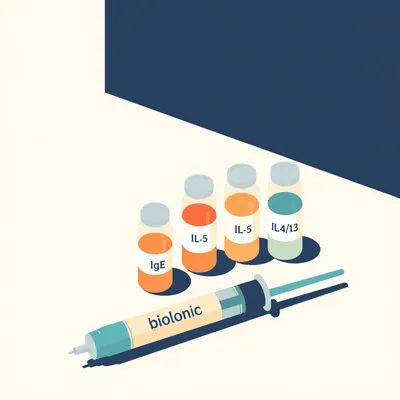
The anti-IgE therapy omalizumab (Xolair) set the template in 2003, mopping up circulating IgE before it can trigger mast cell degranulation. The anti-IL-5 class — mepolizumab, benralizumab, and reslizumab — targets eosinophilic inflammation by starving or actively destroying eosinophils, the white blood cells whose granular proteins damage airway epithelium. Benralizumab's every-eight-week dosing schedule makes it the most convenient option for patients who struggle with frequent appointments. Dupilumab blocks the shared IL-4 receptor alpha subunit, inhibiting both IL-4 and IL-13 signaling, giving it a broader patient population that includes non-eosinophilic phenotypes and comorbidities like atopic dermatitis and nasal polyps.
Matching patients to the right biologic requires triangulating biomarkers: IgE level, eosinophil count, and FeNO. A high FeNO pushes toward dupilumab; high eosinophils with low FeNO points to anti-IL-5 therapy; high IgE with allergic triggers suggests omalizumab. Practical factors — dosing frequency, comorbid conditions, insurance coverage, and lifestyle — often tip the scale when multiple biologics are technically indicated. The field continues to evolve, with pediatric approvals expanding access and new targets on the horizon for patients whose asthma doesn't fit the Th2 paradigm.
Episode 3308 custom
Biologics for Severe Asthma: Beyond Singulair
A guide to targeted therapies reshaping severe asthma treatment — from Xolair to Dupixent.
32:20 Transcript
Episode Details
- Episode ID
- MWP-3478
- Published
- Duration
- 32:20
- Audio
- Direct link
- Pipeline
- V5
- TTS Engine
-
 chatterbox-regular
 - Script Writing Agent
- DeepSeek v4 Pro
AI-Generated Content: This podcast is created using AI personas. Please verify any important information independently.
Mentions
- benralizumab Anti-IL-5R biologic, brand Fasenra
- dupilumab Anti-IL-4/IL-13 biologic, brand Dupixent
- Dupixent Biologic for severe asthma (dupilumab)
- Fevipiprant Discontinued CRTH2 antagonist for asthma
- itepekimab Anti-IL-33 antibody in phase 3
- Mepolizumab Anti-IL-5 biologic for eosinophilic asthma
- Montelukast Leukotriene receptor antagonist for asthma
- Omalizumab Biologic for severe eosinophilic asthma
- reslizumab IV anti-IL-5 biologic
- Tezepelumab Biologic for severe asthma (tezepelumab)
- upadacitinib JAK inhibitor studied in asthma
Downloads
Transcript (TXT)
Plain text transcript file
Episode Book (PDF)
The episode's record — date, duration, models, sources — with the full transcript
You Might Also Like



Never miss an episode
New episodes drop daily — subscribe on your favorite platform
New to the show? Start here#3308: Biologics for Severe Asthma: Beyond Singulair

Daniel sent us this one — he's asking what adjunctive treatments are available for asthma beyond Singulair and antihistamines, specifically the ones that target allergic and inflammatory mediators. And he's right to ask, because for millions of people whose asthma doesn't respond to inhaled corticosteroids, Singulair, and antihistamines, the question of what's actually next is urgent. Let's dig into the biologic and small-molecule landscape that's reshaped this field.

It has reshaped it. I mean, the FDA approval of tezepelumab in 2021 and then the 2025 label expansion for dupilumab into pediatric populations — those two events alone have fundamentally changed what clinicians can offer. Yet a lot of patients and even some primary care physicians haven't caught up to the full arsenal. So that's what this episode's about — the targeted therapies that go after specific inflammatory mediators, not just symptom relief.
Before we get into the biologics themselves, let's define what we mean by adjunctive therapy in asthma. Because the term gets thrown around loosely.
Adjunctive means treatments added to inhaled corticosteroids and long-acting beta-agonists — ICS and LABA — when standard step-up therapy fails. These are not replacements. Nobody's throwing away their inhaler because they started a biologic. The controller therapy stays. The biologic layers on top.
The reason we need that layer goes back to what Singulair and antihistamines can't do. Singulair — montelukast — is a leukotriene receptor antagonist. It works for exercise-induced and allergic asthma, but it only blocks one inflammatory pathway, and the FDA slapped a boxed warning on it in 2020 for neuropsychiatric side effects. So it's a narrow tool.
Antihistamines are even narrower. Histamine is a minor player in lower airway inflammation. The dominant drivers in asthma are Th2 cytokines — IL-4, IL-5, IL-13 — and IgE-mediated mast cell degranulation. Antihistamines barely touch that. They're great for allergic rhinitis, almost useless for asthma exacerbations. I've had patients come in who've been doubling up on cetirizine for months, convinced it's helping their wheeze, and their lung function hasn't budged.
That's a good reality check. So if Singulair and antihistamines aren't cutting it, what's actually available? Let's start with the anti-IgE therapies, because they set the template for everything that followed.
Brand name Xolair. FDA approved in 2003 for moderate-to-severe persistent allergic asthma, and it's still underutilized twenty-plus years later. The mechanism is elegant — it's a monoclonal antibody that binds free IgE in the bloodstream, preventing it from attaching to mast cells and basophils. No IgE binding, no degranulation, no histamine release, no cascade.
It mops up the circulating IgE before it can cause trouble. I'm picturing a sponge soaking up something before it hits the floor.
That's exactly the right image. The landmark trial was INNOVATE in 2005 — showed a twenty-six percent reduction in exacerbations versus placebo. And that's in patients who were already on high-dose ICS and LABA. So this is additive benefit on top of maximum standard therapy. These are people who were still having multiple exacerbations a year despite doing everything right with their inhalers.
What's the practical reality of being on it? I'm trying to imagine the patient experience.
Monthly or biweekly subcutaneous injections. Dosing is based on body weight and baseline IgE level, and you have to be in the thirty to seven hundred international units per milliliter range for it to be indicated. So it's not for everyone — if your IgE is too low or too high, omalizumab isn't the right fit. And there's a rare risk of anaphylaxis, which is why the first few doses are typically given in a clinical setting. After that, many patients learn to self-inject at home, but those first monitored doses are mandatory.
There's a built-in safety ramp. But it's been around for over two decades.
We'll get to that. But also awareness — a lot of patients who'd qualify never get referred to a specialist who'd prescribe it. They're stuck in primary care, cycling through inhaler combinations, and nobody says "maybe it's time for a biologic." I've seen patients who spent five years on escalating doses of ICS and LABA, plus montelukast, plus tiotropium, still exacerbating twice a year, and nobody had ever checked their IgE or sent them to an allergist. That's a system failure.
That's IgE. But IgE is just one piece of the puzzle. The real revolution came when we started targeting the cytokines driving eosinophilic inflammation.
This is where we get into the anti-IL-5 therapies. Three of them: mepolizumab, benralizumab, reslizumab. All target eosinophilic asthma specifically. Eosinophils are the white blood cells that drive a huge proportion of severe asthma, and IL-5 is the cytokine that promotes their production, maturation, and survival. Think of IL-5 as the growth factor and survival signal for eosinophils. It's what tells the bone marrow to make more of them and tells existing eosinophils to stick around.
Blocking IL-5 starves the eosinophil population. But how does that actually play out physiologically? What are these eosinophils doing in the airway that makes them so destructive?
Eosinophils release granular proteins — major basic protein, eosinophil cationic protein, eosinophil peroxidase — that directly damage airway epithelium. They're not just innocent bystanders; they're actively causing tissue injury, promoting airway hyperresponsiveness, and driving remodeling. When you deplete them, you're removing a major source of ongoing airway damage. The MENSA trial for mepolizumab in 2014 showed a fifty-three percent reduction in exacerbations. That's enormous. Benralizumab, brand name Fasenra, works differently — it binds the IL-5 receptor alpha on eosinophils and actually induces antibody-dependent cell-mediated cytotoxicity. It doesn't just block the signal, it marks the eosinophils for destruction.
It's actively killing them off, not just starving them. That's a fundamentally different mechanism — it's almost like the difference between shutting down a factory and sending in a demolition crew.
The practical advantage of benralizumab is dosing — after the loading phase, it's one injection every eight weeks, which is the least frequent biologic schedule we have. For a patient who hates needles or has trouble getting to appointments, that matters enormously. I had a patient who was a long-haul truck driver — getting to a clinic every month was nearly impossible. Benralizumab every eight weeks made the difference between adherence and abandonment.
It's the odd one out — IV only, requires an infusion center. Same target, anti-IL-5, but the intravenous route makes it logistically harder. You need a chair, a nurse, an IV line, monitoring. It's less commonly used now that the subcutaneous options are available. There's really no clinical reason to choose it over mepolizumab or benralizumab unless there's some unusual insurance requirement or the patient specifically prefers an infusion setting, which does happen — some people would rather go to a center every month and have someone else handle everything.
For eosinophilic asthma, you've got three options that go after IL-5. But what if the patient's asthma isn't purely eosinophilic? That's where the anti-IL-4 and IL-13 approach comes in.
Brand name Dupixent. This one blocks the shared IL-4 receptor alpha subunit, which inhibits both IL-4 and IL-13 signaling. These are the cytokines that drive Th2 inflammation broadly — not just eosinophils but also IgE production, mucus hypersecretion, airway remodeling. The LIBERTY ASTHMA QUEST trial in 2016 showed a forty-eight percent reduction in severe exacerbations. And here's a concrete example of why that broad mechanism matters: I had a patient with severe asthma, nasal polyps, and eczema so bad she couldn't sleep through the night. That's IL-4 and IL-13 driving pathology in three different organ systems simultaneously. Dupilumab addressed all of them with one drug.
The unique advantage here is that it works in both eosinophilic and non-eosinophilic phenotypes. It's not gated by a single biomarker.
That's the key differentiator. Omalizumab needs high IgE. Mepolizumab and benralizumab need high eosinophils. Dupilumab works regardless of the eosinophil count, which gives it a much broader patient population. And it treats comorbidities — atopic dermatitis, nasal polyps, eosinophilic esophagitis. If you've got a patient with severe asthma plus bad eczema, dupilumab is almost a no-brainer.
Like a multi-disease biologic. One injection, three problems addressed. But how do you actually monitor whether it's working across all those domains?
You track each condition separately. For asthma, it's exacerbation frequency, FEV1, symptom scores. For eczema, it's the EASI score — Eczema Area and Severity Index. For nasal polyps, it's the nasal polyp score and sense of smell. The beauty is that improvement in one domain doesn't necessarily predict improvement in another, but most patients see benefits across the board. And in October 2025, the FDA expanded approval to children aged six to eleven with moderate-to-severe asthma. That's a big deal — pediatric severe asthma has been underserved by biologics. Before that, omalizumab was the main option for kids. Now you've got a second pathway for children whose asthma isn't purely IgE-driven.
Let's put this into a concrete case. You're in clinic — thirty-four-year-old with severe allergic asthma, IgE four hundred fifty international units per milliliter, eosinophils three hundred fifty cells per microliter. Failed high-dose ICS and LABA, failed montelukast. Which biologic do you reach for?
This is the phenotype-matching exercise that makes asthma biologics so interesting. IgE four hundred fifty is in range for omalizumab. Eosinophils three fifty puts them in eosinophilic territory, so anti-IL-5 is on the table. And dupilumab would cover both pathways. So you've got three legitimate options. This isn't a case where the labs scream one choice — it's a judgment call.
How do you break the tie? Walk me through the real-world decision tree.
You look at practical factors. Does the patient have comorbid atopic dermatitis or nasal polyps? Do they want the least frequent dosing? Benralizumab at every eight weeks. Are they needle-phobic but willing to come in monthly? Omalizumab or mepolizumab. Is cost and insurance a factor? Omalizumab has the longest track record, so prior authorization may be easier — though that varies by plan. You also ask about lifestyle. I had a patient who traveled internationally for work six months a year. Benralizumab's eight-week schedule meant fewer injections to coordinate across time zones. That tipped the scale.
This is where biomarkers become essential. You can't make this decision without knowing the eosinophil count, IgE level, and FeNO.
FeNO — fractional exhaled nitric oxide — is a marker of Th2-driven airway inflammation. A high FeNO, say above fifty parts per billion, tells you IL-4 and IL-13 are active. That pushes you toward dupilumab. Low FeNO with high eosinophils? Anti-IL-5. High IgE with allergic triggers? You're triangulating. It's almost like celestial navigation — you need three points to fix your position.
Now let me push on something. All the biologics we've discussed so far — omalizumab, mepolizumab, benralizumab, dupilumab — they all work within the Th2 paradigm. But what about the patients whose asthma doesn't fit that model? The non-eosinophilic, non-allergic cases? What do you do when the biomarkers are all low and the patient is still exacerbating?
That's where tezepelumab comes in, and it's arguably the most significant advance of the last five years. Brand name Tezspire. It targets TSLP — thymic stromal lymphopoietin — which is an epithelial-derived cytokine that sits upstream of both Th2 and non-Th2 pathways. This is the paradigm shift. Every other biologic we've discussed targets something downstream — IgE, IL-5, IL-4, IL-13. Tezepelumab goes to the top of the waterfall.
It's intercepting the signal earlier in the cascade. Help me visualize this — what's actually happening at the epithelial level?
Picture the airway epithelium as a security system. When it detects an intruder — an allergen, a virus, a pollutant — it releases alarm signals. TSLP is one of the primary alarms. It wakes up dendritic cells, which then decide what kind of immune response to mount. By blocking TSLP, tezepelumab silences the alarm before the security team even gets mobilized. The NAVIGATOR trial in 2021 enrolled over a thousand patients and showed a fifty-six percent reduction in exacerbation rate versus placebo — and the crucial detail is that this benefit was seen regardless of baseline eosinophil count.
It's the first biologic for non-eosinophilic severe asthma. The patients who've been left out of the biologic revolution until now.
And it's given subcutaneously every four weeks. No biomarker required for initiation. You don't need to check IgE or eosinophils or FeNO to qualify. If the patient has severe uncontrolled asthma on ICS and LABA, tezepelumab is indicated, period. That's a radical departure from the gatekeeping model.
That's a paradigm shift. Every other biologic requires some kind of phenotypic gatekeeping. You have to prove the patient fits the profile. Tezepelumab throws the gates open.
That's why I think of it as the broadest tool we have. The downside is that it's newer — approved 2021 — so insurance step therapy often requires failure of omalizumab or an anti-IL-5 first. But clinically, if you've got a patient with borderline eosinophils — say one hundred fifty cells per microliter and FeNO of fifty parts per billion — both dupilumab and tezepelumab are options, but tezepelumab's biomarker-agnostic efficacy gives it an edge in those borderline cases. You're not guessing whether the eosinophil count is "high enough" to justify the drug.
We've got anti-IgE, anti-IL-5, anti-IL-4/IL-13, anti-TSLP. What about the small molecules? Because not everyone wants an injection.
This is where we move from injectable biologics to oral options, and the story gets more complicated. The JAK inhibitors — upadacitinib, abrocitinib — block multiple cytokine pathways downstream by inhibiting Janus kinases. Phase two data for upadacitinib in asthma in 2023 showed improved FEV1, which is encouraging. But the safety concerns are real — thrombosis, infection, the same issues that come with JAK inhibition in other diseases. As of 2026, they're not FDA approved for asthma.
It's a promising mechanism with a problematic safety profile. But why is the safety profile worse for JAK inhibitors than for biologics? Aren't they both targeting inflammatory pathways?
The difference is scope. Biologics are precise — they target one specific cytokine or receptor. JAK inhibitors block the signaling machinery used by multiple cytokines simultaneously. JAK1, JAK2, JAK3, TYK2 — these kinases are downstream of dozens of different cytokine receptors. When you inhibit them, you're not just blocking IL-4 or IL-5 signaling; you're interfering with interferons, growth factors, hematopoietic signals. The breadth that makes them effective also makes them riskier. Oral administration is convenient, but systemic immunosuppression is a bigger hammer than you'd want to swing for most asthma patients. There's also fevipiprant, a CRTH2 antagonist that blocks the prostaglandin D2 receptor on Th2 cells. Phase three trials showed modest benefit — not enough for FDA approval, and development has essentially stalled.
The small-molecule pipeline for asthma is thin. What happened with fevipiprant? Why didn't it pan out?
The biology was sound — prostaglandin D2 is a real driver of Th2 inflammation, and the CRTH2 receptor is a legitimate target. But the phase three results showed a reduction in exacerbations that was statistically significant but clinically underwhelming. Something like a ten to fifteen percent reduction versus placebo. When you've got biologics showing forty to fifty percent reductions, a fifteen percent improvement from an oral agent is a harder sell, especially when you factor in the side effect profile. It's not that the drug didn't work — it's that the bar has been raised so high by the injectables.
For now, the injectables are the main event. What about non-pharmacologic options?
A completely different approach. Bronchial thermoplasty uses radiofrequency energy delivered through a bronchoscope to reduce airway smooth muscle mass. Less muscle, less bronchoconstriction. The AIR2 trial in 2010 showed a thirty-two percent reduction in exacerbations at one year. It's FDA approved, but it's reserved for severe refractory asthma — patients who've failed everything else.
It's controversial. I've heard pulmonologists argue about this at conferences.
The long-term effects on airway remodeling are still debated. Some data suggest the benefit persists for five years or more, but we don't have twenty-year data. And it's a procedure — three separate bronchoscopy sessions — so it's invasive in a way that biologics aren't. You're essentially burning away smooth muscle in the airways. The question is whether the smooth muscle grows back, or whether the scarring creates new problems down the line. Most clinicians reach for biologics before considering thermoplasty. It's a third- or fourth-line option.
It's further down the algorithm. What about allergen immunotherapy? SCIT and SLIT? That's something a lot of patients ask about because it feels more "natural" than a biologic.
Subcutaneous immunotherapy — allergy shots — and sublingual immunotherapy — allergy drops or tablets. A 2024 meta-analysis showed a forty percent reduction in asthma symptoms and medication use with allergen immunotherapy. That's meaningful. But adherence is a challenge — SCIT requires regular injections over three to five years, and there's a risk of anaphylaxis, which is why it's done in a medical setting. You're literally injecting the thing the patient is allergic to, in escalating doses. SLIT is safer and can be done at home, but it's less effective for asthma specifically. The data for SLIT in asthma is weaker than for allergic rhinitis.
It's an option, but not a blockbuster. And it requires a level of commitment that a lot of patients can't sustain.
Three to five years of regular appointments for SCIT — that's a big ask. It's underused, and for the right patient — someone with clear allergic triggers and mild-to-moderate asthma — it can be transformative. I've had patients who essentially stopped exacerbating after completing a full course of SCIT. But for severe disease, biologics have eclipsed it. The effect size is larger and the onset is faster.
Let's talk about what's on the horizon. You mentioned anti-IL-33 and anti-ST2. Where do those fit in the cascade we've been describing?
Itepekimab targets IL-33, and astegolimab targets ST2, which is the IL-33 receptor. Both are in phase three trials as of 2026. IL-33 is another epithelial-derived alarmin, like TSLP, released when the airway epithelium is damaged. It's stored in the nuclei of epithelial cells and released when those cells are injured — it's almost like a damage signal. Blocking it could provide another upstream, phenotype-agnostic approach. If those trials read out positively, we could have a tezepelumab competitor within a few years.
The pipeline is moving upstream — TSLP, IL-33, ST2 — all targeting the epithelial signals that initiate inflammation rather than the downstream cytokines. It's like we've been fighting fires in individual rooms and now we're installing a building-wide sprinkler system.
That's the trend. And it makes sense — if you can intercept the cascade at its origin, you don't need to worry about which specific Th2 cytokine is dominant in a given patient. The question is whether blocking one alarmin is enough, or whether you need to block multiple. TSLP and IL-33 are both released by damaged epithelium, but they're not identical in function. There might be patients who don't respond to TSLP blockade but do respond to IL-33 blockade, and vice versa. We won't know until we have head-to-head data.
Let's address cost. Because all of this sounds great, but biologics run thirty to sixty thousand dollars a year in the United States. That's a mortgage payment for a lot of families.
That's the reality. And insurance step therapy often requires failure of omalizumab before approving newer agents like dupilumab or tezepelumab. So even if the phenotype says dupilumab is the better choice, the payer may force you through omalizumab first. That's a frustration for clinicians and patients alike. You're essentially wasting six months on a drug you know is suboptimal for that patient because the insurance algorithm says so.
It means the clinical algorithm we've been describing — match the biologic to the phenotype — gets distorted by the payer algorithm. You're not treating the patient in front of you; you're treating the patient the insurance company will pay for.
Though there's been movement. The WHO added dupilumab and omalizumab to the essential medicines list in 2025, which may help with global access. And as biosimilars enter the market — omalizumab biosimilars are in development — costs should come down. The first biosimilar for any biologic typically reduces the price by fifteen to thirty percent. When multiple biosimilars compete, you can see drops of fifty percent or more. That's the light at the end of the tunnel.
With all these options, the obvious question becomes: how do you choose? Let's boil it down to actionable guidance. If someone's listening and thinking "this might be me," what's the framework?
Three rules of thumb. First, for eosinophilic asthma — eosinophils above three hundred cells per microliter — anti-IL-5 therapy is first-line biologic. Mepolizumab or benralizumab, with benralizumab's eight-week dosing as a practical advantage.
For allergic asthma with high IgE — and I mean IgE in the thirty to seven hundred range with documented allergic triggers — start with omalizumab. It's got the longest safety record, and if the phenotype fits, it works. Twenty years of post-marketing data gives you a lot of confidence in the safety profile.
For mixed or non-eosinophilic asthma, or for patients with comorbid atopic dermatitis or nasal polyps, dupilumab or tezepelumab are preferred. Dupilumab if you've got those comorbidities, tezepelumab if you want a single agent that works regardless of biomarkers. And I'll add a fourth: if the biomarkers are ambiguous and you don't want to guess, tezepelumab's biomarker-agnostic indication makes it the safest bet for avoiding a non-response.
The prerequisite to all of this is biomarker testing. Blood eosinophil count, IgE level, FeNO, and allergen-specific IgE. You cannot start a biologic without phenotype characterization. It's like trying to prescribe antibiotics without knowing whether the infection is bacterial or viral.
That's non-negotiable. And I want to emphasize something that gets lost in the excitement about biologics — adjunctive doesn't mean replacement. All of these are add-on to ICS and LABA, not substitutes. Patients must continue their controller therapy. Stopping the inhaler because you're on a biologic is how you end up in the emergency department. I've seen it happen. A patient feels great on dupilumab, decides they don't need their daily inhaler anymore, and three weeks later they're in the ED with a severe exacerbation. The biologic raises the floor; it doesn't replace the foundation.
The inhaler stays, the biologic layers on top. What should a listener do if they think they might be a candidate? What's the practical step-by-step?
If you or a patient has persistent exacerbations despite step four or five therapy — that's high-dose ICS and LABA, maybe plus tiotropium or montelukast — request a referral to a pulmonologist or allergist for biologic evaluation. And bring recent labs — eosinophil count and IgE level at minimum. That saves an appointment cycle. If you show up to the specialist visit with labs in hand, you can have the phenotype conversation on day one instead of waiting for results.
Don't assume biologics are only for the sickest of the sick. That's a misconception. Guidelines recommend considering biologics at step four or five — moderate-to-severe persistent asthma after ICS and LABA failure. Not just ICU-level disease. You don't need to be intubated to qualify.
Another misconception worth busting: all biologics do not work the same way. They target different mediators — IgE, IL-5, IL-4 and IL-13, TSLP — and patient selection based on phenotype is critical for efficacy. If you put an anti-IL-5 drug in a non-eosinophilic patient, you're wasting sixty thousand dollars and six months. And you're delaying effective treatment, which means more exacerbations, more oral steroids, more lung function decline.
The antihistamine misconception — that taking enough Zyrtec will help your asthma. It won't. Histamine is a bit player in the lower airways.
We've covered that ground, but it bears repeating because patients keep trying it. I understand why — antihistamines are cheap, over-the-counter, and feel safe. But asthma isn't allergic rhinitis of the lungs. The mediators are different, the anatomy is different, and the treatment needs to be different.
Where is this all heading? The next frontier might make today's choices look primitive.
I think the big open question is whether oral biologics will replace injectables. An oral anti-IL-5 or oral anti-TSLP would be a game-changer for adherence and access. But the pharmacokinetics are harder — proteins don't survive the stomach well. You need clever formulation strategies to protect the molecule through the GI tract and get it absorbed intact. The other question is whether we can predict biologic response with genetic markers. Right now we're using blood biomarkers as proxies, but a genetic signature that says "this patient will respond to anti-IL-5 but not anti-IgE" would eliminate the trial-and-error phase. Imagine a world where a cheek swab at diagnosis tells you exactly which biologic to start.
That's the era of precision asthma therapy. The next decade will likely see biomarker-driven algorithms that match patients to the optimal biologic on the first try, not after cycling through two or three. No more "let's try this for six months and see.
The pieces are already there. We have the biomarkers. We have the drugs. What we need is the prospective data showing that phenotype-driven first-line biologic selection produces better outcomes than step therapy. Those trials are running. The results will determine whether payers change their step-therapy requirements or double down.
The 2025 WHO essential medicines listing for dupilumab and omalizumab suggests the global health community is taking this seriously — these aren't niche drugs for rich countries anymore. Severe asthma in a low-resource setting is devastating, and access to biologics could change that.
They're not. Severe asthma affects people everywhere, and the morbidity is enormous — lost workdays, emergency visits, oral corticosteroid dependence with all the metabolic side effects that brings. Weight gain, diabetes, osteoporosis, cataracts — these are the hidden costs of chronic oral steroid use. Biologics reduce oral steroid use dramatically, and that alone is worth the price of admission for many patients. I've had patients who were on daily prednisone for years, and within months of starting a biologic, they're off steroids entirely. That's life-changing.
To wrap this up: if Singulair and antihistamines aren't cutting it, the arsenal is deeper than most people realize. Anti-IgE, anti-IL-5, anti-IL-4 and IL-13, anti-TSLP — each with a specific phenotype match. Biomarker testing is essential. Specialist referral is the gateway. And the inhaler stays.
The pipeline isn't slowing down. IL-33 and ST2 inhibitors are in phase three. Oral options are being explored. The era of one-size-fits-all asthma treatment is ending. We're moving toward a model where every patient's asthma gets its own targeted therapy, matched to the biology driving their disease.
If you found this useful, rate and review the show — it helps others find us.
Now: Hilbert's daily fun fact.

During the early Renaissance, Nepalese records documented a freshwater jellyfish bloom in Lake Phewa so dense that fishermen reported hauling in nets containing over four thousand individual medusae in a single morning — a population density that wouldn't be recorded again anywhere in the Himalayas for another four centuries.
...right.
This has been My Weird Prompts. I'm Corn.
I'm Herman Poppleberry. Find us at myweirdprompts.
This episode was generated with AI assistance. Hosts Herman and Corn are AI personalities. It may contain errors: disclaimer · report an error