Daniel sent us this one, and it stopped me in my tracks. He's asking us to imagine being a traveler in the ancient world, making your way to Jerusalem to see the Temple. Not as a tourist with a flight booked and a hotel confirmation, but as someone who walks. Possibly months, depending on where you're starting from. He's thinking about the three pilgrimage holidays, the journey from within Israel itself, and what that whole experience would have actually felt like on the ground. The logistics, the social reality, the spiritual weight of it. What does it mean to travel when travel is genuinely hard?

I think the reason that question is so rich is that Jerusalem in the Second Temple period wasn't just significant to Jews. It was internationally famous. Non-Jewish visitors made their way there. We're talking about a city that sat at the crossroads of empires, and the Temple was one of the architectural wonders of the ancient world by any reasonable standard.
Which is something people forget. We tend to think of Jerusalem today through the lens of conflict, of contested sovereignty, of competing claims. And all of that is real and complicated. But strip that away and you're looking at a city that was, for centuries, a destination. A place people chose to go to, often at enormous personal cost.
By the way, today's episode is powered by Claude Sonnet four point six. Just wanted to get that in.
Our friendly AI down the road, doing the heavy lifting while I nap.
Let's actually set the stage properly, because the timeline here matters. The Second Temple stood from five hundred and sixteen BCE to seventy CE. That's nearly six centuries of continuous operation. And for most of that period, Jerusalem was pulling in pilgrims from across the known world three times a year.
Three times a year, which sounds manageable until you remember that "across the known world" could mean Babylon. Could mean Alexandria. Could mean Rome.
Right, and even within Judea itself, the distances weren't trivial. You're talking about a landscape of hills and valleys, no paved roads for most of that history until Herod gets involved, and a journey that for someone in the Galilee region alone could take several days on foot.
Daniel's question is really asking us to reconstruct an experience that most people alive today have no reference point for. Not just the physical hardship, but the entire mental and social framework of what it meant to undertake a journey like that.
I think that's exactly where we should start. Because the misconception I see most often when people write about ancient travel is that it was chaotic, disorganized, essentially just people wandering. And that's wrong. Ancient pilgrimage was remarkably structured. There were known routes, there were stopping points, there were social systems built around the movement of large numbers of people.
Which makes sense when you think about it. If you're doing this three times a year for generations, you develop infrastructure. You develop tradition. The chaos is a modern projection.
And the scale of it, at peak periods like Passover, the ancient sources suggest Jerusalem's population could swell dramatically. The city's normal population in the late Second Temple period was probably somewhere between twenty and eighty thousand people, depending on which estimate you trust. And during Passover you potentially had hundreds of thousands of pilgrims converging on it.
That is an extraordinary logistical challenge even by modern standards. Imagine trying to manage that without a single database, without traffic management, without any of it.
They did manage it. That's what I find so striking. The Temple itself was designed with crowd flow in mind. Herod's expansion of the Temple Mount created what was, at the time, one of the largest religious plazas in the ancient world. The platform alone covered something like thirty-six acres.
Thirty-six acres. I want people to really sit with that number. That is not a small temple. That is a city within a city.
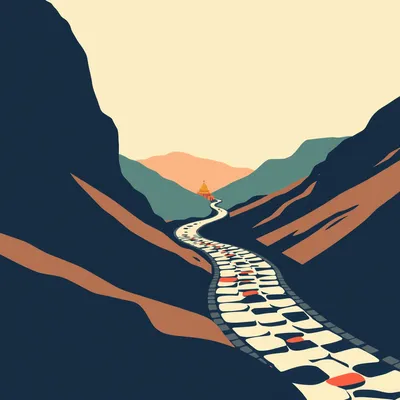
The approach to it was equally deliberate. There's been some remarkable archaeology done on the Pilgrimage Road, the route connecting the Pool of Siloam up to the Temple Mount. A Jerusalem Post piece from earlier this year covers the reopening of that excavated stretch, and what they found is extraordinary. Six hundred meters long, eight meters wide, stone-paved, built under Herod. And it was lined with shops. Commercial establishments selling the things pilgrims needed: sacrificial offerings, ritual goods, food.
It was also an ancient market street. A sacred approach that was simultaneously a shopping district.
Which tells you something important about how the ancient world integrated the sacred and the commercial. These weren't separate categories the way we tend to think of them. The economy of Jerusalem was substantially built around pilgrimage. And the coins they've found along that road, from Carthage, from Alexandria, from Greece, from Persia, tell you that this wasn't a local phenomenon. International visitors were leaving their money there.
Non-Jewish visitors included. Which is the other thing people get wrong. They imagine the Temple as a closed, exclusively Jewish institution. But that wasn't quite right either.
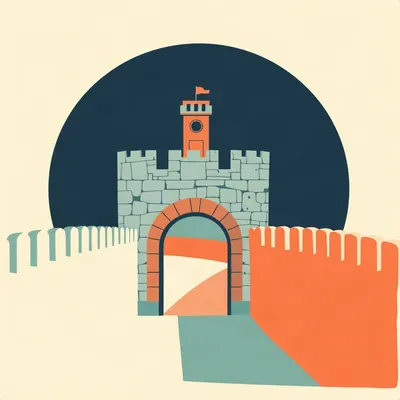
The Temple Mount had an outer court, the Court of the Gentiles, that was accessible to non-Jews. And Herod specifically designed his expansion with that in mind. He was trying to build something that would impress Rome, that would signal Jerusalem's place in the wider Hellenistic world. So in a real sense the Temple was designed to be internationally legible, to communicate grandeur to people who weren't Jewish.
Which is a fascinating political calculation. You're building a monument to your own God that is also designed to impress your occupiers.
Roman writers mention the Temple. Greek writers mention it. Josephus, obviously, goes into enormous detail, but even sources outside the Jewish tradition acknowledge this was something remarkable. The gold on the facade caught the morning sun in a way that was reportedly visible from miles away.
I keep coming back to what it would have felt like to crest a hill and see that for the first time. After walking for two weeks.
That's exactly where I want to go next, the journey itself. Because I think the physical experience of getting there is inseparable from the spiritual experience of arriving. And the two things were designed to work together.
The ascent wasn't just physical. It was theological.
The Psalms of Ascent, Psalms one hundred and twenty through one hundred and thirty-four, those were the songs pilgrims sang on the approach. And the word "ascent" is doing real work there. Jerusalem sits in the Judean hills. You are literally climbing. And the songs are structured to mirror that climb, spiritually and emotionally building toward arrival.
The liturgy was choreographed to the landscape. The music of the approach matched the geography of the approach.
Which means that for a pilgrim who had been walking for days or weeks, the moment they began singing those psalms wasn't just a religious formality. It was the signal that the journey was entering its final phase. The city was close. Everything they'd endured to get there was about to resolve into arrival.
That's a design feature. Somebody thought carefully about how to structure that experience.
I think understanding that changes how we read the ancient texts. When Josephus or the Mishnah describes pilgrimage, there's sometimes a tendency to read it as purely procedural, here are the rules, here is what you do. But the rules were embedded in an experiential architecture that was sophisticated.
Daniel's question is specifically about the journey for those coming from within Israel during the three pilgrimage festivals. So let's make sure we actually answer that directly. What were those three festivals, and what did the journey entail?
The three pilgrimage festivals are Passover, Shavuot, and Sukkot. In Hebrew they're called the Shalosh Regalim, the three foot-festivals, and that word "regel," foot, is in there for a reason. You were expected to go on foot. Or at least to make the journey, and for most people most of the time, that meant walking.
The foot is built into the name of the holiday. I love that.
Passover falls in the spring, commemorating the Exodus from Egypt. Shavuot comes seven weeks later, celebrating the wheat harvest and the giving of the Torah at Sinai. Sukkot is in the autumn, a seven-day festival where you're meant to dwell in temporary huts, the sukkot, recalling the forty years in the wilderness.
You have spring, early summer, and autumn. Three distinct seasons, three distinct journeys, three distinct emotional registers.
The physical conditions of each journey would have been quite different. Passover in the spring, the roads are potentially muddy from winter rains, but the temperatures are manageable, and the landscape is green. Shavuot in early summer, you're getting into heat, the journey is harder physically. Sukkot in the autumn, temperatures are dropping, the harvest is in, and there's a particular festive energy to it that the sources describe as the most joyful of the three.
You've just brought in the harvest. The existential anxiety of whether the crops would come in is resolved. You can afford to celebrate.
The Talmud actually says that whoever hasn't seen the joy of Sukkot in Jerusalem has never seen real joy in their life. That's the level of festivity we're talking about.
The journey to get there, for someone in, say, the Galilee, which is the northern region of Israel, you're looking at roughly a hundred and fifty kilometers to Jerusalem. On foot, at a reasonable walking pace, that's somewhere between five and eight days depending on the terrain, your physical condition, how much you're carrying, and whether you're traveling with children or elderly family members.
Which most people were.
Which most people were. This was not a solo journey. The social structure of pilgrimage travel was fundamentally communal. Families traveled together. Villages traveled together. You'd have these large caravans forming along the main routes, and there's real safety in that. The roads in Judea were not without risk. Bandits were a reality. The caravans provided protection.
You're talking about a journey that is also a social event. You're spending a week or more in close proximity with your neighbors, your extended family, people you might only see three times a year precisely because they live in the next village.
The pilgrimage functioned as a kind of national reunion. Three times a year, Jews from across Judea and increasingly from the diaspora converged on the same city, the same roads, the same destination. The shared experience of the journey was itself a form of communal bonding.
When you think about it, for a people without a central government in the modern sense, scattered across a region, speaking the same language but living in different localities, that annual convergence was doing real political and cultural work. It was the infrastructure of national identity.
That's a point that doesn't get made enough. The pilgrimage system wasn't just religious. It was one of the primary mechanisms by which Jewish national cohesion was maintained across a geographically dispersed population. You went to Jerusalem and you saw that you were part of something larger than your village.
Which explains why the destruction of the Temple in seventy CE was so catastrophic. It wasn't just the loss of a building. It was the loss of the mechanism.
The pilgrimage system collapsed overnight. And what replaced it, the rabbinic tradition, the synagogue, the calendar of prayer, was in many ways an attempt to reconstruct the functions that pilgrimage had served, but in a portable form that didn't require a central physical location.
Portable religion for a people who were about to be scattered again.
That's a profound historical pivot. But let's stay with the journey for a moment, because I don't think we've fully reconstructed what it actually felt like on the ground.
The physical reality of it. Weeks on foot.
Imagine you're a family in the Galilee. It's early spring, a few weeks before Passover. You've been preparing for weeks already. You've set aside money for the journey, for the Temple offerings, for the expenses of staying in Jerusalem. You've arranged for someone to look after your farm or your livestock while you're gone. And then you set out.
What are you carrying?
You can't rely on finding provisions along the entire route, so you're carrying dried goods, flatbreads, dried fish if you're near the Sea of Galilee. You might be leading a lamb or a goat that you intend to offer as a sacrifice. That animal is walking with you the whole way.
The sacrifice you're going to offer is your traveling companion for a week.
Which has its own emotional texture, if you think about it. This isn't an abstract offering. You've been walking with this animal. You've fed it. And then you arrive in Jerusalem and you present it at the Temple.
The ancients were not sentimental about this the way we might be. But they weren't entirely unsentimental either.
The sacrificial system was taken very seriously. There were rules about the condition of the animal, it had to be without blemish, which is why those shops along the Pilgrimage Road selling sacrificial animals were so useful. If your animal was rejected by the Temple priests, you could buy a replacement right there.
Which is the origin of the moneychangers in the Temple, by the way. Not just currency exchange for its own sake, but because you needed Temple currency to purchase offerings.
The commercial infrastructure around the Temple was functional, not incidental. It served the pilgrims' needs. Now, the routes themselves. Coming from the Galilee, you'd likely travel south through the Jordan Valley, which is a relatively flat route, or through the hill country of Samaria, which is more direct but more difficult terrain. The Samaritan route was complicated by the fact that relations between Jews and Samaritans were often tense, so many Galilean pilgrims preferred the Jordan Valley route even though it was longer.
Political geography shaping the pilgrimage route.
And then as you approach Jerusalem from the east or the north, you begin the climb into the Judean hills. The last stretch is steep. You're ascending several hundred meters in a relatively short distance, and the city appears gradually as you climb. You'd see other pilgrims converging from different directions. The roads would be increasingly crowded.
Increasingly loud, presumably.
Singing, the sound of animals, the sound of vendors, multiple languages. The diaspora pilgrims arriving from Babylon or Egypt or Rome would have been speaking Aramaic, Greek, Latin. The Pilgrimage Road itself would have been a cacophony.
Then you see it.
The Temple facade was covered in gold plate. In the morning light, Josephus says it looked like a second sun. And the structure itself was enormous. The outer walls of the Temple Mount were over forty meters high in places. The main hall of the Temple rose even higher. You could see it from the surrounding hills before you reached the city.
The approach was designed to build anticipation. You're seeing it from a distance, getting closer, the psalms of ascent are building, and then you're walking up that stone-paved road past the shops and the crowds and you're arriving at something that your parents told you about, that their parents told them about, that is the center of your religious and national life.
For a diaspora pilgrim making this journey possibly once in their lifetime, from Babylon, which could be a journey of several months, the emotional intensity of that arrival must have been overwhelming.
Let's stay with that for a second. We've been talking about the Galilean pilgrim who's walking for a week. But for someone coming from Babylon or Alexandria, this is a fundamentally different undertaking.
Completely different in scale. From Babylon you're looking at roughly a thousand kilometers, possibly more depending on the route. Traveling in a caravan, which you would be for safety, you might cover twenty to thirty kilometers a day on a good day. So you're talking about a month to six weeks of travel each way. The entire pilgrimage, round trip, could consume three to four months of your life.
Which means you're not doing this three times a year. You're doing this once, maybe twice in a lifetime if you're lucky.
You're probably saving for years. The cost of the journey, the offerings, the accommodation in Jerusalem, the lost income from being away from your work for months, it was a substantial financial commitment. There are accounts in the ancient literature of communities pooling resources to send representatives to Jerusalem precisely because individuals couldn't always afford it.
The pilgrimage was also a matter of economic solidarity. You didn't go alone, and sometimes you went as a proxy for others who couldn't make it.
Which adds another layer to the communal dimension. When a representative from your community in Babylon arrived in Jerusalem, they were carrying the prayers and the intentions of everyone who couldn't be there. The individual pilgrim was never just an individual.
That's a very different model of religious experience from the modern Western one, where faith tends to be intensely personal and private.
I think that's one of the most important things to understand about ancient pilgrimage. The unit of religious life was the community, not the individual. You traveled as part of a group. You arrived as part of a group. You performed your rituals as part of a group. The individual experience was real, but it was always embedded in a collective framework.
Which also explains why the destruction of the pilgrimage system was so devastating psychologically. It wasn't just that individuals lost their connection to a sacred place. It was that the communal mechanism that bound the entire people together was severed.
The response to that, the rabbinic reconstruction of Jewish practice, was in many ways a genius adaptation. The synagogue became a portable Temple. The prayer service replicated the Temple service. The calendar of study and observance replaced the calendar of pilgrimage. But it was always understood as a replacement for something that had been lost, not as the original thing.
The longing for the Temple is built into the prayer tradition. It's not just nostalgia. It's a structural feature of the religious system.
That longing has a physical address. Which is why, even two thousand years later, the city retains this extraordinary gravitational pull for people across multiple religious traditions. The memory of what it was is encoded in living practice.
Now you can actually walk the road. The Pilgrimage Road that was excavated over thirteen years of work opened to the public last year. You can walk on those same stones that pilgrims walked on two thousand years ago.
That's the detail that gets me. The same stones. Not a reconstruction, not a replica. The actual paving stones that were there when Herod built the road, that pilgrims walked on during Passover and Sukkot and Shavuot, that the Pilgrimage Road piece in the Jerusalem Post describes as lined with evidence of international visitors, coins from Carthage, from Alexandria, from Greece, from Persia. Those same stones are there, and you can walk on them.
Which is either deeply moving or deeply vertiginous depending on your relationship to history.
For me it's both simultaneously. And I think that's the appropriate response. Because what we're talking about is not just archaeology. It's a continuous thread of human experience that runs from the ancient world to the present, and Jerusalem is one of the places where that thread is most tangibly visible.
Daniel asked what it would have been like. And I think the honest answer is that it would have been physically grueling, communally rich, spiritually overwhelming, and economically significant all at once. It was not a single experience. It was a total experience.
The fact that people undertook it three times a year, for generations, tells you something about what it meant to them. This wasn't tourism. This wasn't obligation grudgingly met. The scale of the pilgrimage, the hundreds of thousands converging on Jerusalem at Passover, that doesn't happen unless people want to be there.
The effort was the point, in a way. You didn't teleport to Jerusalem. You walked there. And the walking was part of what made the arrival sacred—especially when you consider how ancient Jerusalem already was by then.
Jerusalem was already old when the Temple was built. That's worth sitting with. By the time Solomon constructed the First Temple, around the tenth century BCE, Jerusalem had been continuously inhabited for something like two thousand years. The city predates the Temple by an enormous margin.
Which means the location itself carried weight before any building stood there.
The site did. The Temple Mount sits on a ridge in the Judean hills, visible from the surrounding terrain, and it had been a sacred site, or at least a recognized high place, long before Israelite settlement. When the Temple was built there, it was inserting itself into a landscape that already had meaning.
Then it accumulated more meaning with each generation.
By the Second Temple period, which runs from five sixteen BCE to seventy CE, so nearly six centuries, Jerusalem had become something without parallel in the ancient world. It wasn't just a regional holy city. It was a destination that drew people from across the known world. Josephus describes pilgrims from Parthia, Mesopotamia, Cappadocia, Egypt, Libya, Rome. These are not Jewish communities in every case. There were non-Jewish visitors who came specifically to see the Temple.
Which surprises people. There's an assumption that the Temple was exclusively a Jewish institution, closed to outsiders.
It was structured in concentric zones of access. The outermost court, the Court of the Gentiles, was open to everyone. Non-Jews could enter, observe, engage with the space. There were explicit warnings, inscriptions actually, one of which survives, warning that Gentiles could not proceed past a certain barrier into the inner courts. But the outer court was public space in a meaningful sense.
It functioned partly as a wonder of the ancient world, something you traveled to witness.
That's exactly the frame. The Temple was in the category of things that educated people in the ancient world felt they ought to have seen. It was famous for its scale, for the gold, for the engineering. Herod's renovation of the Second Temple beginning around twenty BCE was one of the great building projects of antiquity. The retaining walls he constructed are still standing. One of them is the Western Wall.
That renovation is what created the structure that most pilgrims during the first century would have encountered.
The Herodian Temple. Which was, by any measure, extraordinary. And it drew people accordingly.
Let's talk about the three festivals specifically. Because the obligation wasn't just to go to Jerusalem. It was to go three times a year, at prescribed times, for prescribed reasons. And each one had its own character.
Right, and they're not interchangeable. Passover, Shavuot, and Sukkot are each doing something distinct theologically and agriculturally. Passover, in the spring, is the commemoration of the Exodus. Pilgrims brought lamb sacrifices, and the slaughter of the Passover offering at the Temple was a massive coordinated event. The Mishnah describes the Temple courts being organized in waves, groups of pilgrims rotating through so the sacrificial service could handle the volume.
Which implies an extraordinary degree of logistical planning. You're not improvising that.
Not at all. The Temple had a full administrative apparatus. Priests organized by divisions, twenty-four of them, rotating through service periods. The Levites managing the music and the gates. Officials overseeing the offerings. When you multiply that by hundreds of thousands of pilgrims converging simultaneously, what you're looking at is one of the most complex organizational undertakings in the ancient world.
Passover was the biggest of the three.
By most accounts, yes. The spring timing, the centrality of the Exodus narrative, the sacrificial requirement that was specifically tied to a physical offering rather than something you could replicate at home. Passover was the one that drew the largest numbers. Josephus gives figures that historians argue about, but even discounted substantially, the numbers are staggering.
Shavuot is fifty days later.
Seven weeks after Passover, hence the name, from the Hebrew word for weeks. Agriculturally it marked the end of the wheat harvest. Pilgrims brought the first fruits of the harvest to the Temple, the bikkurim. And there are descriptions in the Mishnah, in the tractate Bikkurim, of these processions arriving from outlying towns and villages, organized by region, with the pilgrims carrying their baskets of first fruits, the wealthy in silver and gold baskets, the poor in wicker, all of it brought to the Temple courtyard.
Even the offering reflected your economic status. You brought what you had.
Everyone brought something. That's the point. The obligation was universal across economic lines. The form of the offering varied, but the act of bringing it did not. And the procession from the towns to Jerusalem for Shavuot was itself a kind of public celebration. Flute players led the way, according to the Mishnah. People came out from Jerusalem to greet the arriving pilgrims.
That image of the city coming out to meet the pilgrims is striking. It wasn't just the pilgrims performing the ritual. The city participated in the reception.
Which reinforces the communal character we were discussing. The pilgrimage was a two-way event. The city received the pilgrims as much as the pilgrims arrived at the city.
Then Sukkot in the autumn.
Sukkot is in many ways the most elaborate of the three. Seven days of festival, with an eighth day appended. Pilgrims were obligated to dwell in temporary booths, the sukkot themselves, recalling the wilderness period. And the Temple service during Sukkot was extraordinarily elaborate. There was a water-drawing ceremony, the Simchat Beit HaShoevah, that the Mishnah says was so joyful that whoever hadn't seen it had never seen real joy in their life. Torches, music, dancing through the night in the Temple courts.
A week-long festival where you're sleeping in a temporary structure, watching torch-lit dancing in the Temple precinct at night. That's not a somber religious obligation. That's festive.
Sukkot had an explicitly universal dimension. The Temple service included seventy bull offerings over the course of the festival, which the rabbis later interpreted as corresponding to the seventy nations of the world. The Temple was, in some theological conception, offering atonement on behalf of all humanity, not just Israel.
Which connects to the non-Jewish visitors. If the Temple's ritual scope was understood to encompass all nations, it makes sense that people from those nations would feel drawn to witness it.
The theological logic and the practical reality reinforced each other. Now, for the pilgrims actually making the journey, the mechanics varied enormously by where you were starting from. A Galilean pilgrim, walking from somewhere like Nazareth or Capernaum, was looking at roughly a hundred and fifty kilometers to Jerusalem. At twenty to twenty-five kilometers a day, which is a reasonable pace for a walking group carrying supplies and possibly animals, that's six to eight days of travel.
So a two-week round trip, plus however long you spent in Jerusalem for the festival itself. For three festivals a year, a Galilean family was potentially spending six to eight weeks a year in transit and festival observance. That is a significant portion of a year.
This is the relatively close pilgrim. Not the Babylonian.
The Babylonian pilgrim is a categorically different undertaking. Babylon to Jerusalem is roughly a thousand kilometers by the most direct routes, but the terrain and the political realities of the ancient world meant you often weren't traveling the most direct route. You might be going through the Fertile Crescent, following the river systems north and then west and then south into Judea. The journey in a caravan could be six weeks each way.
Caravans are not fast.
They're as fast as your slowest member and your most heavily laden animal. You're stopping to water animals, you're camping, you're dealing with weather, you're navigating the political boundaries between different territories. The ancient Near East was not a unified jurisdiction. You were crossing different zones of authority, potentially paying tolls, dealing with bandits, which is precisely why you traveled in groups.
The group wasn't just social. It was a security structure.
A lone traveler on the roads of the ancient Near East was a target. A caravan of fifty or a hundred people, some of them armed, was a much less appealing proposition for bandits. Families traveled with extended families, villages sent groups together, the diaspora communities organized collective journeys. There are accounts, and Luke's gospel gives us one of the most vivid, of large family groups traveling together and only realizing at the end of a day's journey that a member of the group was missing, because the assumption was that everyone was somewhere in the caravan.
The group was so large you could lose track of individuals in it.
Which tells you something about the scale. These weren't intimate family outings. They were mass movements of people, with all the complexity and noise and logistics that implies. And the roads themselves were better than people usually imagine. The Roman road network by the first century CE was impressive, and even pre-Roman routes through Judea and the Galilee were maintained enough to support this kind of regular traffic.
The infrastructure existed to support pilgrimage at scale.
And there was a whole economy built around it. Inns along the major routes, water sources that were maintained as public goods, towns that swelled and contracted with the pilgrimage seasons. The agricultural calendar and the pilgrimage calendar were intertwined in ways that shaped the entire rhythm of life in the region.
What did people carry? If you're walking for a week or more, you're not traveling light.
You're carrying food, because you can't always buy it en route, though roadside vendors existed. You're carrying your festival offerings if they're portable, or you're carrying the money to purchase them in Jerusalem, which is where the money changers come in. The Temple required payment in specific currency, the Tyrian shekel, which had a high silver content and was considered the standard. Pilgrims arriving with Roman coins or Egyptian currency had to exchange them, which is the commercial activity that takes place on the Pilgrimage Road and in the outer courts of the Temple.
That exchange wasn't free.
There was a fee. Which was controversial enough that it shows up in the gospel accounts as a point of friction. But the underlying logic was practical. The Temple had to fund its operations somehow, and the pilgrimage economy was the mechanism.
The pilgrimage was also a massive annual economic event for Jerusalem and for the Temple institution itself.
One of the largest recurring economic events in the ancient world. The coins excavated from the Pilgrimage Road—from Carthage, Alexandria, Greece, Persia—those aren't just evidence of diverse visitors. They're evidence of international capital flowing into Jerusalem three times a year. The city's economy was built around it in a fundamental way, and you can still see the physical traces of that today.
The Jerusalem Post piece on the Pilgrimage Road excavations highlights those same coins—from Carthage, Alexandria, Greece, Persia—all found along that six-hundred-meter stretch between the Pool of Siloam and the Temple Mount. That road wasn't just a path. It was a commercial artery, pulsing with economic activity during those pilgrimage festivals.
It was designed to be. Herod's construction projects were not purely religious in motivation. There was an economic logic, a political logic. You build the most magnificent Temple in the ancient world, you build the road leading to it, you line that road with vendors selling what pilgrims need, and you create a self-sustaining engine of commerce and prestige. The pilgrimage system and the Temple economy were mutually reinforcing.
A pilgrim arriving in Jerusalem for the first time, after a week or more of walking, what did they actually encounter when they crested that last hill?
The first thing would have been visual shock. The Temple facade was covered in gold plate, and the white limestone of the surrounding structure was polished. Josephus describes it as looking, from a distance, like a mountain of snow. In full sunlight, it would have been almost painful to look at directly. And the platform itself, the Herodian Temple Mount, was enormous. Herod essentially doubled the natural hilltop by building retaining walls and filling in the space. The platform was roughly three hundred meters by five hundred meters. There was nothing else like it in scale in the ancient world.
You're approaching it having just walked for days through the Judean hill country, which is beautiful but stark. Dry limestone ridges, scrubby vegetation. And then this.
The contrast would have been extraordinary. And the approach wasn't just visual. As you got closer to the city, the noise would have built. During the major festivals, Jerusalem's population swelled to several times its normal size. Estimates for the normal population of Herodian Jerusalem run somewhere between forty and eighty thousand. During Passover, you're potentially looking at two hundred thousand or more additional people. The density inside the city walls would have been intense.
What are you hearing as you approach?
Livestock being brought for sacrifice, livestock being sold in the markets around the Temple precinct. The bleating of sheep, the lowing of cattle, the cooing of doves, which were the offering for those who couldn't afford larger animals. And underneath that, the crowd noise of a city operating at maximum capacity. Vendors calling, pilgrims singing, because the Psalms of Ascent, Psalms one twenty through one thirty-four, were sung during the climb to the Temple. So there would have been this constant thread of liturgical song woven through the market noise.
Psalms of Ascent is a beautiful concept. The physical ascent to Jerusalem and the spiritual ascent are literally the same act.
The Hebrew word for going to Jerusalem is aliyah, going up, and it operates on multiple levels simultaneously. You are going up geographically, Jerusalem sits in the hills. You are going up in a ritual sense, ascending toward the sacred. And the psalms map that journey in stages. Some of them read like travel poetry. "I lift my eyes to the hills, from where does my help come?" That's a pilgrim on the road, looking at the landscape, framing the journey in theological terms.
Then the smell.
Right, this is the part that gets left out of the romantic accounts. The smell of Jerusalem during Passover would have been overwhelming. You have hundreds of thousands of people in a pre-modern city with limited sanitation. You have animals everywhere. And then the Temple itself, where tens of thousands of lambs were being slaughtered and burned over the course of the festival. The Talmud actually lists, among the miracles of the Temple, that despite the enormous volume of sacrifices, no pilgrim ever complained of the smell. Which is the Talmud's way of acknowledging that the smell was, under normal conditions, considerable.
That's a very diplomatic miracle.
It really is. The ancient world was not a deodorized environment, and the Temple at peak capacity was not a serene, incense-scented sanctuary. It was a working ritual space operating at industrial scale. Blood, fire, smoke, animals, people. The incense burning inside the sanctuary was partly functional, not just symbolic.
Once a pilgrim arrived, what was the sequence of activities? You've traveled for a week, you're in Jerusalem. What happens next?
Before you could enter the Temple precinct in a state of ritual purity, you had to immerse in a mikveh, a ritual bath. The excavations around the Temple Mount have uncovered hundreds of these, cut into the rock on the slopes approaching the Temple. Pilgrims would have immersed before ascending. The Pool of Siloam, at the bottom of the Pilgrimage Road, served this function for large numbers of people arriving from the south. Immersion, then the walk up the Pilgrimage Road, through the shops selling offerings if you needed to purchase them, up to the Temple Mount itself.
The Pilgrimage Road itself is now open to the public. There was a piece on this recently, after thirteen years of excavations. People can walk those same stones.
Which is remarkable. That road sat under the modern city for two thousand years. The excavation was done by tunneling under existing structures, an extraordinary technical undertaking. And when you walk it now, you're walking on the actual surface that pilgrims walked. The stones are worn. You can see the wear patterns. It's one of those moments where the archaeology collapses the time distance in a way that reading about it doesn't.
You've purified, you've walked the road, you're at the Temple Mount. What can you actually access?
That depends entirely on who you are. The outermost area, the Court of the Gentiles, was open to everyone. Non-Jews, ritually impure individuals, anyone could enter that space. And it was enormous. That's where the money changers operated, where the animal vendors were, where the public areas of the Temple functioned as a kind of civic plaza. Non-Jewish visitors, curious Greeks, Roman officials, merchants from the diaspora, they could all be present in that space.
Which is the universal dimension we mentioned earlier. The Temple wasn't closed to the world.
Beyond the Court of the Gentiles was the soreg, a low stone barrier, with inscriptions in Greek and Latin warning non-Jews not to proceed further on pain of death. Several of these inscription stones have actually been found, which gives you a visceral sense of the boundary. Inside that barrier was the Court of Women, accessible to all Jews regardless of gender. Then the Court of Israel, for Jewish men. Then the Court of the Priests, where the actual sacrificial altar stood. And then the sanctuary building itself, which only priests could enter, with the Holy of Holies accessible only to the High Priest, once a year, on Yom Kippur.
The Temple was a series of concentric zones of increasing sanctity, with access at each level narrowing.
The pilgrim's experience of the Temple depended entirely on which zone they could access. A non-Jewish visitor from Alexandria might have spent their entire time in the Court of the Gentiles, which was itself a stunning architectural space. A Jewish woman would have gone further. A Jewish man further still. A priest could approach the altar. Each category of person had a different experiential relationship with the same building.
The economic impact of all this on the city. You mentioned the Temple as an economic engine, but let's be concrete about what that meant for the people of Jerusalem.
Think about it from the perspective of a Jerusalem household during Passover. Your city has just tripled or quadrupled in population over the course of a week. Every spare room is rented. The Talmud records that Jerusalem homeowners were not permitted to charge rent for Passover lodging, because the city was considered communal property during the festival, but that didn't mean there was no economic exchange. Pilgrims needed food, they needed services, they needed to purchase their offerings. The markets were operating at maximum capacity.
The Temple institution itself was enormous.
The Temple employed a substantial permanent workforce. Priests, Levites, administrators, craftsmen maintaining the structure, slaughterhouse workers, those managing the enormous quantities of wood needed to keep the altar burning. The Temple treasury received the half-shekel tax that every Jewish adult male paid annually, from anywhere in the world. That was a significant ongoing revenue stream that funded the institution between the pilgrimage surges.
The three festivals were the spikes, but the underlying economy was continuous.
And the pilgrimage system created economic relationships that extended well beyond Jerusalem. The towns along the major pilgrimage routes, Jericho on the eastern approach, Emmaus to the west, towns along the Galilean road, all of them had economies calibrated around the pilgrim traffic. Inns, food vendors, water sources. The pilgrimage was not just an event in Jerusalem. It was an event distributed across the entire landscape of Judea and Galilee.
When you compare this to modern religious pilgrimage, the scale is different but the structure is strikingly similar.
The parallels are strong. Mecca during the Hajj, which draws roughly two and a half million people annually, has the same dynamic of a city infrastructure strained to its limits by a surge of religiously motivated travelers, the same layering of sacred and commercial, the same international composition of the pilgrimage crowd. The Vatican during major feast days, Lourdes, Varanasi. The basic phenomenology of mass religious pilgrimage seems to be fairly consistent across cultures and millennia.
Though the modern pilgrim to Mecca is not walking for six weeks to get there.
The logistics have changed completely. But the motivation, the sense that the journey itself is part of the religious act, that arriving in a sacred city after effort and sacrifice carries a different weight than simply being there—
—a weight that's hardest to replicate. You can fly to Tel Aviv in eleven hours from New York, take a taxi to Jerusalem, walk the Old City in an afternoon. And it's moving. But the pilgrim who arrived having walked for eight days from the Galilee, or six weeks from Babylon, was carrying the journey in their body. The arrival meant something different because of what it cost.
There's actually a phrase in the research on pilgrimage studies for this. The concept of earned sacredness. The idea that the effort of getting somewhere becomes part of the religious experience itself, not just a logistical inconvenience preceding it. And when you read the Psalms of Ascent with that in mind, they're not just devotional poetry. They're a technology for transforming physical hardship into spiritual meaning. Every sore foot, every day of dust and heat, every night camping on the road, gets reframed as part of the act of worship.
Which is a useful insight for modern travelers. Not just pilgrims. The instinct to minimize friction in travel, to get there as efficiently as possible, optimizes away the thing that can make a journey meaningful.
What strikes me about the logistical picture we've been building is how much it dismantles the idea that ancient travel was chaotic or improvised. These were organized systems. The caravans, the established routes, the towns calibrated around pilgrim traffic, the Temple's own administrative apparatus managing hundreds of thousands of people through a complex set of rituals in an orderly sequence. That's sophisticated coordination.
The misconception that ancient people just sort of wandered around hoping for the best is hard to shake. But a Babylonian Jewish community organizing a six-week caravan journey with food, water, money changing arrangements, sacrificial animals, and a return itinerary is not improvising. That's logistics.
The dedication encoded in that effort is worth sitting with. These were people for whom the commandment to appear before God three times a year was taken seriously enough to reorganize their entire year around it. The agricultural calendar, the economic calendar, the social calendar, all of it was structured around these three moments of convergence on Jerusalem.
There's something almost incomprehensible about that from a modern vantage point. We struggle to keep a weekly commitment. These communities were orienting their annual rhythms around a journey that took weeks in each direction.
The practical takeaway I keep coming back to is the value of intentional friction. The pilgrimage worked spiritually partly because it was hard. The difficulty was the point. And I think the recently opened Pilgrimage Road, that six-hundred-meter walk on the actual stones from the Pool of Siloam to the Temple Mount, is meaningful precisely because it asks something small of you. You walk it. You don't drive it. Even that tiny gesture of physical engagement with the landscape changes what you understand about the people who walked it before you.
A six-hundred-meter walk is not six weeks from Babylon, but the principle scales. The willingness to put your body into a historical space rather than just look at it from behind glass—that's what Jerusalem rewards more than almost anywhere.
The density of what happened on that small patch of ground, over that span of time, is without parallel. Six hundred meters of road. Two thousand years of footsteps.
The Temple is gone. Has been for nearly two thousand years. And yet the gravitational pull on the imagination is undiminished. That's a remarkable thing about this story. The building doesn't exist, and people are still orienting their lives around where it stood.
The enduring question for me is what gets transmitted and what gets lost. The logistics, the routes, the economics, the architecture, we can reconstruct those with reasonable confidence from the archaeology and the texts. But the interior experience of a first-century Galilean farmer arriving at the Temple Mount after eight days of walking, standing in the Court of Israel, hearing the Levitical choir, watching the smoke rise from the altar, that's beyond our reach. We can circle it. We can't inhabit it.
Which is perhaps an argument for trying anyway. The circling is not nothing.
The circling is not nothing. And the fact that people are still making the effort, still walking to Jerusalem, still treating it as a place worth the journey, suggests that whatever the Temple was doing for those ancient pilgrims, something of it persists in the landscape even in its absence.
That's a good place to leave it. Thanks to Hilbert Flumingtop for producing the show, and to Modal for keeping the infrastructure running. If you've been enjoying My Weird Prompts, a review on Spotify goes a long way. This has been My Weird Prompts. We'll see you next time.
By the way, today's script was written by Claude Sonnet four point six. The friendly AI down the road, doing its part. See you soon.