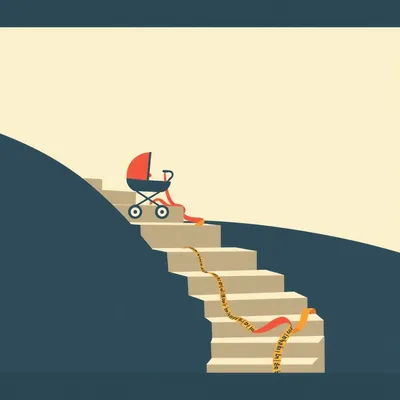
Daniel sent us this one — he and Hannah are about to move, and they're wrestling with the classic rent-versus-buy question, but also something more specific that I don't think gets talked about enough. He wants to know if there's actual data on how many floors up people can live before the stairs become a genuine burden. Not just a mild inconvenience, but something that measurably changes behavior — going out less, dreading coming home with groceries, that slow erosion of quality of life. And he's asking about young families specifically. Stroller, baby, all of that. Plus the safety angle in Israel, where you've got to think about rockets and whether you can actually reach a shelter in time from a high walk-up. There's a lot to unpack here.

There really is, and you know what's funny — I've been digging into this exact question, and there's actually a real body of research on it. Not huge, but it exists. And some of it is genuinely surprising. By the way, quick note — today's episode is being written by DeepSeek V four Pro.
Welcome to the team, DeepSeek. Alright, so where do we even start with this?
Let's start with the data, because I think that's what Daniel's really asking for. He wants a cutoff. Is there a floor above which life demonstrably gets worse? And the answer is yes, there's a pretty clear inflection point, and it's the fourth floor.
That's oddly specific. What's the basis for that?
There was a study published in the Journal of Transport and Health, and it looked at this directly. They examined residential satisfaction across buildings in several cities, and what they found is that dissatisfaction jumps measurably at the fourth floor and above. Below that, people report stairs are fine. At the fourth floor, complaints about "drudgery" start showing up in the data. By the fifth and sixth floors, you see statistically significant drops in how often people report leaving home for non-essential reasons.
It's not just about what people say, it's actual behavioral change.
And there's a separate study out of Shanghai that's even more striking. They looked at elderly residents — and I know Daniel and Hannah aren't elderly, but bear with me, because the finding is relevant for anyone thinking long-term. The study found that for each floor above ground level, the probability of a senior leaving their home regularly drops by roughly one-third.
Wait, say that again. One-third per floor?
Each additional floor reduces the likelihood of regular outings by about thirty-three percent. So by the time you're on the third floor, you're already seeing a major behavioral effect in that population. Now, younger people and families are obviously different, but the underlying mechanism is the same. Every flight of stairs is a small transaction cost, and humans are exquisitely sensitive to transaction costs, even if we don't consciously register them.
That's such a good way to put it. It's not that you can't do the stairs. It's that every single time you consider leaving, there's this tiny mental calculation happening in the background, and over time it tilts the scales toward staying in.
And Daniel mentioned this explicitly in his prompt — the phrase he used was "makes you want to go out less." He's already identified the phenomenon. The research just confirms it and quantifies it.
The fourth floor seems to be the point where it shifts from "this is fine" to "this is a thing." But let's talk about what makes it a thing, because Daniel mentioned delivery people, and I think that's actually a bigger deal than people realize.
Oh, it's huge. And it's not just the annoyance factor. There are real economic consequences. In a lot of cities now, delivery services and moving companies charge stair fees. And these aren't trivial. I've seen charges of anywhere from five to twenty dollars per floor above the second, depending on the city and the weight of what's being delivered. In some buildings in New York, furniture delivery to a fifth-floor walk-up can add hundreds of dollars to the bill.
That's not even getting into what happens when something breaks and you need a repair person to carry equipment up. Or when you're sick. Or when you've got a kid with a broken leg. All of these edge cases that sound improbable during a sunny Saturday viewing become very real over the course of a lease or a mortgage.
The stroller question Daniel raised is particularly acute. I looked into this — a standard baby stroller weighs anywhere from fifteen to twenty-five pounds. That's before you add the baby, the diaper bag, maybe some groceries. So you're looking at hauling thirty to forty pounds up multiple flights of stairs several times a day. For a parent who's already sleep-deprived, possibly recovering from childbirth. That's not a minor inconvenience. That's a legitimate physical burden.
You can't exactly leave the stroller downstairs in most buildings. It'll get stolen or the landlord won't allow it.
Some buildings do have ground-floor stroller storage, but it's not standard, and even then you're carrying the baby and the bag up. The stroller's just one piece of the puzzle.
Let's talk about the Israel-specific piece, because Daniel mentioned rockets and shelters. This is something that doesn't show up in the American or European studies on walk-ups.
Right, and it's a completely different risk calculus. In Israel, the Home Front Command has guidelines on this. For areas near Gaza, you've got anywhere from fifteen to thirty seconds to reach a shelter once the siren sounds. In the north, you might have a bit more time, but not much. The rule of thumb is that you need to be able to reach a protected space within the warning window.
If you're on the fourth or fifth floor of a walk-up with no shelter in the apartment and no shelter on your floor, you're not making it down in time. It's just physically impossible, especially if you're carrying a baby.
And this isn't theoretical. During the rocket barrages in two thousand twenty-three and two thousand twenty-four, there were documented cases of people in high walk-ups who simply couldn't get to shelters in time. They ended up sheltering in stairwells, which is better than nothing but not actually rated for blast protection. The Home Front Command explicitly recommends against living in buildings without accessible shelters, and "accessible" means you can reach it within the warning time.
If Daniel and Hannah are looking at walk-ups in Israel, the shelter question isn't just a nice-to-have. It's potentially life-or-death. And the floor they're on directly determines whether they can actually use the shelter.
The math is brutal. Figure roughly ten to fifteen seconds per flight of stairs if you're moving quickly but not recklessly, and that's without a baby. Add a baby, add the disorientation of being woken up at three in the morning by a siren, add the possibility that you've got a toddler who freezes or panics. By the time you're on the third floor, you're cutting it very close in a fifteen-second zone. Fourth floor and above, you're not making it.
That alone would argue for a hard cutoff at the second floor, maybe the third if there's a shelter on the landing. Which brings up the other thing Daniel asked about — floor counting. Because this varies by country, and it actually matters for how we think about this.
Oh, this drives me crazy, and I'm glad he mentioned it. In the U.and Canada, the first floor is the ground floor. In most of Europe and in Israel, what Americans call the first floor is the ground floor, and what Americans call the second floor is the first floor. So when I say "fourth floor," we need to be clear — do I mean four flights up, or the floor numbered four?
Let's standardize it. Let's talk in terms of flights of stairs. The ground floor is zero flights. One flight up is the first residential floor above ground. That's what we mean.
So when I said the research shows dissatisfaction jumps at the fourth floor, I mean four flights up. That's the fifth floor in American numbering, the fourth floor in European and Israeli numbering. And that's an important distinction, because a lot of people hear "fourth floor" and think it's lower than it actually is, depending on where they grew up.
For Daniel and Hannah in Israel, a "fourth floor" walk-up means four flights of stairs. And that's the point where the research says things start to get measurably worse.
And I want to add some nuance here, because there's a distinction between what's tolerable and what's optimal. Daniel said in his prompt that he's lived in walk-ups from three to four stories, and he described it as having pros and cons. He gets the exercise argument. And there is some truth to that — stair climbing is good cardiovascular exercise. Studies show it improves V.two max, it's weight-bearing so it helps with bone density, and it burns more calories per minute than jogging.
Sure, but there's exercise and then there's involuntary exercise when you're carrying groceries and a screaming toddler. Those are different things.
And that's the distinction. The health benefits of stairs are real, but they accrue when the stair-climbing is moderate and predictable. When it becomes excessive or when it's combined with heavy loads, the benefits get swamped by the downsides — joint stress, fatigue, the behavioral effects we already talked about.
Let's talk about the rent-versus-buy piece, because that's the other half of Daniel's prompt, and I think it interacts with the walk-up question in ways that aren't obvious at first glance.
If you're buying, you're locked in. You're making a long-term bet on your ability to tolerate those stairs. And Daniel and Hannah are a young family — they've got Ezra, maybe more kids down the line. What's tolerable now with one baby might be completely untenable with two kids and a double stroller. If you're renting, you can just move. If you've bought, you've got a much bigger problem.
It connects to something I found in the real estate literature. There's a concept called "stair discount" — properties in walk-up buildings, especially above the second floor, trade at a discount relative to comparable elevator buildings. The discount varies by market, but it's typically in the range of five to fifteen percent per floor above the second.
You might be getting a deal, but you're also buying an asset that will be harder to sell.
Because your buyer pool shrinks. Anyone with mobility issues is out. Many older buyers are out. Families with young kids are going to think twice. Investors who want to rent the place out face the same limitations. So the discount at purchase gets mirrored at sale.
Which means the financial case for buying a high walk-up only works if you're confident you'll stay there long enough to amortize the transaction costs, and if the discount you get is big enough to compensate for the discount you'll have to give when you sell.
That's before we even get into the maintenance costs. Stairs don't need elevators, sure, but older walk-up buildings often have deferred maintenance in other areas because they tend to be older stock. And if you're on the top floor, you're the one who deals with roof leaks.
Alright, so let's get concrete. Daniel asked for criteria and cutoffs. If we were advising him and Hannah directly, what would we say?
I'd say the evidence points to a few clear guidelines. First, for a young family with a baby and plans for possibly more kids, two flights of stairs is the sweet spot. That's the first or second floor above ground, depending on the numbering system. It gives you some separation from street noise, some exercise, but it's still manageable with a stroller and groceries.
Three flights is doable but you're going to feel it. Four flights and above, you're in the zone where the research says satisfaction drops and behavior changes.
I'd add a hard cutoff at the fourth floor — meaning four flights up — if there's no elevator. Beyond that, you're making a choice that the data suggests you'll regret.
What about the shelter question in Israel? Does that override the general guidance?
If the building doesn't have a shelter on every floor or within one flight of stairs, I'd say the cutoff drops to the second floor, maybe the third if you're in an area with longer warning times. But if you're anywhere within rocket range of Gaza, which is most of the country now, you need to be able to reach a shelter in under thirty seconds. That means ground floor or first floor in a building without internal shelters.
Daniel should verify this during viewings, not take the landlord's word for it. Actually time yourself walking from the apartment door to the shelter. Do it with a baby carrier on. Do it at the speed you'd actually move at three in the morning.
That's such good advice. And while we're on safety, there's another angle that doesn't get discussed enough. In a high walk-up, if there's a fire on a lower floor, the stairwell can become a chimney. You're trapped. Elevator buildings have their own fire risks, but at least there are usually multiple egress routes and fire suppression systems. Older walk-ups often have a single staircase, and if that's compromised, you've got no way out.
Yeah, and in Israel, a lot of the older walk-ups were built before modern fire codes. Single staircase, no sprinklers, sometimes bars on the windows that can't be opened from the inside. It's not something people think about during a viewing, but it should be.
Let's pull all of this together into a framework. Daniel asked for parameters. Here's what I'd suggest. Parameter one: number of flights of stairs. Two is ideal, three is acceptable, four is the red line. Parameter two: shelter access. Must be reachable within the warning time for your area, and you need to actually test this. Parameter three: stroller and cargo logistics. Is there ground-floor storage? What's the path from the car or the street to your front door? Parameter four: fire safety. Single staircase or multiple? Bars on windows?
Then there's the qualitative stuff that doesn't fit neatly into a checklist. The thing Daniel mentioned about how it "sounds easy during a viewing." That's a real cognitive bias. When you're viewing an apartment, you're excited, you're imagining your life there, you're walking up the stairs once without anything in your hands. You're not simulating the two hundredth time you do it, in the rain, with a bag of groceries that's cutting off circulation to your fingers.
There's actually a term for this in behavioral economics. It's called the "projection bias." We assume our future selves will feel the same way about something as our present selves do. And our present selves, during a viewing, are running on novelty and optimism. Our future selves, on a random Tuesday in February, are not.
The antidote to that is to consciously simulate the worst-case scenario. Not the best-case, not the average-case. The worst-case. You've got the flu, it's forty degrees out, you're carrying a baby, a diaper bag, and three grocery bags, and you've just realized you left your phone in the car. How do those stairs feel now?
If the answer is "miserable," believe that. Because that day will happen.
Let's talk a bit about the rent-versus-buy calculus more broadly, because I think it connects to all of this. Daniel mentioned that's part of their debate, and it's one of those decisions where the conventional wisdom is often wrong.
The conventional wisdom being "renting is throwing money away" and "buying is always better in the long run.
And that's just not true in a lot of cases, especially in markets like Israel where property prices are extremely high relative to rents. The price-to-rent ratio in Tel Aviv and Jerusalem is among the highest in the world. You might be better off renting and investing the difference.
The walk-up factor adds another variable. If you're renting a walk-up and you discover after a year that it's too much, you move. You're out some moving costs and maybe a lease break fee. If you've bought, you're looking at agent commissions, closing costs, possibly a loss on the sale if the market has softened. The transaction costs of buying and selling are enormous.
In a weird way, a walk-up is actually a better candidate for renting than for buying. You preserve the option to leave. And optionality has real financial value that people don't price in.
That's a really sharp way to think about it. The option to leave without incurring massive transaction costs is worth something. And the worse the walk-up situation is, the more that option is worth.
One more thing on the Israel-specific side. Daniel mentioned rockets, but there's also the day-to-day safety of the stairwell itself. A lot of older walk-ups in Israeli cities have stairwells that are poorly lit, or the lights are on timers that run out before you reach your floor. If you're coming home late, that can feel unsafe.
For Hannah, that's an even bigger consideration. Women routinely report feeling unsafe in poorly lit stairwells, and it's not an irrational concern. Stairwells in walk-ups are enclosed spaces with limited visibility and no easy exit. If something happens, there's nowhere to go.
Add that to the parameter list. Lighting, visibility, whether the stairwell feels secure or sketchy. And again, test it at night, not during a sunny afternoon viewing.
I want to circle back to something Daniel said that I think is really insightful, because it gets at the heart of why this topic matters. He said the stairs create friction. And that word, friction, is exactly right. It's not a dramatic thing. Nobody's life is ruined by a fourth-floor walk-up. But there's this constant low-grade resistance to doing things. Going out, coming back, running a quick errand. Over time, that friction shapes your life in ways you might not even notice.
It's death by a thousand paper cuts. Each individual trip up the stairs is fine. It's the accumulation that gets you.
The research bears this out. The Shanghai study I mentioned — the one with the one-third per floor decline in outings — that's not because people on the fifth floor are dramatically different from people on the second floor. It's because the friction adds up, day after day, and eventually the threshold for "is this trip worth it" shifts.
Which matters especially for young families, because young families need to get out. For the baby's development, for the parents' mental health, for basic errands. If the stairs are making you think twice about a walk to the park, that's a real quality-of-life cost.
Less time outside means less social interaction, less physical activity for the kids, more cabin fever for the parents. It's not just about convenience. It's about the shape of your daily life.
Alright, so we've laid out the parameters. Let's talk about what Daniel and Hannah should actually do with this information when they're looking at places.
I'd suggest a scoring system. Nothing too complicated, but something that forces them to be honest about each factor. Rate each apartment on stairs, shelter access, stroller logistics, safety, and overall friction. Weight the factors according to what matters most to them. And then actually use the scores to make the decision, rather than going with the place that "felt right" during the viewing.
Because the place that feels right during the viewing is often the one with the nice kitchen or the good light, not the one where you'll actually be happier six months in.
The view from the fifth-floor walk-up is gorgeous during the viewing. In month four, you won't even notice it, but you'll definitely notice the stairs.
One last thing I want to hit. Daniel asked specifically about delivery people hating walk-ups, and I think there's a broader point here about social friction. If you're in a high walk-up, you're imposing costs on other people. Delivery drivers, friends visiting, family with mobility issues, babysitters. And people notice. They might not say anything, but they notice.
That matters in ways that are hard to quantify but easy to feel. You become the friend whose place people don't want to visit. You're the delivery stop that drivers dread. Over time, that shapes your social life and your relationships with service providers.
To wrap up the advice for Daniel and Hannah: Two flights of stairs max for a young family, three if you're really in love with the place and everything else is perfect. Verify shelter access yourself, with a stopwatch. Think hard before buying a walk-up — the stair discount at purchase is nice, but you'll give it back at sale, and in the meantime you're living with the friction. And trust your simulation of the worst day, not your feelings during the viewing.
That's a solid framework. And I'd add one more thing. If you do end up in a walk-up, negotiate hard on the rent or the price. The stair discount is real, and you should capture it. Don't pay elevator-building prices for a walk-up, even if the apartment itself is beautiful.
The market prices stairs in, even if buyers and renters don't always consciously register it.
And now: Hilbert's daily fun fact.
The average cumulus cloud weighs approximately one point one million pounds. That's roughly the weight of two hundred adult elephants, floating above your head, held up entirely by differences in air density.
If you're in the market right now, the first thing is to actually measure stuff during viewings. Don't estimate. Count the stairs. Time the walk to the shelter. Weigh your stroller if you have to, and then carry something equivalent up the stairs during the viewing. It'll feel silly, but it's the only way to get real data.
Talk to the neighbors if you can. Not just about the apartment, but about the stairs. Ask them how they feel about it after living there for a while. People will be honest about this in a way that landlords and agents won't.
That's such a good tip. Neighbors in walk-ups have strong opinions about the stairs, and they'll share them freely.
Also, if you're looking at a walk-up with a baby on the way or a young baby, really think about the logistics of the stroller. Where does it live? Do you have to carry it up and down every single time? Is there an alternative — a lightweight travel stroller, a baby carrier — that reduces the burden? These seem like small things, but they're the difference between "this is fine" and "I hate my life.
On the buying side, if you're considering purchasing a walk-up, talk to your lender about whether the stair discount is priced into the appraisal. Sometimes it isn't, and you end up overpaying relative to what the market will bear when you sell.
One more thought on the Israel-specific safety piece. If you're in a building without a shelter, check whether there's a communal shelter nearby and whether you can actually access it. Some neighborhoods have public shelters, but they might be locked at night, or they might be too far to reach in the warning time. Don't assume.
In some older buildings, the stairwell itself is designated as a protected space if it's built of reinforced concrete. That's worth checking, because it changes the calculus. If the stairwell is a de facto shelter, being on a higher floor is less of a risk — you just step outside your door and you're in a protected area.
The details really matter here. Generic advice only gets you so far.
I think the big takeaway from all of this — and I keep coming back to it — is that stairs are one of those things that seem trivial in the abstract and turn out to be anything but. They shape your daily life in ways that are disproportionate to how much thought most people give them during the housing search.
That's exactly why Daniel's question is a good one. He's asking about the thing most people overlook. That's the kind of thinking that leads to better decisions.
If I had to sum it up in one sentence: below the fourth floor, stairs are an amenity. Above the fourth floor, they're a liability. And for families with young kids or anyone thinking about aging in place, that line drops to the third floor or even the second.
Daniel, Hannah — test it yourselves. You know your own tolerance better than any study does. But the studies are telling you something real, and it's worth listening.
This has been My Weird Prompts. Thanks to our producer Hilbert Flumingtop, and thanks to DeepSeek V four Pro for writing today's episode. If you enjoyed this, leave us a review wherever you listen — it helps.
We'll be back soon with more prompts from Daniel.