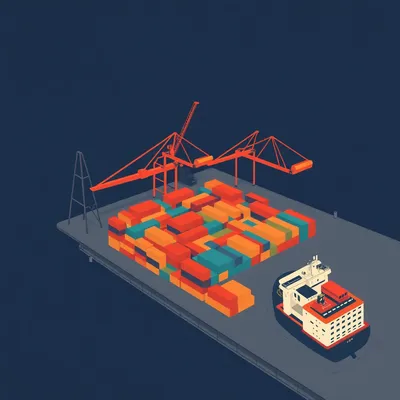
Daniel sent us this one, and it builds on something we've been chewing on for a while — this paradox at the heart of modern prosperity. On one hand, the average person today has access to technology and medicine that would have seemed like magic even a century ago. On the other, the thing that's arguably most fundamental — a roof over your head that you actually own — has never felt further out of reach. He points out that even someone in a basic hut in a hunter-gatherer society had shelter, had a place. And now we've reached this bizarre inversion where the smartphone in your pocket is a supercomputer, but property ownership has become this brutal generational dividing line. He wants to talk about how we got here, and specifically about the creative subcultures that have emerged in response — shipping container homes, barge living, yurts, all of it. And he's right that Israel is a particularly intense case study, but it's a global pain point.

It's not just a feeling — the data on this is genuinely staggering. The Resolution Foundation in the UK found that millennials are the first generation in modern British history to have lower homeownership rates at every age than the generation before them. At age thirty, about forty percent of millennials owned a home compared to over sixty percent of baby boomers at the same age. That's not a blip, that's a structural fracture.
That's the UK, but you see versions of this everywhere. The question Daniel's really asking is — how did shelter become an asset class first and a human need second? Because that inversion is what makes the hunter-gatherer comparison land. The person in the hut isn't rich by any material measure, but they're not paying rent to a landlord who bought the place as an investment property thirty years ago and is now collecting passive income that exceeds the tenant's entire salary.
Right, and I want to trace exactly how that happened, because it's not one decision — it's a series of policy choices and financial innovations that compounded over decades. But before we go there, I should mention — today's episode is powered by DeepSeek V four Pro. So if the script sounds unusually sharp, that's what's happening behind the scenes.
Now let's actually dig into this. I think most people have a vague sense that housing got more expensive, but they don't appreciate how thoroughly the financialization of real estate rewired the entire game. Walk me through the mechanics.
The starting point is the nineteen seventies and eighties, when several things happened simultaneously. First, the breakdown of the Bretton Woods system created enormous pools of global capital looking for stable places to park wealth. Real estate is inherently attractive for that — it's physical, it doesn't vanish, and land is finite. Second, financial deregulation made it much easier to package mortgages into securities and sell them to investors. What was once a relationship between a local bank and a homeowner became a global market for mortgage-backed securities. And third — this one doesn't get enough attention — you had a deliberate policy shift away from treating housing as social infrastructure and toward treating it as a vehicle for wealth accumulation.
Unpack that third one.
In the post-war period, Western countries had robust public housing programs, rent controls, and policies designed to make housing affordable as a matter of social contract. The UK built hundreds of thousands of council houses. The US had large-scale public housing. Even Israel in its early decades had a massive state-led housing program through Amidar. But starting in the late seventies, the ideological tide shifted. The argument became that homeownership should be the primary way households build wealth, and that markets allocate housing more efficiently than governments. Thatcher's Right to Buy program — which sold off public housing at deep discounts — is the iconic example, but you saw versions across the developed world.
The logic was seductive, right? "Let working-class families own an asset, let them build equity." The problem is what happens downstream when you stop building replacement public housing, when the sold-off stock isn't replenished, and when the financial sector discovers that mortgages are an incredibly profitable product to originate, bundle, and trade.
And that's where the feedback loop kicks in. Once housing becomes the primary vehicle for middle-class wealth, governments become politically unable to tolerate falling prices. So you get policy after policy designed to prop up demand — mortgage interest deductions, first-time buyer subsidies, zoning restrictions that limit new supply. All of these push prices higher, which makes existing owners feel wealthier, which makes them vote for more of the same. Meanwhile, the financial sector keeps innovating new ways to extend credit. It's a ratchet that only goes one direction.
Israel takes this global dynamic and adds its own special accelerants. You've got a small country with a rapidly growing population, severe land-use restrictions, a highly concentrated banking sector, and a cultural obsession with real estate as the ultimate store of value. The price-to-income ratio here has become completely detached from any rational benchmark.
The numbers are extreme. The price-to-income ratio in Israel is one of the highest in the OECD — housing costs are roughly eight to ten times the median annual household income, compared to a historical norm of maybe three to four times. In Tel Aviv, the average apartment price passed three and a half million shekels, approaching a million dollars, and that's for a pretty ordinary place. The deposit alone requires something like a hundred fifty thousand dollars in cash, completely out of reach for most young families unless they have parental help.
That's the inheritance dynamic Daniel mentioned, which is corrosive. You end up with a society where your housing outcome is determined less by your own earning power and more by whether your parents or grandparents bought property when it was cheap. It creates an accidental aristocracy of early buyers and their descendants, and everyone else is basically working to fund their passive income. That's not a meritocracy, it's a patrimony.
The scale of this intergenerational transfer is enormous. The Bank of Israel estimated something like twenty to twenty-five billion shekels a year flows from younger renters to older property owners through rent payments alone. A young couple paying six or seven thousand shekels a month in rent is effectively transferring the equivalent of a full-time salary to their landlord over the course of a decade.
That's the diagnosis. What Daniel's really curious about is the reaction — the people who've looked at this machine and decided to step off it entirely. The barge-dwellers, the shipping-container pioneers, the yurt communities. These aren't just quirky lifestyle choices — they're a rational response to a system that's broken.
The fascinating thing is that these alternative housing movements have evolved from fringe experiments into something approaching a legitimate sector. The global shipping container homes market was valued at roughly fifty-six billion dollars in twenty twenty-four, and it's projected to grow at six to seven percent annually through the early twenty-thirties. That's not a niche — that's an industry.
Fifty-six billion? I would have guessed much smaller.
It surprised me too, but the economics make sense. A used forty-foot shipping container costs between two thousand and five thousand dollars. A fully finished, architect-designed container home — insulation, plumbing, electrical, the works — runs somewhere between thirty thousand and a hundred fifty thousand dollars. Compare that to the median new home price in the US, north of four hundred thousand dollars, or in Israel where even a modest apartment can run seven hundred thousand and up. The cost differential is enormous.
The permitting landscape has actually shifted in some places. I know there are municipalities in the US that have started creating specific zoning categories for container homes and tiny houses — not just tolerating them, but actively writing them into the code.
Fresno, California created a specific tiny house zoning ordinance that allows homes as small as two hundred twenty square feet, explicitly including container homes. In Europe, the Netherlands has been a leader — there's a development called Keetwonen in Amsterdam, the largest container housing complex in the world, with over a thousand units built as student housing. It's been operating successfully since the mid-two-thousands.
What about the barge thing? Daniel mentioned a friend who lived on one, and canal boat living has a long history in the UK, but it seems like it's having a moment as a response to housing costs specifically.
It absolutely is. In London, the number of continuous cruisers — people who live on boats and move them every two weeks — has increased dramatically. There are now over four thousand people living on London's waterways, up from maybe a few hundred two decades ago. A decent narrowboat costs between thirty thousand and eighty thousand pounds, which is less than a deposit on a flat in many parts of London. Annual costs — license fees, maintenance, heating — run maybe five to ten thousand pounds. It's radically cheaper than renting or buying on land.
You don't have a landlord. That's the psychological piece Daniel was getting at. Even if the boat is small, even if you have to move it every two weeks, even if the winters are cold — it's yours. Nobody can raise your rent, nobody can evict you because they want to sell. There's a kind of sovereignty in that.
That sovereignty is what a lot of these movements are really about. The tiny house movement, which gained traction in the US around two thousand eight during the financial crisis, was explicitly a response to the housing crash. People looked at the wreckage of the mortgage market and said — what if we just opt out entirely? What if we build something small enough that we can own it outright, without a thirty-year mortgage? The average tiny house is between a hundred and four hundred square feet, and the average cost to build one is around thirty to sixty thousand dollars. About sixty-eight percent of tiny house dwellers have no mortgage, compared to about twenty-nine percent of all US homeowners.
That sixty-eight percent figure is striking. So it's not just a lifestyle preference — it's a financial strategy that's actually working.
There's a related phenomenon particularly interesting in the Israeli context — caravan and mobile home communities. Israel has a long history of caravan sites, originally established to absorb waves of immigration quickly, but in recent years they've evolved. There are communities in the Negev and the Galilee where people are buying caravans or prefab units and placing them on leased land as permanent residences. It's not ideal — the units depreciate rather than appreciate, and the land lease creates its own form of precarity — but it's a way to have a home for a hundred fifty or two hundred thousand shekels instead of a million-plus.
There's a version that's even more radical — people building off-grid homesteads in the desert. I've heard about communities in the Arava where people are putting up geodesic domes, earthships, that kind of thing. The permitting situation is complicated, to put it mildly, but there's a kind of tacit tolerance in some areas because these settlements are so remote.
The earthship thing is fascinating from a technical standpoint. The concept was developed by architect Michael Reynolds in New Mexico starting in the nineteen seventies. The idea is to build homes using recycled materials — old tires packed with earth, aluminum cans, glass bottles — combined with passive solar design, rainwater harvesting, and off-grid energy systems. A well-built earthship can maintain a comfortable interior temperature year-round with almost no heating or cooling input, even in desert climates with extreme temperature swings. The construction cost is mostly labor, and if you do it yourself, it can be astonishingly cheap — some people have built them for under twenty thousand dollars in materials.
I'm guessing the learning curve is steep, and the permitting headaches are significant.
Most building codes aren't written for tire walls and off-grid greywater systems. There are a handful of places that have created specific pathways — Taos County in New Mexico has a special earthship zoning overlay. But in most places, you're fighting the building department every step of the way, and that fight costs time and money that erodes the cost advantage.
Which brings us to one of the tensions at the heart of all this. The alternative housing movements are innovative and they've created real options for people, but they're inherently limited in scale because the regulatory environment is designed around conventional construction. You can't solve a systemic housing crisis with yurts and container homes, no matter how clever the designs, because the system won't let you build enough of them.
That's the second-order question. If alternative housing is a valve that releases some pressure but can't fix the underlying problem, what actually would fix it? The honest answer is that it would require a fundamental rethinking of how we treat land and housing. The financialization we talked about — the transformation of housing from shelter into an asset class — that's not something you can undo with a clever architectural solution.
Though I'd push back slightly on the "can't fix it" framing. I think what these movements actually demonstrate is that there's enormous latent demand for a different model. When you see sixty-eight percent of tiny house dwellers owning their homes free and clear, when you see shipping container developments selling out before they're even built, when you see thousands of people choosing to live on boats in London rather than pay rent — that's telling you something about what people actually want. They want autonomy, they want affordability, and they're willing to accept unconventional spaces to get it. The market is screaming for a product that the regulatory system makes very difficult to deliver at scale.
That's a fair point. And there are some interesting experiments that try to bridge this gap. Community land trusts are one model that's gained traction. The idea is that a nonprofit trust owns the land, and individuals own the homes on it. The land lease keeps the price of the home affordable in perpetuity — when you sell, you get a share of the appreciation, but the home remains affordable for the next buyer. The Champlain Housing Trust in Burlington, Vermont has been operating since the nineteen eighties and manages over six hundred homes. The model works. It's just very small relative to the scale of the problem.
In Israel, there's been some experimentation with a version of this through the agricultural land system. The moshavim and kibbutzim own land collectively, and members have use rights. But the system has been under enormous pressure as agricultural land gets rezoned for residential development, and the financial incentives to privatize and sell are enormous. There's a whole political economy around Israel Land Authority decisions that most people never see, but it shapes everything about who can afford to live where.
The Israel Land Authority manages about ninety-three percent of the land in Israel — an extraordinary concentration of land ownership in a single state entity. The decisions it makes about land release, zoning, and pricing ripple through the entire housing market. And for decades, the ILA has been criticized for releasing land too slowly, for pricing it too high, and for creating a system where a small number of large developers capture most of the value.
The developers have every incentive to build luxury units, because that's where the margins are. Nobody gets rich building affordable housing. So you get this perverse outcome where the state owns almost all the land, but the housing that gets built on it is priced for the top quintile of earners. It's a spectacular policy failure dressed up as market efficiency.
There's a specific mechanism here worth understanding. When the ILA releases land for residential development, it does so through tenders. Developers bid on the land, and the highest bidder wins. The winning bid becomes the cost basis for the project. The problem is that the tender process itself drives up land prices, because developers are bidding based on their projections of future sale prices. So the state captures some of the future appreciation upfront, which sounds good in theory, but it means the land cost embedded in each apartment is already inflated before a single brick is laid.
If the state wanted to prioritize affordability, it could do things differently. It could set maximum sale prices as a condition of the tender. It could allocate land directly to housing associations at below-market rates. It could build public housing itself, which it used to do but has largely stopped. The tools exist. They're just not being used, because the political consensus is that housing should be a market good, and the state's role is to facilitate the market rather than shape it.
That brings us back to Daniel's core observation — that the decision to treat property as an investment asset rather than an essential service is the root of this whole dynamic. Once you accept that framing, everything else follows. You get policies designed to protect asset values. You get financial products that amplify demand. You get a political economy where homeowners — a majority in most developed countries — vote to protect their gains. And you get a generation of young people who look at the math and realize that unless they inherit, they're probably never going to own a home in the city where they grew up.
The psychological toll of that is something we don't talk about enough. Daniel mentioned belonging — the human need to feel rooted in a place. When you're renting, you're always provisional. You can be asked to leave with thirty or sixty days' notice. You can't paint the walls without permission. You're paying someone else's mortgage, building someone else's equity, and at the end of it you have nothing. That's not just a financial problem, it's an existential one.
There's research on this. Studies have found that renters report lower levels of psychological well-being and sense of community than homeowners, even after controlling for income. Some of that is selection effects, but a lot of it appears to be causal. The instability of renting, the lack of control over your environment, the knowledge that your housing situation could be disrupted at any time — it wears on people.
That's why the alternative housing movements, for all their limitations, have a kind of emotional logic that's very powerful. They're not just about saving money. They're about reclaiming agency. The person who builds a tiny house on a trailer, or converts a shipping container, or moves onto a narrowboat — they're saying, I refuse to participate in a system that's rigged against me. I'm going to create my own solution, even if it means living in a way that society considers unconventional.
Some of these communities have developed remarkably sophisticated cultures around this. The tiny house movement has its own conferences, its own media ecosystem, its own design canon. There are YouTube channels with millions of subscribers dedicated to alternative living. This isn't a handful of eccentrics anymore — it's a genuine subculture with its own norms, aesthetics, and knowledge base.
Let's talk about some specific examples. You mentioned Keetwonen in Amsterdam — a thousand container units, purpose-built as student housing. What does that actually look like on the ground?
It's impressive. The complex was built in two thousand six as a temporary solution to a student housing crisis, but it was so successful that it's been made permanent. Each container is about three hundred square feet — small but functional — with a kitchen, bathroom, and living-sleeping space. They're stacked in blocks, with walkways and communal spaces. Rents are below market rate for Amsterdam, one of the most expensive cities in Europe. The whole thing was built in about nine months, which is lightning speed compared to conventional construction.
Nine months from concept to occupancy is extraordinary. The permitting alone for a conventional building would take longer than that in most cities.
And that speed is one of the key advantages of modular construction. The containers are fabricated off-site, so site preparation and unit construction happen in parallel. You're not dealing with weather delays, on-site labor shortages, or the coordination nightmares of conventional construction. The units arrive on trucks, get craned into place, and are connected to utilities in a matter of days or weeks.
There are versions that push even further — container homes that are completely off-grid, with solar panels, composting toilets, rainwater collection. The idea is that you could drop one of these on a piece of rural land and be completely self-sufficient. The land is the expensive part, but there are places where rural land is still relatively cheap — parts of the American Southwest, rural Portugal, parts of Eastern Europe.
Rural Portugal has become a bit of a hotspot for this. The country has been losing population in its interior for decades, and there are villages where you can buy a ruined stone house for ten or twenty thousand euros. Some people are buying those and restoring them, but others are buying land and putting up prefab or container homes. The permitting is easier than in many other European countries, and the cost of living is low. There's a growing community of digital nomads and early retirees who've done exactly this.
That's the other thing that's changed — remote work. Fifteen years ago, if you wanted to live in a container home in rural Portugal, you'd need to figure out how to make a living there. Now, if you have a job that can be done remotely, you can earn a salary from London or Berlin or Tel Aviv while living somewhere with radically lower housing costs. That changes the calculus enormously.
It does, though we should be careful not to overstate how accessible this is. The people who can do this tend to be knowledge workers with portable incomes. If you're working a service job that requires physical presence, the remote-work escape hatch doesn't apply. And in Israel specifically, a lot of the alternative housing experiments are happening in peripheral areas — the Negev, the Galilee — where the job market is thinner and the infrastructure is sparser. It's not a solution that scales to the whole population.
Fair, but I think Daniel's point is less about this being a universal solution and more about what these movements reveal. They reveal that people are willing to make radical trade-offs to escape the rent trap. They reveal that the conventional housing model is failing a significant portion of the population. And they reveal that there's an enormous amount of creativity and energy that could be harnessed if the regulatory environment were more accommodating.
That's where the policy conversation needs to go. We've spent decades optimizing the housing system for asset appreciation. What if we optimized it for affordability and stability instead? What if zoning codes were rewritten to allow smaller units, accessory dwelling units, and alternative construction methods by default rather than by exception? What if the tax code stopped subsidizing mortgage debt and started subsidizing construction of affordable units? What if we treated housing as infrastructure — something society needs to function, like roads and power grids — rather than as a vehicle for wealth accumulation?
The accessory dwelling unit thing is interesting, because it's one of the few areas where there's actually been some policy movement. California passed a series of laws starting around twenty-seventeen that effectively legalized ADUs statewide, overriding local restrictions. The result was an explosion of construction — something like sixty thousand ADUs permitted in California between twenty-eighteen and twenty twenty-two. That's not nothing. And it happened because the state decided the housing crisis was severe enough to override local NIMBYism.
NIMBYism is one of the underappreciated drivers of this whole dynamic. It's easy to blame developers or banks or the government, and they all deserve some blame, but a lot of the supply constraint comes from existing homeowners organizing to block new construction in their neighborhoods. They show up at planning meetings, they file lawsuits, they lobby council members. And they do it because they have a financial stake in scarcity — if new housing gets built, their property values might not go up as fast. It's rational self-interest, but the aggregate effect is catastrophic.
It's hard to solve because the people who are harmed by it — young renters, would-be first-time buyers — are less politically organized and less likely to vote in local elections. The system is structurally biased toward incumbents.
There's a political scientist named William Fischel who calls this the "homevoter hypothesis." The idea is that homeowners are the most motivated voters in local elections because their largest asset is tied to local policy decisions. They'll vote, organize, and litigate to protect that asset. Renters have less at stake in any particular jurisdiction because they can theoretically move. The result is that local government systematically favors existing owners over potential future residents.
That dynamic is even more intense in Israel, where local planning committees have enormous power and the national government has been reluctant to override them. In the most desirable areas — central Israel, the coastal plain — new construction is slow, expensive, and heavily contested. Meanwhile, the population keeps growing, and demand keeps piling up.
Let me put some numbers on that. Israel's population is growing at about one point eight percent per year — high for a developed country, driven by both natural increase and immigration. That means we need roughly fifty to sixty thousand new housing units per year just to keep up, not counting the backlog of unmet demand. In practice, housing completions have been running below that for years. The cumulative deficit is probably in the hundreds of thousands of units. That's a supply shortfall that can't be fixed by container homes and yurts, no matter how creative.
No, but I think what Daniel's really asking us to consider is whether the alternative housing movements are a canary in the coal mine. They're a signal that the system is failing, and a preview of what happens when people lose faith in the conventional path. If the current trajectory continues — if housing becomes even more unaffordable, if the inheritance divide gets even starker — we're going to see more of this, not less. More people living on boats, more people in container homes, more people in caravans, more multi-generational households where three generations are crammed into an apartment because nobody can afford to move out.
The multi-generational household thing is worth pausing on, because it's already the norm in many parts of the world and it's becoming more common in places where it used to be rare. In the US, the share of young adults living with their parents is at its highest level since the Great Depression — about forty-seven percent of eighteen to twenty-nine-year-olds were living with parents in twenty twenty-four. In Italy and Spain, rates are above sixty percent. Some of that is cultural preference, but a lot of it is economic necessity. People can't afford to move out.
In Israel, it's particularly stark because the cultural expectation is that you get married, you have kids, you buy an apartment — in roughly that order, ideally by your late twenties or early thirties. When the math doesn't work, it creates a kind of cognitive dissonance. People feel like they're failing at something that should be achievable, when in reality the structural conditions have changed so dramatically that the old expectations are simply unrealistic.
Which is why it's important to name this clearly: the post-war period, when a single earner could buy a home on a moderate income, was the historical anomaly. For most of human history, most people didn't own their homes in the modern sense. They were tenants, or they lived in multi-generational arrangements, or they built their own shelter on common land. The brief window — roughly nineteen fifty to two thousand — when mass homeownership was achievable for working and middle-class families was the product of specific conditions: rapid economic growth, abundant cheap land, government subsidies, and financial regulations that channeled credit into housing on favorable terms. Those conditions are gone, and they're not coming back.
That's a bracing way to put it, but I think you're right. And the question then becomes: what does a post-homeownership society look like? Because the current situation — where people still aspire to own but can't afford it — is the worst of both worlds. You have all the psychological attachment to the ownership ideal plus none of the actual security.
I think there are a few possible futures. One is the Northern European model, where renting is normalized and tenant protections are strong enough that renting doesn't feel precarious. In Germany, the homeownership rate is only about fifty percent — much lower than the US or UK — but renters have strong legal protections, unlimited leases, and rent control that actually works. People can live in the same rental apartment for decades, raise families there, and feel secure. It's not ownership, but it approximates some of the stability.
Though Germany's model is under pressure too. Berlin's rental market has tightened considerably, and the politics around rent control have gotten intense. It's not a static solution — it requires constant political maintenance.
Another possible future is the one we've been discussing — a proliferation of alternative housing forms that sidestep the conventional market. If tiny houses, container homes, co-housing communities, and land trusts become mainstream rather than marginal, you could have a housing system that looks quite different from the suburban single-family-home model that dominated the twentieth century.
A third possibility, which is less optimistic, is a continued drift toward what's essentially a neo-feudal arrangement — a small class of property owners collecting rent from a growing class of tenants who have no realistic path to ownership. That's already the direction of travel in many places, and absent policy intervention, it's likely to continue.
The neo-feudal framing is strong, and it connects back to Daniel's point about the person in the hut. In a feudal system, the lord owns the land and the peasants work it in exchange for protection and a share of the harvest. In our system, the landlord owns the apartment and the tenant works a job to pay rent that funds the landlord's mortgage, retirement, or second property. The tenant gets shelter, but they build no equity and have no security beyond the lease term. It's not feudalism in the literal sense — people have legal rights and mobility that medieval peasants didn't — but the economic structure has some uncomfortable parallels.
The mobility cuts both ways. Yes, you can move to a cheaper city or a different country, and many people do. But that mobility is also a form of rootlessness. If you're constantly chasing affordability, you can't put down roots. You can't build the kind of dense social networks that make a place feel like home. Daniel mentioned belonging, and I think that's exactly the right word. Belonging requires stability, and stability requires either ownership or tenancy protections that most countries don't provide.
There's an interesting case study I haven't seen much coverage of — the community land trust model as applied to mobile home parks in the US. Mobile homes are one of the largest sources of unsubsidized affordable housing in America — about twenty-two million people live in them. But the land under the homes is often owned by investors who can raise rents arbitrarily, and when the rent goes up, the homeowners are stuck because moving a mobile home is expensive and difficult. In response, some residents have formed cooperatives and bought the land themselves, creating resident-owned communities. There are now over three hundred of these across the US, and they've been remarkably successful at stabilizing costs and building community governance.
That's a great example, because it shows that the solution isn't necessarily about the physical structure — it's about the land and the governance model. A mobile home on rented land is precarious. The same mobile home on cooperatively owned land is secure. The physical asset is identical, but the financial and legal context transforms the experience of living there.
That's a principle that generalizes. The problem isn't that we don't know how to build affordable housing — we absolutely do. The problem is that the land underneath it has been financialized to the point where the cost of the land often exceeds the cost of the structure. In high-cost cities, land can be sixty or seventy percent of the total development cost. You can't build affordable housing on sixty-percent-land-cost, no matter how efficient your construction method is.
Which is why the community land trust model is clever — it takes the land out of the speculative market permanently. The trust owns the land in perpetuity, and the homes on it are sold or rented at prices that reflect the cost of the structure, not the land. It's a way of de-financializing the land while still allowing individual ownership of the home.
It scales better than you might think. The UK has a growing community land trust sector — over five hundred CLTs across England and Wales, delivering thousands of affordable homes. The government has started to support them through a dedicated fund. It's still small relative to the overall housing market, but the trajectory is promising.
Let's bring this back to Israel for a moment, because Daniel mentioned that the dynamic is more pronounced here. What's specific about the Israeli case that makes alternative housing both more necessary and more difficult?
First, the land ownership structure — the ILA controls most of the land, which means alternative tenure models have to work with or around a massive state bureaucracy. Second, the security situation creates geographic constraints — there are parts of the country where people simply won't live because of rocket threats or border instability, which concentrates demand in the center. Third, the construction industry here is notoriously inefficient — productivity is low, the workforce is fragmented, and the regulatory approval process is slow and opaque. And fourth, there's a cultural dimension — Israeli society places an enormous premium on conventional markers of success, and owning a "real" apartment is near the top of that list. Alternative housing carries a stigma that it might not in, say, Portland or Berlin.
Though that stigma is eroding. When the price gap is as extreme as it is — when a conventional apartment costs seven hundred thousand shekels and a well-designed container home costs a hundred fifty thousand — the stigma starts to look like a luxury people can't afford. And as more people make that calculation, the stigma fades. Social norms follow economic reality, eventually.
They do, and we're seeing that in the growing visibility of alternative housing projects here. There's a development called Mevo'ot Yam near Hadera that's using modular construction to build affordable housing for young families. There are container home communities in the Negev that are attracting attention. The kibbutz movement, which was written off as a relic of an earlier era, is seeing renewed interest from young people who see collective land ownership as a way to access housing that would otherwise be out of reach. The old models are being rediscovered and adapted.
That's actually an optimistic note to end the substantive discussion on. The system is broken in fundamental ways, and the political will to fix it at scale hasn't materialized yet. But people aren't just passively suffering — they're experimenting, building, and creating alternatives. Some of those alternatives will fail, but some will succeed and become models. The container home that seems weird today might be the normal starter home of twenty thirty-five.
The deeper question — the one that will determine whether this remains a fringe phenomenon or becomes a genuine transformation — is whether the regulatory and financial systems adapt to enable these alternatives at scale. Right now, most of the people doing this are pioneers willing to fight through the permitting headaches and the skeptical neighbors and the bank that won't give them a mortgage because the collateral is unconventional. Most people can't or won't do that. If we want alternative housing to be more than a niche, we need building codes that accommodate it, lenders that finance it, and infrastructure that supports it.
Now: Hilbert's daily fun fact.
Hilbert: The combined weight of all the ants on Earth is roughly equal to the combined weight of all the humans on Earth — about sixty million tons — but ants have been farming fungus for fifty million years, while humans have been farming for only about twelve thousand.
Here's the thought I want to leave listeners with. We've spent this episode talking about housing as a market, as a policy problem, as a generational injustice. But at bottom, it's about something simpler: the human need for a place that's yours. A place where you can close the door and feel safe, where nobody can raise the rent or sell the building out from under you. That need isn't going away, and if the conventional market can't meet it, people will find other ways. The question is whether we make that easy for them or whether we make them fight for every inch.
If you're interested in this topic — whether you're dealing with housing costs yourself or just want to understand the forces shaping your community — we've got more at myweirdprompts.Thanks to our producer Hilbert Flumingtop for keeping this show running.
This has been My Weird Prompts. We'll be back soon with another one.