Daniel sent us this one, and it's a heavy one. He's asking about the progressive response to October seventh, specifically the sexual violence against Israeli women that day. Mass rape, brutal assault, well-documented, and yet large swaths of the self-described progressive world have either downplayed it, ignored it, or outright denied it. Movements that built their moral authority on believing women and condemning sexual violence suddenly went quiet. Daniel's question is basically: what does that tell us about the progressive movement? Is this just moral inconsistency, is there an ideological hierarchy of victims at work, or is something deeper going on in how identity politics decides whose suffering counts?

Before we get into the ideology piece, I want to anchor this in what actually happened, because the facts matter here and a lot of people never got them. itself eventually issued a report. Pramila Patten, the U.special representative on sexual violence in conflict, visited Israel and concluded there are, quote, reasonable grounds to believe that conflict-related sexual violence occurred on October seventh, including rape and gang rape. This wasn't some Israeli government claim. This was the United Nations.
Which, let's be honest, is not exactly known as a pro-Israel cheerleading squad.
And the evidence is extensive. We have eyewitness testimony from survivors, first responders, forensic evidence from bodies recovered at multiple sites. There's the Nova festival site, kibbutzim, military bases. The Associated Press reviewed autopsy reports, photo evidence, testimony from a forensics team at the Shura military base where bodies were taken. One volunteer described seeing a woman with nails and other objects in her genital area. These aren't rumors.
Yet the response from a lot of progressive spaces was basically, let's wait for more evidence, or worse, these are propaganda claims being weaponized to justify what came next in Gaza.
The timeline on this is important. The initial silence was deafening. Women, which exists specifically to advocate for women facing gender-based violence, took nearly two months to issue a statement. Compare that to their response time on literally any other mass sexual violence event. There was a New York Times investigation published in late December twenty twenty-three that detailed the sexual violence extensively. The response from certain corners was to attack the Times, to pick apart the reporting, to question the credibility of witnesses.
Let's get at the core question here. What is actually happening when a movement that says believe women suddenly says, well, not these women?
I think it's a combination of things, and none of them reflect well on the movements in question. The first is what you might call an ideological hierarchy of victimhood. In the framework that dominates a lot of progressive discourse, the world is divided into oppressors and oppressed along axes of power. Israelis are coded as white, colonial, powerful. Palestinians are coded as people of color, indigenous, oppressed. Once you've slotted people into those categories, the moral calculus becomes automatic. The suffering of the oppressor class doesn't register the same way. It's not that people actively wish harm on Israeli women, it's that their suffering doesn't fit the narrative and so it gets minimized or explained away.
That's where it gets really troubling, because we're not talking about abstract political disagreements here. We're talking about whether you can acknowledge that women were raped. That's not a policy position. That's basic human decency.
There was a piece in the Jewish Journal that framed this really sharply. It asked, how do you center your feminism on believing victims and then turn around and say, but only when the perpetrator is from the right demographic? That's the tension that's impossible to resolve. Either you believe women or you don't. Either sexual violence is always wrong or it's sometimes understandable given the context. And once you open the door to context-dependent sexual violence, you've abandoned any coherent moral principle.
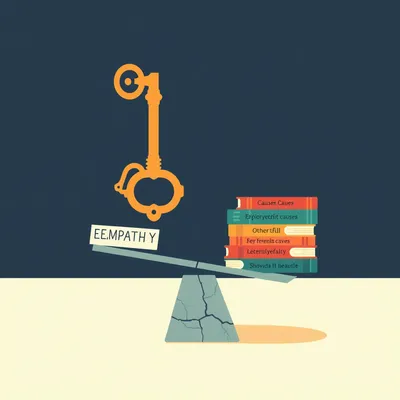
The phrase I keep coming back to is the boundaries of empathy. Every moral framework has boundaries, whether people admit it or not. The question is where you draw them and why. What October seventh exposed is that for a significant portion of the progressive left, Israelis fall outside the boundary. And I don't think that's an accident. I think it's a structural feature of how identity politics sorts people.
Let me push on that a bit. Is it identity politics per se, or is it something more specific to the Israeli-Palestinian conflict? Because I can think of other cases where identity politics doesn't seem to short-circuit basic empathy in the same way.
That's fair. I think the Israeli-Palestinian conflict is a special case in a lot of ways. It's become this symbolic struggle onto which people project all sorts of things that aren't actually about Israelis or Palestinians. For a lot of Western progressives, Palestine functions as a stand-in for every colonial struggle they've read about in postcolonial theory. And Israel becomes the stand-in for Western imperialism. Once you've abstracted people into symbols, the actual human beings involved become inconvenient.
There's also the social dynamics within progressive spaces. This is something I don't think gets talked about enough. If you're in a progressive social circle, a progressive workplace, a progressive academic department, there is enormous social pressure to stay in line on certain issues. And Israel-Palestine has become one of those litmus test issues where deviating from the consensus carries real social costs.
What you're saying is it's not just ideology, it's social conformity.
If you're a feminist academic or activist and you speak up about the sexual violence on October seventh, you risk being accused of Islamophobia, of being a Zionist, of supporting genocide. Those are career-ending accusations in certain circles. The safer move is to stay quiet, to say nothing, to wait until the news cycle moves on. And that's what a lot of people did.
The cowardice angle is real. But I think there's something even more disturbing underneath it. If you genuinely believe that acknowledging Israeli suffering would undermine the Palestinian cause in some way, that suggests you think empathy is a zero-sum resource. That you can't hold two things in your head at once. That recognizing Israeli women were raped somehow makes you less able to care about Palestinian civilians. That's a really impoverished view of human moral capacity.
There's a term for this in psychology. It's the idea that groups in conflict compete over who has suffered more, and acknowledging the other side's suffering feels like a betrayal of your own side. It's well-documented in conflict resolution research. But what's striking about the October seventh case is that it wasn't Israelis and Palestinians doing this. It was Western progressives doing it on behalf of Palestinians. They were performing competitive victimhood by proxy.
In doing so, they revealed something about how they see the conflict. That it's not actually about human beings for them. It's about a narrative. It's about a moral drama with clearly assigned roles. The rapists become resistance fighters. The victims become privileged oppressors who had it coming. The whole thing becomes this inverted moral universe where the most basic ethical instincts get suppressed in service of ideological consistency.
Let me bring in some specifics from what actually happened in the aftermath. There was a group of Israeli and Jewish women who organized under the banner of hashtag Me Too Unless You're a Jew. They documented over a hundred instances of feminist organizations and women's rights groups that either ignored October seventh entirely or released statements that didn't mention Israeli victims at all. These are organizations whose entire reason for existing is to respond to violence against women, and they couldn't bring themselves to say Israeli women were raped.
The hashtag Me Too Unless You're a Jew is devastating because it's accurate. It captures the conditional nature of the empathy on offer.
It gets worse when you look at specific cases. There was an incident at the University of Alberta where a professor who had signed a letter minimizing the sexual violence claims faced a complaint. The details of how institutions handled this stuff are revealing. You had women's studies departments that will spend entire semesters on rape culture and the importance of believing survivors, and they had nothing to say about the most extensively documented mass sexual violence event in recent memory.
What do you think explains the active denial piece? Because it's one thing to be silent. It's another thing to actively claim it didn't happen, that it was fabricated, that it was hasbara, Israeli propaganda.
I think active denial serves a psychological function. If the rape claims are true, then the moral framing collapses. You can't have a clean narrative about heroic resistance fighting against colonial oppression if the resistance is gang-raping women at a music festival. So the facts have to be denied, because the facts are incompatible with the narrative. It's motivated reasoning in its purest form.
The narrative is more important than the truth because the narrative serves a political purpose. If you're organizing around Palestinian liberation as your central moral cause, you can't afford to have the moral clarity of that cause muddied by inconvenient facts about what some Palestinians actually did.
There's a really uncomfortable question here about how the progressive movement thinks about agency and moral responsibility. In a lot of progressive discourse, oppressed people are not held to the same standards of moral accountability as oppressors. Their actions are always contextualized, always explained by structural conditions, never simply condemned. You see this in the language people used. They would say things like, we need to understand the context of occupation, as if occupation somehow makes rape understandable.
That's deeply dehumanizing to Palestinians, by the way. It treats them as if they're not full moral agents capable of making choices. It's a kind of soft bigotry of low expectations applied to an entire population. Palestinians are human beings. They're capable of moral reasoning. They're capable of choosing not to rape people. Saying otherwise is not progressive. It's patronizing.
There's an irony here that I think is worth pointing out. The progressive left often critiques conservative religious communities for having purity cultures that don't actually protect women, that blame victims, that excuse perpetrators if they're in the in-group. And then you see some of those exact same dynamics playing out in progressive spaces when the victims are Israeli and the perpetrators are Palestinian. The in-group gets protected. The out-group gets blamed. The mechanism is identical. The only difference is who counts as in-group and out-group.
That's a really sharp point. The tribal psychology doesn't change. Only the tribes change.
I think this is where a lot of people who consider themselves progressive have had to do some soul-searching. There was a piece in E Jewish Philanthropy about faith-driven feminism after October seventh, and it talked about how Jewish feminists found themselves completely abandoned by the broader feminist movement. These were women who had marched in Women's Marches, who had advocated for Me Too, who had done all the work, and then when it was their sisters, their daughters, their friends being raped, the movement they'd been part of was nowhere to be found.
The betrayal piece is significant. It's not just that the progressive movement failed to extend empathy to Israeli women. It's that it betrayed Jewish women who were part of the movement. There were Jewish feminists who had been organizing alongside these people for years, and suddenly they were being told that their pain didn't count, that their dead weren't worth mourning, that their raped sisters weren't worth believing.
This connects to a broader phenomenon that's been building for a while. The progressive movement has increasingly adopted a framework where Jews are coded as white and privileged, and therefore not eligible for the protections that the movement extends to marginalized groups. It's a framework that erases Jewish history, erases the fact that most Israeli Jews are Mizrahi, erases the fact that Jews have been persecuted for millennia, and reduces everything to a simplistic oppressor-oppressed binary that doesn't map onto reality.
The erasure of Mizrahi Jews is particularly galling because it exposes the racial reductionism at work. Most people making these arguments don't even know that the majority of Israeli Jews have roots in the Middle East and North Africa. They've constructed this fantasy version of Israel as a country of white Europeans colonizing brown natives, and they just ignore any facts that don't fit.
Let's step back and answer Daniel's question directly. What does this say about the progressive movement?
I think it says that the progressive movement has developed a moral framework that is not actually universal. It's particular. It protects certain categories of people and not others. The categories are determined by a specific ideological analysis of power and oppression. If you fall on the wrong side of that analysis, you don't get empathy. You don't get solidarity. You don't get the benefit of the doubt. You get silence at best, denial at worst.
I think it also says that the progressive movement has a serious problem with how it handles complexity. The world is complicated. Conflicts are complicated. People are complicated. But the progressive framework as it currently operates has very little room for complexity. It wants clear heroes and villains. It wants unambiguous moral narratives. When reality doesn't cooperate, reality gets edited.
There's a concept from political science called the narcissism of small differences. It's originally about how groups that are very similar can have the most intense conflicts. But I think there's a version of it here where the progressive movement is so invested in its own moral self-image that it can't tolerate anything that threatens that self-image. Acknowledging that the people you've coded as oppressors can also be victims, that the people you've coded as victims can also be perpetrators, that threatens the entire moral architecture.
If the architecture collapses, then what? Then you have to actually do the hard work of moral reasoning case by case. You have to hold multiple truths in tension. You have to admit that the world doesn't fit neatly into your categories. That's hard. It's much easier to just deny the inconvenient facts.
I want to push on one thing though. Is this a new development or is this just the latest example of something that's been true for a long time? Because if you look at the history of progressive movements, they've always had blind spots. The suffrage movement in the U.had serious racial blind spots. Parts of the labor movement had gender blind spots. The question is whether the current iteration is worse or just more visible.
I think it's worse in a specific way. The difference now is that the progressive movement has achieved a kind of institutional and cultural dominance that previous movements didn't have. It's not just a political faction. It's embedded in universities, in media, in HR departments, in cultural institutions. So when it has a moral blind spot, the consequences are much broader. It's not just that some activists are being inconsistent. It's that major institutions are systematically failing to respond to sexual violence because the victims are the wrong kind of victim.
That's where the practical stakes become clear. This isn't just an abstract philosophical debate about moral consistency. There are real women who were raped, some of whom were killed afterward, some of whom are still being held hostage. Their families are waiting for the world to acknowledge what happened to them. And the world's response has been, in too many cases, to look away.
There's a specific detail from the U.report that I think about a lot. Pramila Patten described seeing photographs of women's bodies with their legs spread, with their clothes torn off, with clear signs of sexual mutilation. These are not ambiguous cases. These are not he said, she said situations. These are corpses with the evidence written on them. And still, still, people found ways to not see it.
I think what this moment revealed is that the progressive movement's commitment to believing women was always conditional. It was never an absolute principle. It was a strategic principle, deployed when it served the right political ends and quietly shelved when it didn't. And once you realize that, it's hard to take the moral posturing seriously anymore.
There's a question Daniel's prompt raises that I think is worth sitting with. Is this a failure of moral consistency, an ideological hierarchy of victims, or something more troubling? I think it's all three. The moral consistency failure is obvious. The ideological hierarchy is the mechanism. And the something more troubling is what that hierarchy reveals about how identity politics actually functions. It's not a framework for universal human dignity. It's a framework for allocating moral concern based on political utility.
Once moral concern is allocated based on political utility, you've abandoned the core insight of universal human rights. The whole point of universal human rights is that they apply to everyone regardless of which tribe they belong to, regardless of whether their suffering is politically convenient to acknowledge. That's what universal means. The progressive movement has replaced universalism with particularism, and it's doing it while still claiming the moral authority of universalism. That's the fraud at the center of this.
I think there's also a lesson here about how ideological capture works. Most of the people who stayed silent about October seventh probably didn't think of themselves as making a calculated political decision. They probably just felt a vague discomfort and looked away. That's how ideology works. It shapes what feels important, what feels real, what feels worthy of attention. You don't have to actively decide to ignore Israeli suffering. The ideology just makes Israeli suffering not register as salient.
It trains your attention. It trains your empathy. It trains what you notice and what you don't.
And that's much harder to fight than explicit bias, because people don't think they're doing anything wrong. They just don't feel anything when they hear about Israeli victims. The emotional response that would normally be there, the outrage, the sympathy, it's just absent. And because it's absent, they assume there must be a good reason for it. The facts must be disputed. The sources must be unreliable. Something must explain why they don't feel what they normally feel.
That's a really unsettling way to think about it. The absence of empathy gets rationalized after the fact as skepticism about the evidence. People don't say I don't care about these women. They say I'm not sure the evidence is solid enough. But the reason they're not sure, the reason they're applying a level of skepticism they would never apply to other cases, is that they don't care. The skepticism is downstream from the lack of empathy, not the other way around.
This is where the progressive movement has a real problem, because it has built its entire moral brand on empathy. On being the people who see suffering and respond to it. If it turns out that the empathy is selective, that it's distributed based on political criteria, then the brand collapses. All that's left is a political faction like any other, but one that's been claiming the moral high ground.
The moral high ground is a dangerous thing to claim if you're not actually going to live up to it. Because when the gap between your stated principles and your actual behavior becomes visible, the disillusionment is intense. There are people who watched this happen, who watched feminist organizations stay silent about mass rape, and who will never take those organizations seriously again. The credibility damage is permanent.
Now: Hilbert's daily fun fact.
The Pacific barreleye fish has a transparent head filled with fluid, and its tubular eyes can rotate within this transparent dome to look upward through the top of its own skull.
Where does this leave us practically? I think for listeners who are trying to make sense of this, the first thing is to recognize that moral consistency is hard. It requires constantly checking whether you're applying the same standards to everyone, including people you're politically inclined to dislike or dismiss.
The test I find useful is the reversal test. Whenever you find yourself making an argument about one group, ask yourself whether you would make the same argument if the groups were reversed. If you're skeptical about Israeli rape claims, would you be equally skeptical if the victims were a different nationality? If the answer is no, something is wrong.
Another practical takeaway is to pay attention to what people don't say. In the aftermath of October seventh, the silence from certain organizations and individuals was as revealing as anything they could have said. When an organization that normally has a lot to say about sexual violence suddenly has nothing to say, that silence is a statement.
I think there's also value in seeking out perspectives from people who are trying to hold complexity. There are feminists who have condemned the sexual violence on October seventh while also criticizing Israeli government policy. There are people who are pro-Palestinian who have acknowledged what Hamas did was monstrous. Those voices exist. They're often marginalized precisely because they refuse to simplify the moral picture.
That's maybe the deepest lesson here. The moral frameworks that demand simplicity, that demand you pick a side and then defend everything that side does and condemn everything the other side does, those frameworks are not serving human dignity. They're serving tribalism. A genuine commitment to human rights means being able to say, this group I generally support did something terrible, or this group I generally oppose suffered something terrible. If you can't say both of those things, you're not a human rights advocate. You're a partisan with a moral vocabulary.
The progressive movement's failure on October seventh wasn't just a one-time lapse. It was a stress test, and the movement failed it. The question now is whether anyone inside the movement is willing to reckon with that failure, or whether the instinct to protect the narrative will win out over the commitment to truth and universal human dignity.
Thanks to Hilbert Flumingtop for producing. This has been My Weird Prompts. You can find us at myweirdprompts dot com or wherever you get your podcasts.
We'll be back with another one soon.